Monday, April 5, 2021

The Tail that Wagged the Dog

This article has been included in The Leadhead's Pencil Blog Volume 7, now available here.

If you don't want the book but you enjoy the article, please consider supporting the Blog project here.

After an eight-hour drive, it only took me an hour or so to preview the auction lots I specifically came to see at the Krinke auction – the two pencils I needed to preview (the stainless Eversharp Skyline as well as another one I’ll tell you about later), plus a dozen or so other things my friends wanted me to look over before they decided how much to bid for them.

Oh, but there were thousands of other things there to look at, too, and this was the closest thing to a pen show I had been able to experience for a year . . . it would be such a pity not to geek out over the rest of the auction fare, just for kicks.  So I kicked.

One curious lot that I didn’t think I needed was this Eversharp/Wahl Pen store display:


“Curious,” I thought, in how it was being offered for sale.  The display had been in Fred Krinke’s Fountain Pen Shop since it opened in 1922, according to legend, and it was being sold as one lot, complete with its contents.  However, there was no reason to include the what was in the box – yes, it was fully stocked with fountain pens, pencils, and leads, but this clearly wasn’t the original stock.  


Those red, white and blue lead containers in the upper left cubby hole are V-Mail leads from World War II, and the plastic lead containers in the next cubicle are from the late 1930s.  Similarly, the pens and pencils span at least a decade . . . the only thing these items had in common was that Fred Krinke thought they all looked nice together in this case.  As for the leads . . . well, I’ve got a few of those to spare already.

From what I could tell online, I didn’t see anything I’d want to add to my collection . . . just inventory for the next pen show, whenever that happens.  A closer examination confirmed that assessment . . . with the exception of just one item:


If it looks a little bit fat, good eye – this is a rare oversized Eversharp metal pencil.  If you noticed the pattern – “wave,” the company called it – bonus points.

If you noticed that it’s an oversized Eversharp metal pencil with the wave pattern . . . well, you must read this blog a lot.  I’ve found just a handful of these oversized pencils over the years.  Some take .075" lead, some take standard .046" lead, but all of the ones I have found have either plain metal barrels or the “Grecian Border” pattern: 


The last time I visited the subject of the oversized metal Eversharp (Volume 4, page 96), I mentioned that the gold filled example is illustrated in the 1928 Wahl catalog but the Oxidized Grecian Border (silver filled over brass, with the brass exposed by the chasing) was not.  That’s technically correct, but I should have been more clear – 


The catalog shows the gold filled oversized pencil, second from left, with the grecian border pattern, designated model J414 (the regular full-length pencil to its left was model 14, and I’m betting J means oversize, and 4 means .046" lead).  Immediately to the right of the oversized is the standard diameter model, made to accommodate .075" lead and designated model 714 (the prefix “7" must mean .075" lead), so I’d bet that an oversized Grecian Border pencil with .075" lead would be model J714.  Oversized pencils with plain barrels are not found in the 1928 catalog – neither in silver plate nor gold filled.

The wave pattern, however, isn’t cataloged in any size at all in 1928.  Unfortunately, the PCA library doesn’t include catalogs for 1927 or 1926; a low-quality copy of a 1926 dealer’s flyer shows a “New Big Barrel, Big Lead Eversharp,” but it looks like that is the typical mottled hard rubber or jade celluloid model, not an all-metal one.  The 1925 catalog illustrates wave pencils, but only in ringtop and standard diameter clip models:


According to this, the standard issue wave pencil was model 35, which would make this oversized example a model J435 if Eversharp was consistent (I know that’s a mighty big if – we’ll see if a catalog ever shows up to substantiate this).   Here’s the oversized model shown next to the standard issue model 35, for comparison:


Whatever it was called, I had to have it if possible . . . but it was the only item in that case that interested me.  Even the case itself didn’t particularly interest me, since I have an entire double printer’s cabinet which houses my “world’s largest” Eversharp collection, with still a third of the drawers vacant:


I messaged Trevis Young, a metal Wahl pen fanatic, to see how much he might pitch in for the pens if I gave chase during the bidding, then sat on pins and needles.  The auctioneer’s only other pause in the bidding to hype up an item was for this lot, but his pitch focused on the fact that this case had been in Fred’s shop, allegedly since it was founded in 1922, and that it was offered intact, just as it had been left until this auction.  No attention was drawn to the items inside.

The opening bid was $500.00, and they had that bid from the online peanut gallery.  I bid $550.00, and for a moment bidding stalled . . . long enough that Trevis told me later he nearly jumped in, just in case I was sleeping at the switch.  Just before the hammer fell, someone else jumped in, but at the end of the day I was the highest bid, at $950.00.  

The price was mighty steep for one pencil and a case I didn’t really need, but Trevis was true to his word and he took a few items to help defray some of the cost.  Back in my hotel room, I went through what was in the case, and when I took out my prized new pencil, I found something I didn’t notice during the preview:


The pencil is fitted with one of the price “wafers” Eversharp used in the late 1920s, and unlike most of these the lettering isn’t worn at all.  And . . . a second pristine price wafer was in one of those cubby holes with the leads!

But there’s a problem.  The pencil also has a price band, with no model number, and neither of the wafers has a model number matching what I suspect the number would be for the pencil.  Also, those holes with side cutouts were generally used on ringtop models, so they slide over the ring to secure on the barrel end, and the spare one is bigger than the pencil’s diameter.

I hit the books looking for any reference to these numbers, and I found them in the 1929 catalog.  As I suspected, the wafer on my pencil was added later, just for a bit of NOS goodness, or maybe just as a convenient place to keep it.  Model 5212w designated a ringtop pen in jade green (“w” in Eversharpese meant “with ring”):


While Model 6412w designated the larger, gold seal Personal Point ringtop, also in jade:


That was a bit disappointing, but not a total loss – I’m confident there’s an Eversharp collector or two out there who needs these rings to add some correct NOS flavor to these exact pens, and that will also help offset the cost!

My apologies to any underbidders who wanted to see and handle the contents of this case intact, before they are separated to the four winds into my hands, Trevis, and other collectors.  As a consolation, Trevis and I agreed that before I shipped him his pens, I’d take the time to shoot better pictures of what was included, exactly as it came to me.  First up are the pens:
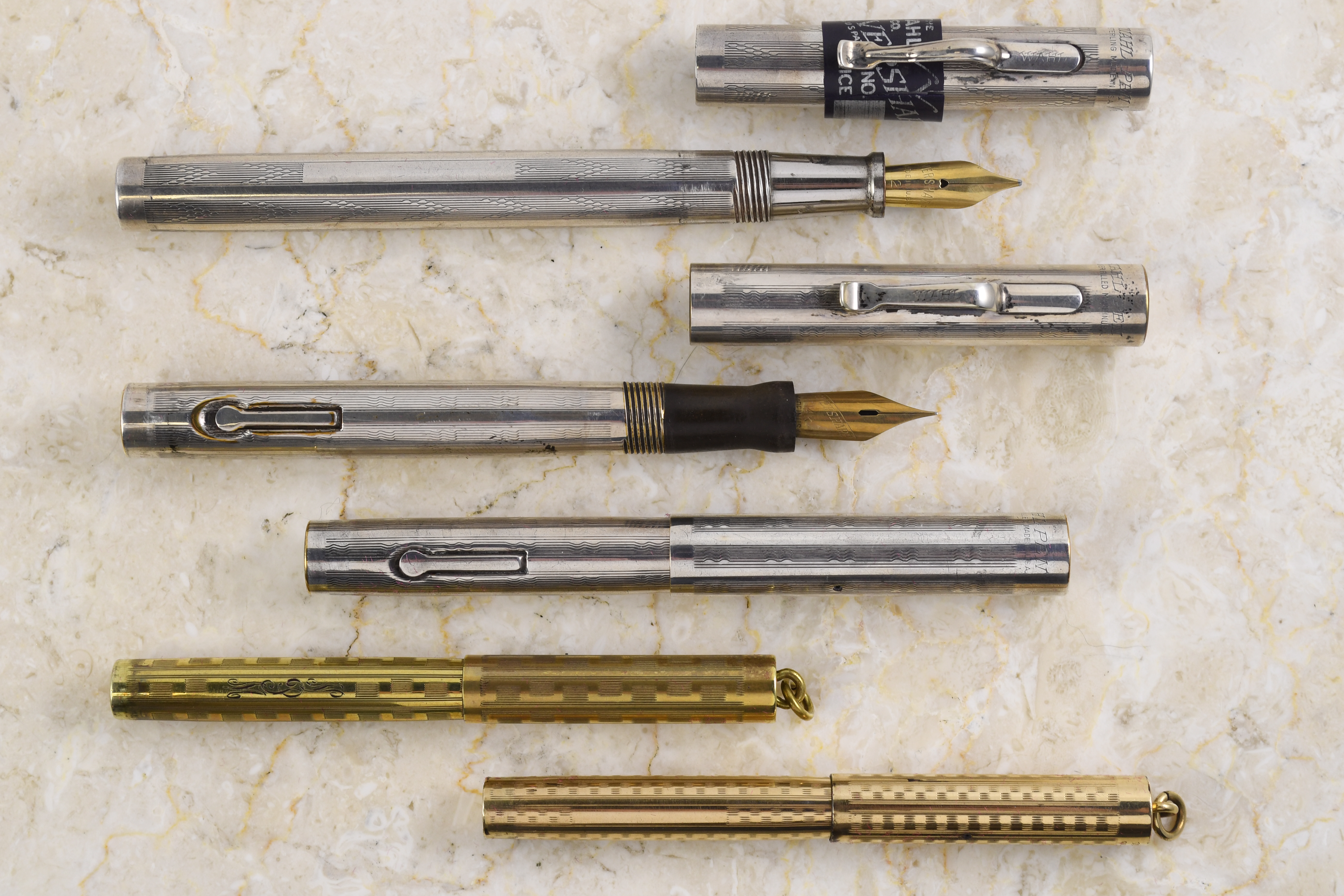

The top example has interesting flourishes on either side of the imprint that I haven’t seen before:


Two of the ringtops are earlier models, carrying over design features from the Boston Fountain Pen Company, which Wahl acquired in 1917:


Next are some Eversharp metal pencils, including two post-1924 model in “ripple” with the matching engraving on the works inside:


The second one from the bottom also had another neat feature on top:


An instruction sheet found in the case would have been correct for those post-1924 models, as it illustrates the “New, Perfected Wahl Eversharp.”


The last four pencils in the case are relatively unremarkable:


However, the one with the price banded is an upgrade to the one I have, and I’ll also keep that enamel-over-aluminum pencil in an unusual color I haven’t seen before, something close to Parker’s “Pompeiian.”

As for the case itself . . . well, now that it’s here, I have put it to good use.  I’ve long thought it a shame to confine my early Heath-clip Ever Sharp pencils to that printer’s cabinet, and this cabinet is early – not as early as the Heath-clip pencils of 1914-1915, but note that the “S” in Eversharp is a bit bigger:


That is only found on very early Wahl stuff – after the Boston pen acquisition at the beginning of 1917, but perhaps a transitional step from “Ever Sharp” (two words) to the truncated Eversharp of 1918.

Nevertheless, my earliest and most prized Ever Sharp pencils now reside comfortably in Fred Krinke’s case.  I’ve kept the leads in there for now, as a nod to his legacy, as well as the small slip of paper I found inside:


Thanks, Fred. 


Sunday, April 4, 2021

Star of the Show

This article has been included in The Leadhead's Pencil Blog Volume 7, now available here.


If you don't want the book but you enjoy the article, please consider supporting the Blog project here.

The most distinctive item in the first day of the Fred Krinke auction was a curved-top display case, embellished with the acid-etched inscription “Leroy W. Fairchild’s Gold Pens,” which sat in Fred’s Fountain Pen Shop in Los Angeles for many, many years.  I took a photograph of it during the preview, since I never expected to see it again:


David Nishimura and I talked about this one before the auction - all Krinke provenance aside, finding an ornate store display from the dip pen era is nearly impossible.  If I could get it for anywhere close to the opening bid, I said, I’d give chase.

Hopes were dashed that I would, as the auctioneer took a rare pause in the bidding when this one came up to discuss what a significant piece this was in the Krinke legacy.  Yet the bidding stalled out much earlier than anyone including myself expected, and I was able to bring it home.  It was a perfect storm: I didn’t have to worry about having it shipped, live attendance at the auction was sparse due to the bug, and it is just so big that most people don’t know where they would put it.

Finding room for it in my increasingly cramped collection zone, however, proved a challenge.  I moved the Redipoint exhibit to another area of the museum, and it barely fit atop one of my printer’s cabinets:


While there were logistical problems finding space for it, this case solved a huge problem for me.  As readers of The Catalogue have noted, there isn’t much in that ten-year-old book about Victorian writing instruments.  My interest in those has evolved in the years since the book was written, and by the time I moved the museum to its current quarters, I dedicated the top two rows on the “wall o’ pencils” to Victorians.  God’s plenty space, I thought at the time.

The rabbit hole deepened, then widened.  New additions have been stacking up like cordwood over spaces I had left open for new makers and examples, and I have puzzled about how I might rearrange things so things are a bit better organized.  Here’s the John Holland section, for example:  


A large Fairchild case easily accommodates all of my Fairchilds, my Fairchild & Johnsons, and the examples I have from the later Fairchild & Co.


I know it probably isn’t entirely cricket including the latter, unrelated companies here, but for me it’s about finding a place for everything so that everything has a place.  At last, the Victorian wing has a bit of breathing room . . .

For now!

Saturday, April 3, 2021

I’m Gonna Drive (500 Miles)

This article has been included in The Leadhead's Pencil Blog Volume 7, now available here.


If you don't want the book but you enjoy the article, please consider supporting the Blog project here.

Never again will I forget that The Proclaimers were from Scotland after my visit there in 2018.  Late one night in Inverness, some of my fellow travelers and I went to the pub next door to our hotel – a very traditional Scottish pub with the improbable name of “Johnny Foxes.”  The live band was playing a surreal mix of music, and when John Denver’s “Take Me Home, Country Roads” was on tap, the entire audience was belting out “WEST VIRGINIA” like we’d all been there.

We were likely the only ones who actually had been.

The song ended.  The crowd was out of breath, sweating from jumping around, and a bit hoarse.  But then . . . then the quiet opening of The Proclaimers’ catchy 80's tune “I’m Gonna Be (500 Miles)” instantly re-energized the packed bar.  Things got exponentially sweatier as the audience crowded onto the dance floor, bouncing in unison to the beat and yelling out every word along with the band.  The singer’s lips were moving, but you couldn’t hear him.

It was glorious.

In the weeks leading up to the Fred Krinke auction, as I browsed through the online catalog there was only one item that had me wondering to myself whether it would be worth the drive.  Never mind the long-overdue time off, a roadtrip, and the spectacle of the auction . . . would I drive 500 miles just for that one thing?

Yes, I told myself.  Well I would drive 500 miles – and then I’d drive 500 home. . . 

Da da da (da da da) . . . the earworm crawled into my head and got comfortable, escorting me all the way to Chicago and back.  I suppose I could have turned on the radio to clear it out, but I kind of liked it.  Da Da Da Dun Diddle Un Diddle Un Diddle Uh Da Da, I said out loud to myself, more than a few times I’m sure.

What had me havering all the way to Chicago was this one pencil.  I needed to see it in person and examine it, though, before I would bid serious money on it.  I satisfied myself that I would at the preview table, but I asked to take a few pictures of it before the auction, in case I didn’t win it:


“Skyline Noir,” I called this raw image when I posted it on Facebook.   I took better “just in case” pictures of it, but I thought this one best captured perfectly my anticipation and suspense as the auction marched forward until we reached Lot 2278.  Would anyone else see what I was seeing?

Bidding was frenzied at the outset, steadily increasing in $10 increments . . . then $25 increments.  Fortunately it stopped, well short of my existential “what the hell am I doing” number, and all of my “just in case” shots were no longer needed.  Here it is in proper lighting, flanked by the other two items that were included in the lot:


The green Eversharp Skyline, even with its mismatched black plastic nose, was an upgrade from the one in my collection with its price band - I swapped out the nose and added it to the collection.   


At the bottom is a Skyline with a stainless upper section and gold filled trim; an extremely rare piece in its own right (see Volume 4, page 193).


But that middle one . . . I have never seen or heard of a Skyline pencil with a full-length stainless steel barrel, and the reason I needed a hands-on examination of it was to reassure myself that this is indeed a factory piece, and not someone having a bit of fun.  

I’ve expressed concern in the past about adding steel tubing to the top of an otherwise ordinary “presentation” Skyline (with a gold-filled top end), but I’ve long since dismissed that possibility as being very unlikely – those derbies are so difficult to remove and replace that it wouldn’t seem worth the effort, even if the result was worth ten or twenty times the value of a gold filled example.

But this . . . the stakes would be higher should it prove legitimate, but the feat of “making” one is also exponentially harder since the barrel material is tapered to fit the profile, rather than just straight tubing.  I looked for signs of a skilled metalworker having a bit of fun, and I found none.  Besides, the stainless clip assembly is found only on these stainless models – finding one, let alone successfully grafting it in place without breaking it – is next to impossible.

Then notice the nose . . .


Unlike the other more typical examples that accompanied it, this has a brushed, almost satin nickel look to it – and note the absence of the typical groove you always see about a sixteenth of an inch from the end towards the barrel.

I removed the tip to be sure the steel sleeve was secured to its lining – if it slid off easily, I’d be concerned.  It doesn’t budge.  

Does the word “prototype” fit?  I think not - by stickler standards (and we pen and pencil folk are loaded with sticklers), a prototype would be an evolutionary step in the development of a production piece.  To my knowledge, full stainless-barrel Skylines were never put into regular production . . . subject, of course, to the possibility that someone may someday stumble across a box of these bearing model number and price bands. 

“Lunchbox special” doesn’t make much sense, either, since the stainless steel clip was used only on some known stainless models . . . there wouldn’t have been extras just laying around waiting for a bored worker to spend a bit of time off cobbling something together, and the tip appears to be a one-off.   No, I think this is better described as a shop piece or experimental model, and its one I’ll be going along with for the rest of my days:


Of course, I still have a nagging feeling that this subcollection might still be incomplete.  Skyline pens exist with sterling silver caps rather than stainless, but I’ve never seen a sterling Skyline pencil.  

If I did, my earworm might be a bit closer to the original: well I would drive 500 miles and I would drive 500 more, to be the man who drives a thousand miles to fall down at your door!

Friday, April 2, 2021

“Auction of a Lifetime”

This article has been included in The Leadhead's Pencil Blog Volume 7, now available here.


If you don't want the book but you enjoy the article, please consider supporting the Blog project here.

I wasn’t planning to attend the auction of Fred Krinke’s collection at first.  Fred was a well-known pillar in our pen community, the third-generation proprietor of The Fountain Pen Shop in Los Angeles, California.  Since I have never made it to a Los Angeles show, I didn’t know Fred well – although I think I might have met him at one of the DC pen shows back in the day.  Mostly, I knew Fred by reputation as the generous donor who shared his collection of vintage catalogs with the Pen Collectors of America (these would later form the backbone of the PCA’s library).

It was billed as “The Auction of a Lifetime,” but when the catalog was finally made available just a couple weeks before the auction started, nobody was sure whose lifetime we were talking about . . . many lots were parts and damaged pieces, and the descriptions were disconcerting: one item, for example, was described as having a cracked and warped barrel, but concluded with “overall excellent condition.”

I wondered, as did many of my friends, in what dictionary this curious definition of “overall excellent condition” might be found.

Then there’s this nagging, stupid virus thing . . . when I initially suggested I might make the drive, Janet pointed out that after being so careful and so concerned for so long, it didn’t make sense to put myself in a situation where I might be exposed.  In early February, that logic made sense . . . after all, with the vaccine coming out, things will be back to normal soon and there will be plenty of time for pen shows.

By late February, I was no longer buying into that logic.  I had been doing what my government has told me to do like a good boy for a year, and I hadn’t missed a single day of work since the Baltimore Show (which started, ironically, exactly one year before Day Two of the Krinke auction).  Vaccines had arrived, but my government has decided I wouldn’t be important enough to get one in the foreseeable future.  The new moron who replaced the old moron in our Nation’s highest office was so effective in his promise to employ the Defense Production Act that if he had been president during World War II we’d all be speaking German or Japanese by now. 

I decided if I was going to be unvaccinated sitting duck,  and that wasn’t going to change any time soon, I might as well be enjoying myself while I inevitably catch the bug.  And I really, really, REALLY needed a day off. 

Several friends had been sending me messages to ask if I would be attending the auction.  Just like me, they wanted “boots on the ground” at the auction to examine the items that interested them firsthand - plus, the buyers’ premium was only 15% if you were there in person, as opposed to (gulp) 23% if you bid online.  As for the technology . . . nobody trusted it completely, and it’s impossible to react as quickly as a live bidder can.  

By auction day, I was bidding for myself as well as for four of my friends.  Up at 3am I was . . . on the road at 4, and I arrived at 11am local time.  


Previewing an auction in person is a must if you are planning to bid.  There was just one thing I absolutely needed to see in person because I wanted to be sure . . . I’ll get to that one tomorrow.  But since I was there (and I had plenty of pent-up pencil deprivation, without any pen shows in a year), I spent a couple hours of quality handling-the-goodies time.


 And I noticed things I hadn’t noticed before.

Evening was upon me in no time, and after a nice dinner at the steakhouse across the parking lot from the hotel, I sat outside and enjoyed a cigar.  It felt almost like a pen show, relaxing after a few hours seeing friends and geeking out a bit, with the anticipation of what tomorrow would bring:


Maybe, I thought, if the bug scared away the in-person crowd I’d have the opportunity to take home more than just the one thing that brought me there.  The next day saw just a few live bidders, three of whom I knew: Roger Wooten was there to help the organizers with the auction.  Brian Anderson and Eric Magnuson were there, too.  


By the end of the day, it was location, location, location . . . the two signature lots from the first day of the auction were spectacular but extremely cumbersome to ship safely.  A guy who was there in person, with a big truck to get them home in one piece, and for no more than the cost than the gas he would have bought anyway, was successful:


Nothing really interested me that was up for bids on the second day of the auction, so Sunday morning I headed back to Leadquarters to spread out the day’s haul . . . 


. . . and this doesn’t include the things I bid on for four of my friends!

When I closed out Volume 6, I expressed my hopes that if/when I ever started posting articles here again, it would motivated by the objects of my affection themselves rather than the doomsday-driven need to connect with others because of the bug.  I’ve been quietly writing articles here in the time since, waiting for a catalyst to trigger the avalanche.

Last time, I wanted to give you a taste of normal in an abnormal time.  With numbers declining and the vaccine in my arm at last, my fatalistic “what happens tomorrow, happens tomorrow” has turned to optimism. This series isn’t going to be a taste of normal.  This is a taste of getting back to normal.

Thursday, April 1, 2021

Getting Unstuck

This article has been included in The Leadhead's Pencil Blog Volume 7, now available here.


If you don't want the book but you enjoy the article, please consider supporting the Blog project here.

My longtime friend John Hall was so proud that one of his pencils was included on the cover of Volume 6.  When the book arrived from the publisher last September, I looked forward to hand-delivering him his copy, signed on the title page, “For Princess.”    

“Princess” was our inside joke: years ago, a mutual friend was getting all worked up over something trivial at a pen show – “Settle down, Princess,” I said, and the crack caught John so off guard that he guffawed, back in the days when John could muster a guffaw.  The name stuck.

As John’s COPD worsened, his belly laughs wore down to a smile and a quiet chuckle under his breath.  We still managed to attend six or seven pen shows each year together, hauling his scooter and oxygen in the back of my truck and setting up at adjoining tables.  Our last show together was the 2019 Ohio Show.  

I hadn’t seen John since, although we talked on the phone every week or so to catch up.  “I’ll bet you’re bathing in Purel these days,” I joked with him last spring, when the pandemic shut everything down.  “Boy, you ain’t a-f***in’ kidding!” he said.  If you knew John, you can hear him saying that.

When Volume 6 arrived from the publisher, I called John and offered to bring over his copy and a bottle of Scotch.  I’ll set up a lawn chair in your front yard, I said – Amy can bring your book inside along with a drink, and we’ll toast through your front window.  No, John said.  He just wasn’t feeling up to it. 

On September 25, 2020, John called me while I was with a client, so I couldn’t answer.  I assumed he’d seen something on eBay that looked interesting or there was amusing drama within our circle of pen friends, but since I don’t have voice mail set up on my cell phone John couldn’t leave a message.  I called back after things quieted down by mid-afternoon, but John didn’t answer.  John had his phone with him all the time, and I couldn’t remember a time he didn’t answer.

I tried again an hour later.  No answer.  No response to increasingly frantic texts, either.  

John’s wife Amy called me a couple hours later to confirm my worst fears.  For a couple of days John had been convinced their cat had chewed holes in his oxygen line, because he wasn’t getting any air.  

It wasn’t the cat’s fault.

I was allowed to visit John in the hospital Sunday morning.  I’d taken along a couple gifts I’d been saving for the next time I saw him:


I’d bought a pack of four of those goofy emoji pencils months earlier - it was one of those lots you buy from China for a buck plus fifty cents shipping, then a month or two later they arrive on your doorstep.  I’d originally bought them to present one to Joe Nemecek as a joke - Joe, predictably, was neither amused nor willing to add one to his collection.  I planned to give another one to John the next time I saw him . . . but I never anticipated how the different faces would so perfectly encapsulate everything racing through my head that day.

The pearl pencil on the left was something that had turned up online - and I knew it was destined for John.  These were made by the Nichols Products Corporation, best known for the Tri-Point and those goofy RCA pencils, but this one had the perfect name imprinted on the barrel: The Nichols “Princess Pearl.”

Amy was at home and John’s son was flying into town, so it was just John and I for two hours or so, accompanied by machines beeping away all around us.  I think John knew I was there as I jabbered away about the pencils I’d brought to give him, and I called a few of our mutual friends on speaker so John could hear them say hello.  I was allowed to stay in the room even after John’s family arrived, and John peacefully slipped away late in the afternoon.

It was weeks before I could even talk about John without breaking down, and I will beat myself up for the rest of my life that I didn’t take his call that busy Friday.  Paul Erano asked me to write an obituary for his Fountain Pen Journal - 150 words, he said.  If you count them, there’s exactly 150.  

I had more.

I told myself life goes on, and I started work on a book about the Dur-O-Lite archive, titled “Dur-O-Lite: The Clandestine Company”:

Chapters and photographs came together nicely at first, but progress slowed down after the holidays. By January, I would spend a couple of hours writing and have only a paragraph or two to show for it.  Then for three weeks, I didn’t touch it at all.

My friend Felix Tarasco, who had only just learned about John’s passing from the obituary in Fountain Pen Journal, sent me an email in early February to tell me how sorry he was.  In an instant, all that grief I have been pushing down roared back to the surface and I was consumed for the remainder of the day.  

In the introduction to Volume 6, I wrote that I was reviving this blog as a way to stay connected, since a complex, solitary project like the Dur-O-Lite book would have been unbearable during the isolation of the pandemic.  I didn’t listen to my own advice, just as my senses of loss and isolation went off the charts with the death of one of my closest friends.  I shut the world out.

I have never stopped photographing new finds since I last signed off.  As I pawed through them, I remembered how much I really like writing these articles, how many amazing new things I’ve learned, and how much I really, really want to share it all with you. 

I know this will help me.  I hope you’ll enjoy them, too.

Friday, January 29, 2021

A Worthy Wearever At Last

 I'll admit that my interest in writing articles about the repair and restoration of these old pencils is not entirely altruistic.  More often than not, my mission isn't so much to educate mankind in the care and feeding of these little beasts . . . it's so that later I can remember how I did it, too.

The lowly Wearever brand, produced by David Kahn, Inc., doesn't get as much love as it should.  Kahn was a real visionary in writing instruments who found ways to make pens and pencils that mimicked the look of higher priced brands, but more cheaply and efficiently.   They remain plentiful today, and since it takes a lot to knock one of these out of commission, the fact that almost all of them still work today means that there hasn't really been much call for me to dive into repairing one.

Until Loyal Knight Harry Shubin asked if I could take a shot at this one:


Wearever Deluxe pencils are not too terrible, and the sample engraving on the side of this one makes it better and, Harry and I agreed, worth taking a shot at getting it to work again.  The Wearever Deluxe was a rear drive pencil that advanced and retracted the lead by turning the top, a feature typically found on more expensive pencils, but in the case of this one the entire top was missing:


I happened to have a suitable donor lounging around in one of my bins.  It was missing the cap (or more likely, as often as the caps go missing, it already gave its cap up to complete another one in my collection), so it was just waiting for the opportunity to give its last full measure of service:


Tug as I might, I couldn't get the damned bushing out of the top so, rather than risk crushing it using pliers, I decided to attack from the other end.  After wrapping a rubber band around it and twisting without any progress, I twisted the other way . . . yep, it is reverse threaded (tuck that one away for future reference):


I figured that spiral mechanism was all that held the upper bushing in place.  I figured wrong.  Time to bring out the big guns . . . 


That's a knockout block for getting feeds and nibs out of their sections, which I've used more times than I can count in circumstances like these.  I had to put two of those rods into the barrel in order to reach the bushing, then a couple sharp whacks got the job done.


The reason it was so stubborn was that there is a groove in the barrel of the orange one into which the bushing seats.  That was probably added later in production:


The bushing engages the mechanism with the help of 2 little bumps protruding near the top of the spiral:


I inserted the bushing into the top of Harry's pencil, and like magic, the pencil worked perfectly.  The only issue was that the bushing pulled out easily, so I used a pair of flat pliers to squeeze the end of the bushing slightly out of round -- just like I do to give cracked Parker drive tubes enough "grab" to work without soldering. 

Now about that missing cap . . . there were a few different variations of these caps, but I have a pretty good idea what they looked like:


I heard a story about these caps once, about how they were repurposed tire valve caps from military Jeeps.  Hogwash, I say.  Although I do have one that has an actual tire valve cap, it looks terrible and obviously out of place.  Besides, the insides of these caps aren't threaded.

So Harry, you owe me a cap: