Showing posts with label Eversharp Gold Seal. Show all posts

Friday, August 29, 2025

Last But Not Least

Two days ago, I started what I thought would be a quick introduction to a group of new old stock pencils in their boxes, which I had received from Gabriel Galecia Goldsmith.


The first pencil in that group told a longer story than I expected, so I adjourned to a second installment to run through the others; however, when I started writing about that last one, there was so much more than initially meets the eye . . .


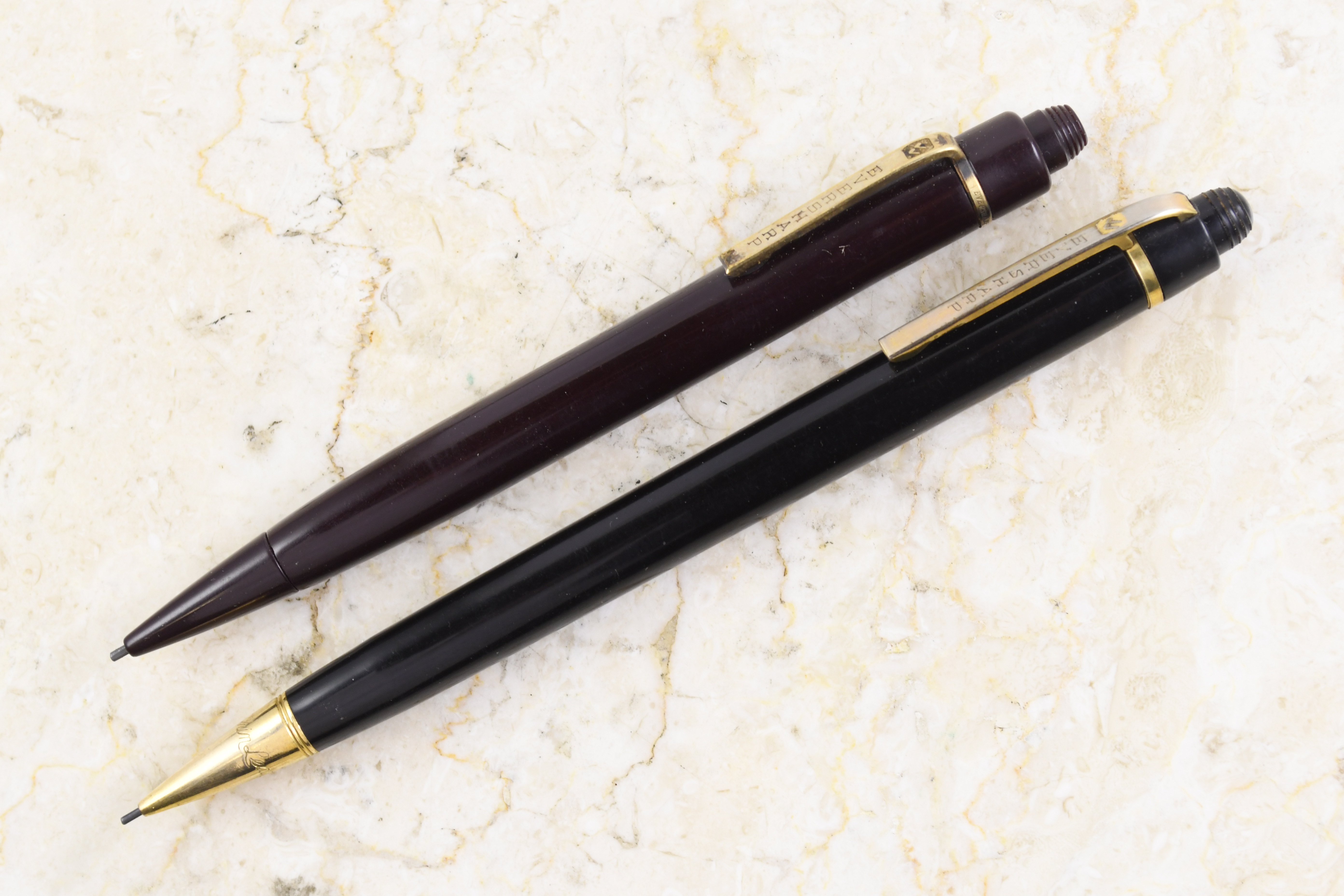
The Christmas box is one I haven’t seen before, and there’s quite a wad of papers in here that we will delve into in a minute. But first, the pencil: it is a “Signature-style” Eversharp; as I discussed in Chapter Eight of Eversharp: Cornerstone of an Industry, in which I spent a few pages explain why “Signature-style” is a better collective name for them than “Tempoint” or “Tempoint-style,” as I referred to them in The Catalogue.

Strictly speaking, these were the “New $3.50 EVERSHARPS That Match the New $5.00 WAHL PENS” (see the Eversharp book at page 177). Wahl flirted with naming the pens the “Fivespot,” but it didn’t stick (page 179) – and Wahl never referred to the matching pencil as a “Threeandahalfspot.”

At least, that’s what they were called when the line was introduced in 1927, with the old-style Eversharp mechanism in use since 1924. Black and pearl was not part of the original lineup of colors, and was introduced after the 1928 Wahl catalog was printed. It is first shown in the summer 1928 edition of Eversales, Wahl’s internal magazine at the time (see page 177 in the book). The military clip version of the pencil was given model designation K4004SC.


But wait a tick . . .  these are not the pencils we have here . . . at least, not quite. That gold-filled tip and longer top are a giveaway that Gabriel’s new example is a later example, fitted with the same mechanism used on the Equi-Poise series introduced in 1929. At top in this next image is the original Model K4004SC (for short with clip), our new addition, and examples with Equi-Poise mechanisms in military clip and ringtop configurations.


Examples with the Equi-Poise mechanism are more difficult to find, and they may have been manufactured primarily to use up leftover celluloid stock. Wahl’s 1929 catalog includes the new streamlined Equi-Poise line and the flattop Signature-style line, identical to what was introduced in 1928 but with the model designation changed to 4004SC (dropping the K prefix).

The mechanism used on the new Equi-Poise pencils was apparently incorporated into the flattop line after the 1929 catalog was printed. It would make sense to conclude these were discontinued in 1931 with the introduction of the new Doric, since there is no mention of these in Wahl’s 1931 catalog. However, a commemorative imprint on a coral example shown on page 188 of the book indicates it was made in 1934 (the 25th anniversary of the class of 1909 - see the bottom example in this image from page 188 in the book).


Full sized examples usually have a seal above the clip, while ringtops with the Equi-Poise mechanism have a seal on the side. The military clip version has the seal on the top of the pencil, as shown on page 189:


Note that these rounder tops are thicker than what is seen on the new addition:


That is because Gabriel’s pencil does not have a seal: instead, it has a special-order top piece advertising “Hoffman 77 Valves,” a water vent valve for heating radiators which remains in production today. 


That might explain the unusual model designation on the price sticker on the back, and maybe not:


Model 4004ESC. I say maybe, maybe not because I don’t have any documentation to say what a “normal” Signature-style pencil with an Equi-Poise mechanism was called. With an old-style mechanism, this was Model 4004SC in the 1929 catalog; maybe all pencils later fitted with Equi-Poise mechanism had an ESC suffix – say, for “Equi-Poise,” and maybe the E was added to indicate it was “especially” made for a custom order.

Does the paperwork help? Not on that point, but it provides plenty of other information there to discuss. First, this one includes a warranty certificate:


"Gold Seal” pens and pencils was the name adopted by Wahl with the introduction of what collectors have nicknamed “Deco Band” models, with their elaborate greek-key center bands. When the Equi-Poise mechanism was adopted, the double-check gold seals were broadly applied to most models, so I’ll accept that this is the correct paperwork for this non-Deco Band model. 

Then there’s the instructions:


The Equi-Poise line shared the same pencil mechanism with the Doric, so it does not surprise me to see a Doric pencil illustrated in the paperwork. However, patent information printed in the lower corners might help to narrow down when these instructions were printed. On one side, the Doric’s design patents are noted:


Both of these design patents were issued on August 5, 1930 to Robert Back.


That is not particularly helpful, since we already knew flattop models were still in production in 1930. But wait . . . there’s more. On the back side, there’s some discussion about Wahl’s new patented “Kleen-Fill” ink bottles, along with some additional patent information:


The latter of these, patent 1,800,330, was applied for by John C. Wahl and Albert H. Stenerson on October 24, 1925, and it was granted on April 14, 1931.


Well crap.  All that patent information, and nothing conclusively establishes that Signature-Style pencils with Equi-Poise mechanisms were in production any later than what I already knew. One additional clue helps just a tiny bit more: the cap band on the Doric pencil that is illustrated:


“First year” Dorics have a split band, with part of the band on the upper barrel; according to Wahl’s advertising, production was simplified in late 1931 or early 1932 by incorporating the entire band into the lower barrel. This was discussed on page 216 of the book:


That pushes the probable date of production back to late 1931, given the Christmas box in which it resides . . . again, that doesn’t shatter anything I believed, since that coral example discussed earlier dates to 1934. Coral, though, might be a different story than black and pearl: bizarre variants abound in coral material, including some flattops that were made during the 1939 “garage sale” in which Wahl cobbled things together in preparation of the company’s reorganization as Eversharp, Inc. See “The Weirdness of Coral” (April 23, 2021: Volume 7, page 57) and page 190 in the Eversharp book.

All of the foregoing is ultimately a house of cards . . . or cardstock, I suppose. Yes, all of this - box, new old stock pencil, and paperwork appear consistent. Yes, when these artifacts are considered together, they all appear to prove that the Equi-Poise fitted Gold Seal pens and pencils were in regular production during the 1931 Christmas season, after the Doric was introduced and after they were omitted entirely from Wahl’s 1931 catalog. Yes, I am confident that this package came to me exactly as it came to Gabriel.

I am, however, assuming that this pencil was wrapped in these papers and placed in this box back in 1931. Colonel Mustard may be in the right room, but he’s still holding something behind his back.

Wednesday, June 16, 2021

All For the Paper

This article has been included in The Leadhead's Pencil Blog Volume 7, now available here.


If you don't want the book but you enjoy the article, please consider supporting the Blog project here.

This was advertised as a “set” in an online auction.  


The pencils are run-of-the-mill Eversharp Skylines, and both went straight to the sale bins for the next pen show.  The box is also Skyline era . . . nothing special there:


The paperwork, however, grabbed my attention.  I’ve arranged them as they were shown in the auction pictures, and I could see something that didn’t fit in at all with the pencils or the box.  In fact, they didn’t fit in with any Eversharp paperwork I’ve been able to study:


Eversharp didn’t refer to Skylines as “Gold Seal Repeaters,” because instead of a seal the double-check mark was incorporated into the clip.  This paperwork therefore likely pre-dates the introduction of the Skyline in 1941, and the combination of those two terms – “Gold Seal” and “Repeater” – places that paperwork within a very narrow, fascinating time period in Eversharp’s history.

When the item arrived, there were papers for both Gold Seal Repeaters and Gold Seal pens:


With one extra little twist:


“Eversharp, Inc.”  We’ll come back to that in a minute, because there was one other piece of paper folded up in this group . . . with stars on it . . .


For the Eversharp White Star Repeater.  Printed on the back are generic Eversharp repeating pencil instructions, which apply to all Eversharp models of this time period:


Step 2 of the instructions, regarding removal of the “Magic-Button,” illustrates a Coronet clip:


The Coronet, however, didn’t have any seals or white stars . . . and there’s something else to notice on the front side:


The White Star paperwork was printed by The Wahl Company, not Eversharp, Inc., in March, 1940.  

I’ve also written about Wahl’s garage sale of pens and pencils cobbled together from leftover parts – most notably, in connection with the X-seal pens and pencils (see Volume 6, page 110-112).  The general consensus has been that these weird variants were part of a financial reorganization of the company in 1939.

While Wahl might have been making use of leftover parts in 1939, the reorganization didn’t happen until 1940.  An account published in The Chicago Tribune on June 12, 1940, after the dust settled, stated that The Wahl Company showed a net loss for the year ending February 29, 1940, as well as in 1938 (no information was reported for 1939).  

The company’s largest and most formidable group of creditors was its own shareholders: dividends had been declared over the years, but Wahl had not paid accrued dividends on preferred shares of the company’s stock since 1930, and holders of common shares had not been paid since 1924.

On March 13, 1940, The Wilmington, Delaware News Journal reported that a new corporation, Eversharp, Inc., had been incorporated.   


On April 13, The News Journal published notice of a special meeting of the shareholders in The Wahl Company: on May 7, 1940, the shareholders would be considering a merger.  Holders of 7% preferred shares of Wahl Company stock, which had accrued dividends of $80.50 per share, would receive six shares of preferred stock and five shares of common stock in the new company.  Common stockholders would receive one share of common stock in Eversharp, Inc. for every 2 ½ shares of Wahl Company common stock:


The Associated Press reported that the deal was approved at the May 7 meeting, by a vote of 120,907 to 3,701.  

All of this happened just as the White Star line was being introduced.  I’ve written about “White Star” Eversharps before (see Volume 3, page 238 and most recently in Volume 5, page 224), and I’ve always dated them to 1940 or so because at some point I’ve seen another piece of paperwork, also dated March, 1940.  The typical White Star pencil is an aluminum-barrel affair, sporting Eversharp’s prettiest clip of all time:


The domed, gold-filled caps are correct on this series; the top example has a Skyline button for a replacement, and one has an eraser simply wedged in where the button should be.  The example second from top isn’t clipless – I’ve turned it around to show the location of the imprint.

Advertising for these pencils is consistent with the paperwork I’ve turned up.  The earliest advertisement I found for them appeared in The Indianapolis News on March 27, 1940, describing them as the “World’s First Thin Lead Eversharp Repeater Pencil”:


That’s pretty awkward wording.  Official national advertising described them as the “World’s First Thin Lead Repeating Pencil,” like this one published in The Spokane Chronicle on May 10, 1940:


The other series of pencils Eversharp made with White Stars are much harder to come by:


These featured in Volume 5, page 224, and the second one from bottom, with two equally thick gold bands at the top and a double check seal rather than the White Star, was discussed in Volume 3, page 238:


Could this be the “Gold Seal Repeater” from the paperwork at the beginning of this article?  Maybe . . . after all, these have been identified as the Eversharp “Victory,” advertised in 1941 (see Volume 4, page 174):


If . . . Eversharp was consistent in how the company referred to its products – recall that the Four Square from around the same time was referred to at different times as the Forty Niner or the Red Spot (see Volume 5, page 130).  Could “Gold Seal” Repeater have referred to things which didn’t have Gold Seals, like the Skyline?

The earliest advertisements I found reveal that the Skyline moniker was used from the model’s introduction.  Here’s an advertisement published in The Town Talk in Alexandria, Louisiana on October 4, 1940:


However, on January 21, 1941, The Indianapolis News ran an advertisement for “The New Eversharp Gold Seal Pen”:


Granted, both of these are jewelers’ advertisements rather than official Eversharp ads . . . but The Town Talk didn’t pull the word “Skyline” out of thin air, and I doubt that The Indianapolis News plucked “Gold Seal Pen” out of the blue, either.  

Then there’s this advertisement, which ran in several newspapers in February, 1941.  This one ran in The Bloomington Pantagraph on February 13:


These advertisements specifically mention Henry Dreyfuss as the designer, but the name “Skyline” isn’t used.  The pen is described only as having a “Magic Feed,” although the picture of the airplane and the reference to writing at altitudes above 12,000 feet tie in well with the Skyline name.

There’s one other thing to notice: the placement of the trim band on the pencil.  In the January, 1941 advertisement, the band falls on the boundary between the striped upper section and solid color lower section, but in the February advertisements, the band is moved up into the striated section, to better match the bands on the pen. 

Was this artistic license?  After all, the trim band on pencils always falls on the boundary between the two materials, right?


Almost always.  Out of all my Skylines, this is the only example like this that I’ve been able to find.  Apparently the modification was extremely short-lived, very early in production.