Showing posts with label Larter & Sons. Show all posts

Friday, June 18, 2021

Tying in Tamis

This article has been included in The Leadhead's Pencil Blog Volume 7, now available here.

If you don't want the book but you enjoy the article, please consider supporting the Blog project here.

We know more about Edward Todd and William S. Hicks during their decline than I ever thought we would know just a few years ago.   You would think after the article I posted on June 4 (https://leadheadpencils.blogspot.com/2021/06/the-end-of-ws-hicks-revealed-at-last.html), it would be easy to explain how Louis Tamis wound up with all of Edward Todd’s equipment.  Maybe Hicks was making Edward Todd’s stuff, Larter & Sons bought Hicks, then Larter and Sons sold to Louis Tamis & Son, perhaps when Larter discontinued the Hicks name between 1943 and 1947.

Nope.  There’s a problem.  Two, actually.  We don’t know exactly what Larter & Sons bought, and we don’t know exactly what Louis Tamis & Son bought, either.

Let’s back up and start with what we know.  

1. Larter & Sons acquired William Hicks’ Sons between 1925, when the Hicks boys were still running the show, and 1929-1931, when Halsey Monroe Larter’s patents were being used inside Hicks-marked pencils (and other of Larter’s patents were assigned to Hicks).  If that seems to thin to accept as definitive, we know it must have happened by the time the Larters were named as Hicks’ partners in the 1933-1934 New York directory.

2.  The business of Edward Todd & Co. “Was discontinued in 1932,” according to Edward Todd, Jr.’s obituary five years later.  That’s equally thin evidence for a definitive date, but reliable for the fact that Edward Todd, Jr. was out of the business for a time before he died.   The firm is still listed in the 1933-1934 city directory, with Edward Todd, Jr. at the helm; maybe the information was collected during 1932 and Edward Todd Jr. closed up or sold out at the end of 1932 – but maybe not.

3.  In the 1933-1934 directory, Louis Tamis is still affiliated as a partner in Schanfein & Tamis, in which he had been involved since 1910 or so – as a jeweler, with no known involvement in the writing instruments industry.  

4.  Larter & Sons changed Hicks’ address to 10 Austin Street, Newark, New Jersey in 1937. That’s the house next door to Larter & Sons’ four-story factory, which Larter had occupied to manufacture its products since 1909. 

4.  Edward Todd, Jr. died in December, 1937.

5.  Sometime between publication of the 1933-34 and 1940 directories, Louis Tamis leaves Schanfein & Tamis and forms Louis Tamis & Son.

6.  The last mention of Hicks is in the 1943 Newark directory; when the next published edition came out in 1947, Hick is gone. 

Something else we know, but we don’t know when it happened, is that someone made identical pencils marked with Hicks and Edward Todd hallmarks, pursuant to William M. Hicks’ 1918 patent.  See Volume 6, page 40 for a pair of identical perpetual calendar pencils (the article is still online at  https://leadheadpencils.blogspot.com/2020/04/that-thing-i-hate-to-do.html).

Now, let’s supplement this story with what Larry Liebman and David Nishimura learned when they visited the Louis Tamis & Son factory a couple years ago.  The Tamis archives include pencils and documents which do not fit neatly into our timeline, the earliest of which is this advertisement, which Larry indicates was pencil-dated 1937 (the same year Hicks’ offices were relocated to Newark):
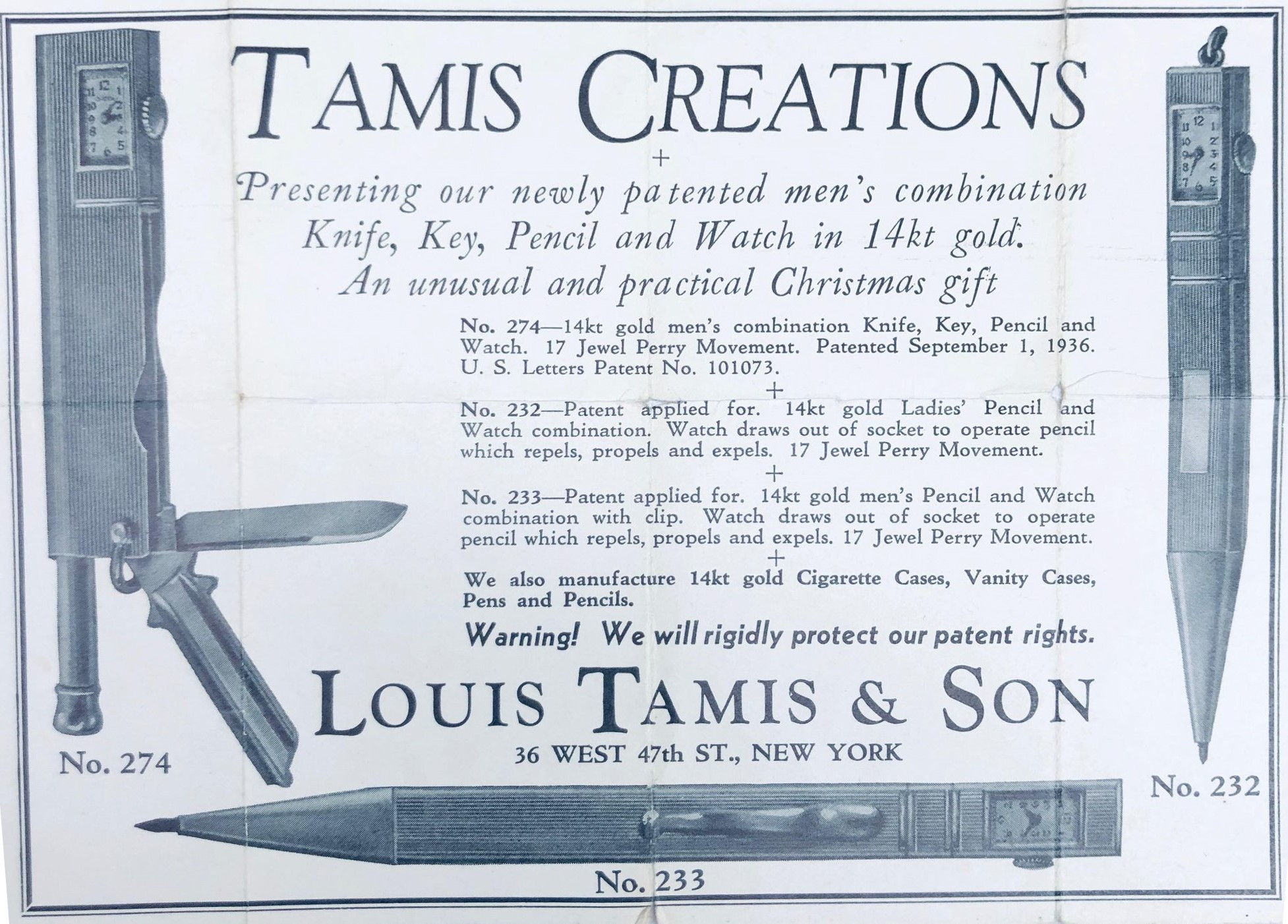

The clips on the side clip model shown are Hicks-style, and the advertisement states these pencils were “manufactured” by Tamis – although the watch movement was not, and the pencil mechanism likewise might not have been.  The “newly patented” language is consistent with the patent references:  Jack Tamis’ design patent number 101,073 for the pencil/knife/watch combination was applied for on June 30, 1936 and was issued September 1, 1936: 


Note that the model 232 ringtop and 233 side clip watch pencils are both “patent applied for.”  Jack Tamis was working on more than just the outward appearance of writing instruments – the patent covering these pencils was a utility patent for the mechanism.  Tamis applied for patent number 2,107,879 on December 12, 1936, and it was issued on February 8, 1938.  It was designed so that the top pulled out of its rectangular housing a bit, then twisted like an ordinary screw drive pencil:


Right as my recent article on the end of William S. Hicks was publishing, Eric Magnuson pointed out an example of one of Tamis’ watch pencils in an online auction.  It sold for exactly the exorbitant price I predicted, and although I hate paying gold value, I couldn’t resist:


The advertisement for this pencil proves two things: first, by 1936 Louis Tamis & Son was in the writing instruments business.  Second, the firm was developing mechanical expertise (suggesting also some manufacturing capability) to make much more than just the outer shells. 

Tamis’ archives also includes a notebook containing details of the firm’s product offerings, and David Nishimura snapped a few pictures with his phone and agreed to share them here.  One page is titled “L. Tamis & Son Report July 31, 1938" and another page states “L. Tamis & Son Report April 30, 1939.”  


The products shown appear to be Edward Todd pencils.  Note the alternating vertical/horizontal ribbed pattern typical of Edward Todd, and models 391-55 and 391-17 appear identical to those Edward Todd pencils I recently showed on May 31 (see https://leadheadpencils.blogspot.com/2021/05/narrowing-gap.html):


There is also an illustration of one of Edward Todd’s square, extending ruler pencils, sporting the more conical nose I’ve observed on pencils marked Cartier and Pen-N-Pencil, and consistent with Edward Todd Jr’s 1925 design patent (see Volume 6, page 10):


The notebook also includes handwritten price sheets for fountain pens and combination pen/pencils (referred to as “Duplexes”), which itemize four product lines: “plain,” “E.T.,” “B.C.-17" and “S-55.”


“B.C” and “S” are a mystery, but “Plain” suggests without any branding, and “E.T.” must mean that Tamis was offering writing instruments branded Edward Todd in 1938 and 1939.  This is consistent with Larry Liebman’s oral history, which states that Louis Tamis & Son acquired whatever remained of Edward Todd, whenever Edward Todd, Jr. gave up making writing instruments.

Larry and David observed that Louis Tamis & Son also has pen and pencil-making equipment, which was acquired (according to the company) from Edward Todd – however, all of the remaining equipment on hand pertains to manufacturing the barrels, not the mechanisms inside.

If we knew who was making the insides of the pencils Edward Todd and Hicks were selling, before Todd sold to Tamis and Hicks sold to Larter & Sons, the complete story behind all of these firms would be much easier to put together.  

I have always thought Hicks had taken over the manufacturing for Edward Todd, based on identical Todd and Hicks pencils made under Hicks’ patent. I thought Edward Todd’s listing in the 1933-1934 directory, showing that the firm occupied rooms on the eighth floor of a 6th Avenue address, further supported that – not so fast, says David Nishimura, who points to the fact that many jewelry firms (including Tamis) have actual manufacturing going on upstairs, rather than at street level.

Jack Tamis’ utility patent for the watch pencil also suggest that along with the name, Tamis & Son also acquired wherewithal – at least to invent mechanisms, but perhaps also to make them.

On the other hand, Larter’s decision to move Hicks to the house next door to Larter & Sons’ manufacturing facility suggest Hicks was was making mechanisms as well as the shells that surrounded them, because there wouldn’t be any reason to park Hicks’ offices next door to Larter’s factory if Hicks existed in name only. As long as Larter’s offices were at 15 Maiden Lane and separated from Larter’s manufacturing, it would make more sense to keep Todd’s offices at the same location. 

We just don’t have any evidence yet to tell us whether either Todd or Hicks was making pencils for the other, whether each was making its own using shared equipment and technology, or whether both firms were sourcing the insides of their writing instruments from some unknown third-party supplier.

It’s still a dead end, but it isn’t as dead as it used to be.  The truth has a habit of floating to the surface as additional pieces of the story come together, and we know more than we did just a few weeks ago.

Friday, June 4, 2021

The End of W.S. Hicks - Revealed at Last

This article has been included in The Leadhead's Pencil Blog Volume 7, now available here.


If you don't want the book but you enjoy the article, please consider supporting the Blog project here.

I was so close.

In “Tasty Crow” posted earlier this week (https://leadheadpencils.blogspot.com/2021/04/tasty-crow.html), I laid out all of the information I could find regarding the final years of William S. Hicks –  William S. Hicks’ Sons, as it was known by then.  It felt like something was missing.  All the pieces of the puzzle appeared to be there, but it just didn’t look like it made a complete picture after I assembled it.

Richard Keith figured out why.

Richard emailed me to point out something I included in my article that was right in front of me -- something that I didn’t notice which explains everything.  I’d shared a picture of the building at 88 Parkhurst in Newark, New Jersey to which W.S. Hicks had been relocated (sometime before 1940, according to a New York City Directory reference I found):


There is a name on that building, above the door: Larter & Sons.


Richard tunneled a little deeper into who Larter & Sons was – which led him straight to another article I posted here some time ago titled “Hicks Family Oddities II” (Volume 4, page 207, still live at https://leadheadpencils.blogspot.com/2016/10/hicks-family-oddities-ii.html).  Between my recent article and what I wrote in Volume 4, all of the pieces of the puzzle fit perfectly and it all makes sense – but only because Richard noticed the name on the side of the building.

According to the company obituary published by National Jeweler in 2015, Larter & Sons was founded as Larter, Elcox & Co. in 1865.  The company was a fixture on Maiden Lane in New York, where its showroom was located at 15 Maiden Lane.  Larter’s manufacturing facilities, however, were located in Newark, New Jersey.  Through 1908, Larter’s factory was located at 49 Chestnut Street, Newark; the 1909 directory reports that Larter had relocated to 86 Parkhurst, Newark.  The partners were Fred H. Larter, Halsey M. Larter, and Harry C. Larter.  


By 1922, when our story begins, the address for Larter & Sons had been changed to 88 Parkhurst in the Newark city directory.  Meanwhile, the 1922-1923 New York directory continues to list Larter & Sons showroom and offices at 15 Maiden Lane.  The partners were Frederick H. Larter, Halsey M. Larter, Harry C. Larter and Warren R. Larter:


William S. Hicks’ Sons is also listed in the New York directories for 1922-23 and 1925.  The firm’s address in both directories is 235 Greenwich, but the partners, Edward D. Hicks and William M. Hicks, have residence addresses in Cranford, New Jersey - about 11 miles or so southwest of Larter’s manufacturing facilities in Newark:


In “Tasty Crow,” I accurately reported the listing for William S. Hicks’ Sons in the 1933 Manhattan directory . . . but I didn’t catch the significance of what it said:


Hicks has been relocated to Larter & Sons’ address at 15 Maiden Lane, and Hicks’ sons, Edward D. Hicks and William M. Hicks, have been replaced by “H. Monroe & Warren R. Larter,” which I completely misread when I wrote my previous article.  The first named partner is not H. Monroe – it is Halsey Monroe Larter, who appeared in the “Hicks Family Oddities II” article in Volume 4 because of this:


Halsey Monroe Larter applied for patent number 1,808,171 on November 7, 1929, and the patent was issued on June 2, 1931.  Although this patent was assigned to Larter & Sons, it came to light because I had found a surviving example of Larter’s pencil:


It is marked Cartier, accompanied by “Pat. Pend.” and a Hicks hallmark:


Yes, Virginia . . . some time between publication of the 1925 New York Directory and June 2, 1931 (when the Larter patent was issued), Larter & Sons acquired William S. Hicks’ Sons.

And, of course, there’s more.

In “Tasty Crow,” I dutifully reported that in the 1940 New York directory, Hicks is listed at a new address: 88 Parkhurst, which we now know was the manufacturing facility for Larter & Sons.  

I was otherwise derelict in my duties.  Say what you will about Newark, New Jersey, but don’t you dare criticize the city’s library, which beats the New York Public Library’s online resources by a blue mile.  It has a complete collection of Newark telephone directories, and they are infinitely more user-friendly.  

Hicks is absent from Newark City Directories until 1937, when it was listed at 10 Austin.  As revealed in “Tasty Crow,” that’s the residence adjacent to and around the corner from 88 Parkhurst. The listing further establishes that Hicks had been fully absorbed into Larter & Sons.


Hicks appears in Newark directories through the 1943 edition; there’s a gap in the library’s collection, and the library’s site indicates that city directories were not published annually after 1943.  The next available edition is from 1947 - and Hicks is no longer listed.

Now it all makes sense.  Jewelry firms such as Tiffany and Cartier wouldn’t have minded a Hicks hallmark on their writing instruments, since Hicks was primarily a writing instruments manufacturer and none of these high-end jewelers ever held themselves out as pencil makers.  

A hallmark by a competing jeweler such as Larter & Sons on a pencil marked Tiffany or Cartier, however, would be a different matter – so Larter continued to use the Hicks name after it acquired the company in order to continue discretely supplying other jewelry firms.  After Larter abandoned the Hicks name, Larter couldn’t substitute its own hallmark, which is why later pencils obviously made using Hicks’ equipment and clip bear no hallmarks at all.  

But wait . . . there’s even more.  Recall that Edward Todd & Company failed in 1932 (see “Narrowing the Gap” on May 31, 2021) – that was after Hicks had already been acquired by Larter & Sons.  Edward Todd, which was supplied by Hicks in its later years, could not have been acquired by Hicks.

The story, now much more detailed, is summarized as follows:

At some point during the 1920s, as Edward Todd & Co. declined, William S. Hicks’ Sons took over Edward Todd’s manufacturing.  Sometime between 1925 and 1929, Larter & Sons bought Hicks and moved the firm to Larter’s existing showroom and offices at 15 Maiden Lane.  In 1937, Larter moved Hicks’ manufacturing to Larter’s existing factory at 88 Parkhurst, Newark, New Jersey, and set up Hicks’ offices at the residence around the corner at 10 Austin.  Larter abandoned the Hicks name between 1943 and 1947.

How does Louis Tamis & Son fit into the story?  I had concluded in “Tasty Crow” that Louis Tamis and not Larter & Sons had made Hicks-style writing instruments without hallmarks, since Tamis eventually wound up with Edward Todd’s equipment.  My analysis missed a step – an intervening owner, Larter & Sons, is that missing step.

It wasn't a clean succession; there was some overlap between when Larter & Sons discontinued the Hicks name and when Louis Tamis started production of Hicks-style writing instruments.  I've just received some new information about Tamis from Richard Keith, Larry Liebman, and David Nishimura, and I'm trying to figure out how these additional pieces fit into the story as we now know it.

Tuesday, October 11, 2016

Hicks Family Oddities II

This article has been edited and included in The Leadhead's Pencil Blog Volume 4; copies are available print on demand through Amazon here, and I offer an ebook version in pdf format at the Legendary Lead Company here.

If you don't want the book but you enjoy this article, please consider supporting the Blog project here.

When this showed up in an online auction, right before the DC show, I knew it was going to take a chunk out of my pencil budget for the show weekend.  And it did.


Yes, this monster is a Hicks:


This one has it all.  First, let’s put it next to a full-sized Hicks stockbrokers’ pencil to give you a sense of scale:


To change leads, the front portion of the barrel can be pulled forward:


Enameled arrows, concealed when the pencil is being operated, are revealed to indicate the colors available:


Twist the lower barrel to line up the color you want with the embossed arrow on the upper barrel, then push in the lower barrel to advance the lead:


Except this one has a twist . . . literally.  With most multicolor pencils in this genre, what “advances” is merely a wire with a stick of lead on the end – how much lead you want to advance is controlled by how far in you push the lower barrel.   This one is different: the barrel is pushed into place to advance an entire pencil mechanism, which twists to advance or retract the lead.

In addition, there’s three more interesting features to consider with this one, all of which are on the cap:


This one is stamped “Cartier” – it’s fascinating that the high end jeweler would associate itself with a multicolor “trick” pencil, a specialty normally found running in less highbrow circles.  Note also the faint serial number or model number, 8870, imprinted perpendicular to the other lettering.

And, of course, note the “PAT. PEND.” stamp.

I’m going to stop for a minute and toot my own horn for a great book I’ve written that you’ve probably never read: American Writing Instrument Patents Volume 2: 1911-1945.  No, this one doesn’t stand a chance of reaching The New York Times’ best sellers list – but it is a highly specialized and useful tool that I wrote for myself for a very specific purpose.

This precise purpose.

The book organizes a spreadsheet of thousands of writing instrument patents I’ve compiled into five sections, ordering them first by date and number, then by description, inventor, assignee and last, by location.  In the “by description” section, I’ve grouped together all patents for “Mechanical pencil (multicolor),” so instead of spending hours combing through all of the insane categories into which something like this might have been filed, I can simply go down the list of patents I’ve already indexed.

It’s still a pretty long list, almost two pages’ worth, but with the 30th patent on that list I hit paydirt:


Halsey Monroe Larter applied for patent number 1,808,171 on November 7, 1929, just after the stock market crash that triggered the Great Depression; his patent was awarded on June 2, 1931 and assigned to Larter & Sons of Newark, New Jersey.  As impressive as this pencil is, the unfortunate timing of its introduction as a Hicks-made, Cartier luxury accoutrement leaves no doubt in my mind of how extraordinarily rare these pencils are.

The patent drawings illustrate a number of features shown on my pencil, from the rounded top to the shape and relative size of the indicator marks on the barrel.  However, since the patent was assigned to Larter & Sons rather than to Hicks, I tunneled a bit deeper, turning to the “inventor” section of my book, and I found that Halsey Monroe Larter has three writing instrument patents to his credit, with this being one of them.  The other two are design patents, numbers 84,352 and 84,353, and both are assigned – you guessed it – to William S. Hicks’ Sons:


Larter & Sons was a New York jewelry firm on Maiden Lane, founded in 1865.  According to the company’s obituary, published in National Jeweler on January 5, 2015, the company closed its doors on November 26, 2014.