Showing posts with label Cartier. Show all posts

Wednesday, September 24, 2025

As My Last Bastion Falls

Back in 2022, Larry Liebman was in Columbus for the Ohio Show, and he spent a night or two at our place so he could fully take in the museum. He did not come empty handed: Larry brought with him some of the pieces he has collected made by Louis Tamis & Son, the New York jeweler’s firm that made high quality writing instruments both on its own account as well as for luxury retailers such as Tiffany, Cartier and the like.

Larry collects these because he has a distant family connection to LT & Son - he’s tried to explain it to me, and I keep getting confused about who is twice or thrice removed. Most recently, I talked about that in  “Narrowing the Gap” (May 31, 2021: Volume 7, page 156). Larry snapped a few photos with his iPad in preparation of his visit to see what he should bring for better shots; this one was the one I couldn’t wait to lay my hands upon, even if only for a brief photo session:


Yes, it is solid gold - and a two-tone yellow and rose gold to boot.


I recreated this pattern for my Legendary Pencil Company Model 124, which I dubbed the “Trinity.” I wasn’t deifying Tamis’ work - the Trinity reference is rooted in the fact that this same sort of design was used by three distinct makers.


Here, Larry’s LT & Sons pencil is flanked by two examples in my collection. The top one is a magic pencil bearing a W.S. Hicks hallmark. It isn’t stamped very well, but you can make it out near where the pencil emerges:


The one at bottom is a later gold filled pencil made by Mabie Todd & Co. in the late 1930s. These frequently slip under the radar because the imprint is in the center of the pencil:


Now I have to correct something a little bit. On the Legendary Pencil Company’s website listing for the Model 124, I identified the trinity of father, son, and pencil ghost as Louis Tamis & Son, William S. Hicks, and Edward Todd & Co. – not Mabie Todd & Co.


At the time I came up with the Trinity name, I had forgotten about these later Mabie Todds . . . forgivable, I hope, since this was the only models Mabie Todd did in this pattern, while the other three used it with abandon on lots of different things. If it isn’t forgivable, I’d hedge and say we’ll call it three and a half, given the abnormally close relationship between Edward Todd and Hicks.

Mea culpa. Trinity sounds much better than “Foursome” or “Trinity-ish,” so we’ll just chalk up my mistake to brilliant marketing and move on to the other thing Larry wanted to be sure we photographed. 


This solid gold fountain pen has the typical turned-up ball clip used by Edward Todd, Hicks and Louis Tamis – but not by Mabie Todd (see, I knew there was a reason I left Mabie out of the equation). While I can probably rule out Edward Todd, which used a slightly smaller clip, it is a tossup as between the other two, since it isn’t marked for either. This one is marked only for Tiffany & Co.


While we were having fun playing with these things and I had all of my similar stuff out for manhandling, I took a better picture of my LT & Son watch pencil. I had noticed that in the last time I talked about it, I had used only the auction house picture – I think I was so excited to write about it that the article published before the pencil was in my hands. See “Tying In Tamis” (June 18, 2021: Volume 7, page 206):


Over the years, I’ve expressed my disdain for buying solid gold, since I value history more than metal and for the price I can buy more history if the gold is not pure. I’ve also had a bit of a chip on my shoulder about high-faluting names - yeah, I apologize for my recent comparison of Tiffany products to Buckeyes memorabilia and dog turds. For God’s sake, don’t get me started on “precious resins,” either – precious, my butt. At least all I got wrong in my marketing was a model name.

I do cry Uncle on Larry’s solid gold stuff. They are absolutely beautiful and in my opinion, worth more than the metal in them solely based on their artistic merit. I have surrendered myself to the fact that the reason the Tiffany name commands a premium is because the company has earned it.

I have, however, maintained my last bastion of resistance to those bamboo pencils, which are nearly always marked only for the luxury retailer that offered them. LT & Son was the last of the “trinity” to survive, and I believe LT & Son made most if not all of these. They come in pencils as well as ballpoints, and I last visited them in “Dr. Seested, I Presume . . .” (January 18, 2016: Volume 4, page 97). 

Vic Seested and I finally met in person at the DC Show that year, after months of email correspondence. He had brought a spread of Hicks, LT and the like for me to photograph, including his solid gold bamboo pencil, marked both LT & Son and Tiffany:


“Dang, again,” I wrote, “as in dang, that’s ugly, but I do appreciate the attraction to something so distinctive . . . every time I see one, I think to myself to hold one is to look like you have waaaaay too much money. Maybe that is what they were going for.”

I don’t think I was wrong.

Dan Schenkein has recently taken a liking to these metal bamboo figurals, too. Here are his two ballpoints and an LT-marked pencil.


I am gradually developing greater appreciation and fewer objections on principle to these. When my friend Chiaming Chen in Taiwan posted a picture of this Cartier-marked example – in real bamboo, not metal – I quickly jumped on the opportunity to obtain permission to use the images:


It has British 18k hallmarks on the nose, above the Cartier name:


My growing appreciation and waning objections to bamboo pencils finally hit critical mass when I quietly managed to find one of these up for myself. At last I had spotted my prey laying in the weeds, improperly described, and buried in with a bunch of unrelated junk, so I was able to scoop it up at a price I could swallow: 


It actually wasn’t laying too deep in the weeds: since it measures over six inches long, it was more like a giraffe hiding behind a telephone pole in the middle of an open field. Still, nobody else seemed to pick up on what it was. On one nose, it is stamped “Made in Italy” and “laminato oro,” meaning gold filled or plated:


The other end reveals which high-end retailer thought a six-inch, double ended piece of wood sticking out of one’s shirt pocket might be considered a status symbol in certain circles:


Gucci. 

Friday, March 27, 2020

Everybody and Their Brother - Part Two

This article has been edited and included in The Leadhead's Pencil Blog Volume 6, now on sale at The Legendary Lead Company.  I have just a few hard copies left of the first printing, available here, and an ebook version in pdf format is available for download here.

If you don't want the book but you enjoy this article, please consider supporting the Blog project here.

Note: this is the second installment in a two-part series.  Part one is at https://leadheadpencils.blogspot.com/2020/03/everybody-and-their-brother-part-one.html.

As we left things yesterday, your hapless researcher was tearing his hair out trying to find Edward Todd’s design patent for the firm’s line of ruler pencils by reading his own book, American Writing Instrument Patents 1799-1910; yet no design patents with Todd’s name on it were issued around January, 1897.  I was positive I put it in there.

I didn’t, and as it turns out, that was with good reason.

Fast forward to spring of last year, when I received a message from Aaron Svabik, the fellow behind Pentiques.com.  I’ve bought pencils over the years from my fellow former Ohioan, and he had a few laying about needing a good home to show me.  This was one of them:


Not that I’d mind having an extra Edward Todd ruler pencil on hand, but I’m a collector by design and a dealer only because I have duplicates, so I asked him what made this one different.  He showed me what was on top:


That’s a company logo for Otis elevators, and I’ve had an affinity for those ever since I first wrote about that great orange Dur-O-Lite with a perpetual calendar, topped off with that same logo (I first showed off John Coleman’s example in 2014, and then I couldn’t help but brag a little when I found my own example at https://leadheadpencils.blogspot.com/2016/11/three-more-interesting-dur-o-lites.html).

This wasn’t the only pencil Aaron was offering, and the price for the whole bunch was reasonable enough, so Otis the Second found his way to the museum.  And when it arrived, I noticed something odd:


This one says “Pat. No. 68281,” not “Pat. January 19, 1897.  Since at the time I wasn’t posting articles here, I didn’t think too much of it and filed Sir Otis away alongside his next of kin.

But wait a tick . . . after I tore my hair out a bit trying to find the January 19, 1897 patent for yesterdays article, I finally found the Watts/Smith utility patent – and it was number 575,671, not 68,281.  Either a digit is missing or . . .

That’s the design patent I was trying to remember!


Edward Todd, Jr. did get a design patent for the ruler pencil, just as I remembered.  But he didn’t apply for it until March 5, 1925, and it wasn’t issued until September 22, 1925.

I did remember it right - Edward Todd (albeit Junior) did secure a design patent for his ruler pencil, and I did include it in my patent book.  The reason it wasn’t in American Writing Instrument Patents 1799-1910 was because I put it where it belonged, in American Writing Instrument Patents Vol. 2: 1911-1945.  

But why would Todd apply for a design patent for something that had been patented more than 25 years earlier?   There’s one easy answer: Todd’s pencils were popular, and now that the utility patent had expired, he was facing competition:


On November 25, 1925, James J. Murphy of New York, New York applied for utility patent 1,607,097, for something which appears to be a pencil identical to Todd’s venerable ruler pencil.  It wasn’t assigned to Edward Todd & Co., and I’ve no idea what possessed the patent office to grant this application on November 16, 1926, given the 1897 Watts/Smith patent and Todd’s design patent.  Nor have I ever seen this number imprinted on any ruler pencil by any manufacturer – my bet is that both Todd’s design patent and this one were swiftly determined to be invalid, since both the outward appearance and the internal design had long been in the public domain.

Take, for example, Exhibit A:


This ruler pencil has Edward Todd’s distinctive upturned ball clip, but note that it has a pointy nose shown in both the Todd design patent and Murphy’s 1925 drawings.


Note also that rather than the graceful, Victorian-styled numbers, this one has spartan, sans serif numbering on the side.  There’s no Edward Todd imprint on this one and no patent number, but there is an imprint, on the innermost section right next to the nose:


Cartier.  Edward Todd, Hicks, and LT & Sons all made writing instruments for prominent jewelers such as Tiffany and Cartier.  Larry Liebman, who has a family connection to the Tamis family, has seen the remaining Edward Todd equipment, which was inherited by Tamis after Edward Todd folded in 1932, and the Tamis archive includes advertisements for ruler pencils made for Cartier.

However, there’s no known association between Edward Todd and these:


These have a long, straight clip similar to what you might find on a Hutcheon:


But the imprints are for a firm known more for kitchy novelty pencils, not high-quality writing instruments:


I’ve written about the Pen-N-Pencil Co. of New York here in 2012, in connection with the company’s “Marvel” line of lower-quality pencils with lucite magnifiers as well as in connection with another lower tier pencil with a smoker’s toolkit stowed away inside the barrel:


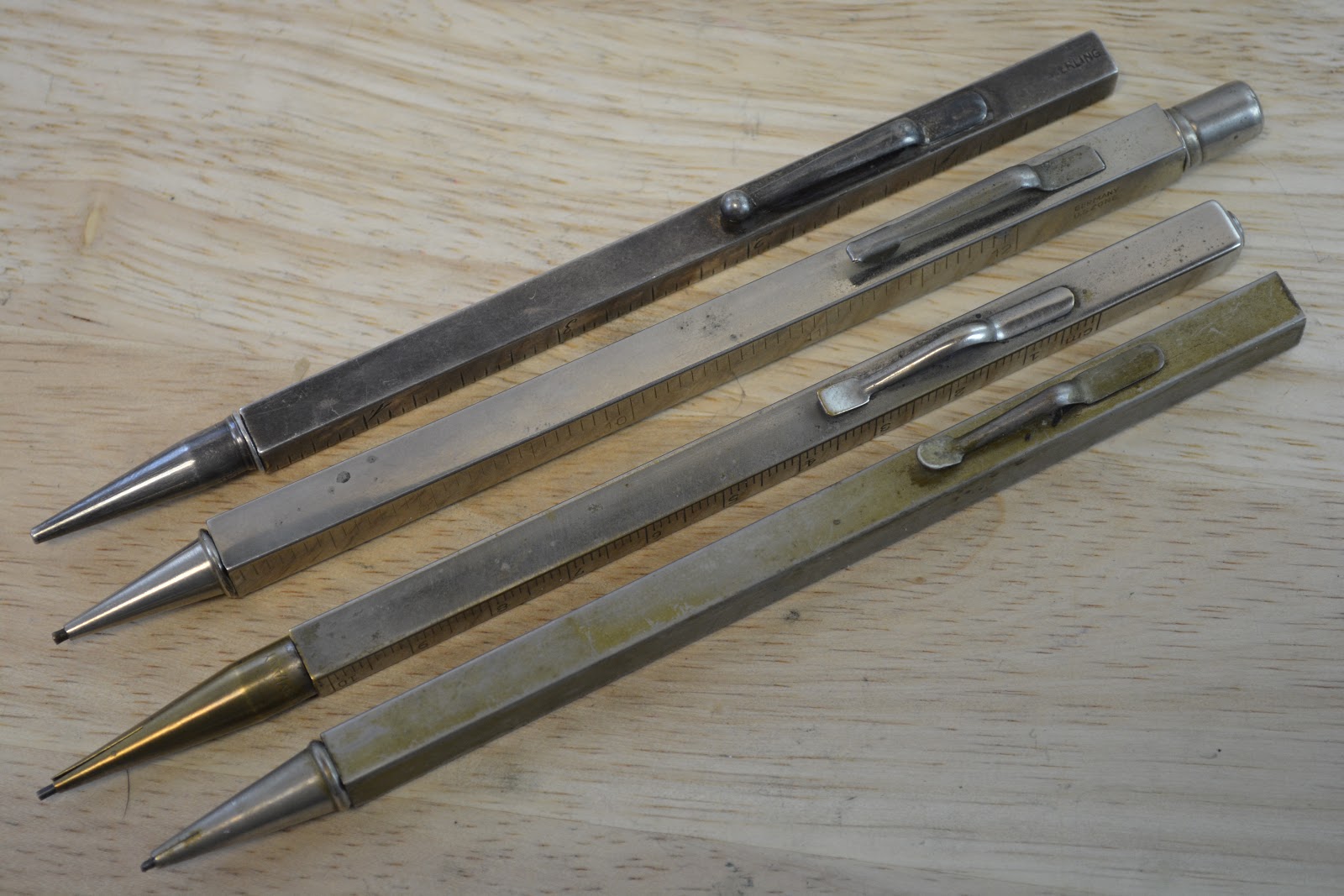
The floodgates were open.  After World War II, the ruler pencil was further appropriated for production in post-War Germany:


The top example is our sterling Pen-N-Pencil, but the other three are German productions.  One of these is marked Bavaia and “Rofeco,” and that’s the most prevalent variation.  Maybe as a fig leaf to discourage copycats, it bears an imprint including “Des. No. 68281,” a reference to Todd’s 1925 design patent.


One is marked only “Germany / US Zone,” a reference to allied occupied Germany, before it was formally referred to as West Germany:


And the third, marked “Pilgrim Novelty Company New York,” is also made in Germany:


And . . . horror of horrors . . . it includes a scale in the metric system!


Friday, February 20, 2015

The Mystery Mark

This article has been edited and included in The Leadhead's Pencil Blog Volume 3; copies are available print on demand through Amazon here, and I offer an ebook version in pdf format at the Legendary Lead Company here.

If you don't want the book but you enjoy this article, please consider supporting the Blog project here.

This stockbroker pencil turned up at the Ohio Show:


The overall profile matches that of the Hicks family. The clip lacks the distinctive upturned ball, but it doesn’t appear that it ever had one:


The engine turned pattern on this one is pretty close to Eversharp’s "Dart" pattern, but I think that’s a red herring. The pattern is close enough to the Hicks-marked Cartier I showed off a couple days ago, that I remain confident this pencil’s origins lie in New York, not in Chicago:


However, the hallmark doesn’t match anything else I’ve seen in this family:


I’m not sure whether it’s "DV" or "VD," although the latter might explain why you don’t see many of these around. There was a silversmith named David Vinton, but he traded a full century before this one was made. Clarence A. Vanderbilt used a similar sort of mark, with the CA nested inside the arms of a V, but I can’t find an heir apparent with the initial "D." There’s no silver content stamp or European hallmarks, which eliminates any continental possibilities in my mind.

P.S. - Solved!  See here.

Wednesday, February 18, 2015

The Patriarch of the Family

This article has been edited and included in The Leadhead's Pencil Blog Volume 3; copies are available print on demand through Amazon here, and I offer an ebook version in pdf format at the Legendary Lead Company here.

If you don't want the book but you enjoy this article, please consider supporting the Blog project here.

Two of these pencils were ones I picked up at the Ohio Show’s Saturday auction last November:


The top one was one of them – it’s the same one I compared to the Black, Starr and Gorham pencil here a couple days ago. The middle one was the other item in that lot, also made by Hicks. Since the auction photos were not posted online before the show, I had no idea this was going to be available – that proved to be both good and bad. The bad wasn’t really so bad: I raised my hand at the auction because the example up for bids looked to be larger than what I remembered having at home, and obviously, that wasn’t true.

But the good far outweighed the bad. If the picture had been posted in advance, I likely would have compared it to the one I had, noted just minor differences, and I would have passed on it thinking those minor differences weren’t worth the price of admission.

I also would have missed one other slight difference, one which makes all the difference in the world to me:


The one I bought at the auction, on the left here, is marked W.S. Hicks. The one I had at home was marked Edward Todd. The similarities between pencils offered by these two firms have been well documented here as well as by other collectors, but nothing better illustrates the point, in my mind, than this. I can also think of no better picture to lead into the question: who was making these, and who was having them made?

I believe all the evidence points to the conclusion that Hicks made Edward Todd’s pencils, at least during this period. As we saw earlier, Hicks made pencils for Black, Starr and Frost – both before and after the company’s merger with Gorham.

There are others. Here’s a picture I took of a couple Hicks pencils a while back, alongside the Todd calendar pencil:


At the nose is the Hicks hallmark, and some other important information:


Patent number 1,259,738 was applied for by William S. Hicks on August 23, 1917 and was issued March 19, 1918. It was assigned to Edward D. Hicks (Trading as William S. Hicks’ sons) of New York:


Yet the rounded cap on this one, as distinctive a Hicks feature as the upturned clip which also appears in the patent drawings, bears another name:


Cartier. And then, let’s consider Tiffany & Co. Until recently, I was on the fence as to whether it was Edward Todd or Hicks which made Tiffany’s pencils, such as this one:


I picked this one up at the Ohio Show. The fact that it included a box, even with a few stains, didn’t break my heart, either:


This example is quite a study in understatement: very large, very heavy, but without a clip or any ornamentation.

No ornamentation, that is, except for this:


This is the only example of a Tiffany marked with the actual manufacturer’s hallmark, and it’s marked Hicks. Pulling out Occam’s handy razor, if Hicks made pencils for high quality silver houses such as Black, Starr and Frost, Cartier and Tiffany & Co., and was making pencils at the same time nearly identical pencils were being offered by Georg Jensen, why is there any reason to believe that Edward Todd-marked pencils would be made by anyone else?