Showing posts with label Sheaffer golf pencil. Show all posts

Friday, July 16, 2021

Who Else . . . Part Two

This article has been included in The Leadhead's Pencil Blog Volume 7, now available here.
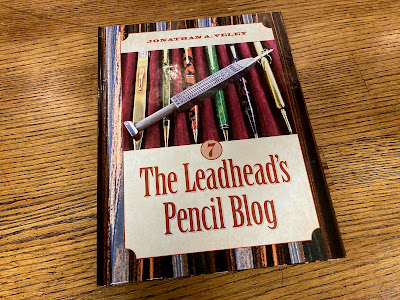

If you don't want the book but you enjoy the article, please consider supporting the Blog project here.

On May 18, I published an article musing about whether a jade golf pencil I had found might have been made by Sheaffer.  A major consideration weighing in favor of that possibility was Sheaffer’s design patent covering golf pencils in that distinctive teardrop shape (design patent 80,362), coupled with Sheaffer’s notorious reputation for stamping out any infringement, through threats and litigation.  

As mentioned earlier, William Cuthbert and Earl Sodeberg applied for the golf pencil design patent on August 30, 1929 – long after applying for the patents for the pencil, pen and combination pen and pencil, seemingly as an afterthought.  The fact that Sheaffer sued Eagle for violations of those other three patents, but apparently gave Eagle a pass on the “Jot Jr.” golf pencils, suggests that perhaps Sheaffer thought twice about trying to enforce its golf pencil design patent; maybe because it was unenforceable, and maybe because it was invalidated.

I still believe its possible Sheaffer made that unmarked pencil from my earlier article.  However, I might have leaned too much on Sheaffer’s design patent, after this one turned up:


The color is generally referred to as “Brazilian green,” because that is what it was called by the company that made the greatest use of it: Wahl-Eversharp.  Celluloids were sourced from other companies, most notably DuPont, and other examples of writing instruments made from this plastic have turned up on pencils made by other companies (offhand, Waterman and the “Ford’s Deluxe” come to mind).

However, the strong association of Brazilian green with Eversharp had me opening my drawer of Equipoised-era pencils:


The top example is clearly marked, and while collectors refer to these as “Eversharp golf pencils,” it is made up of parts from an Eversharp convertible set: the front end doubled as the pencil portion of a combination pen and pencil, and the set included both that short cap for pocket use as well as a desk taper.  In the early days, I captured a poor photograph of Cliff Harrington’s set when he displayed it at the Chicago Show in 2012 (see Volume 1, page 217):


As for those other two golf pencils . . . the tapered flattop one is unmarked, but it was sold to me as an Eversharp by a member of our community who knows his stuff - I won’t say who, because I’m not entirely sure about that now, and I’m not suggesting I was misled.   

Then there’s the Sheafferesque example, with a shape that should have triggered a patent dispute . . . IF someone other than Sheaffer made it, IF it was made after Sheaffer’s patent was filed, and IF Sheaffer’s patent was enforceable.  Attributing this one to Eversharp is equally thin:


IF this is from Eversharp’s stash of Brazilian green, IF Eversharp made both marked and unmarked golf pencils, IF Eversharp added gold bands to some of them, IF Eversharp used triangular loops on their ringtops, and IF Eversharp dared to openly defy Sheaffer’s patents.

OK, maybe a little less thin because that last IF isn’t just an if, because Eversharp DID . . . 


This model is illustrated in Eversharp’s 1929 catalog, and after Sheaffer promptly cried foul it was quickly withdrawn.  There’s a progression here: note the difference between the two ringtop examples shown:


There were two versions of the ringtop, the one with a flattened area at the top like the known Eversharp golf pencil was made after Sheaffer complained, to replace the ones that were streamlined all the way to the top, just like a Sheaffer Balance.

The parts are not interchangeable between my imprinted Eversharp golf pencil and either of the other two.  Can I say conclusively that my Sheaffer-shaped golf pencil in Brazilian Green was made by Eversharp?  No.  But I’m more likely to attribute it to Eversharp than to Sheaffer.

Tuesday, May 18, 2021

Who Else?

This article has been included in The Leadhead's Pencil Blog Volume 7, now available here.


If you don't want the book but you enjoy the article, please consider supporting the Blog project here.

When this unmarked ringtop showed up in an online auction, I was probably buying it for all the wrong reasons, but I wanted to test a theory:


The pencil bears more than a passing resemblance to a Sheaffer golf pencil, and the thought rumbling around in my head was whether this unmarked pencil might have been made by Sheaffer:


It’s very close, but not exact:


Even the rings on top are nearly identical:


I was hoping the cap and barrel of this new one might be interchangeable.  There’s two types of threading on Sheaffer golf pencils, one much narrower than the other.  My gray one has threading that looked close, and again . . . close but not exact:


The parts are a perfect match for another unmarked golf pencil I’ve had laying around.  I was so confident I’d written an article suggesting a Sheaffer connection with this one, I spent time scrolling through close to 100 articles on the brand.  I still keep it alongside my Sheaffer golf pencils:


It isn’t in any known color for a Sheaffer golf pencil, but that shape . . . why does that shape alone have me pondering whether there might be a Sheaffer connection?


When Sheaffer introduced the Balance line of streamlined pens and pencils, the company applied for design patents for the new, tapered ends.  Design patents were awarded first for pencils, then fountain pens and combination pens/pencils, but almost as an afterthought, on August 30, 1929 William Cuthbert and Earl Sodeberg also applied for a design patent for the teardrop-shaped golf pencils.  It was awarded as Design Patent 80,362, and Sheaffer was extremely aggressive in protecting its patent rights as the streamlined shape became all the rage (recall that The Pick Pen Company was one of those which ran afoul of these patents, and Sheaffer’s patents were upheld and held infringed).  If anyone other than Sheaffer made this pencil, that manufacturer did so at his peril.

But what of that band, you say? 


Doesn’t look very Sheafferish, you say?  But wait - there is some precedent for that band in the Sheaffer universe:


These “off catalog” pencils have special bands - double and triple ones - and on close examination, they are very similar to what we find on my unmarked golf pencil:


Yet again . . . very close, but not exact.


Tuesday, February 3, 2015

Maybe Not All

This article has been edited and included in The Leadhead's Pencil Blog Volume 3; copies are available print on demand through Amazon here, and I offer an ebook version in pdf format at the Legendary Lead Company here.

If you don't want the book but you enjoy this article, please consider supporting the Blog project here.

If I had a nickel for every time an online seller claimed that some junky unmarked pencil they had was a Sheaffer golf pencil . . . ok, maybe I’d only have a dollar. But still, it happens waaaay too often. After all, it’s really easy to detect whether a golf pencil is a Sheaffer, right? The fact that they are marked "Sheaffer" is a dead giveaway, right?

Until the Philly show, I would have said right. Gimme a dollar. Today, however, I say "maybe." As I was going through the pencils in the "mother lode" that turned up at the Philly show, I found this one in a bag of unmarked golf pencils:


If this one had a ringtop, I’d swear it was a Sheaffer. OK, if it had "Sheaffer" marked on it, I’d swear it was a Sheaffer. But them are cheap words. Suffice to say when I was going through things with a friend looking over my shoulder, I looked at it under a loupe, saw it was marked and nevertheless turned around and asked, "doesn’t this look like it’s a Sheaffer?"

John Hall, who was set up at the table next to mine, overheard the conversation and happened to have a couple Sheaffer golf pencils for sale. So we lined them up to see just how close it is:


Wow. Close. Very, very close. Interestingly, John’s black and pearl example was a little bigger around, but the marine green and pearl example was exactly the same diameter, so I tried swapping the tops to see how they fit:


They are threaded differently, so that wasn’t possible. However, as you can see from this picture, everything about these two is otherwise identical: identical proportions, nose cones, everything. So these days, when I say if I had a nckel for every time an online seller claimed to have a Sheaffer golf pencil that wasn’t marked, I might have ninety-five cents in my pocket . . .

And one other instance when I’d say maybe, maybe not.

Monday, December 1, 2014

My Quandry Is Resolved

I wish I could say things at the museum are as organized as they look in the pictures I share here. Sure, most of what’s there is in drawers or on shelves, and I can generally find everything when I try. But there are also little piles of stuff laying about – pencils in the queue to be photographed, pencils pulled from the shelves and grouped together for comparison, and sometimes just groups of pencils I pulled from different places because I thought they would look cool together.

Here’s one of those little piles:


These are all Sheaffers in "ebonized pearl" – in my opinion, one of the most distinctive and beautiful plastics produced by any company during the golden age. Most of the pencils shown in this picture are too special to just be laying around like this, with double band, jewelers’ bands and "fishscale" bands in the mix. Yet they’ve been sitting there for several months: I pulled them out of several different drawers of Sheaffers (I group my Sheaffer’s by year and trim configuration, not by color) because I wanted to see them all alongside two very special additions I’ve been meaning to write about . . .

To learn more, this full article is included in The Leadhead's Pencil Blog Volume 3, available at Amazon, Barnes & Noble and everywhere else you buy books, or you can order a copy signed by yours truly through the Legendary Lead Company HERE.