Showing posts with label Century. Show all posts

Friday, October 3, 2025

Observe and Report

Step one: observe. Step two: compare what you observe to what you know. Step three: draw reasonable conclusions that flow from the first two steps. 

When step two is a big fat goose egg, my reasonable conclusion is that all I can do is throw out there what I have observed in the hopes that someone – maybe next week, maybe in ten years or so – can help me connect the dots.  Most of these images are several years old and have been sitting in the dead letter office, because I'm stuck.

This Victorian pencil is marked “J.A.B. & Co.” Unfortunately, the pencil is generic and is not marked with any patents that might be helpful.


This next one was my only purchase when Janet and I stopped in Lebanon, Ohio on our way back from that big Eagle Pencil Company purchase. It was two dollars:

The lettering on the side interested me – “Guys Dropper Lamp” didn’t ring a bell, but the Shanklin Manufacturing Company did.


The name Shanklin on a pencil reminded me of this Shanklin Sure Sharp pencil, which appeared on page 19 in A Century of Autopoint.


The Shanklin Sure Sharp was invented by George Bergen, an early inventive collaborator with Charles Keeran as Keeran developed the earliest versions of the Autopoint. Alas, the Shanklin behind Guys Dropper Lamps was a different Shanklin. Wrong city, wrong industry. The only marking on this pencil that resembles some sort of model or manufacturer’s name is above the clip – “Poor,” I think it reads, in script lettering? 


The best clue that might unravel this one is that distinctive cap. We’ve seen it before:


Here is our mystery pencil in the company of pencils marked “Thatpencil.”


That connection is only slightly helpful, though, because not much is known about the “Thatpencil” either - all I knew about it went into a very early article here, “No Really . . . ‘That Pencil’” (February 24, 2012: Volume 1, page 126), and I haven’t learned anything new about them in the years since. 

Up next is something that I had to buy in an online auction just to get my paws on it to see what was going on. 


The pencil is nested in that ringtop case.


Around one side of the cap are those tantalizing words, “Pat. Apld. For”:


However, the only other clue is on the other side - H.F.B.


I have been unable to track down any patent that was ultimately issued to someone with those initials. This one looks a lot like something Bates & Bacon might have made, but none of the principals in that organization had the initials H.F., either.

This next one might not be American, but it might have an American connection. 


The clip is a standard issue 1915 patent accommodation clip marked for the Eagle Pencil Company - while it looks like it has been there for some time, since it is a clip that just slides on, I’m confident but not certain that it came with this pencil.


An Eagle clip would be consistent with what is written around the cap: “D.R.P.” stands for Deutsches Reichspatent, meaning German patent. “Made in Germany” in English suggests that it was made for the American market. Eagle also sometimes stamped early Eagle Stop Gauge pencils with the German patent number. 


The cap pulls off, and underneath it is an odd mix of word salad: “Depose” suggests a French connection, as in “registered,” and there’s a specific German patent - number 331474, I think it reads.


I’ve tried to look up a German patent number 331,474, but all roads lead to some random Norwegian patent having nothing to do with pencils. There have been a few other examples of these pencils that have surfaced in recent years online, and in each case people have marveled about their weird mechanisms. Under that cap is a hole, maybe just a place for spare leads or maybe they were intended to feed automatically.


And on the top, both on and under the cap, the word “JACO.”


I’m sharing this next one as a second cry for help - one every seven years or so, I suppose:


It’s marked “L Pen Co.” on the clip, and it joins another example that turned up back in 2018 - see “The L Pen” (April 22, 2018: Volume 5, page 240). I fingered at the time that Diamond Point was the likeliest suspect to have made it. 


I didn’t know anything about the “L Pen Co.” then, and I haven’t figured anything else out about it in the years since.


Hard rubber pencils like this next one look European, and my eyes tend to glaze over when I see them.


This one, however, had a very faint but interesting imprint on the barrel:


“The Rosemady That’s For Remembrance” it reads - there’s a lot of excess China Marker on here, because every time I tried to clean off the extra white stuff it all came off and you couldn’t read it. I have no idea who or what “Rosemady” is.

Along those same lines is this “Rufford”:


That’s a very British-sounding name, and this one fooled me when I found it on Rob Bader’s table in Chicago a few years ago. It’s not even a pencil, I learned during shooting . . . it’s a stylographic pen. What the heck - it’s my blog and I’ll share a stylo if I want to. Besides, I’d like to know more about who made the “Rufford.”

Matt McColm pointed this next one out to me when it showed up in an online auction:


“Statter Bros. / Buffalo” reads the imprint. I did find one reference to Statter Brothers as a manufacturer of numbering machines in the July 1931 edition of the Rand McNally Bankers Directory, but I don’t know whether the company also sourced pencils to offer under their name as another line of business. 


I had this one photographed, but the images didn’t turn out very well the first time:


After a trip to the buffing wheel, the second photo session was more fruitful . . .


I’ve seen a few of these “M Co.” pencils over the years. My best guess is that M is for Morrison . . . except Morrison was never bashful about emblazoning its full name on its products. Was Morrison being uncharacteristically understated, or is this something else?


Myk Daigle bequeathed me this next one a couple years ago. I think it was keeping him awake at night, and he figured better me than him:


It looks a little bit European, but the imprint is partially in English:


“Skopeographe / Pat Applied For Bte S.G.D. . . .” something. Looks like it might end with another G. I hoped that I might learn more by taking it apart, but alas . . . 


Hmm. Looks like a continuity tester, sort of like the Kastar . . . although I’m not sure how you’d know if there was continuity without any window in the barrel. 

My internet searches were at the same time refreshing and infuriating. When I typed “Skopeographe” into a Google search, there were no best guesses, no random suggested result; only results akin to “Did you mean ‘waterbeds?’ Here’s a zillion people who might sell you one of those.” Just . . . nothing. Google Books yielded the same result. It’s rare that no intelligence, human or artificial, even hazards a guess, and I have fared no better.

This last mystery pencil – for now – is one of those that has me taking out my loupe to over and over. It’s such a high quality pencil that it should be marked somewhere.


Geez . . . it even has a “Pat. Applied For” imprint which will be impossible to track down without breaking a solder weld or two to tear it apart.


My best guesses, based solely on a flimsy comparison of external similarities, had me posing this one in between a Century at top, and a Henber at bottom.


“Dorothea” is the only name on it – if it’s a personalization, it’s the most elaborate, hand engraved personalization I’ve ever seen. 


Maybe like John Foley’s “Madeleine” pencils, it’s more than just the owner’s name. All I know is that it wasn't my mother-in-law’s -- that’s the only other Dorothea I’ve met.

Tuesday, July 6, 2021

While I'm On the Subject . . .

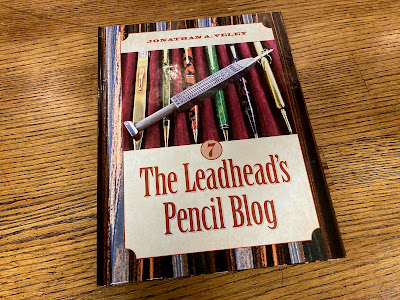
This article has been included in The Leadhead's Pencil Blog Volume 7, now available here.


If you don't want the book but you enjoy the article, please consider supporting the Blog project here.

Yeah, I know . . . once I start talking about the Rex Manufacturing Company, I keep talking about the Rex Manufacturing Company.  

In the last volume, I wrote about the history of The Century Pen Company (Volume 6, beginning on page 163 - the three-part series was also picked up by The Pennant magazine).  Something from that story bugged me: I had never found a Century pencil that I could conclusively attribute to Rex, and I thought they had to be out there somewhere.

Century Pen Company, according to the corporation’s own records, never actually made anything; the company only assembled pens from parts made by other manufacturers.  Early in the company’s history, the Parker Pen Company supplied all of the company’s parts, since George Parker and William F. Palmer were stakeholders in Century.  However, Parker had no officers or seats on the board of directors after 1916 (Volume 6, pages 170-173), leaving Century free to source parts from anywhere.  During the 1920s, Century turned to C.E. Barrett & Co. in Chicago; by the 1930s, Barrett was one of Century’s biggest creditors and, by 1938, Barrett’s patience ran out (as did the patience of Century’s other creditors) and the company was forced to close and dissolve.

Barrett sourced pencils (at least the mechanisms - the barrel was just a simple tube threaded at either end) from The Rex Manufacturing Company; however, I had not seen a Rex-made pencil branded for Century . . . until, of course, very shortly after that series of articles published.


Maybe the articles I wrote enticed the seller to list it. Almost certainly the recent attention Century has received drove up the price.  The trim is a bit worse for wear, but I’m not complaining:


The top was dented, but fortunately it is a generic Rex cap with the “Four Horsemen” patents listed (for a rundown on all of them, see Volume 2, page 103).  I had a spare around, and while it also could use replating, at least it is free of dents:


And, it fills in a gap in my small sampling of Century pencils:


Thursday, June 11, 2020

The EVRDA Boogeyman

This article has been edited and included in The Leadhead's Pencil Blog Volume 6, now on sale at The Legendary Lead Company.  I have just a few hard copies left of the first printing, available here, and an ebook version in pdf format is available for download here.

If you don't want the book but you enjoy this article, please consider supporting the Blog project here.

(Note: this is the third installment of a series of articles concerning who made identical pencils marked Century and EVRDA.  If you landed here by an internet search, the link to the first installment is at https://leadheadpencils.blogspot.com/2020/06/in-footsteps-of-giants.html).

Over the past two days, I’ve been sorting out who made identical pencils marked Century and EVRDA:


Century I’ve ruled out, in both its incarnations.  The first Century Pen was marketed only in 1882, and the second Century Pen Company, by all accounts, only assembled pens but didn’t manufacture any of the parts.

EVRDA, so the story goes, was a tradename used by the last incarnation of A.A. Waterman & Co., which had marketed “Everyday” pens.  A.A. Waterman & Co., we are told, adopted the trade name “Chicago Safety Pen Company” to get out from under the baggage of having to use that ungainly “Not Connected with the L.E. Waterman Company” disclaimer that was ordered by the Courts in 1914.

Here’s the examples of the EVRDA pencil I’ve been able to turn up:


Since we know A.A. Waterman did make its own pens, I theorized that maybe A.A. Waterman’s redheaded stepchild, the Chicago Safety Pen Company, might have manufactured these EVRDA pencils.

Wrong.  Well, kinda wrong.  I found the answer, which wasn’t the answer I was expecting to find and which is not consistent with the A.A. Waterman story we have been told.

The obvious starting place is to look for the trademark “EVRDA,” to see who filed it for registration.  The mark was published in the Official Gazette on March 1, 1921:


No, this one isn’t in American Writing Instrument Trademarks 1870-1953, and no, it isn’t because I missed it.  Trademark registration in 1921 (as is the case today) is a two-step process: if a mark passes preliminary review by an examiner, it is “published for opposition” in the Official Gazette – that puts the world on notice that if anyone wants to object to the mark being registered, now’s the time to do it.

After the time for objections has passed, then the mark is granted registration – and notice that registration was granted is published again in the Gazette.  American Writing Instrument Trademarks reports those marks which were granted registration.

The EVRDA mark did not pass that second step.  We’ve seen that happen before, most famously when the Sandfelder Corporation objected to Salz’ registration of “Salrite” because they claimed that it sounded too much like “Shur-Rite,” generating a court case memorializing that dustup for the benefit of all us armchair historians today (see https://leadheadpencils.blogspot.com/2016/01/flash-in-pan.html).

Since the mark made it into the Gazette, what prevented the registration of EVRDA was an objection by someone else.  Given who tried to register it, that is a fascinating realization.

The Gazette indicates only that the application was filed by Stephen J. Meyerpeter, a name which seems like an obvious choice given the story as it has been handed down to us.  Not much is known about Meyerpeter, but George Kovalenko wrote a significant article at his blog (the link is http://fountainpenhistory.blogspot.com/2014/08/waterman-v-waterman.html) in which he found a reference that Meyerpeter, like Arthur A. Waterman himself, was a valued member in the L.E. Waterman organization early on - Meyerpeter assisted A.A. Waterman at the 1896 Exposition in New Orleans (the reference was in the February 6, 1896 issue of The American Stationer, at page 244).

Says George: “And who was Steven J. Meyerpeter?  He also eventually left the Waterman’s company and helped to run a series of other pen companies, including Resevo, and Modern Pen Co., the later incarnations of A. A. Waterman Pen Co. after A. A. was forced out of the company, so the story goes.”

We know that Meyerpeter was manager of the “L.A. Waterman & Co.” (sic) as late as December, 1919 when this interview was published.  Apparently the author was also confused about who Meyerpeter represented, mixing up his L.E. and A.A., but the address on North Dearborn makes it clear he was representing A.A. Waterman & Co.:


Could Meyerpeter have been attempting to register the EVRDA mark on behalf of another “later incarnation” of A.A. Waterman?  Maybe, but the fact that he couldn’t get a trademark through, on a mark riffed on a well-known A.A. Waterman mark says it all.  He couldn’t register it because someone else was using it – maybe Meyerpeter was no longer involved with A.A. Waterman by 1921.

Or maybe he was still with A.A. Waterman, and whoever was using the EVRDA name was not.

The only primary source we have for who made or produced the EVRDA pencils and matching “Chicago Safety” pens is a catalog preserved at the Pen Collectors of America’s online library:


These are clearly our pencils, and the “Chicago Safety” pens they were meant to accompany are identical to contemporary pens marked A.A. Waterman.  The assumption that Chicago Safety was the next (and last) incarnation of A.A. Waterman & Co. has therefore been a reasonable one.

That assumption, however, is wrong.

There were a couple problems with the story that didn’t make sense to me.  The first was that this catalog is the only evidence I have been able to find that something called the “Chicago Safety Pen Company” ever existed:


But the more serious problem was that the Modern Pen Company, also known as A.A. Waterman & Co., was operating at the same time as this Chicago Safety Pen Company - just a few weeks ago I showed off an A.A. Waterman pencil made in the early 1920s, and Meyerpeter’s trademark application was filed by March 1, 1921, when notice was published in the Official Gazette.  In fact, here’s a “Special Introductory Offer” for Arthur A. Waterman fountain pens, published on May 23, 1922:


The key to this mystery was the address on the cover of that Chicago Safety Pen Company catalog: 538 South Clark Street, Chicago.  My search was turning up really weird, inconsistent results for occupants at that address until I realized that wasn’t just an address . . . it was a space station . . .

OK, so I’m a Star Wars nerd.  Sue me.

When I ran across a reference that one entire business at that address was in “room 807,” I realized just how big 538 South Clark is.  Chicagoans at the time knew it simply as the Rand McNally Building (that’s Rand McNally, the map publisher), at the corner of Clark, Harrison and LaSalle Streets.  It’s the Federal Building today:


I found a roster of all the occupants in that building during 1922 – exactly when that Chicago Safety catalog was printed.

There was only one pen manufacturer in that entire building.

And you know who he is.


Clarence E. Barrett, disgraced as a patent infringer during the Sheaffer v. Kraker smackdown, later to rise again as the “boogeyman” behind National Pen Products:


This badge is in the collection of Loyal Knight Brian Holstine, who contributed this picture after his daughter resolved “technical issues” she described as the “200-pound object placed directly between his keyboard and his chair.”

Oh, but Barrett has always been the easy way out – “the boogeyman,” I like to call him, since this blog has spent more time debunking the notion that Barrett was responsible for everything big, colorful and flattopish than it has devoted to giving the poor man credit for keeping his head up despite enormous adversity in the face of Walter Sheaffer.  This time, however, it looks like Barrett was our man, turning out pens that looked like A.A. Waterman pens and blocking A.A. Waterman’s frontman, Meyerpeter, from being able to register a trademark for the name EVRDA.

However, there’s more.  Barrett may have been the only pen man in the Rand McNally Building at the time, but many of my articles posted here over the years have illustrated that while he made or assembled pens, he usually sourced pencils and pencil parts from other suppliers.  I still craved that clincher of knowing where EVRDA pencils came from.

I found it.

It’s been years since I’ve looked at the EVRDA and tried to figure out who might have made it.  All of them have a “Pat. Applied For” imprint, which might be helpful if there weren’t a zillion or so patents pending in the early 1920s.

There were two helpful silver linings in the patent search department, though.  First was that even though the Century and EVRDA pencils can’t be taken apart readily, that same catalog at the PCA library has a page including a skeletal view of what’s inside:


The second is that the process of elimination has reduced a zillion or so down to just a kajillion or so.  Or maybe a handful.  Years of writing blog articles about different examples of patents proved useful as I've written about pencil patents listed in American Writing Instrument Patents 1911-1945, and so many more of these patents are familiar since the last time I looked at this.  Instead of throwing up my hands and saying to myself “god, this is hopeless,” this time I was saying “oh, that’s not it . . . oh, that’s not it. . . " until I got to one I didn’t remember looking at before.

It was issued to Loring L. Blake of Chicago, and it was issued to the “Blake Pencil Company.”  The application was filed on June 26, 1920 – squarely within the right time frame – and it was issued as number 1,388,693 on August 23, 1921:


See it?


And now for the punch line.  I followed up on this “Blake Pencil Company,” and I found an announcement of the corporation’s incorporation:


By Clarence E. Barrett, his sister-in-law Bernice O’Neill, and their lawyer, O.W. Jurgens, as announced in The National Corporation Reporter on September 23, 1920 - at the same address used by "Chicago Safety Pen Company."  Five years ago, I revealed that Clarence and his sister in law, along with a Montgomery Ward executive, incorporated National Pen Products in 1922 to supply writing instruments to Montgomery Ward stores (https://leadheadpencils.blogspot.com/2015/07/what-about-boogeyman.html).

“Even if Clarence E. Barrett was a master salesman and a nice guy with whom you might want to do business,” I suggested, “after what happened to those who bought parts from him in the Kraker fiasco, who in their right mind would want to risk buying anything from him just four years later, in 1922?”

Even more so two years earlier, in 1920.

Does this mean that C.E. Barrett & Co. was making A.A. Waterman’s pens by the early 1920s?  As controversial as that conclusion may be, I believe it is correct.  My friend Allan Goforth added some more evidence to pile onto that conclusion on Facebook, when he posted a picture of a tray of pens which included this one:


I’d written here about the matching pencil, marked “Miller’s Guaranteed Pencil,” and compared it to a very similar John Holland pencil, back in 2018 (see https://leadheadpencils.blogspot.com/2018/10/millers-guaranteed-pencils.html):


“That floral clip is reminiscent of writing instruments assembled by C.E. Barrett,” I had observed.  So was Allan’s pen a Miller’s, a John Holland, or something else? 

Something else indeed:


It’s marked “Resevo.”  And, as provided in American Writing Instrument Trademarks 1870-1953, we know who that was:


The name was registered by Stephen J. Meyerpeter, as president of A.A. Waterman and Company, who claimed the company had used the name since May 1, 1919.

Yes, Virginia . . . C.E. Barrett & Co. made pens and supplied pencils for A.A. Waterman & Co. after the company moved to Chicago.  EVRDA pencils, however, were sourced by Barrett through another Barrett subsidiary, the Blake Pencil Company, to accompany Chicago Safety pens Barrett marketed on his own account through another of his companies, the Chicago Safety Pen Company.   

And Blake Pencil Company also supplied identical pencils to the Century Pen Company.