Showing posts with label Wearever. Show all posts

Monday, May 10, 2021

The Wiiiide Circle

This article has been included in The Leadhead's Pencil Blog Volume 7, now available here.
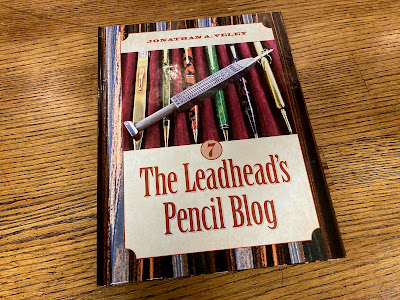

If you don't want the book but you enjoy the article, please consider supporting the Blog project here.

When one of these came my way recently, I was eager to circle back around:


Even the fuzziest of online auction pictures showed that clear window mid-barrel to show where the spare leads are kept, so I knew exactly what it was:


“Tripp Barr.”  These pencils come in two sizes, and as is the case with my new addition, the caps are often missing.  Here’s all of the examples that have come my way over the years:


That turquoise one at bottom is really nice, and it’s in far better condition than average for these.  Let’s back up and try that again:   “. . . so I knew exactly what it was:”


I haven’t written about the Tripp Barr since 2012, when I posted two articles which appear in Volume 1.  In the first, the main point of the article was to marvel at how crazy people seem to go for the Tripp-Barr when they show up in online auctions (Volume 1, page 228).  I revisited the brand a couple months later, when a short version of the all-transparent barrel surfaced in the pencils I acquired from the estate of Edgar Nichols (inventor of the Tri-Point and proprietor of the Nichols Products Corporation - see Volume 1, page 293):


Information often comes fast and furious when I post an article about an obscure brand like this one, and I’m writing follow up articles every few months.  The Tripp-Barr has been a much longer fishing trip - since I threw out a baited hook in 2012, that bobber’s just been sitting dead in the water with nary a ripple for nearly ten years.

In September 2020, I logged into the administrator’s area of the blog to clean out junk comments (the spammers tend to play when the blog is inactive).  The Tripp-Barr bobber was gone, and the tip of the pole was touching the water, since Terrence A. Beverley had posted a comment to my Tripp-Barr article:

“The Tripp Barr pencil was patented in 1933 by Edmund R. Barany, the paternal grandfather of my wife,” Terrence wrote.  “We have the original patent documents which are beautiful works in themselves. The Tripp Barr was carried by Macy's and sold for $1.47 with the slogan ‘Loaded with lead for the year ahead.’

“We have a Tripp Barr brochure and a full newspaper page showing the Macy's ad. The pencil was manufactured and sold in two configurations. One being a two-part solid shaft and the other being a three-part shaft with one of the parts known as an indicator window. To gain access to the spare LED, remove the cap and remove the eraser. Tilt the pencil and the spare LEDs will slide out.”

Well!  Send that stuff along, I said, and let’s answer a few questions!

I included Edmund Barany’s patent in American Writing Instrument Patents Volume 2: 1922-1945, but I never associated Barany with the Tripp-Barr because what makes the Tripp-Barr stand out – the center visible window – doesn’t appear in his drawings.  


The patent is consistent with the first part of the family history Terrence passed on: Edmund R. Barany applied for his patent June 10, 1933, and it was issued on May 15, 1934 as number 1,959,226.  The patent number also appears in the brochure Terrence mentioned, which he was kind enough to share with us:


Terrence also forwarded a copy of that Macy’s advertisement, which appeared in The New York Herald on April 1, 1934:


Yes, the Tripp Barr was marketed at Macy’s – but not exclusively.  Hutzler Brothers, a local jeweler in Baltimore, also advertised the pencils in The Baltimore Sun on May 5, 1934:


The Tripp Barr disappears from circulation within a year . . . at least, in the form we know.  Another bit of information Terrence supplied provided a clue.  He mentioned the family was in possession of original patent documents, and he forwarded one of them to me:


Recall above the “Other Patents Pending” reference in that brochure?  Since these drawings don’t match the only pencil patent I found issued to Barany, these drawings must have been prepared in connection with another patent application which was never granted . . .  and that cap, with its star-shaped metal insert to create a lead magazine within the barrel, reminded me of something else . . . 


A while back Rob Bader sold me a few trade catalogs, which I’ve scanned and at some point will contribute to the PCA library (projects, projects, projects).  One of these catalogs is from David Kahn, Inc., makers of the Wearever, and I dated it to 1935 or 1936, since one page in the catalog advertises the “Treasure,” complete with the same 1935 photograph from “Mutiny on the Bounty” from the “Treasure Chest” set I wrote about in 2018 (see Volume 5, page 140).  


Another page in the catalog illustrates the “new” Wearever “Visible Pencil” . . . 


That’s right.  Edmund Barany’s design for a pencil with a cap including a star shaped insert might have been intended for his Tripp Barr line, but it wound up on David Kahn’s Wearever “Visible Pencil.”

There’s more.

While I was researching this story, I ran across an online auction that I just missed by a month or so; the auction title included the words “Tripp Barr.”  I zoomed in on the terrible pictures, and by process of elimination I figured out which one bore that obscure name.  It was another all-translucent barrel model, with a telling difference:


I immediately recognized the diagonal brick pattern on the barrel . . . it shows up on another page of my David Kahn catalog, illustrating the Wearever Visible “Year ‘Round” pencil:


Early in my collecting days I had fun chasing down the diagonal and horizontal versions of Kahn’s “Year ‘Round” in the cataloged colors of black, red and green:


Incidentally, it drove me a little crazy to find two varieties of the clip on these, one with a pronounced hump and larger ball, the other one straight with a smaller one – since the catalog artwork seems to show something in between the two, I’m thinking they were using whatever was on hand at the time.  The bottom example has a clip marked “Onward,” another Kahn brand, another thing rubbing my OCD tendencies a bit raw. 

“Year ‘Round” . . . sort of reminiscent of the tagline on that Tripp Barr brochure, isn’t it?  “Loaded with lead for the year ahead.”


I am sure to a moral certainty that David Kahn, Inc. manufactured the Tripp Barr, but according to Terrence the brand was solely Edmund Barany’s baby; if that’s true, David Kahn made the pencils for Barany – it was not a Kahn production.

So where did the name “Tripp Barr” come from?  Unfortunately, the family’s oral history didn’t preserve that information.  Barany’s son, from whom Terrance got what information he was able to provide, passed away in 2019.  However, I do have a theory.

Edmund Barany was a very prolific inventor with dozens of patents to his credit, but his dabbling in the pencil business was a very brief one.  Earlier in his career he invented and patented numerous innovations in flashlights, including one which was near and dear to my heart: a flashlight with a second button, so with the flashlight on you could easily flick it on and off to communicate in Morse code:


My grandfather had one of these I used to play with as a kid – that’s the same grandfather whose Autopoints inspired my Dad to start collecting pencils and in turn inspired me.  I remember how effective this device could be, not so much in signaling Morse code as annoying Gramps on weekend sleepover visits, after nights of drinking too many sugary “Little Hugs” over games of Yahtzee.

“Tripp Barr” would make sense as a cute riff on “trip bar” - a mechanical device which would hold a circuit open or closed in electrical applications.  Perhaps the name was Barany’s tongue-in-cheek homage to his earlier career as a flashlight inventor.

Edmund Barany wasn’t finished as an inventor after his brief foray into pencils.  Terrence reports that his best-known invention was still to come: the reader head on those reel-to-reel sound recording devices.  He also shared a picture of Edmund, at work later in his career:


I wonder . . . 


. . . if there was ever a desk pencil version of the Tripp Barr?

Friday, January 29, 2021

A Worthy Wearever At Last

 I'll admit that my interest in writing articles about the repair and restoration of these old pencils is not entirely altruistic.  More often than not, my mission isn't so much to educate mankind in the care and feeding of these little beasts . . . it's so that later I can remember how I did it, too.

The lowly Wearever brand, produced by David Kahn, Inc., doesn't get as much love as it should.  Kahn was a real visionary in writing instruments who found ways to make pens and pencils that mimicked the look of higher priced brands, but more cheaply and efficiently.   They remain plentiful today, and since it takes a lot to knock one of these out of commission, the fact that almost all of them still work today means that there hasn't really been much call for me to dive into repairing one.

Until Loyal Knight Harry Shubin asked if I could take a shot at this one:


Wearever Deluxe pencils are not too terrible, and the sample engraving on the side of this one makes it better and, Harry and I agreed, worth taking a shot at getting it to work again.  The Wearever Deluxe was a rear drive pencil that advanced and retracted the lead by turning the top, a feature typically found on more expensive pencils, but in the case of this one the entire top was missing:


I happened to have a suitable donor lounging around in one of my bins.  It was missing the cap (or more likely, as often as the caps go missing, it already gave its cap up to complete another one in my collection), so it was just waiting for the opportunity to give its last full measure of service:


Tug as I might, I couldn't get the damned bushing out of the top so, rather than risk crushing it using pliers, I decided to attack from the other end.  After wrapping a rubber band around it and twisting without any progress, I twisted the other way . . . yep, it is reverse threaded (tuck that one away for future reference):


I figured that spiral mechanism was all that held the upper bushing in place.  I figured wrong.  Time to bring out the big guns . . . 


That's a knockout block for getting feeds and nibs out of their sections, which I've used more times than I can count in circumstances like these.  I had to put two of those rods into the barrel in order to reach the bushing, then a couple sharp whacks got the job done.


The reason it was so stubborn was that there is a groove in the barrel of the orange one into which the bushing seats.  That was probably added later in production:


The bushing engages the mechanism with the help of 2 little bumps protruding near the top of the spiral:


I inserted the bushing into the top of Harry's pencil, and like magic, the pencil worked perfectly.  The only issue was that the bushing pulled out easily, so I used a pair of flat pliers to squeeze the end of the bushing slightly out of round -- just like I do to give cracked Parker drive tubes enough "grab" to work without soldering. 

Now about that missing cap . . . there were a few different variations of these caps, but I have a pretty good idea what they looked like:


I heard a story about these caps once, about how they were repurposed tire valve caps from military Jeeps.  Hogwash, I say.  Although I do have one that has an actual tire valve cap, it looks terrible and obviously out of place.  Besides, the insides of these caps aren't threaded.

So Harry, you owe me a cap:


Sunday, April 26, 2020

Wearever, Not Whatever

This article has been edited and included in The Leadhead's Pencil Blog Volume 6, now on sale at The Legendary Lead Company.  I have just a few hard copies left of the first printing, available here, and an ebook version in pdf format is available for download here.

If you don't want the book but you enjoy this article, please consider supporting the Blog project here.

I got to see Daniel Thayer at the Baltimore Show this year, and that’s an occasional reunion I always enjoy.  When I edited The Pennant a few years ago, I started a back-page feature that profiled some of the new collectors I was seeing at the pen shows – “New Faces at the Show” is what I called it, not very imaginatively.

We pen(cil) folk are a gregarious bunch, and there’s never any shame in walking up to someone at a show and saying “Hey.  I don’t know you.  What is your name and tell me about you.”  But it does take a special sort of volunteer to tell you everything you want to know, and let you take their picture, and then print it. Many of the folks I approached were cautious, and I was just as cautious about who I picked to appear in the magazine.

My judgment was good with Daniel, and we’ve remained on good terms since my days at The Pennant ended some four years ago now . . . geez, has it been four years?  Feels like it’s just been ten minutes or so.  Sigh . . . I digress . . .

Daniel had a few pencils on hand he was looking to move on, and this was one of them:


I didn’t roll my eyes that the clip read “Wearever,” although the brand doesn’t get a lot of respect in collecting circles.  David Kahn, Inc., maker of the Wearever brand (as well as Pioneer, Leeds and a host of others) was more innovative than the credit given to the company.  David Kahn himself held quite a few patents – true, his company was known for maing cheap pens and pencils, but the company was a real pioneer in how they made things more cheaply.

Take the clip on this one, for example.  If you knew immediately that was a Wearever clip, that’s because Kahn took steps to protect that look.  It was the subject of a design patent issued to Kahn on an application he filed on November 18, 1935, issued as Design Patent 98,255 on January 21, 1936:


I have archived the different variations of Wearevers that have come my way over the years, but I couldn’t recall ever seeing one in this color.  With that cap, I assumed it was a combination pen and pencil, which I don’t normally collect.  What the heck, I thought to myself, I might as well check out the nib on the off chance something better than your typical steel nib was installed in this one.

Something better was indeed hiding under that cap, but it wasn’t a nib . . .


This one is fitted with a slip cap over the other end of a double ended pencil.  So here’s a color I haven’t run across before, a slip cap when all the pens and combos I’ve seen have screw caps, and while I’ve seen double-ended Wearever pencils, I haven’t seen a short one like this – and never with a cap.  In all my years of collecting, this one was all new to me. 

Tuesday, April 21, 2020

Back of the Virtual Milk Carton

This article has been edited and included in The Leadhead's Pencil Blog Volume 6, now on sale at The Legendary Lead Company.  I have just a few hard copies left of the first printing, available here, and an ebook version in pdf format is available for download here.

If you don't want the book but you enjoy this article, please consider supporting the Blog project here.

After the Hershey Metal Products piece ran, it was driving me crazy trying to remember what the other pencil was in that picture  – the long one with the clip:


I remembered that the only connection between the two was that they both came to me in the same box of junk, and that neither of them were the reason I bought that box of junk.  The pictures I shot were end-of-day shots, when I had finished shooting what I thought was the important stuff and I was just making sure I had these two documented.  I didn’t even care enough to shoot them separately.

But then I poked around and learned the story behind the little ringtop in that picture, which was marked “Hershey / Derby Conn.”  Maybe it’s the OCD in me, maybe it was a hunch that the other shoe might drop with that other pencil . . . I spent way too much time combing through hundreds of images in the dead letter office to find the shots of that other pencil.

Believe me, that was easier than going down and browsing through the museum looking for it.  I would have stowed it away alphabetically, and probably in a drawer since it isn’t really the sort of thing you’ll see on the wall o’ pencils (since the wall is the stuff I love looking at whenever I flip on the lights).

At last, it turned up.  Fortunately, I had made a duplicate of that full-length shot and named it with the other brand name, followed by a shot of the barrel imprint:


“No. 36 Kenrite St. Louis,” the imprint reads.   I did do a little bit of checking at the time I took these pictures, and I retraced my steps again in preparation for writing this, but I’m finding nothing about a Kenrite company (except the leather company in Australia, which I think I’m safe in ruling out) or any mention of a company turning out a pencil called the “Kenrite.”

So I’m left with comparing the Kenrite to other things in the museum.  That combination of design features had me first thinking David Kahn, Inc., makers of the Wearever and other third-tier lines.  Here’s why I thought so:


Slim model Wearevers aren’t as common as their full-sized counterparts; the clips are the same size as the bigger ones, so they share that similar, gawky appearance as the Kenrite.  Yet both of these Wearevers are nose-drive pencils, while the Kenrite is rear-drive.  So maybe, maybe not.

The Kenrite’s imprint reads “St. Louis,” which is the biggest reason I’m looking elsewhere.  After all, why would someone in St. Louis import product from North Bergen, New Jersey when there were two great sources for pencils like these locally – Ritepoint and Quickpoint?

Ritepoint wasn’t the logical answer to me, since I haven’t seen anything like this bearing the Ritepoint name.  Quickpoint, though, is a different story:


At first blush, these don’t look like a match.  However, all three of these Quickpoints are rear drive pencils, and while the company did turn out thinner models, none of the ones I’ve found have this older style clip.  And it is the same clip . . .


Wednesday, October 1, 2014

Adding to Clan Kahn

The Hiriter appears on page 89 of The Catalogue, and all I said about it was that it was "probably a Wearever subbrand." I recently picked up a couple other examples, one of which looks very much like the lime green one that appears in the book:


I’ve long since stopped using the phrase "Wearever subbrand" because I’ve learned that "Wearever" was not actually a company, but was instead just one trade name used by David Kahn, Inc., which manufactured writing instruments under a whole host of names that have been featured here. It would have been more correct to say that Hiriter was probably another brand name used by David Kahn, Inc. Here’s why I thought so:

To learn more, this full article is included in The Leadhead's Pencil Blog Volume 3, available at Amazon, Barnes & Noble and everywhere else you buy books, or you can order a copy signed by yours truly through the Legendary Lead Company HERE.


Sunday, March 10, 2013

Just Because You Can . . .

I received permission from an online seller to use these pictures. Since he was such a good sport, I’m not going to use his name here.

This was the Eversharp he had listed in an auction:


To learn more, this full article is included in The Leadhead's Pencil Blog Volume 2, available at Amazon, Barnes & Noble and everywhere else you buy books, or you can order a copy signed by yours truly through the Legendary Lead Company HERE.


Monday, August 6, 2012

The Wrath of Kahn

If there’s ever a second edition of The Catalogue, some years down the road, there’s one great injustice in there that I’m going to be sure that I correct. I will need to call one of the most influential men in the American pencil industry by name. After all, he earned it.

David Kahn was a man who arguably holds the title of being the most prolific producer of mechanical pencils in the United States. Although I haven’t tallied how many patents and design patents are credited to him or assigned to his company (David Kahn, Inc.) in George Kovalenko’s book, he’s got to be right up there with Eagle at the top of the "most innovative" list.

And his most recognized brand? Wearever.

OK, I didn’t say recognized was necessarily a good thing, because many of Kahn’s innovations involved ways to make more and cheaper pencils, not necessarily better ones. But not everything that the company made was terrible – at least as far as the pencils went (the pens, however . . . sheesh).
Take this one, for example, from the late 1920s or so . . .

NOTE:  This article is now included in the print version of The Leadhead's Pencil Blog, available anywhere you buy books, or also from The Legendary Lead Company.

To order, here's the link:  Volume 1 at Legendary Lead Company