Showing posts with label Keystone. Show all posts

Sunday, September 7, 2025

The Key to the Keystone

I strive to make clear the difference between what I know and what I have deduced from what I know. In “Banker and the Specialty King” I offered proof that James Kelley, the slick self-described “Specialty King,” marketed pens and pencils under the names “Banker,” “New Banker,” and “Keystone Banker.”

I never said that James Kelley was the only one to use these trade names. To the contrary, with a character like James Kelley it is more likely than not that others used the same or similar names, given Kelley’s penchance for “lifting” names when nobody was looking. After all, any claims Kelley himself had to use the name were so shaky that anyone horning in on that territory would have just as much right to do so.

The follow up articles to “Banker and the Specialty King” were published the following two days in “All the King’s Horsemen, Part One” (July 26, 2021: Volume 7, page 290) and Part Two (July 27, 2021: Volume 7, page 293). Those two articles dragged other lower-quality brands into James Kelley’s orbit, including “Master” (another name lifted from the original Banker Pen Company, which marketed a “Master Pen”), Nassau, Packard, and Keystone. There may be others – in fact, given James Kelley’s antics, there probably were.

My attribution of the “Keystone” name to James Kelley was only in relation to pencils along these lines:


Then there are these, which are marked “Banker” but which were referred to in Kelley’s advertising as the “gothic” or “Keystone Banker.”


No, I did not say that James Kelley was the only person on this big blue marble to call his pens and pencils the “Keystone.” In fact, I noted one puzzling detail in that previous article: the word “Keystone” was registered as a trademark with respect to pens and pencils, but not by James Kelley:


The Blaisdell Pencil Company, by its president A.C. Berolzheimer, had applied for registration of the Keystone mark on October 27, 1921, and it was granted registration as number 153,408 on March 21, 1922. In the registration, Berolzheimer claimed the mark was first used in commerce around January 1, 1911.

Both the mark’s first use and its trademark registration  occurred before James Kelley entered the picture in 1925 or so, so I don’t believe any of Kelley’s activities hastened Blaisdell’s application to register the mark. The ten-year delay in filing the application was more likely the result of the evolving and complicated relationship between Blaisdell and the Eagle Pencil Company, the latter of which was founded and run by the Berolzheimer family.

Blaisdell and Eagle had spatted back and forth over patent infringement claims beginning in the 1890s; in the early teens, Blaisdell was still a separate entity, but as the Keystone trademark shows, the Berolzheimer family controlled Blaisdell by 1921. Blaisdell formally became a subsidiary of the Eagle Pencil Company in the 1930s.

All of this means that by the time James Kelley started selling “Keystone” pens and pencils in the mid-1920s, the Keystone name was already reserved essentially to the Eagle Pencil Company. Did Eagle make James Kelley’s Keystone-marked products? I don’t think so; if anything, they look more like something David Kahn, Inc. might have made (Kahn is better known for its flagship brand, Wearever).

But there’s another bit of evidence on this point that recently surfaced . . . unintentionally.


This fountain pen turned up at one of the shows I attended this year; it is marked “Worth” on the clip:


When I say it provides an “unintentional” bit of evidence, that’s because I bought it for reasons having nothing to do with today’s subject. I bought it because I suspected that it proved the Eagle Pencil Company might have supplied Worth with at least some of its pens, due to its uncanny similarity to other Eagle metal fountain pens:


More on that tomorrow. Suffice to say that when I bought it, it was so cheap that I did not even bother to see if it had a nib in it. But when I did . . . 


While it clearly isn’t “gold filled” to the brim, the Keystone part hit me squarely between the eyes. Blaisdell’s trademark registration for the Keystone name had established that Eagle had at least some rights by representation to the name, but I was unsure whether that was found only on wood pencils or something else – say fountain pens – that might be a bit outside of my normal area of expertise. 

Am I backtracking on my earlier attribution of the use of “Keystone” to James Kelley? No – in fact, James Kelley was exactly the sort of slippery character who had few reservations about appropriating someone else’s name, even without the legal right to do so. I think both Blaisdell (Eagle) and James Kelley were both using the mark, one with and one without the legal authority to do so.

My friend Stan Klemenowicz and I discussed my earlier Keystone article, and he questioned whether an example in his collection, which strongly resembles something branded for Morrison, might suggest that the Keystone was a Morrison brand rather than a James Kelley production.  He posted an article at his blog, “stan’s pens” titled “Kahnstone, Kelleystone, or Keystone?” (posted here) to address other examples, including a few examples that appear to have been made in France.

I don’t disagree that at least some of the examples Stan shared in his article were likely not James Kelley productions – or Eagle’s either, for that matter. One of the most fascinating parts about collecting these things is the connections they establish between manufacturers, producers, and suppliers, and surprising connections turn up all the time. Consider this one:


Stan pointed the online auction for this example after he published his article, and once I saw it I felt the need to buy it. The missing pen might have been useful in providing a more definitive analysis of who was responsible for this one, but the paper on both the pencil and the matching warranty sheet was all I needed for the point I’m making today:


The makers of this “Famous Keystone” had some serious cajones reminding buyers to “Beware of Imitations,” since this looks like nothing made by either Blaisdell or Eagle, the rightful owners of the name. The top, though, is a familiar sight:


When these turn up, they are typically unmarked  – as is this one, other than the fortuitous price band. I’ve only found a few examples marked with a producer’s name:


The two complete examples are marked “E-Z Rite,” one on the cap and the other on the clip:


The third, however, provides another possible, surprising connection:


John Holland? Now wait a minute, my sharp-eyed peanut gallery might say . . . that might be a cap from a Rex Manufacturing Company pencil (you can just make out the “four horsemen” patent dates to the right of the name). Rex is well-known to have supplied pencils to John Holland, so isn’t that just a convenient replacement? Bear with me on that . . . there is sufficient “junk box provenance” with this example to suggest that this cap accompanied this pencil from whomever might have manufactured it and yes, I think that “whomever” might have been Rex.

More on that later, because this web is already sufficiently tangled. The question of the day is this: who made the Keystone? The answer is simple: anybody who thought they could get away with it without being prosecuted by Blaisdell, Eagle, or the newly-minted Federal Trade Commission.

That last sentence, combining the words “Eagle” and “prosecuted,” leads nicely into what I was going to tell you about the Worth Featherweight Pen Company. That story tomorrow.

Saturday, September 6, 2025

The Real Deal

Something else occurred to me as I was rereading the two previous articles I discussed yesterday (“Captain Obvious” on January 24, 2016: Volume 4, page 109 and “A Death Most Untimely” on July 23, 2021: Volume 7, page 280). These two articles, posted six years apart, reveal something interesting.

Yesterday I discussed the connection between the New Diamond Point Pen Company and the Eclipse Pen Company. The Court case discussed in “A Death Most Untimely” discussed Marx Finstone’s desire to consolidate Eclipse with his competitors: not just with Diamond Point, but also with two other New York pen companies, Salz Brothers and J. Harris & Co. Only Diamond Point was at issue in the litigation, so there’s no information regarding whether his other merger attempts were successful. 

At the end of “Captain Obvious,” I shared a stationer’s advertisement published in the Wilkes-Barre (Pennsylvania) Record on April 18, 1925:


At the time, I mused whether Diamond Point was also responsible for the Ambassador and “Banker’s Special” brands in addition to the Collegian, since this advertisement says all three are “Guaranteed by manufacturer,” not “manufacturers.”

That hypothesis is thin, and I knew that at the time; however, since I had forgotten that detail by the time I wrote about the Diamond Point/Eclipse litigation, I do think it bears a closer look now. “Ambassador” is well-documented as a J. Harris & Co. brand, so Marx Finstone’s interest in J. Harris may well have been for the same reasons as he was pursuing Diamond Point.

As for the “Banker’s Special,” I’m not so sure. In “Banker and the Specialty King” (July 25, 2021: Volume 7, page 285), I laid out all of the sordid details surrounding James Kelley, the flamboyant self-promoter. Kelley engaged in a cross-country cat-and-mouse game with the newly formed Federal Trade Commission, which hounded Kelley for his flagrant violations of laws regarding unfair and deceptive practices. Most notably, the FTC targeted Kelley’s trading on the good name of the L.E. Waterman Company by adopting the name “Waterson” in connection with pens and pencils.

Perhaps the FTC was being overly aggressive with Kelley to teach him a lesson, since Kelley was flagrantly thumbing his nose at the new agency. After all, as I noted in that article, any consumer who bought one of Kelley’s low-grade Waterson pens thinking it was a Waterman was a fool who should be parted with his money.

I didn’t find any evidence that James Kelley was responsible for any pen or pencil formally called the “Bankers’ Special.” He did, however, appropriate the “Banker” name from a Banker’s Pen Company that failed by 1922 and traded under the names “Banker,” “New Banker,” and “Kelley Banker.” He referred to his Banker pens and pencils with pointy or “gothic” top ends as the “Keystone Banker” in advertising.

As for that Keystone name . . . we’ll get to that one tomorrow. 

For our purposes today, the conclusion at which I had arrived in my earlier article was that the “Banker” and “New Banker” pencils with which we are familiar were products of James Kelley’s ventures. Kelley had appropriated the name from the original Bankers’ Pen Company, which had shuttered sometime in late 1921 or early 1922, likely a casualty of the brief but sharp 1921 economic slowdown. 

It is of course possible that there was another huckster who had also appropriated the “Banker’s Special” name – no honor among thieves and all. Had that been the case, I would have expected to find something marked “Banker’s Special” or some reference to the name other than in this lone stationer’s advertisement. Eliminating that possibility would be nice, but I’m inclined to “bank” on what is probable rather than what is possible. I don’t believe that in 1925, Kelley’s Banker pens and pencils were in any way connected with whoever was manufactured and warranted the Collegian or the Ambassador brands.

Neither did I believe that the original Bankers’ Pen Company made any pencils at all, because I didn’t know things like this existed at the time:


This hard rubber pencil turned up in an online auction, imprinted “Bankers Pen Co., Inc. / New York Pat.”:


Kelley’s Banker and New Banker writing instruments came in pretty colors, but they were not technically very sophisticated - none of their features were anything that would have been the subject of a patent. Also, Kelley’s Banker products are not known to exist in hard rubber. I am convinced this is the “real” Banker, made prior to the original Banker’s Pen Company’s failure sometime in 1921 or 1922.

What of this “patent” nonsense suggested by the imprint? There’s two suspects, one at either end of the pencil. At the nose, it has a “catch and release” leadholder configuration – unscrewing the nose a bit releases the lead, while tightening causes it to clamp down on the lead to secure it.


That was a patented innovation, but it was another New York manufacturer, not Banker’s, which laid claim to it:


Egon L.  Schmitz applied for patent number 960,588 on December 21, 1909, and when it was issued on June 7, 1910, it was assigned to the Eberhard Faber Pencil Company. I think this is most likely the patent referred to on this Bankers’ pencil – the time and the location fit what we know about the company well.

At the other end of the pencil, there’s another interesting feature that may have been patented somewhere along the line:


Those little prongs are pretty effective as a pencil sharpener. I checked that outstanding reference,  American Writing Instrument Patents Volume 2: 1911-1945, and nothing struck me as applying to this doohickey. However, since it is an attachment rather than a writing instrument itself, it might have been filed away in some obscure patent category I wouldn’t have thought to search. 

That’s possible, but as I mentioned earlier, I’d rather bank on what is probable rather than what is possible. My money is on old Egon until something like this turns up with an actual patent date or number.   

Tuesday, July 27, 2021

All the King's Horsemen, Part Two

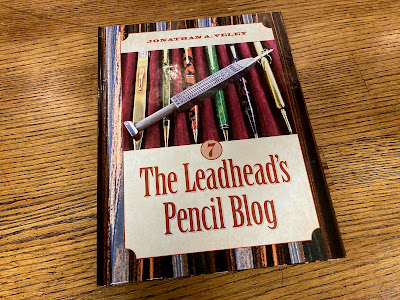
This article has been included in The Leadhead's Pencil Blog Volume 7, now available here.


If you don't want the book but you enjoy the article, please consider supporting the Blog project here.

Now to circle back to one of “Specialty King” James Kelley’s advertisements, in which he advertised the “gothic” “Keystone Banker” in 1932.  


There was a trademark filed for the Keystone name, but it was registered by Alfred Berolzheimer on behalf of the Blaisdell Pencil Company.  Berolzheimer claimed that Blaisdell had been using the mark since January 1, 1911, and he applied for registration on October 27, 1921:


I’ve always thought that the trademark was problematic, since the Keystone pencils I have don’t bear any strong resemblance to Eagle products (Blaisdell was a subsidiary of Eagle by this point); if anything, they look more like they were supplied by David Kahn, Inc.  


Then there’s the logo above the word: a K within a Keystone shape most of the time (one has the K within a diamond):


I’ve wondered whether that K stood for Keystone . . . but that seems a bit redundant.  Kahn?  These look more like David Kahn products, but they aren’t exactly the same . . . and besides, known David Kahn brands have DK in a circle, not just the letter K.  

Since Kelley had also “lifted” the Banker and Master names after the previous incarnation of the Bankers’ Pen Company had given it up, and he referred to his “gothic” Bankers as “Keystone Bankers,” I suspect the K on Keystone pens and pencils stood for James Kelley.  Once again, Kelley appeared to be appropriating an abandoned name – there was a “Keystone Fountain Pen Company” advertising pens during the teens and early 1920s, using many of the same shenanigans Kelley would later employ.  One was advertised in The Bourbon News (Paris, Kentucky) on April 20, 1917:


Keystone is no longer listed in the 1922-1923 New York directory, and advertising halts for this incarnation of the Keystone in 1925; four years later, the Keystone name was revived – apparently by James Kelley – and he would drag yet another third tier brand into the mix.

Classified advertisements for “cheap new” Keystone pen and pencil sets appear in Pomona, California beginning in April, 1929 - at 225 N. Rebecca, a single-family residence.  These notices began on April 26, 1929 in The Pomona Progress Bulletin:


Beginning in November 1929, advertisements very similar to those hawking Banker and Waterson pens and pencils begin appearing in drugstore advertisements in Los Angeles, a $11.50 set selling for just $1.50.  This one appeared in the Modesto (California) News-Herald on December 11, 1929 . . .


. . . and it was identified as a product of the “Packard Pen Company.”  Packard is a name that makes collectors shudder – later examples are some of the ugliest pens and pencils in pen(cil)dom:


Who do you suppose was behind the Packard Pen Company?  An advertisement for Packard pens in the Battle Creek (Michigan) Enquirer on June 21, 1928 answered that question:


The tipoff is buried in the fine print: “Packard & Waterson pens also made in smaller size”:


On December 23, 1930, the Rosslyn Drug Company advertised a three-piece set including a pocketknife strongly resembling Salz’ “Three Musketeers” set in the Los Angeles Evening Post:


The following year, “Bullet shaped” Keystone Pens were offered on behalf of its unnamed manufacturer in The Los Angeles Times on September 13, 1931.  The similarities between this and Kelley’s Banker advertisements are too much to ignore:


An advertisement in The Idaho Statesman illustrated “Banker-Keystone” pens and pencils on December 16, 1931.  These were more rounded than the bullet-shaped models; however, if Sheaffer forced the modification, it didn’t scare Kelley much.  These were offered with “Lifetime Chromium” nibs and if you look close, the illustrations showing the letter S in a circle at the top of otherwise unmarked clips:


An address for the company was finally revealed on March 4, 1932, when an advertisement in the Brooklyn Times Union identified the Keystone Pen and Pencil Company at 467 Willoughby Avenue, Brooklyn, New York.  


The company is listed at that address in the 1933 Brooklyn City Directory, and Sam Krasnor is identified as the proprietor:


Just as was the case in California, 467 Willoughby Avenue is a residence, in this case a three-story brownstone in an exclusively residential area - the 1933 directory lists Sam Krasnor and his wife Ruth as the occupants.  From what I can tell, “Sam Krasnor” had no other connections to the pen and pencil industry – I conclude that he and the Keystone Pen and Pencil Company were just another front for James Kelley’s operations.

Keystone advertisements along the lines of what have already been presented limp along through 1937, after which sets are offered on clearance for less than a dollar – no gimmicks, no side deals.  I never found any indication that the Federal Trade Commission caught up with Sam Krasnor or the Keystone Pen and Pencil Company, so perhaps Kelley’s nine-headed Hydra sacrificed a noggin for the cause.

However, the FTC did catch up with the Packard Pen Company, identifying it as an alias for one Harold Tanner – another name with no other apparent connections to the writing instrument industry.  On August 23, 1937, the FTC enjoined Tanner from the same litany of offenses as Kelley’s other enterprises, including specifically his use of the term “Lifetime Guaranty” . . . 


. . . and his use of “Master Banker’s” as a measure of size.  If the FTC had any inkling what was going on, they would rightly had assumed that the use of “Master” and “Banker” only meant James Kelley was behind it all.


Thursday, October 18, 2012

Could This Be The Key?

As I was musing about the "DK" logos denoting David Kahn, Inc., I went back through and checked clips on several other lower-quality brands to see if they shared the same connection. Enter the Keystone, one that I’ve long suspected might have a David Kahn (Wearever) connection. 

The clips on each of these have a "K" on the clip, all right. Duh. It could be Keystone, but could it also stand for Kahn?

NOTE:  This article is now included in the print version of The Leadhead's Pencil Blog, available anywhere you buy books, or also from The Legendary Lead Company.

To order, here's the link:  Volume 1 at Legendary Lead Company


Wednesday, November 23, 2011

A Different Keystone


On page 93 of The Catalogue, I illustrate three different examples of the Keystone, all of which are middle joint, nose drive pencils.   This example, a rear drive flattop, surfaced a couple weeks after The Catalogue went to press. . . .

NOTE:  This article is now included in the print version of The Leadhead's Pencil Blog, available anywhere you buy books, or also from The Legendary Lead Company.

To order, here's the link:  Volume 1 at Legendary Lead Company