Showing posts with label E-Z Rite. Show all posts

Sunday, September 7, 2025

The Key to the Keystone

I strive to make clear the difference between what I know and what I have deduced from what I know. In “Banker and the Specialty King” I offered proof that James Kelley, the slick self-described “Specialty King,” marketed pens and pencils under the names “Banker,” “New Banker,” and “Keystone Banker.”

I never said that James Kelley was the only one to use these trade names. To the contrary, with a character like James Kelley it is more likely than not that others used the same or similar names, given Kelley’s penchance for “lifting” names when nobody was looking. After all, any claims Kelley himself had to use the name were so shaky that anyone horning in on that territory would have just as much right to do so.

The follow up articles to “Banker and the Specialty King” were published the following two days in “All the King’s Horsemen, Part One” (July 26, 2021: Volume 7, page 290) and Part Two (July 27, 2021: Volume 7, page 293). Those two articles dragged other lower-quality brands into James Kelley’s orbit, including “Master” (another name lifted from the original Banker Pen Company, which marketed a “Master Pen”), Nassau, Packard, and Keystone. There may be others – in fact, given James Kelley’s antics, there probably were.

My attribution of the “Keystone” name to James Kelley was only in relation to pencils along these lines:


Then there are these, which are marked “Banker” but which were referred to in Kelley’s advertising as the “gothic” or “Keystone Banker.”


No, I did not say that James Kelley was the only person on this big blue marble to call his pens and pencils the “Keystone.” In fact, I noted one puzzling detail in that previous article: the word “Keystone” was registered as a trademark with respect to pens and pencils, but not by James Kelley:


The Blaisdell Pencil Company, by its president A.C. Berolzheimer, had applied for registration of the Keystone mark on October 27, 1921, and it was granted registration as number 153,408 on March 21, 1922. In the registration, Berolzheimer claimed the mark was first used in commerce around January 1, 1911.

Both the mark’s first use and its trademark registration  occurred before James Kelley entered the picture in 1925 or so, so I don’t believe any of Kelley’s activities hastened Blaisdell’s application to register the mark. The ten-year delay in filing the application was more likely the result of the evolving and complicated relationship between Blaisdell and the Eagle Pencil Company, the latter of which was founded and run by the Berolzheimer family.

Blaisdell and Eagle had spatted back and forth over patent infringement claims beginning in the 1890s; in the early teens, Blaisdell was still a separate entity, but as the Keystone trademark shows, the Berolzheimer family controlled Blaisdell by 1921. Blaisdell formally became a subsidiary of the Eagle Pencil Company in the 1930s.

All of this means that by the time James Kelley started selling “Keystone” pens and pencils in the mid-1920s, the Keystone name was already reserved essentially to the Eagle Pencil Company. Did Eagle make James Kelley’s Keystone-marked products? I don’t think so; if anything, they look more like something David Kahn, Inc. might have made (Kahn is better known for its flagship brand, Wearever).

But there’s another bit of evidence on this point that recently surfaced . . . unintentionally.


This fountain pen turned up at one of the shows I attended this year; it is marked “Worth” on the clip:


When I say it provides an “unintentional” bit of evidence, that’s because I bought it for reasons having nothing to do with today’s subject. I bought it because I suspected that it proved the Eagle Pencil Company might have supplied Worth with at least some of its pens, due to its uncanny similarity to other Eagle metal fountain pens:


More on that tomorrow. Suffice to say that when I bought it, it was so cheap that I did not even bother to see if it had a nib in it. But when I did . . . 


While it clearly isn’t “gold filled” to the brim, the Keystone part hit me squarely between the eyes. Blaisdell’s trademark registration for the Keystone name had established that Eagle had at least some rights by representation to the name, but I was unsure whether that was found only on wood pencils or something else – say fountain pens – that might be a bit outside of my normal area of expertise. 

Am I backtracking on my earlier attribution of the use of “Keystone” to James Kelley? No – in fact, James Kelley was exactly the sort of slippery character who had few reservations about appropriating someone else’s name, even without the legal right to do so. I think both Blaisdell (Eagle) and James Kelley were both using the mark, one with and one without the legal authority to do so.

My friend Stan Klemenowicz and I discussed my earlier Keystone article, and he questioned whether an example in his collection, which strongly resembles something branded for Morrison, might suggest that the Keystone was a Morrison brand rather than a James Kelley production.  He posted an article at his blog, “stan’s pens” titled “Kahnstone, Kelleystone, or Keystone?” (posted here) to address other examples, including a few examples that appear to have been made in France.

I don’t disagree that at least some of the examples Stan shared in his article were likely not James Kelley productions – or Eagle’s either, for that matter. One of the most fascinating parts about collecting these things is the connections they establish between manufacturers, producers, and suppliers, and surprising connections turn up all the time. Consider this one:


Stan pointed the online auction for this example after he published his article, and once I saw it I felt the need to buy it. The missing pen might have been useful in providing a more definitive analysis of who was responsible for this one, but the paper on both the pencil and the matching warranty sheet was all I needed for the point I’m making today:


The makers of this “Famous Keystone” had some serious cajones reminding buyers to “Beware of Imitations,” since this looks like nothing made by either Blaisdell or Eagle, the rightful owners of the name. The top, though, is a familiar sight:


When these turn up, they are typically unmarked  – as is this one, other than the fortuitous price band. I’ve only found a few examples marked with a producer’s name:


The two complete examples are marked “E-Z Rite,” one on the cap and the other on the clip:


The third, however, provides another possible, surprising connection:


John Holland? Now wait a minute, my sharp-eyed peanut gallery might say . . . that might be a cap from a Rex Manufacturing Company pencil (you can just make out the “four horsemen” patent dates to the right of the name). Rex is well-known to have supplied pencils to John Holland, so isn’t that just a convenient replacement? Bear with me on that . . . there is sufficient “junk box provenance” with this example to suggest that this cap accompanied this pencil from whomever might have manufactured it and yes, I think that “whomever” might have been Rex.

More on that later, because this web is already sufficiently tangled. The question of the day is this: who made the Keystone? The answer is simple: anybody who thought they could get away with it without being prosecuted by Blaisdell, Eagle, or the newly-minted Federal Trade Commission.

That last sentence, combining the words “Eagle” and “prosecuted,” leads nicely into what I was going to tell you about the Worth Featherweight Pen Company. That story tomorrow.

Wednesday, July 1, 2015

How I Know

This article has been edited and included in The Leadhead's Pencil Blog Volume 3; copies are available print on demand through Amazon here, and I offer an ebook version in pdf format at the Legendary Lead Company here.

If you don't want the book but you enjoy this article, please consider supporting the Blog project here.

Note: this is the second installment in a series of articles which started yesterday.  To start from the beginning, see http://leadheadpencils.blogspot.com/2015/06/nailed-it-pretty-much.html.

The E-Z Rite / S&K set that I showed you yesterday wasn’t the first time I bought a set thinking I might have found that last piece of the puzzle.  Several months ago a similar set turned up in an online auction:


I’m showing it here exactly as it was posed in the pictures online, with “Criterion” in the lid, a pencil that looked just like an Eclipse “Never Dull” and just enough of the paperwork showing to provide the tantalizing words “made by us” on a certificate that looked almost exactly like what you’d find on something made by Rex.

Alas, there were no markings on either the pen or the pencil.  None.  Nada.  As much as this pencil looked exactly like what I was looking for, there wasn’t any evidence conclusive enough for me to even say these were in the right box.  And the paperwork?  Talk about infuriating:


It’s a guarantee, entitling the bearer to return for repair any pen or pencil “made by us,” but there’s no indication who “us” was.  If that bugs me ninety years later, imagine how much it bugged a customer with a repair issue when this set was new!

Am I sure, given that the set bears no markings, that this is even a Criterion set?  Yes, given the number of boxed sets that are out there.  Am I sure this certificate goes with this set?  Yes, given the number of other boxed sets like this that have that same paperwork.

And am I sure this set was made by the Rex Manufacturing Company?  I am now.  Compare the certificate from this Criterion set with the E-Z Rite certificate from yesterday’s post:


Exactly the same language.  Only the words “marked Rex” and “marked E-Z Rite” are added.  The generic certificate found with my Criterion set is probably what was intended to accompany Rex-made sets made to order for retailers, including the S&K set from yesterday’s article.  What a happy accident it was that they threw the wrong certificate in the box!

There was something else about the Criterion which I’ve suspected, but I thought it was a little too speculative to post about until now.  Now that all this is coming together, I think I’ll speculate tomorrow.

jNote: The story continues at http://leadheadpencils.blogspot.com/2015/07/two-cans-of-worms.html.

Tuesday, June 30, 2015

Nailed It . . . Pretty Much

This article has been edited and included in The Leadhead's Pencil Blog Volume 3; copies are available print on demand through Amazon here, and I offer an ebook version in pdf format at the Legendary Lead Company here.

If you don't want the book but you enjoy this article, please consider supporting the Blog project here.

Almost two years ago, I posted an article here (“Establishing a Connection” on August 19, 2013, 
http://leadheadpencils.blogspot.com/2013/08/establishing-connection.html) in which I was looking at the early metal Eclipse “Never Dull” pencils, comparing them to a pencil marked “Rexhold” and other similar pencils, many of which bore a patent date of February 19, 1924.  That date was for Lawrence McNary’s patent, the first of a series of patents assigned to the Rex Manufacturing Company.   I theorized, based on many similarities between them, that Rex made Eclipse’s early metal pencils.

If only, I said at the time, I could conclusively establish that “Rexhold” referred to the Rex Manufacturing Comapny.  That “if only” was resolved when I stumbled across a notation in a 1922 trademark directory establishing without a doubt that in fact was true (see http://leadheadpencils.blogspot.com/2015/05/a-definitive-answer-and-more-distinct.html, posted on May 11, 2015).

There was one last “if only”in that 2013 post: a metal pencil marked “E-Z Rite.” That pencil bore several fingerprints consistent with this theory – three out of four similarities, in fact: the clips, keyed caps, crimped tops were identical.  The only difference was a slight variation in the barrel pattern, slight enough to cause me to pull back a bit.  Wouldn’t it be nice to establish without question that the E-Z Rite was made by Rex and eliminate any lingering doubts?

Earlier this month, Daniel Kirchheimer tipped me off that this set was listed in an online auction:


The set is fairly nondescript, and it wasn’t even listed as an E-Z Rite set.  But look at what came with it!


There it is . . . the last nail in the coffin.  The E-Z Rite was made by the Rex Manufacturing Company.  Rexhold was a Rex trademark.  The Eclipse “Never Dull” is practically identical to both.  There’s no question.  Rex made Eclipse’s first pencils.

But wait . . . there’s more.  Here’s a closer look at the set:


I was hoping, given that the certificate indicates that the company made pens marked “Rex,” that the pen would bear that name somewhere, but no – the only marking is “14k Gold Filled” on the barrel:


The instructions for the pen are no more helpful:


In fact, the pencil instructions are similarly generic:


But the pencil yielded a surprise:


It isn’t an E-Z Rite.  It’s an “S&K.”  Now I was thoroughly stumped, and I started pouring through everything I could find in the hopes that I could turn up known pen companies starting with S and K . . . the closest I could find were Settles and Kritikson, both of whom were associated with the Security check protector pens, but all the evidence I could find indicated that it was first Settles and then Kritikson – no indication that the two were ever operating together in partnership.  Yet I found one curious tie between them: Settles produced the “Supremacy” line of writing instruments, and pencils I have marked Supremacy were made by Rex.  Maybe?

As of now, that remains a wild theory.  As Daniel Kirchheimer and I batted this around, he thought a more likely possibility was Skinner & Kennedy, a stationer’s house in St. Louis, Missouri which was operating during the 1920s.  I have to agree that a Skinner & Kennedy house brand seems more likely, but neither of us has found anything concrete to indicate they offered a house brand of writing instruments.

And what of the E-Z Rite paperwork that came with this set?  Even though it conclusively solves the Eclipse/Rexhold/E-Z Rite question, it’s a little anti-climactic that the pencil isn’t an E-Z Rite and the pen isn’t marked Rex.  Even so, I’m convinced that this paperwork is what came with this set from the Rex factory . . . although it was a factory goof.

How do I know this?  I’ll show you tomorrow.

Note:  this story continues at http://leadheadpencils.blogspot.com/2015/07/how-i-know.html.

Monday, August 19, 2013

Establishing a Connection

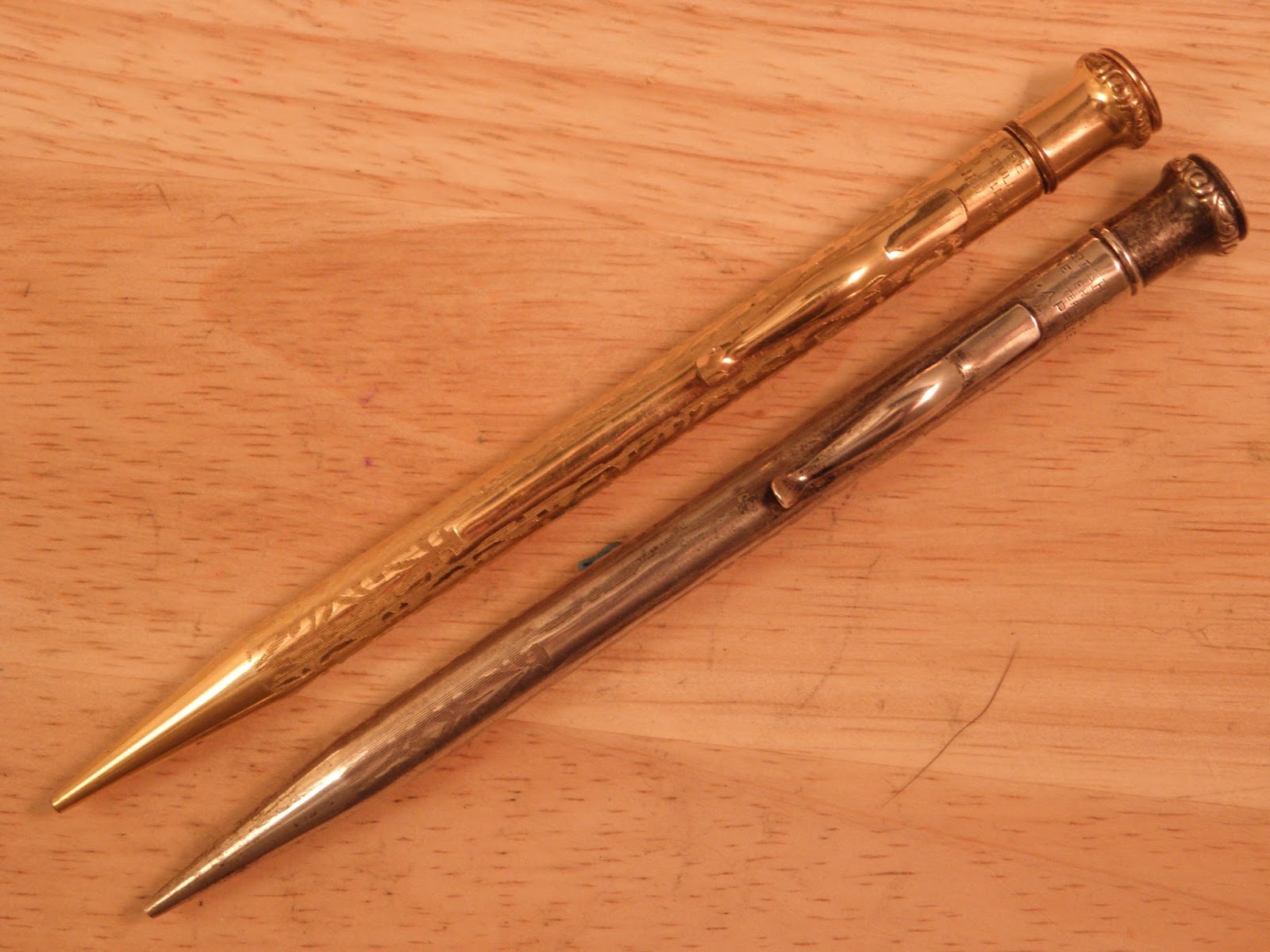
Sometimes it’s kind of spooky how pieces of this giant puzzle just fall into place.   Not very long ago, I wrote an article on the “Never Dull” pencils, which appear on pencils marked Eclipse, Albert Howard and the “Rexhold.”   Here’s an example of the Eclipse, in gold fill, next to the sterling Rexhold:


To learn more, this full article is included in The Leadhead's Pencil Blog Volume 2, available at Amazon, Barnes & Noble and everywhere else you buy books, or you can order a copy signed by yours truly through the Legendary Lead Company HERE.