Showing posts with label Redypoint. Show all posts

Tuesday, May 25, 2021

Still Not Done . . . After Three Tries

This article has been included in The Leadhead's Pencil Blog Volume 7, now available here.


If you don't want the book but you enjoy the article, please consider supporting the Blog project here.

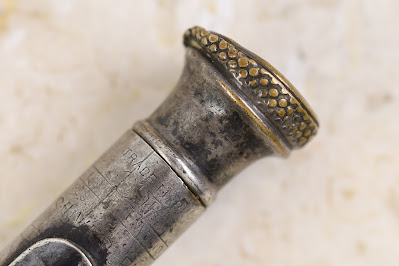
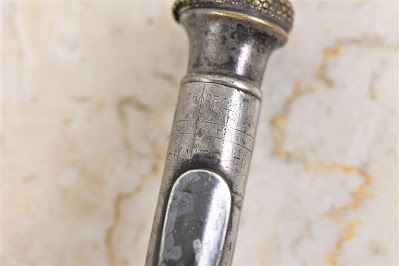
The “Redypoint” is among the earliest pencils made by DeWitt-LaFrance (better known as manufacturers of the “Superite”), for Boston stationer Samuel Ward Manufacturing Company.  

I first started shooting some photographs of my Redypoints when the one at the bottom of this picture came my way:


The top example is the Redypoint which unraveled the whole story of “Wahl, Sheaffer and the Race for Boston” (Volume 4, beginning on page 300) - it is identical to an early Sheaffer Sharp Point pencil, and the pattern engraved on the barrel is unique to early Sheaffers.

Other than the name on the side and some really weird, heavy wear on the crown, this new one was the cleanest example I’ve found:


And I thought I was done.  Kind of a short article, so I didn’t do anything with it.

Then along came another example, in sterling, with something else that I’ve been itching to delve into a bit more:


As mentioned earlier, the only Redypoint I’ve found in a pattern also used by Sheaffer is that Sharp Point lookalike – but that checkerboard chasing on this example is closer to a Sheaffer pattern than any other I’ve seen to date.  Of course, it’s also close to a pattern found on pencils made by another character in the Wahl/Sheaffer story:


The silver Redypoint is shown here flanked above by an early Heath-clip Ever Sharp made by Heath for Charles Keeran before Wahl started making his pencils.  Below it are two Sheaffer Sharp Points - the one with the broken clip has a normal gauge barrel, while the bottom one is much lighter and thinner, more like the GF (General Fireproofing) pencils I’ve speculated about.  

Here’s a closeup of the Redypoint and the Ever Sharp:


They are close - on both, you can see how the chasing blades bounce a little with each cut.  However, the Redypoint has squares consisting of four lines, while the Ever Sharp has five.  

The more refined of the two Sharp Point pencils has squares consisting of six lines, and the engraving is more even:


While the other example with the thinner barrel has more pronounced lines like the Redypoint, but in squares of five lines:


And with that, I thought I was done with this article . . . again.  All I have to report is that this latest Redypoint has engraving which is similar to both a pre-Wahl Ever Sharp and two Sheaffer Sharp Points, but not identical to either.

Then I received an email that a package was being shipped to me from David Nishimura’s Vintage Pens, LLC.  Curious, I thought: I hadn’t ordered anything from David’s website, and all I was expecting from him was a check for the things I bought for him at the Krinke auction.  Maybe he was sending me one of those really big checks as a gag or something, I thought.

Nope.  A normal-sized check arrived in a box accompanied by a small “thanks for bidding for me” gift . . . one David knew would grab my attention:


There’s another Masonic emblem, the third to arrive since John Hall passed.  I swear my buddy is pestering me from the hereafter:


However, there is no manufacturer’s mark, which is infuriating since it is a dead ringer for a General Fireproofing pencil:


That’s a ringtop GF pencil in the same pattern, and the lighter Sheaffer Sharp Point.  As to the GF, I mean the same pattern, not a similar one –  boxes made up of four lines, just like on my new sterling Redypoint:


The last time I was muddling around with GF pencils, it was to discuss an example I had found that shared the same triangle/dot pattern found on my Redypoint/Sharp Point lookalike (see Volume 6, page 197).  I was so close to proving that the GF pencils were made by DeWitt-LaFrance in 1917-1919 that I could taste it: “All we need now is documentation to establish when General Fireproofing began offering pencils for sale,” I concluded.

You can see lettering on the barrel of the Masonic pencil . . . could this be the missing piece?


“Wieland - No. 714 / 1871-1921.”  Geez . . . this pencil is almost what I’ve been looking for in so many ways.  It’s almost a General Fireproofing pencil, but without any markings there’s no way to know for sure.  It almost fits within the timeline, but just a couple years too late – after Sheaffer had set up its pencil manufacturing plant in Fort Madison.  

And the embossing for that commemorative inscription?  Raised lettering rather than stamped is something I haven’t found on a GF, a DeWitt-LaFrance pencil or a Sheaffer.

Almost . . . almost . . . almost.  I’ve taken three swings at this article, and I still haven’t found the answers I’m seeking!

Wednesday, June 17, 2020

Flashpoint

This article has been edited and included in The Leadhead's Pencil Blog Volume 6, now on sale at The Legendary Lead Company.  I have just a few hard copies left of the first printing, available here, and an ebook version in pdf format is available for download here.

If you don't want the book but you enjoy this article, please consider supporting the Blog project here.

In "Wahl, Sheaffer and the Race for Boston" I laid out the case that Sheaffer’s earliest Sharp Point pencils were invented by David J. LaFrance, even though the patent was issued in Walter Sheaffer’s name.  Some nagging questions linger:   as I mentioned the last time I wrote about the Sharp Point in April, “I never found the evidence to prove whether it was the Boston Fountain Pen Company before Wahl purchased it, or David J. LaFrance on his own, or LaFrance working a fledgling pencil program for Sheaffer.”  See "When the Point Was Sure".

And then there’s Charles Keeran, the man who invented the Eversharp and who helped orchestrate Wahl’s purchase of the Boston Fountain Pen Company.  He was abruptly and mysteriously ousted from Wahl shortly after the purchase was consummated in early 1917, and almost immediately after Sheaffer’s Sharp Point was introduced in mid-1917.  

Was Keeran forced out for incompetence, because he failed to scoop up LaFrance’s pencil design along with the rest of the Boston Fountain Pen Company, or was he suspected of actively collaborating with LaFrance and/or Sheaffer with establishing a pencil program in 1917?

One thing is certain: between 1917 (when the Sharp Point was introduced) and 1919 (when Sheaffer set up its own pencil manufacturing works in New York), the same hands were making Sheaffer Sharp Points and Redypoints for Samuel Ward.    

My last article in April concluded with very similar pencils marked GF (for General Fireproofing of Youngstown, Ohio) and how they fit into this mix.  I didn’t bring them up in “Wahl, Sheaffer and the Race for Boston” because their connection wasn’t quite as direct – “a tremendous amount of smoke, but no fire yet.”
  
And, with the April article done and in the can, I did what I always do . . . scoped around a bit to see if there were any other examples of General Fireproofing pencils out there that I might want to scoop up.  

There were two.

And both add significantly more smoke:


The silver filled one was in a bunch of parts pencils in an online auction, and I didn’t notice until the package arrived that it was from Richard Lott, accompanied by a nice note that he hopes we see each other at another pen show soon.  This one was in the bunch because the cap is a bit scrunched on one side:


But, I suppose it can share custody with the cap from one of my early Sheaffer Sharp Points.  The parts are interchangeable:


To be honest, I thought from the auction photos it might be an unmarked Sharp Point, since the GF imprint is so faint:


But there it is – and here it is, posed between the Redypoint and Sharp Point pencils from “Wahl, Sheaffer and the Race for Boston,” proving the connection between the two:


I was disappointed that the Redypoint was clipless, since that would have provided one more nexus for comparing the two.  This one does, but you might argue it proves nothing, since it terminates in a flatter, more spoon-shape tang rather than the Sharp Point’s more graceful, pointed terminus:


But . . . that’s just one style of Sheaffer clip.  Another style (the one I call the “bowler clip,” since it looks like a bowler hat at the top) has an identical tang:


Advertisements at the time suggest that the bowler clip, at least on Sharp Point pencils, came after the earlier, more pointed clips.  General Fireproofing pencils, however, might never have had the same clips . . . or at least, not enough of them have surfaced to know.  But at last I’ve got a General Fireproofing pencil that was indisputably made by the same hands that crafted the Redypoint and Sharp Point:


From the top, these are the Redypoint, the General Fireproofing, the Sharp Point and the later Sharp Point – and note also that those double bands at either end of the barrel were dropped by Sheaffer.
And what of that gold filled example of the GF?


It has a very distinctive pattern on it, and when I compared it to all my other Sharp Points – all my other Sheaffers, t00 – it isn’t even close to anything else I’ve found.  Yet it looked so familiar . . . I was sure I’d seen it somewhere . . . 

Wait a tick . . . you don’t suppose . . . 


A checkerboard pattern on most of the barrel – very close.  The GF has squares comprised of four lines, while the match I found has blocks of five lines.  And on the front, a cartouche pinched in the middle like a peanut:


That’s the GF at the top.  Note that like the checkerboard pattern, it isn’t identical, but it clearly evokes the same lines.  Line up fifty, or a hundred, or what the heck .... all my other metal pencils with cartouches like this, and you’ll see: there is no question that the pattern on this GF pencil deliberately, but admittedly feebly, copied the pattern on this other pencil.

And that other pencil is . . . 


A Heath-clip Eversharp, made by the George W. Heath Company for Charles Keeran’s fledgling Eversharp Pencil Company before Keeran contracted with Wahl to make them for him in October, 1915.  This pattern was never made by Wahl.

And then here’s the kicker: the pattern is also found on Sheaffer Sharp Point pencils.  Jerome Lobner had this one recently – unfortunately, I was so preoccupied with writing that I didn’t see it, but he let me use his picture:


Time to step back and string the clues together.  Between 1917 and 1919, one manufacturer was making Sheaffer Sharp Point Pencils, Redypoint pencils for Samuel Ward & Co. and pencils for General Fireproofing.  The Redypoint ties in with David J. LaFrance, the pencil’s inventor.  LaFrance was working for Boston when Keeran helped arrange the sale of Boston to Wahl.    Keeran admittedly neglected his duties at Wahl after the sale to attend to patent disputes “etc. etc.” in New York.  The GF pencil that just turned up and Jerome's Sheaffer Sharp Point copy a pattern Charles Keeran used on his Eversharps before he became involved with Wahl, which his current employer was not using.  Keeran is relieved of his duties after the introduction of Sheaffer’s Sharp Point is made public.

What we need is documentation to establish when General Fireproofing was offering pencils for sale.

Saturday, December 31, 2016

A Great Way to End the Year

This article has been edited and included in The Leadhead's Pencil Blog Volume 4; copies are available print on demand through Amazon here, and I offer an ebook version in pdf format at the Legendary Lead Company here.

If you don't want the book but you enjoy this article, please consider supporting the Blog project here.

When the article you’ve been reading over the last few days was first published in The Pennant, one prominent collector pulled me aside to tell me he thought it was too speculative – a good story, but too speculative to be fact.  Guess you can never have too many endnotes.

I couldn’t believe the story either as I was researching it.  But that one clue – the “Redypoint” which was a dead ringer for a Sharp Point, yet made for one of DeWitt-LaFrance’s first customers – was the thread that unraveled a giant sweater.  Every clue I found fit the story which emerged: that Walter Sheaffer actively pursued the Boston Fountain Pen Company, influenced the terms of its sale to Wahl, and “stole” Boston’s superintendent, David J. LaFrance, who invented the mechanical pencil Sheaffer patented in his own name and introduced in mid-1917 as the Sharp Point, before LaFrance got into business with William DeWitt and formed DeWitt-LaFrance.

The day after Thanksgiving, I found something which, like all the other clues I have found along the way, fits perfectly.  In the article, I had concluded that Samuel Ward’s “Redypoint” brand:


preceded the “SAWACO” on Ward’s line of pencils (which Ward was already using on its line of papers and other products):


The theory was based on the fact that Brown and Bigelow had previously trademarked the name “Redipoint” and likely objected to the later use of such a similar name by Ward.  That’s a good guess, but it was still a guess: both the S. Ward “Redypoint” and “SAWACO” names appear on DeWitt-LaFrance pencils which are marked “Pat. Pend.” on both the clip and the barrel of the pencil, indicating only that both brands were made before mid-1920.

There was a lot riding on this guess.  If the Redypoint didn’t come before the SAWACO, the story doesn’t fit together – my Sharp Point lookalike “Redypoint” makes perfect sense if it came before the pencils DeWitt-LaFrance made for Samuel Ward.


It doesn’t make nearly as much sense if it was made contemporaneously with or after DeWitt-LaFrance suplied Redypoint pencils to the stationer.  

The pencil I found the day after Thanksgiving provides the hard evidence I needed that I was right.  I picked it up without knowing how important it was, partly because I didn’t know whether I had one in gold fill, and mostly because I always pick SAWACO pencils up when I find them.  I’ve got a soft spot for DeWitt-LaFrance.


But when I looked at the imprint up close, there’s more to it:


“SAWACO” has been superimposed over a Redypoint imprint.  In fact:


It’s been hand-engraved over the stamped imprint.  There’s no better evidence that the Redypoint pencils were made first, were replaced by the SAWACO pencils . . . and when they were, it was because the Redypoint-marked pencils could no longer be sold.

Friday, December 30, 2016

Wahl, Sheaffer and the Race for Boston - Part Five

This article has been edited and included in The Leadhead's Pencil Blog Volume 4; copies are available print on demand through Amazon here, and I offer an ebook version in pdf format at the Legendary Lead Company here.

If you don't want the book but you enjoy this article, please consider supporting the Blog project here.

Note:  this is the fifth installment in a five-part series of articles originally published in The Pennant in the Winter 2015 and Spring 2016 issues.  The first installment was posted at http://leadheadpencils.blogspot.com/2016/12/wahl-sheaffer-and-race-for-boston-part.html.


The DeWitt-LaFrance “Redypoint” Is the Key

If it is true that David J. LaFrance was the inventor of the Sheaffer Sharp Point, the proof would lie in a surviving example of a pencil which is identical to the Sharp Point, lacking any indication that a patent application was filed to protect it, and traceable back to LaFrance.  Until last year, no such pencil was known to exist.

That changed at the 2015 Philadelphia Pen Show, where I acquired a hoard of several hundred early metal pencils.  One of these, in my opinion, is the proof I have sought for many years.  It is stamped “Redypoint / S. Ward Mfg. Co. / Boston,” and the barrel does not indicate that there is any patent applied for, pending, or granted.  It is, with the exception of not having a clip, identical in every respect to a first generation Sheaffer Sharp Point.

Figure 18:  A first generation Sharp Point (with clip), shown next to the Redypoint found at the 2015 Philadelphia Pen Show.
Figure 19:  Imprint of the Redypoint pencil.
Figure 20:  Detail of barrel design of Sharp Point and Redypoint compared.
Figure 21:  Crowns of Sharp Point and Redypoint.
Figure 22:  Sharp Point and Redypoint shown disassembled.
David J. LaFrance’s involvement in the invention of the Sheaffer Sharp Point is, I believe, conclusive.  Samuel Ward, a regional Boston stationer, only marketed pencils under the Redypoint name for a very short period of time (due to the conflict with the filed trademark for the “Redipoint” name), beginning in August, 1918 and ending before August, 1920.  David J. LaFrance’s activities are unknown between January, 1917 and mid-1918, when he and William P. DeWitt established The DeWitt-LaFrance Company – and Samuel Ward is known to be one of DeWitt-LaFrance’s earliest customers.  In early 1919, Kugel moves production of the Sharp Point to 440 Canal Street in New York, and shortly thereafter DeWitt-LaFrance begins to manufacture Redypoint pencils for Samuel Ward using their new, patent-pending clip and pencil design.

The Fallout 

If we can conclude from the scant evidence remaining a century later that David J. LaFrance was the man who actually invented the Sheaffer Sharp Point, or that at a minimum he was instrumental in Sheaffer’s success in entering the mechanical pencil business, it is reasonable to believe Wahl arrived at the same conclusion at the time.  David J. LaFrance, the man who invented the lever-filled pen which enticed Wahl’s directors to purchase Boston in the first place, had now slipped through Wahl’s fingers and helped Walter Sheaffer create a pencil to compete with Wahl’s Eversharp.  Wahl nether forgave nor forgot. 

In 1921, C.A. Frary penned an article titled “What We Have Learned from Marketing Eversharp,” which appeared in the August 11, 1921 edition of Printers’ Ink. Frary’s comments on the state of the industry by that point were telling:

“[I]t seems to me almost axiomatic with a new product, a specialty, which if it is successful at all is sure to be copied and imitated very soon.  For a few years, for example, we were alone.  But recently we made a canvass of competition, and we discovered that we had between eighty and one hundred competitors.  Many of the competing pencils copy our designs very closely.  In our sales department we have assembled an exhibit of competing makes, and except by examining them minutely, it is next to impossible to tell some of them from our own.”[i]  

Wahl didn’t have much of a leg to stand on when it came to preventing others from producing pencils which were similar in appearance to the Eversharp.  Crown-shaped finials had topped metal writing instruments for more than half a century before the Eversharp was introduced, and as documented by David Nishimura, the Eversharp’s external appearance was borrowed from the George W. Heath Co., the firm which first manufactured Eversharps for Charles Keeran in 1913.  Heath simply modified existing the barrels and caps Heath was already manufacturing to accept Keeran’s new mechanisms.[ii]

However, that didn’t mean Wahl wouldn’t try to bully competitors – one in particular.  Out of “between eighty to a hundred competitors,” Wahl singled out only one for the test case:  DeWitt-LaFrance.   On May 6, 1922, the Cambridge Chronicle reported that the Wahl Company had filed a bill in equity against the company, alleging that DeWitt LaFrance was engaging in unfair competition with the marketing of its “Superite” pencils.  “The bill of complaint alleges that the lettering on the Superite pencil is imitative of that on the Eversharp,” the report states, “and that other distinctive features of the Wahl company product are also imitated.”[iii] 

Figure 23:  Out of “between eighty and one hundred competitors” offering pencils that bore some resemblance to the Eversharp, Wahl singled out just one for a lawsuit:  DeWitt-LaFrance.
The suit apparently did not get very far, but whether the costs of defending the litigation were too significant to bear or whether Dr. DeWitt and Mr. LaFrance lost their appetite for competing in this arena, they sold their company’s assets, including their patents, to Carter’s Ink Company in 1925.

As the Sharp Point Rises, Keeran Falls . . . And Rises

Historians generally view Charles Keeran as collateral damage in this story, as the inventor taken advantage of by Wahl’s directors in a classic tale of corporate greed.  Maybe that is true.  But consider in light of the foregoing whether Wahl had reason to doubt Keeran’s competency, his loyalty . . . or both.

In Keeran’s 1928 letter, he claims that the deal he negotiated on behalf of Eversharp was to purchase “the whole works” of the Boston Fountain Pen Company.  Wahl’s directors, who had been reluctant purchasers at best, were finally moved to spend more than a million dollars in today’s money for a pen company they didn’t want – until they thought Walter Sheaffer might get it and they would lose the successful pairing of Eversharp pencils with Boston lever-filled pens (see part one of this article in the previous issue of The Pennant).  The pairing of the two products was critical:  sales of Eversharp pencils had increased dramatically when The Smith-Newhall Company started selling Boston lever filled pens with them, and that was the success on which Wahl’s directors wished to capitalize.

If the Boston Fountain Pen Company was preparing to introduce a mechanical pencil of its own, would Wahl have wanted it as part of “the whole works?”  Absolutely.  Even if they didn’t plan to manufacture it, they never would have wanted Walter Sheaffer to do so!

Did Charles Keeran know that David J. LaFrance had invented one?  That is a fascinating question.  Even if Keeran did not, what happened after January, 1917 looked bad for him.  He admits neglecting his sales duties after the purchase of Boston in January, 1917, to go to New York to “straighten out” patent disputes . . . “etc. etc.” in his words.  Would Wahl’s directors reasonably question what “etc. etc.” meant?  After all, Walter Sheaffer filed a patent application for a new pencil, traceable to a former Boston Fountain Pen Company superintendent, which when introduced had the same spikey Winchester-inspired lettering as Keeran’s Eversharp. 

From Wahl’s perspective, it likely didn’t matter whether Keeran was incompetent, had failed to ;exercise due diligence to discover the LaFrance pencil, or whether he had actively collaborated with Sheaffer during his trips to New York.  Keeran reports in his 1928 letter[iv] that in August, 1917, at exactly the same time Sheaffer launched its national advertising campaign for the new Sharp Point, C.S. Roberts called Keeran into his office at Wahl and informed him “curtly” that he had been replaced as sales manager.  Keeran left the company soon after.

In Wahl’s eyes, Sheaffer now had Boston’s pencil, a pencil as good as Keeran’s Eversharp.  Sheaffer would also receive royalties from Wahl for the Sheaffer lever filler.  Keeran was believed by Wahl to have had a hand in allowing all this to happen and that, I believe, is why Charles Keeran was ousted from the company.

Charles Keeran did not allow the grass to grow under his feet after his ouster from Wahl, and he continued to invent mechanical pencils and a variety of other products for the rest of his life.   In July, 1918 he claimed in his trademark registration that he first used the name “Autopoint” on a new series of pencils, and in late 1920, the Autopoint Pencil Company was formed, for which he served on the initial board of directors.   Colonel William E. Smith, “for many years with L.E. Waterman Co. and more recently with Wahl Co.,”[v] left Wahl to join Keeran, also serving on Autopoint’s board.
In 1921, also in Chicago, the Realite Pencil Company was formed to produce pencils which operated in almost exactly the same way, but with the plunger rod threaded into a removable nose cone.  Unlike the first Autopoints, which operated by a thin plunger rod operated from the rear of the pencil, Realites operated by twisting a removable nose cone.  Keeran never claimed to have invented the Realite.

Keeran was also the general manager of Realite, but he apparently was neither an officer nor on the board.[vi]  As general manager, it was Keeran who hired none other than Arthur L. Kugel in February, 1922, who had left Sheaffer after facilitating the construction of Sheaffer’s pencil works.  If we believe Arthur Kugel, David LaFrance and Walter Sheaffer pulled a fast one over on Keeran and Wahl, a maneuver which cost Keeran his job, it seems odd that Keeran would hire one of the men who got him fired just a few years later.  Maybe Keeran, unlike his former employer, did forgive and forget – or maybe there is more to the story concerning whether Keeran knew what Kugel was up to.  As of this writing, no evidence has surfaced to support either possibility.

In 1923, Realite purchased Autopoint, and the surviving company was renamed “Autopoint Products Company.”  The new company’s first president was Charles R. Keeran.  The acquisition brought together under one roof, albeit predictably briefly, three of the most influential characters in this story:  Charles Keeran, the man who guided Eversharp and Wahl into the pen business; Arthur Kugel, the man who guided Sheaffer into the pencil business; and Col. Bill Smith, the man who drew Sheaffer and Wahl into head-to-head competition in the fight for the Boston Fountain Pen Company.

Figure 24:  From left, Arthur L. Kugel in 1922; Colonel William B. Smith, at left, walking the boardwalk with three friends in 1922; and Charles R. Keeran, circa 1916.


[i] Frary, C.A., “What We Have Learned from Marketing Eversharp,” Printers’ Ink, August 11, 1921, at page 6.
[ii] Nishimura, David, “Who designed the Eversharp pencil?” http://vintagepensblog.blogspot.com/2013/12/who-designed-eversharp-pencil.html.
[iii] Cambridge Chronicle, May 6, 1922, at page 6.
[iv]Charles Keeran’s 1928 letter, which provides the backbone of the story in the first part of this article regarding the sale of the Boston Fountain Pen Company, has been reproduced by Bob Bolin at http://unllib.unl.edu/Bolin_resources/pencil_page/keeran/index.htm.
[v] Typewriter Topics, May, 1920, at page 56.
[vi] Autopoint + Realite – The Confluence of Two Pencil Companies, by James Stauffer.  http://www.vintageautopoint.com/Autopoint_Realite_beginnings_v2.pdf


Thursday, December 29, 2016

Wahl, Sheaffer and the Race for Boston - Part Four

This article has been edited and included in The Leadhead's Pencil Blog Volume 4; copies are available print on demand through Amazon here, and I offer an ebook version in pdf format at the Legendary Lead Company here.

If you don't want the book but you enjoy this article, please consider supporting the Blog project here.

Note:  this is the fourth of a five-part series. The first installment is posted at http://leadheadpencils.blogspot.com/2016/12/wahl-sheaffer-and-race-for-boston-part.html.


LaFrance and the Good Dentist

Throughout David LaFrance’s years at the Boston Fountain Pen Company, LaFrance was involved in the Agassiz Council Number 45 of the Royal Arcanum, a local service organization.  On January 1, 1910, the Cambridge Sentinel reported that LaFrance served on the banquet committee for an event honoring the head of the club’s membership committee, and the entertainment was furnished by the Agassiz Instrumental Quartet, in which a prominent local dentist, Dr. William P. DeWitt, played the clarinet.  

Figure 7: The Cambridge Sentinel reported on a banquet of the local Agassiz Council on January 1, 1910, showing DeWitt and LaFrance in attendance.  Note also that the quartet was assisted by “M.J. Cypher” on the cornet:  could this be “M. G. Sypher,” the man later identified in Moore’s announcement as Boston’s superintendent?

The DeWitt family became very close to LaFrance:  in 1913, when LaFrance married, he and his bride went on an “automobile party to the White mountains” with Dr. Newton A. DeWitt (also a dentist in Cambridge), staying at DeWitt’s summer home for a week before returning to their new home at 5 Day Street, just a few doors down from DeWitt’s house at 19 Day.

In the latter half of 1918, The DeWitt-LaFrance Company was quietly organized in Cambridge, Massachusetts to manufacture writing instruments.   William P. DeWitt and David J. LaFrance filed a patent application for a new lever-filled fountain pen, with a spring-loaded single bar, on May 10, 1918 (the patent was issued on April 15, 1919 as number 1,300,849).  However, not even the local press reported anything about the new company until 1920, when the Cambridge Tribune noted on October 16, 1920, that the company had been organized approximately two years earlier and had been making its new pencils “for a few months.”  “About two years” fits nicely into a timeline which assumes that David J. LaFrance was in Sheaffer’s employ until Sheaffer’s patent was all but secured.  “A few months,” however, is an understatement – unless, as I believe, the article suggests that DeWitt-LaFrance was making its new pencils for only a few months, but was making some other pencils before then. 

DeWitt-LaFrance pencils are relatively easy to date, because the distinctive clips were patented separately from the pencils on which they were mounted.  Side clip models are stamped either "Patd." or "Pat Pend." on the clip, a reference to patent  1,350,412, which was applied for on September 13, 1918 and was granted on August 24, 1920.  In addition, the pencils barrels are separately marked with either “Pat.” or “Pat. Pend.”  DeWitt and LaFrance applied for two separate patents for the pencil mechanisms themselves on October 2, 1919, which were granted on July 25, 1922 as patent 1,423,603 and on November 22, 1922 as patent 1,434,684.

Figure 8:  Pencils manufactured by The DeWitt-LaFrance Company, including a few marked “Signet” and sold through Rexall Stores.  
Figure 9:  From top, “Pat. Pend.” on clip and barrel; “Patd.” on clip and “Pat. Pend.” on barrel; “Patd.” on clip and “Pat.” on barrel.
Therefore, DeWitt-LaFrance pencils with “Pat. Pend” on both the clip and the pencil were made between late 1919 and mid-1920; those reading “Pat. Pend.” on the pencil but “Patd.” on the clip were made between 1920 and 1922, and if both the barrel and the clip indicate they were patented, the pencil was made after 1922.  DeWitt-LaFrance manufactured identical pencils under a variety of trade names, both on the company’s own account (the best-known DeWitt-LaFrance trade name was “Superite”) as well as for other customers (most notably, the “Signet” line for the United Drug Company’s Rexall stores).  Understanding the patent history is critical to determining when DeWitt-LaFrance pencils were made, and critical also to our story. 

One of DeWitt-LaFrance’s first customers, we know from the DeWitt-LaFrance patent history, was the Samuel Ward Manufacturing Company, a Boston stationer.    Beginning at the turn of the last century, Ward traded stationery products under its house-brand name, SAWACO.   When Samuel Ward first offered mechanical pencils as one of its product lines, though, it did so under the name “Redypoint.”  The choice of the name was unfortunate, because Brown and Bigelow had already started marketing pencils under the name “Redipoint.”  It appears Ward was quickly forced to abandon the name, reverting to the use of its established SAWACO name on its house-brand pencils, as well. 
Figure 10:  Typical (but rare) DeWitt-LaFrance pencils marked “Redypoint” and “SAWACO.”
Figure 11:  Detail of imprints on Redypoint and SAWACO pencils.  All known examples of both varieties are marked “Pat. Pend.” on both the clips and the barrels.
A handful of DeWitt-LaFrance pencils marked “Redypoint” have turned up and, as expected, all are marked “Pat. Pend.” on both the pencil barrel as well as the clip.  From the DeWitt-LaFrance patent chronology, we know this means these pencils were made no earlier than October, 1919, when the patent applications for the pencil were filed.


However, in Samuel Ward’s trademark registration for the name “Redypoint” in connection with pencils, Ward first claimed to use the name on August 12, 1918: that is two months before Sheaffer’s patent application was granted, right around the same time DeWitt-LaFrance was established, and before DeWitt and LaFrance filed their patent applications for their distinctive clip and pencil.

Figure 12:  Redypoint trademark filed by The Samuel Ward Manufacturing Co.
Did DeWitt-LaFrance make a different pencil when the company opened its doors?  If so, did these pencils resemble the pencil patented by Walter Sheaffer?   The answer to both of these questions is a resounding yes.

Before that answer is presented, though, it is important to identify the characteristics of the earliest Sharp Point pencils, as they were originally introduced in July, 1917.  Surviving examples of the first Sharp Points are extremely rare, and it is only by comparing those earliest examples to a recent discovery that David J. LaFrance can be conclusively identified as the inventor of the pencil.

Development and Refinement of the Sharp Point

The earliest Sheaffer Sharp Points – the ones made before Kugel established a factory to make them at 440 Canal Street In New York – are easy to distinguish from later models in three respects:  first, they have a crown-style top reminiscent of the Eversharp.  Second, the font used for the imprints is the same Winchester-inspired, spiky lettering found on contemporary Ever Sharp pencils.  Third, the clips had a straight mounting where the clip was soldered to the barrel. 

Figure 13:  Top:  The earliest Sharp Points have a straight clip mounting and crown top.  Second from top:  the “bowler clip,” with side extensions added to the clip mounting for greater stability.  Third from top:  Sheaffer’s patented, flared bell top is added.  Bottom:  Sheaffer’s patented ball clip is added.  This example has a Sharp Point imprint on the barrel in addition to “Sheaffer’s” on the clip. 

Figure 14:  Detail of imprint on earliest Sheaffer Sharp Points.  Note the same font as used on contemporaneous Eversharps.

Soon after the pencils were introduced, “wings” were added to the lower portion of the mounting, so that the upper part of the clip resembles a bowler hat – collectors refer to these as “bowler clips.”  On April 10, 1919 (just as the 440 Canal Street factory was opening), Walter Sheaffer filed an application for a design patent for a pencil, showing the “bowler clip” as well as a flared, bell-shaped cap.  Although design patents only protect the outward appearance of an object, the wings were doubtless added for stability rather than aesthetics.  Sheaffer later applied for and received a utility patent for the distinctive flared, bell-shaped cap, under the pretense that it would be less prone to denting (a claim which any Sheaffer pencil collector will tell you is pure hogwash).  Finally, Sheaffer abandoned the “bowler clip” for the familiar ball clip the company used well into the 1920s.

Figure 15:  Sheaffer’s Design Patent number 59,039, application filed April 10, 1919, showing both the “bowler clip” and flared bell cap.  The existence of many examples of “bowler clip” pencils with crown tops indicates that the clip was modified well before the new cap was added.
Figure 16:  Sheaffer’s Utility Patent number 1,554,604 for the bell cap, filed in May, 1919.
Figure 17:  Sheaffer’s patent 1,531,419 for the company’s familiar ball clip.

In the final installment tomorrow, it all comes together . . .   part five is at http://leadheadpencils.blogspot.com/2016/12/wahl-sheaffer-and-race-for-boston-part_30.html.