Showing posts with label Lipic. Show all posts

Saturday, July 3, 2021

Odd Ducks . . . Or Penguins

This article has been included in The Leadhead's Pencil Blog Volume 7, now available here.
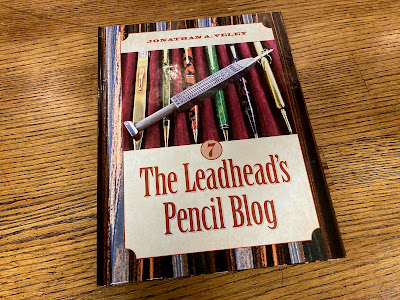

If you don't want the book but you enjoy the article, please consider supporting the Blog project here.

Don Jacoby was a man after my own heart.  He was every bit as enthusiastic about the campy, the odd, and the just plain goofy as he was about things we “serious” collectors should be.  A few random things I found in his collection are worth a chuckle, but none of them merit an article all their own . . . so today I thought I’d put these odd ducks (or, borrowing from the “Penguins in the barnyard” reference, penguins) on parade today.

First up is a “trick” pencil – one that does something else in addition to writing:


The imprint on the side reads “Pen-N-Pencil Co. / New York, USA / Pat. Apl’d. For:”


It looks like a combination pen and pencil, but under the cap is something else entirely:


It’s a postal scale – hang a letter on it, and it will tell you how much your item weighs:


According to Wikipedia, the postage rates shown were in effect beginning July 6, 1932 and continued until raised by a penny on August 1, 1958; this looks to be on the earlier end, I should think.  The box adds only the location where it might have been sold - but I think given that the paperwork was still in the box, this might be how it was originally sold:


Ah, that paperwork . . . instructions for “The New Marvel Two-in-One Combination Postal Scale and Mechanical Pencil”: 


Early on here at the blog (Volume 1, page 91), I provided pictures of very similar paperwork from the Pen-N-Pencil Company, for “The New Marvel Two-in-One Save Your Eyes Combination Magnifier and Mechanical Pencil,” with a lucite magnifier on the end:


Both instruction sheets identify these as “‘Twinpoint’ Quality Products,’” and both indicate the same address, at 1 West 47th Street, New York.  Both also elicit a chuckle from me whenever I see them.

Far more serious, however, is this next one:


Serious, in that there are loads of pencils like these, with little floating (or actually and somewhat ironically, sunken) ships in the top end . . . and a person with an OCD collector gene would likely try to find examples with all the different ships.   This is a pool into which I have resisted dipping so much as a single toe, for fear that I might fall in.

The pencil is unmarked as to manufacturer, packed in a plain, unmarked box along with rudimentary instructions.  “R.M.S. ‘Queen Elizabeth’” emblazoned on the side and a tiny model of the ship in the top end:


The representation looks pretty good, with twin smokestacks and a pronounced bridge.  The Queen Elizabeth was launched on September 27, 1938 but the pencil was probably offered as a ship-board souvenir at some later time – given the outbreak of World War II, she served as a troop carrier during the conflict and didn’t enter her intended service as an Ocean Liner until October, 1946.  She was replaced by the QE2 in 1969.

As people prayed they didn’t end up underwater a ship in a pencil, this last pair also bears mention:


These little key ring pencil are readily identifiable as examples of “Lipic’s Streamlined Pencils,” from this store display featured here in Volume 1, page 230:


Each is marked with a reminder: “Jesus Never Fails”:


At least with a pencil chained to him, I’m sure he’d never fail to find it!

Friday, September 8, 2017

Thoughts Regarding a Few Connections

This article has been edited and included in The Leadhead's Pencil Blog Volume 5; copies are available print on demand through Amazon here, and I offer an ebook version in pdf format at the Legendary Lead Company here.

If you don't want the book but you enjoy this article, please consider supporting the Blog project here.

I’ve had this one laying around for a long time, trying to make some sense out of it:


The celluloid has some great depth, and the clip is marked “Deluxe” in a nice, Old-English style script:


It is clearly from the same product lines as the Gold Bond.  Here it is alongside two examples, one in almost the same (but not quite as “deluxe”) color, and another sporting that same clip.  Note that the Deluxe has an extra trim band at the top, and all three have that black top piece with some nice detailing traditionally attributed to C.E. Barrett and National Pen Products:


However, the evidence I pieced together suggests that if these weren’t made by Rex, who clearly made earlier models of the Gold Bond, they might have been made by Sheaffer, which appears to have very quietly turned out Gold Bonds before later models were introduced which were clearly rebadged Eversharps and Watermans:


(For the whole scoop on that story, start with http://leadheadpencils.blogspot.com/2016/08/maybe-big-three-out-of-four.html . . . from there, you can hop back to the first part of that series).

Now let’s turn the conversation up a notch:


Note that same black end with detailing at the top end?  These are essentially thinner versions of the Gold Bond, with different clips.  Two of these pencils – the longer ones – are ones you are probably familiar with.   They are imprinted “The Monogram Pen / Unbreakable / Sold Only at the Rexall Store.”  But that shorter one – like the Deluxe, with an extra trim ring at the top, says something entirely different:


The Joseph Lipic Pen Company of St. Louis.

I don’t know what all of this means.  Lipic clearly made some pens and pencils, but the company may also have acquired product for a short time from Sheaffer, Rex or whomever was turning out Monogram Pens.  As for Rexall, the United Drug Co. acquired product from DeWitt-LaFrance (remember the Signet?) as well as from Moore and Eagle, so it’s entirely possible to throw Rex or Sheaffer into the mix.

Chalk this article up as throwing out one piece to a giant puzzle and hoping someday I figure out at least which puzzle it’s supposed to fit in.

Tuesday, August 1, 2017

Not Your Garden Variety Scripto

This article has been edited and included in The Leadhead's Pencil Blog Volume 5; copies are available print on demand through Amazon here, and I offer an ebook version in pdf format at the Legendary Lead Company here.

If you don't want the book but you enjoy this article, please consider supporting the Blog project here.

A couple years ago, I bought this one from Michael Little . . . and promptly misplaced it, lost in a sea of ordinary metal Scripto pencils:


Ever since, I’ve been afraid to part with any metal Scripto, because I knew it probably had to be in there . . . somewhere.  I was relieved when I reorganized things around the museum a few weeks ago to see it turn up.

It’s got the same Scripto metal hexagonal barrel, and the same faceted accommodation clip you’ll see on a Scripto, but the clip doesn’t say Scripto:


“G-M Inc.”  And the top section, where you’ll normally find the familiar Scripto imprint?


“Rite-Ezee / Gettier-Montanye, Inc. / Baltimore MD”

Gettier-Montanye is a specialty advertising company, like Brown & Bigelow and Alexander.  The company is still in business, although it doesn’t offer writing instruments anymore, claiming a founding date of 1922 on its website.

What is somewhat interesting for an ordinary specialty advertising firm is the adoption of a model name for a writing instrument: Rite-Ezee – but we know that’s exactly what they did, thanks to a great new book on the subject, American Writing Instrument Trademarks 1870-1953 (shameless plug ... the book is available at http://www.legendaryleadcompany.com/store/c2/Books_by_Jonathan_Veley.html):


United States Trademark number 343,631 was applied for on October 17, 1936 and registered on February 23, 1937.


Carlyle N. Montanye, the company’s president, claimed that the name was first used on or about June 1, 1935.  We know Montanye’s first name was Carlyle because he spelled his name out when he refiled the Rite-Ezee trademark after the Lanham Act of 1946, as number 515,370.

In the case of this Scripto-made pencil, it was easy to associate Rite-Ezee with Gettier-Montanye . . . but that isn’t always the case.  After I started this article, I scoped around online and found this one:


Unlike the Scripto-made example, this doesn’t have the Gettier-Montanye name on it – just “Rite-Ezee” on the clip:


I’ve always associated pencils like these, with shorter lower barrels and longer upper barrels, with the Joseph Lipic Company of St. Louis.

Saturday, October 1, 2016

Clearing Out a Few More No-Names

This article has been edited and included in The Leadhead's Pencil Blog Volume 4; copies are available print on demand through Amazon here, and I offer an ebook version in pdf format at the Legendary Lead Company here.

If you don't want the book but you enjoy this article, please consider supporting the Blog project here.

Most of the time, the “no-name” pencils that find their way into my collection these days arrive in a batch with a bunch of other stuff, like someone you don’t particularly care fore that hangs around with a friend.  Yeah, sure, as long as you’re already here, you might as well stay . . . I’ve got a little drawer of Walthams that have built up over the years that way. 

Today's I picked up on purpose, from Mike Little:


The action isn’t very unusual - just your run-of-the-mill nose drive pencil, but I liked that anodized lower trim band and the faceted top, neither of which I’ve seen before.  The name on the clip is unfamiliar to me as well:


“Pocket Pal.”  That triangular logo might prove to be the clincher some day, but as of now I don’t know what that is.  There is another clue on the barrel:


It’s a salesman’s sample, for the “Sales Builder Sample L-315.”   I think the L designation suggests Lipic, out of St. Louis, but it could just as easily be some random model designation.

Sunday, November 30, 2014

Alexanders . . . Not the Great, But Still Pretty Good.

The last time we encountered the Alexander was with this stocked store display that I got from Joe Nemecek a couple years ago (http://leadheadpencils.blogspot.com/2012/08/sylish.html):


This display indicates that the "Alexander the Great" pencils were from the Alexander Products Corporation of Bloomington, Illinois, and the design of these was so unique that I don’t have any reason to doubt that Alexander Products made these. However, the "Model 100" pencils shown in that previous article were the only Alexanders I’m aware of which were intended solely as writing instruments rather than as advertising novelties.

There’s three possibilities for what happened . . .

To learn more, this full article is included in The Leadhead's Pencil Blog Volume 3, available at Amazon, Barnes & Noble and everywhere else you buy books, or you can order a copy signed by yours truly through the Legendary Lead Company HERE.


Friday, June 8, 2012

Now You Can Call Them By Name

If you have a box of unmarked or castoff pencils laying around somewhere, I'd bet you have at least one of these in there. 

These are found in a wide variety of colors and several varieties, all of which have a couple things in common:  that middle joint that is lower on the barrel, the streamlined top and the clip.   When I first started collecting pencils, I'd put together a pretty nice mini-collection of about a dozen colors of these, but as I became more focused on studying the different manufacturers I let most of mine go, since none of these are marked and I had no leads to go on.

Then in an online auction I found something that explained a lot more about these pencils.  When the item arrived, the box it came in was pretty unremarkable . . .

NOTE:  This article is now included in the print version of The Leadhead's Pencil Blog, available anywhere you buy books, or also from The Legendary Lead Company.

To order, here's the link:  Volume 1 at Legendary Lead Company