Showing posts with label Weidlich. Show all posts

Monday, August 18, 2025

As the Primordial Ooze Turns

 An online auction yielded this mostly ordinary-looking pencil:


These were sourced from some unknown jobber, who produced them for several pen companies, marked only with a name on the bell cap – similar pencils are marked for Weidlich, Ajax, and the Radium Point Pen Company. These are marked for the Weidlich Pen Company of Cincinnati, Ohio:


This one is a little unusual, with its elongated metal nose and secondary tip. More unusual is what is printed on the cap:


“Corona / Antioch Ill.” it reads. After I took these shots and went to file it away, I noticed that I had forgotten about a second example I had found like this one, but missing the end of the two-stage tip:


These were not the first Corona-marked pencils I had turned up. As a Rex Manufacturing Company fanatic, I was well aware that the Corona Pen Company offered pencils. I have a few Rex-made examples:


Including one in a distinctive tortoiseshell plastic I haven’t seen on any other Rex product:


All of the Rex-made examples I have found bear all four of the Rex Manufacturing Company patents, dating them to no earlier than 1926:


Since the later incarnations of Rex-made pencils have similar two-stage tips, I wondered if the new addition might also be made by Rex – looping other brands such as Weidlich, Ajax and Radium Point into the Rex Manufacturing Company’s orbit would solve the longstanding mystery as to who actually made all of them. I took apart the jade Corona and compared it to a Rex pencil . . .


Close, but not close enough to say absofrickinglutely. The threading at the nose is different, and the clip and clip assembly on Rex pencils is entirely absent from the Corona, on which the cap is simply pressed onto the end of the mechanism. 

I have theorized that Parker’s patent infringement case against Rex over Parker’s washer clip patent abruptly ended production of the “four horsemen” patent pencils by Rex, and at the least forced Rex to redesign its pencils to avoid infringement of Parker’s patents. See “My Working Theory” (December 24, 2016: Volume 4, page 298).

These odd Corona pencils suggest that Rex might have hastily redesigned its pencils after Parker’s infringement action, then went on to supply other companies such as Weidlich. However, I don’t think it is conclusive . . . just a tidbit to tuck away and revisit when stronger evidence either way surfaces.  

The pencils themselves begged several questions, but their imprints begged several more. I have crawled out of the same pool of primordial knowledge ooze from which all of us enthusiasts have emerged: our collector’s lore, which teaches us that Corona had some shadowy, unspecified connection with the Parker Pen Company.

That ooze didn’t smell right. I suppose if it did, I would have called it “special sauce” or “nectar of the Gods” rather than “ooze.”

If Corona was somehow connected with Parker, and if Parker was at odds with Rex, why would Corona have ever sourced its pencils from Rex in the first place? Why wouldn’t Corona use rebadged Parker Duofolds, especially after Parker’s infringement action resulted in Rex redesigning its pencils? Where the heck is Antioch, Illinois, and why wouldn’t Corona be located in Janesville, Wisconsin if it was affiliated with Parker? 

Most great adventures begin with “why.” I was off to the races, to learn about the Corona Pen Company . . .

Note: the story continues here.

Wednesday, May 5, 2021

Nobody's Luck Is That Bad

This article has been included in The Leadhead's Pencil Blog Volume 7, now available here.


If you don't want the book but you enjoy the article, please consider supporting the Blog project here.

When I started writing yesterday’s article, my intent was to present the complete history of The Pick Pen Company, in the hopes of finding clues as to what the “S.W.P. Co.” means on pencils which are identical to Pick Pencils:


The Charles R. Brandt connection hijacked the story, so today’s installment will lay out the rest of the company’s tragic story, starting with the historically accurate version of the company’s founding: in 1920, salesman Edwin G. Pick and bookkeeper Arthur W. Schoneberger founded the Pick Manufacturing Company at 214 East Ninth Street, Cincinnati, Ohio.  Stenographer Ruth C. Weidling was brought over from the Weidlich-Simpson Company to become Pick’s bookkeeper.

The company initially had two foremen: Charles R. Brandt (not the same one who owned the Boston Fountain Pen Company, but likely an nephew or other relative), an independent pen maker in Cincinnati since 1917, was brought in to help the company set up its plant, and the company’s regular foreman going forward was Albert J. Aufdermarsch.

The Pick Manufacturing Company operated at the Ninth Street location, sharing the building with the Victor Brass Company, until November 20, 1922, when fire destroyed the five-story brick building.  According to the report published in The Dayton Daily News on November 20, damage was estimated at $50,000, the equivalent of more than $750,000 today:


Accounts don’t specify how the fire started, but note that the occupant is identified as “the Pick Fountain Pen Co.,” not the Pick Manufacturing Company.  That might indicate the company was in the process of reorganizing at the time of the fire: in the 1923 directory, Pick Manufacturing is replaced with The Pick Pen Company.  Edwin G. Pick was President and Treasurer, Arthur W. Schoneberger was Vice President, and Ruth Weidling was the company Secretary.  The firm’s new location was 911 Main Street, Cincinnati:


After moving to the Main Street location, the company began offering mechanical pencils to accompany its pens:


These two were supplied by the Rex Manufacturing Company.  The metal ringtop bears McNary’s patent date of February 19, 1924:


The black hard rubber example is also a 1924 McNary patent pencil, but it isn’t marked with the patent date:


By the mid-1920s, Pick had adopted the trade name “Exceptional” to market the company’s writing instruments:


If a trademark application for the “Exceptional” mark was ever filed, registration was never granted.  These pencils were also supplied by the Rex Manufacturing Company; they bear the August 4, 1925 and were manufactured pretty close to that date (later production Rex pencils added 1926 patents to the imprints).


The price is no longer legible on the sticker for the Model 3RG, and I’m not sure what was so complicated about filling them:


Edwin G. Pick is still listed as President/Treasurer in the 1925 Cincinnati directory, but prior to the publication of the 1926-1927 directory, he had left the company that would continue to bear his name.  In 1926, he is listed as being in the “building specialties” trade at the nearby arcade at 9th and Court Streets:


Ed Pick was replaced as president and treasurer by J. Albert Goldman, who was President and Treasurer of the Cincinnati Electrical Tool Company in 1925.  The fact that Goldman was now in charge of both the company and its money (and the fact that the Cincinnati Electrical Tool Company disappears from the Cincinnati directory for 1926-7 suggests that Goldman bought out Ed Pick, and Ed had moved on:


The transfer occurred at a time when security was lax at the Pick Pen Company.   On February 9, 1926, the Cincinnati Enquirer reported that on February 6, an 18-year-old named Robert McNulty appeared at the company’s office looking for a job.  When he was turned down, he was somehow able to steal the company’s mail, and he was caught trying to cash a check made payable to the company:


Pick Pen’s misfortunes would only get worse.  On January 10, 1928, The Cincinnati Enquirer reported that 1,000 pounds of stored celluloid caught fire, and heavy smoke forced the evacuation of the building as fire crews feared an explosion.  The initial report was published before the outcome of the fire was determined:


On January 13, the Enquirer reported that the Main Street plant had been “destroyed by fire,” and the Pick Fountain Pen Company had signed a five-year lease to occupy the third floor at 2100 Reading Road, Cincinnati:


The first floor was occupied by a jeweler, but Pick Pen apparently subleased a show window on street level to demonstrate its products.  On May 4, 1928, Pick advertised in the Enquirer for a “FIRST CLASS show window demonstrator; handwriting must be good.”


Pick offered during the mid- to late 1920s were flattop pens such as this, advertised in the Hamilton, Ohio Journal News on September 3, 1929:


All of the late 1920s flattop pencils I have found are imprinted with the “Exceptional” name.  These were not Rex Manufacturing products, and they bear more than a passing resemblance to Sheaffer pencils.  Later events suggest that Sheaffer might have noticed:   


The price sticker on the top example, identifying it as Model 10V (V almost certainly for “vest pocket”) did not break my heart when I found it:


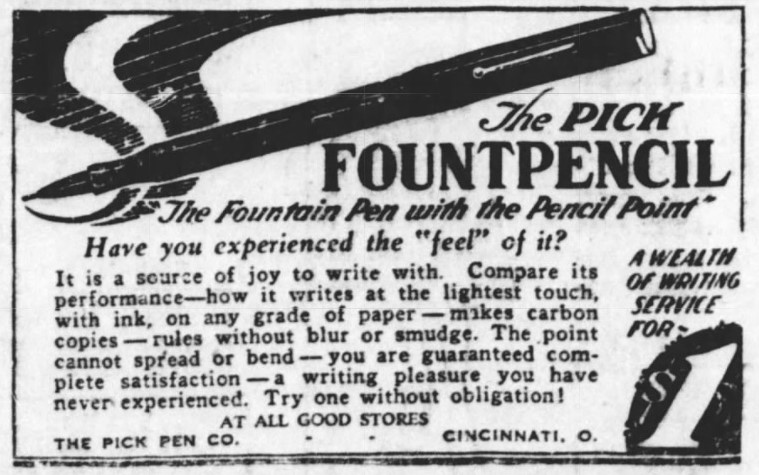
The company also offered a flattop stylographic pen called the “Fountpencil.”  Here is one shown advertised in The Salem (Ohio) News on September 16, 1931:


The year 1931 was grim for Pick Pen.  On February 17, 1931, the Enquirer reported Pick’s third fire, started by an explosion of celluloid stored at the factory.  This time, the company had a sprinkler system installed, so the resulting fire was not as catastrophic as the two previous ones.  Nevertheless, the resulting smoke and fumes overcame 24 of the company’s employees:


Whatever was left after the fire was destroyed by water just a few days later.  On Sunday, February 22, the Enquirer reported that the sprinkler system at Pick gave way, flooding the entire building:


Pick appeared to be making more money from insurance claims than it did manufacturing pens.  Yet things were going to become even more suspicious.

In October, 1931, the W.A. Sheaffer Pen Company filed a patent infringement case against the Pick Pen Company, alleging that Pick had violated three of Sheaffer’s design patents, number 78,777 (for the pencil), 78,794 (for the combination pen and pencil), and 78,795 (for the pen). Here is the last of these three:


The lawsuit puzzled me when I first ran across it, since I wasn’t aware of any Pick pens, pencils or combos which even remotely resembled the Sheaffer Balance.  Then, as this article was percolating in my mind, my friend John Lincoln posted pictures of this pen – I told him I had to have it for this article, and he agreed:


Yep.  That will do it, and I’m sure Sheaffer already had a hair trigger for a patent infringement case, given how much the “Exceptional” pencils shown earlier resembled Sheaffer’s earlier flat top pencils:


The Cincinnati Enquirer reported on November 3, 1931 that Pick Pen had filed an answer denying infringement, but on December 3, 1931 the Associated Press reported that Sheaffer had obtained an injunction against the company.  While I didn’t find the AP report in Pick’s hometown newspaper, it was trumpeted in Sheaffer’s backyard, in the December 3, 1931 edition of the Des Moines Register:


Resolution of the infringement litigation was lightning fast.  The United States Patent Office Official Gazette reported that Sheaffer’s patents were valid and had been infringed by the Pick Pen Company in a decision rendered on February 18, 1932.


That was it for Pick’s President, J. Albert Goldman, and possibly for the Pick Pen Company.  The 1933 Cincinnati directory lists “The Pick Pen Corporation,” with Arthur W. Schoneberger as president.  Ruth Weidling is reported as secretary and treasurer, and a new person, H.F. Fenenbock, is listed as vice president:


There are no Fenenbocks listed in the previous edition of the City Directory, and Fenenbock appears nowhere other than in the listings for Pick Pen Company as vice president, with a residence in Chicago.  He might also have been one and the same as Henry W. (“Swanee”) Fenenbock, the “natural huckster” and the subject of an article by Len Provisor and Henry Fenenbock (I think a descendant) for The Pennant in 2007, titled “Henry ‘Swanee’ Fenenbock - The Ultimate Pen Man” (the article can also be found online, at http://newpentrace.net/articleLPFenenbock.html).  In the early 1930s, Fenenbock was in the Detroit area.

Recalling Nemo’s account of the company’s history from yesterday’s article, Schoneberger’s son had stated that Pick made pens for 13 years beginning in 1920.  Pick was still around in 1933, although Sheaffer’s patent infringement victory in 1932 would have added a formidable creditor to the company’s balance sheets.  With two (and perhaps three) suspicious fires at the company’s factories, what happened next is perhaps not surprising:


On October 21, 1933, several newspapers, including this account from the Fremont (Ohio) News-Messenger, reported that safecrackers had broken into Pick’s headquarters and blown open two safes, stealing $2,500.00 worth of gold pens.  

Think about that: in a company which had suffered three disastrous fires and explosions in its short history, safecrackers used nitroglycerine to open the company’s safes and steal its contents.

Contrary to Nemo’s account, 1933 was not the end of the Pick story.  On November 15, 1934, The Shamokin (Pennsylvania) News-Dispatch published an advertisement for Pick’s new “Perpetual” fountain pen:


Note that distinctive rounded top with a wafer-shaped flat disc at the end.  That was doubtless a modification made to alter the shape to avoid Sheaffer’s claims on all things round.  Also note that the 1934 advertisement offers Pick’s “new” pens as promotional giveaways for trade-in pens, so these might have been made (or modified) by Pick before 1934, but probably after the injunction against Pick issued in December, 1931.

Pick’s “Perpetual” line of writing instruments would include the pencils that started this research project, marked either Pick or “S.W.P. Co.”


Perhaps Sheaffer might be the “S” in “S.W.P.”?  The imprint which started this journey, unfortunately, remains a mystery.  I found no connections with Weidlich, nor with anyone else.  In fact, I’m not even sure that the “P” stands for Pick.

Pick’s last years are undocumented, except for listings in the Cincinnati directories.  In 1936, Fenenbock is gone, leaving Schoneberger and Weidling as the only surviving officers:


Incidentally, this squares with the Fenenbock article cited earlier, which states that Fenenbock “landed broke in Los Angeles in 1936.”

The Pick Pen Company vanished by the time the 1938 Cincinnati directory was published.  Edwin G. Pick, the man for whom the company was named, left Cincinnati in 1936 for Fort Lauderdale, Florida, where he died on January 12, 1955.  Pick’s obituary in The Fort Lauderdale News on January 13 describes him as a building specialist, and makes no mention of his involvement with what had to be the unluckiest pen manufacturer of all time:


Monday, May 3, 2021

My Cincinnati Connection

This article has been included in The Leadhead's Pencil Blog Volume 7, now available here.


If you don't want the book but you enjoy the article, please consider supporting the Blog project here.

Last fall, I arranged to meet Margaret Jacoby at a quaint restaurant in Yellow Springs, Ohio to pick up the rest of Don Jacoby’s pencil collection (of “Penguins in the Barnyard” fame from Volume 6 - see pages 205 and 245).  Since the plan was for me to bring them back to Newark and go through them so I could make a fair offer, I had anticipated that Janet and I would meet her for a nice brunch, then transfer Don’s collection from the trunk of her car to mine.  

I anticipated wrong - in walked Margaret and her two adult daughters, laden with shopping bags full of Don’s pencils.  Margaret intended to give me the guided tour of Don’s collection over lunch; in retrospect, I think she and her daughters wanted to see how tickled I would be as she pulled tray after tray of pencils for me to view.

Tickled, I was.  Dumbfounded, I suspect the wait staff and all the other patrons around us were.  Amused and patient as always, Janet was.

Don had quite a few nice things I’ll be writing about in upcoming articles, but most of it (Margaret and I had already discussed this possibility and it proved true) was inventory – fun things I’ve already got that will eventually be rehomed with fellow enthusiasts.  Then there were the things that reminded me of what I’ve meant to write about, and just never gotten around to, like this ringtop:


I think I blurted out “ooh, I’ll bet that’s a Weidlich” when it emerged from a display tray, which turned out to be right.  My guess wasn’t too much of a stretch of the imagination, since Don and Margaret hail from the Cincinnati area.  Still, if anyone within earshot had any doubts whether I was a nerd . . . well, question answered, suffice to say:


I knew what it was because I’ve got the matching full-length version of that same pencil, and it reminded me of an article I’ve been meaning to write:


Before I dive headlong down that rabbit hole that is the article I've been meaning to write, I’m due to write something about the Weidlich Pen Company, especially since it hails from my native Ohio.  Here’s another pencil I’ve attributed to the company:


Pens with this clip often bear Weidlich imprints (and to my knowledge, no other manufacturer’s imprint), but the pencils are never marked.  I’ve let a few arrivals slip from my grasp over the years, but now that I’ve settled on the notion that this clip appears to have been used only by Weidlich, I’ve become more stingy with them.  I highlighted the imprint hoping for a smidge of illumination, but this one is just a simple advertisement for the Whitaker Paper Company, which doesn’t appear to have had any connection with the writing instruments trade.


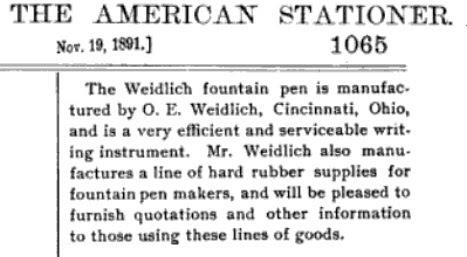
Otto Emil Weidlich (one source reports he was born in Germany in 1851) went into business in the late Nineteenth Century.  “linearM” on the Fountain Pen Network suggested that he founded a pen firm in Cincinnati in 1889; the earliest reference I could find to his pen company was a brief announcement in The American Stationer on November 19, 1891. 


Weidlich ran a humble advertisement in The American Isrealite, a Cincinnati newspaper, on June 9, 1892.  His factory was at the corner of 5th and Sycamore in downtown Cincinnati:


Weidlich’s enterprise gained steam, and by the end of the century his advertising illustrated finely crafted pens.  This advertisement appeared in the New England Stationer and Printer in March, 1899:


On June 19, 1910, the Cincinnati Enquirer announced that Ed M. Simpson, formerly of Simpson & Keller (a druggists’ sundries firm), had acquired a ½ interest in O.E. Weidlich’s pen company for $50,000.00 – a staggering amount of money at the time.


On August 21, 1910, “Weidlich & Simpson” advertised its “Simplofiller” fountain pens at the same 5th and Sycamore address:


That same day, The Cincinnati Enquirer profiled the new firm.  The article states that “for 60 years Cincinnati-made gold pens have had a national reputation,” but clearly that was a reference to John Holland, who had been in business far longer.   The Simpson & Weidlich Pen Company was formally incorporated in 1911, as announced in the April 1, 1911 edition of The Bookseller, Newsdealer and Stationer:


From what I can tell, Weidlich made a huge mistake getting into business with a guy like Simpson, although at the age of 60 or so he might have been thinking about retiring.  Simpson was a wheeler and dealer with a checkered past in stock trading: in 1909, he was sued by a former investor who claimed he promised to buy back the stock that he sold to her, with interest – a promise that was broken when the company folded:


A similar scheme involving Weidlich and Simpson’s stock was revealed in February, 1912: Ms. Sadie Christy claimed that she had invested in the company, and Simpson, aided by accomplice Frank W. Roberts, caused the shares purchased with her money to be registered in Simpson’s name.


Poor Otto’s life was falling apart.  On January 30, 1913, Geyer’s Stationer announced the formation of the O.M. Weidlich Pen Company.  Neither Weidlich nor Simpson are listed among the principals, although Otto is named as “manager”:


It is unclear from this announcement whether Weidlich and Simpson had parted ways, or whether Simpson’s shenanigans forced them to set up a lifeboat company with no apparent connection in order to continue to do business.  Both companies were operating in 1913; Weidlich and Simpson advertised in October at the 5th and Sycamore location.


Weidlich’s personal life was also in turmoil during 1913, when his wife, Marla, was caught sending a series of steamy love letters to Theodore Marienthal.  She claimed it was just a joke, and Otto stood by his woman and said he believed her.  The letters, however, were made public in their entirety after Freda Marienthal sued Mrs. Weidlich for $25,000.00 for “alienation of affection” - that’s legalese for trying to steal her husband.

The salacious details made national news, and if these letters truly were a joke, it was one of the most elaborate jokes of all time.  Half a dozen of the “large batch” of letters she discovered, “containing thousands of words,” were offered in evidence, including one which read, “And then you asked me to kiss you again and I kissed and kissed and kissed again, my darling.  The kisses you love so well - not the Nethersole, but the ‘Glory kiss.’” The Cincinnati Enquirer published pictures of the two women - Mrs. Weidlich and the cuckolded wife – on April 30, 1913, along with additional lurid details:


The “Glory Kiss” case, as it became known, took unexpected turns through 1913.  Mrs. Weidlich and “Teddy” later admitted to having feelings for each other, but when Mr. Marienthal’s deposition was taken in New York, he denied that he was ever married to Freda Marienthal.  Freda’s attorney, George C. Peacock, went back to his client to demand proof that she had married him, and his client disappeared.  After Peacock’s efforts to find his client failed, he withdrew from the case, as reported in the Enquirer on October 26, 1913:


Mrs. Weidlich, her reputation in tatters, nevertheless wanted her day in court to vindicate herself.  The judge, however, had heard enough.  On November 13, 1913, the case was dismissed due to Freda Marienthal’s failure to appear and prosecute the case, the Enquirer reported on November 14.   

Horrifying as the “Glory Kiss” debacle must have been for Otto Weidlich, things would get much worse for him as his pen business collapsed in spectacular fashion.  The Iron Trade Review reported on December 25, 1913 that the machinery of the O.E. Weidlich Pen Company was sold at a receiver’s sale:


On April 1, 1914, The Bookseller, Newsdealer and Stationer reported that “the complete Fountain Pen Plant formerly operated by O.E. Weidlich” had been purchased by the Betzler and Wilson Fountain Pen Company of Akron, Ohio, which combined it with B&W’s other operations.


Although this announcement squares with collectors’ lore concerning the fate of the company, it doesn’t explain an announcement which appeared three months later, in the Cincinnati Enquirer on June 15, 1914:


The Court of Insolvency had enough of Ed Simpson’s games: at 5th and Sycamore, a court-appointed receiver auctioned everything these two had, whether held in the name of O.E. Weidlich, O.E. Weidlich & Co., Weidlich & Simpson or the Weidlich & Simpson Pen Company.

It is unclear what was there to be auctioned in June, if Betzler & Wilson had already moved the company to Akron.  Perhaps the sale in April had been delayed by creditors, and Betzler & Wilson was again the successful bidder in June, 1914.  

What is even more curious is that 1914 apparently wasn’t the end of the name . . . or at least, something similar to it.  A “Weidlich-Simpson Pen Co.” emerged in 1916, advertising in the October 17, 1916 edition of The Cincinnati Enquirer that it was offering “Star Self Filling Fountain Pens” and “Simplofiller” pens at a factory located at the northwest corner of Canal and Jackson Streets in Cincinnati.


The new Weidlich-Simpson Pen Company was owned by David B. Kaufmann, who identified himself as its sole proprietor when he applied to register a trademark for the “Star” name in December, 1916.  He claimed he first used the mark on October 30, 1914, right after the receiver’s auction, and the certificate is found in American Writing Instrument Trademarks 1870-1953:


Kaufmann does not appear to have had any connection with the prior owners of the company, nor did he have any prior history of running a pen company, but he appears to have been successful at it, continuing the business for several years.  

Connecting David B. Kaufmann with Weidlich-Simpson answers another question.  In American Writing Instrument Patents Vol. 2: 1911-1945, I reported patent number 1,428,333, applied for by Kaufmann on October 24, 1921 and issued on September 5, 1922:


Note the ring which fits into an internal groove in the barrel to secure the lever – a development which became ubiquitous on fountain pens in the decades to come.  Kaufmann’s patent wasn’t assigned to anyone, so all we knew without the trademark registration was that he was from Cincinnati; now, we now know that innovation originated right here in Ohio, for pens Kaufmann was making under the Weidlich name.

In September, 1923, a Kentucky pharmacist advertised Weidlich-Simpson pens at half price in the September 10, 1923 Advocate-Messenger (Danville, Kentucky):


The Cincinnati Enquirer
ran a Weidlich-Simpson classified ad for help filling orders, “steady work” on December 2, 1923:


A new “Weidlich Pen Co.” advertised for traveling salesmen to the southern states on March 9, 1924 in The Enquirer:


The 1924 Williams’ Cincinnati City Directory also reflects the name change; Kaufmann was still its proprietor:


A “Weidlich Pen Mfg. Co.” also advertised for salesmen, in the Pittsburgh Daily Post on March 29, 1925:


This last incarnation of the company survived for another thirty years.  The Cincinnati Enquirer reported that the company leased space on the third floor at 119 West Central Parkway, Cincinnati on September 15, 1935:


In 1943, the company was hiring for a “fountain pen assembler and rubber turner.”  I’m wondering if the company actually made pen parts, or just acquired them from jobbers and put them together:


The company renewed its lease for the space at 505 Elm Street in 1944:


The Weidlich Pen Manufacturing Company is listed in the 1953 edition of The Directory of Ohio Manufacturers, still at 505 Elm, but the company disappears by the 1955 edition.

The pencils at the beginning of this article, as well as all the other Weidlich-marked pencils in my collection date from the last incarnation of Weidlich - the Weidlich Pen Manufacturing Company.  

If it seems like I have told an overly long, complex story about the company just to make that point, that’s a fair observation – I’m prone to telling overly long, complex stories.  However, in this case I had an ulterior motive:  I needed the intricacies of the Weidlich story firmly in my head, so that tomorrow’s story makes sense.