These days it is fashionable to put labels on people ending with the suffix “ist,” and most of the time it’s not a positive thing. However, sometimes labels ending in “ist” are merely descriptive: in my early years I was a cellist, which wasn’t a bad thing. These days I suppose you might call me a “writist” should you be so inclined. Or a “historyist.”
One “ist” that I own unapologetically is that of being a “Rexist.” I am a huge fan of the Rex Manufacturing Company, and if I had to choose whether to spend my last hard earned dollar on a Rex pencil or something else, that something else wouldn’t stand a chance.
Rex has come up twice here in the last couple weeks, but I didn’t want to open the floodgates all the way at the moment – I have a boatload of updates to report to you. We’ll start with the oldest of my new finds:

It was very satisfying to find this one, since I already had the ringtop:

Both of these are marked “Compliments of the Season / Rex Mfg. Co. Prov. R.I.” That season was likely around 1922 or 1923, before McNary’s 1924 patent was a twinkle in the inventor’s eye.

This next one also sits on the early end of the Rex spectrum:

If you compare this to the 1924 McNary patent Franklin pencils from yesterday’s article, this one shares the same basic lines, except of course for that exquisite engraving on the nose and top piece:

The stamp near the top reads “Victor”:

This Victor is unusual, but I have seen this sort of nice metal work before; normally, though, it appears on pencils marked for the Artcraft Pen Company. Here’s my Rex-made Victor and Artcraft pencils together:

And, speaking of Artcraft . . .

I shot these two together in preparation for a “Rexes Gone Wild” sort of piece, but the Corona at bottom was later included in the series of articles posted here recently concerning the history of the Corona Pen Company (see “As the Primordial Ooze Turns” on August 18, 2025).
Today’s focus is that top pencil, which turned up in a junk box at the Chicago Show a few years ago. While it is unmarked as to the manufacturer, there’s no doubt in my mind that the Artcraft Pen Company was behind it. I’ve just shown you the proof that Artcraft sourced those black hard rubber pencils from Rex, and Artcraft used this same blue and bronze celluloid on some of its fountain pens – in fact, Artcraft is I believe the only company that did.

This Rex-made ringtop is from the “four horsemen” era, but the two patents relating to the clip have been omitted from the stamp:

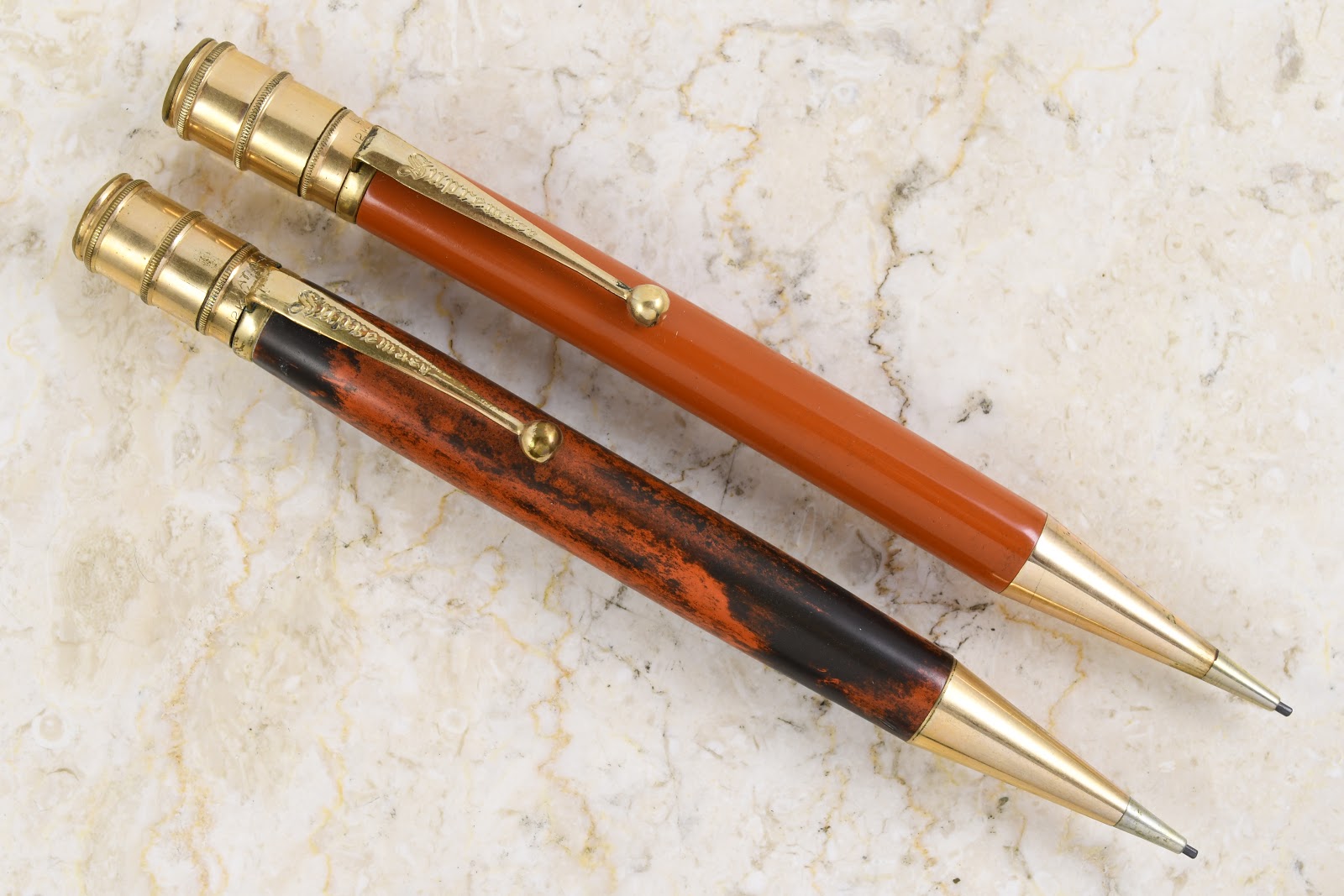
This next pair came in one lot in an online auction, and they are both the earlier 1924 McNary patent Rex pencils:

The cap on the red one is marked “Supremacy,” a brand name used by the Supremacy Ink Company - for the background on the Supremacy name, see “We’ve Had It All Wrong” (April 13, 2018: Volume 5, page 230).

I love these older, paneled Rex barrels. I’ve found the orange (or red) paneled ringtops made for others as well: here are the Supremacy at top, followed by a Webster and one marked “Y & H”:

That woodgrain paneled one, missing its cap, is later. The 1924 patent pencils had a single piece cap, but “four horsemen” era pencils had a two-part cap. Finding one to replace what is missing will be a tall order indeed; here it is shown with that great teal Supremacy from “Widest Range in the Narrowest Market” (May 22, 2020: Volume 6, page 124).

Those slim, paneled barrels are also found in full-length Rex pencils, although they are much more rare. This next one added to the Rex patent family, marked “Whitney” on the clip:


This one has all four of the Rex patents on the clip, which I find unusual: by the time Rex really hit its stride and was marking pencils with all four patents, I thought that the slim paneled barrels had been discontinued.

I’ve only found one other pencil of any sort marked Whitney. It is shown at top in this next image, with a typical John Holland Rex-made pencil at bottom.

I also found a second “four horsemen” Rex pencil with a slim, paneled barrel. I clearly remember this one coming from an online auction, since for weeks I sat on pins and needles waiting for it to arrive while the post office repeatedly returned it from Columbus to whatever zip code they mistook the sender’s handwriting to read.

This one is marked for the Edison Pen Company, and it now sits proudly alongside the other examples in my Edison collection (see “A Pesky Brand” - June 7, 2021: Volume 7, page 174).

The other two in that earlier image just happened to be laying about when the Edison arrived, and they add a couple footnotes to the Rex story. The jade example is a Webster, and it is very unusual to find one with a price band.

As for the other, it is unmarked . . . but I’ve never seen that barrel color on a Rex before.

Speaking of the worthy and unmarked, here’s another great unmarked Rex pencil, shown here next to one marked “Ye Wm. Penn”:

In addition to that great woodgrain and paneled hard rubber, this one is like those earlier ringtops, marked only with McNary’s 1924 patent date, a feature shared with the Ye Wm. Penn:


I’ll circle back to Ye Wm. Penn in a second, after I show you another 1924 McNary patent pencil that answered a question I raised more than ten years ago. This one has a round barrel and is marked “Krest” on the clip.


The Krest made its one and only previous appearance here in “Another No-Name Heard From” (October 5, 2014: Volume 3, page 32), one of those articles that was destroyed by a Google mega-oopsie. The article introduced and discussed this nondescript pencil, interesting only for the Krest name on it:

In that earlier article, I was unable to pinpoint what retailer offered writing instruments under the “Krest” name, but the print version of the article contains a prophetic note at the end. “Note: since this article was written, I’ve also noticed that the diamond pattern on the crown appears frequently on Rex-made metal pencils.”
So there. Move the Krest over from a suspected Rex production to the confirmed pile.
Now to return to “Ye Wm. Penn,” which you might recall from my earlier articles is the only brand name conclusively attributed to the Rex Manufacturing Company in connection with writing instruments Rex made on its own account (that is, made for Rex to sell for itself, rather than marked for and supplied to a third party). See “Ye Wm Penn” (May 19, 2020: Volume 6, page 118).

I have a footnote to add in that regard. This one showed up in another online auction:

It is another 1924 McNary patent ringtop, but in a fantastic paneled, robin’s egg blue barrel . . . and it includes a twist:

What else might one call the ladies’ version of a Ye Wm. Penn? Why, “Ye Ladye Penn,” of course! That find really made my day, giving me this nice shot of Ye Ladye amongst her brothers in the Penn clan:

I was well satisfied with what I found, until David Nishimura dropped this on me at the following Ohio Show in 2023:

Oh, my aching wallet . . . David knows I love these Rex pens and pencils, and he also knows that we are but two members in that exclusive club who appreciate how hard something like this is to find.

Nishimura got me again the following August in DC with this. I thought about including it in yesterday’s article, but I thought it made more sense to include it here:

There’s a lot more paneled, striated goodness with this earlier Rex set:

The lever on the fountain pen is marked “REX”:

The pencil, however, is marked with “Franklin,” further substantiating my theory yesterday that Franklin was an early brand name under which Rex offered pens and pencils for sale on its own account.

Last up for today is something that didn’t cost much because, after all, it is something only a true Rexist would appreciate:

A wood tube of pencil leads with a paper label for the Rex Manufacturing Company is icing on the cake in my collection. In my early articles here at the blog, I spent a lot of time and energy trying to conclusively establish that “Rexhold” was a trade name used by the Rex Manufacturing Company, and the final nail in the coffin did not arrive until 2021, and in a very circuitous manner - see “On Rex’s Own Account” (May 1, 2021: Volume 7, page 75). If only I had access to something like this when all that research started . . .

Oh well. I went the long way around the barn to find the answer, but at least I wasn’t wrong.