Showing posts with label Pen-N-Pencil. Show all posts

Saturday, July 3, 2021

Odd Ducks . . . Or Penguins

This article has been included in The Leadhead's Pencil Blog Volume 7, now available here.

If you don't want the book but you enjoy the article, please consider supporting the Blog project here.

Don Jacoby was a man after my own heart.  He was every bit as enthusiastic about the campy, the odd, and the just plain goofy as he was about things we “serious” collectors should be.  A few random things I found in his collection are worth a chuckle, but none of them merit an article all their own . . . so today I thought I’d put these odd ducks (or, borrowing from the “Penguins in the barnyard” reference, penguins) on parade today.

First up is a “trick” pencil – one that does something else in addition to writing:


The imprint on the side reads “Pen-N-Pencil Co. / New York, USA / Pat. Apl’d. For:”


It looks like a combination pen and pencil, but under the cap is something else entirely:


It’s a postal scale – hang a letter on it, and it will tell you how much your item weighs:


According to Wikipedia, the postage rates shown were in effect beginning July 6, 1932 and continued until raised by a penny on August 1, 1958; this looks to be on the earlier end, I should think.  The box adds only the location where it might have been sold - but I think given that the paperwork was still in the box, this might be how it was originally sold:


Ah, that paperwork . . . instructions for “The New Marvel Two-in-One Combination Postal Scale and Mechanical Pencil”: 


Early on here at the blog (Volume 1, page 91), I provided pictures of very similar paperwork from the Pen-N-Pencil Company, for “The New Marvel Two-in-One Save Your Eyes Combination Magnifier and Mechanical Pencil,” with a lucite magnifier on the end:


Both instruction sheets identify these as “‘Twinpoint’ Quality Products,’” and both indicate the same address, at 1 West 47th Street, New York.  Both also elicit a chuckle from me whenever I see them.

Far more serious, however, is this next one:


Serious, in that there are loads of pencils like these, with little floating (or actually and somewhat ironically, sunken) ships in the top end . . . and a person with an OCD collector gene would likely try to find examples with all the different ships.   This is a pool into which I have resisted dipping so much as a single toe, for fear that I might fall in.

The pencil is unmarked as to manufacturer, packed in a plain, unmarked box along with rudimentary instructions.  “R.M.S. ‘Queen Elizabeth’” emblazoned on the side and a tiny model of the ship in the top end:


The representation looks pretty good, with twin smokestacks and a pronounced bridge.  The Queen Elizabeth was launched on September 27, 1938 but the pencil was probably offered as a ship-board souvenir at some later time – given the outbreak of World War II, she served as a troop carrier during the conflict and didn’t enter her intended service as an Ocean Liner until October, 1946.  She was replaced by the QE2 in 1969.

As people prayed they didn’t end up underwater a ship in a pencil, this last pair also bears mention:


These little key ring pencil are readily identifiable as examples of “Lipic’s Streamlined Pencils,” from this store display featured here in Volume 1, page 230:


Each is marked with a reminder: “Jesus Never Fails”:


At least with a pencil chained to him, I’m sure he’d never fail to find it!

Thursday, April 2, 2020

The Footnote That Was In the Mail

This article has been edited and included in The Leadhead's Pencil Blog Volume 6, now on sale at The Legendary Lead Company.  I have just a few hard copies left of the first printing, available here, and an ebook version in pdf format is available for download here.

If you don't want the book but you enjoy this article, please consider supporting the Blog project here.

Call it “Leadhead’s Luck” . . . these little coincidences that seem to pop up as I’m writing things here.  Time and time again, just as I'm getting ready to post about something, something else I haven’t thought about jumps out at me and provides another missing piece of the puzzle I was working on.  It almost looks like I’m doing it on purpose, but I’m not.

At the time the ruler pencils series was publishing here, I was waiting for what I thought was an unrelated pencil from an online auction I had won on a lark.  I wasn’t looking for anything specific at the time, just idly looking at auctions for mechanical pencils sorted by those “ending soonest” –


The auction pictures were terrible and showed the pencil head-on, so I didn’t even know the barrel was square.  There’s no ruler on the side and there’s no telescoping sections if you tug on the nose, but it certainly calls to mind the ruler pencils from those articles.  Here it is, alongside the Cartier from part two of the series:


The reason I decided to throw in a small, last-minute bid on this one was because the seller had identified it as a Georg Jensen – a brand I haven’t thought about for a long, long time.  My one and only other article about Jensen ran here back in 2015 (the full article is still live and is at https://leadheadpencils.blogspot.com/2015/02/later-than-you-think.html).  Pencils marked “Georg Jensen Inc. USA,” my research found, indicates production between 1941-2 and 1950, although the company had offices in New York from the 1920s.  World War II had made importing silver from Europe impossible for the Danish firm, so Jensen added “USA” to the imprints.

And this little pencil is so marked, with what looks like remnants of red enamel in the lettering:


As I was unpacking this one on arrival, I found it wrapped in a little felt baggie that I almost threw out – sellers frequently ship pencils in all sorts of little bags for a bit of added protection, and I normally don’t see a need to keep unmarked packaging since so much more arrives here than departs.  Fortunately, just as I was about to pitch it I happened to glance down – and I noticed an added bonus that wasn’t shown in the pictures or mentioned in the description for the listing:


A nice, original Georg Jensen felt carrying bag with the company’s New York address of 667 Fifth Avenue, New York!

So, you may be asking yourself, neat as all this is, how does this tie in with “Leadhead’s Luck?”  First, I had no idea when I bought this one that it was square (the pictures were really THAT bad) . . . and I was just talking the other day about Edward Todd Junior’s design patent number 68,281 for such a design (https://leadheadpencils.blogspot.com/2020/03/everybody-and-their-brother-part-two.html):


Notice that Todd’s patent isn’t for a ruler pencil necessarily – it’s for a square one.  If Todd’s design patent had any teeth (and as I mentioned in that last article, that’s debatable), it’s a pretty good indication that my Georg Jensen pencil, sans ruler and small in stature, was nevertheless an Edward Todd product.

Or a progeny of Edward Todd, I should say – recall that Jensen didn’t start using this imprint until 1941 or 1942 . . . if Louis Tamis & Son acquired all of Edward Todd’s machinery and equipment after the firm closed in 1932, then perhaps LT&Son made my Georg Jensen.

Which means . . .


The middle two pencils in this picture are the Georg Jensen pencils I showed in my 2015 article.  Look at those clips . . . the upper one has that long, straight ball clip just like the top pencil in this picture, which is the Pen-N-Pencil Co. ruler pencil I just wrote about last Friday.  I characterized that clip as “Hutcheon-like” and I thought – but didn’t say out loud – that these were made by someone other than Edward Todd.  Now I’m thinking Pen-N-Pencil might have upped their game a bit for their ruler pencil production, sourcing it from either Edward Todd or LT & Son.

Meanwhile, the other Jensen in this picture, the broker pencil third from top, has a clip which is a dead ringer for the one on the bottom -- which is that “Victorian” from Monday’s article (see https://leadheadpencils.blogspot.com/2020/03/victorvictorian.html).  Score another point in the column for the Victorian being another brand manufactured by Louis Tamis!

Friday, March 27, 2020

Everybody and Their Brother - Part Two

This article has been edited and included in The Leadhead's Pencil Blog Volume 6, now on sale at The Legendary Lead Company.  I have just a few hard copies left of the first printing, available here, and an ebook version in pdf format is available for download here.

If you don't want the book but you enjoy this article, please consider supporting the Blog project here.

Note: this is the second installment in a two-part series.  Part one is at https://leadheadpencils.blogspot.com/2020/03/everybody-and-their-brother-part-one.html.

As we left things yesterday, your hapless researcher was tearing his hair out trying to find Edward Todd’s design patent for the firm’s line of ruler pencils by reading his own book, American Writing Instrument Patents 1799-1910; yet no design patents with Todd’s name on it were issued around January, 1897.  I was positive I put it in there.

I didn’t, and as it turns out, that was with good reason.

Fast forward to spring of last year, when I received a message from Aaron Svabik, the fellow behind Pentiques.com.  I’ve bought pencils over the years from my fellow former Ohioan, and he had a few laying about needing a good home to show me.  This was one of them:


Not that I’d mind having an extra Edward Todd ruler pencil on hand, but I’m a collector by design and a dealer only because I have duplicates, so I asked him what made this one different.  He showed me what was on top:


That’s a company logo for Otis elevators, and I’ve had an affinity for those ever since I first wrote about that great orange Dur-O-Lite with a perpetual calendar, topped off with that same logo (I first showed off John Coleman’s example in 2014, and then I couldn’t help but brag a little when I found my own example at https://leadheadpencils.blogspot.com/2016/11/three-more-interesting-dur-o-lites.html).

This wasn’t the only pencil Aaron was offering, and the price for the whole bunch was reasonable enough, so Otis the Second found his way to the museum.  And when it arrived, I noticed something odd:


This one says “Pat. No. 68281,” not “Pat. January 19, 1897.  Since at the time I wasn’t posting articles here, I didn’t think too much of it and filed Sir Otis away alongside his next of kin.

But wait a tick . . . after I tore my hair out a bit trying to find the January 19, 1897 patent for yesterdays article, I finally found the Watts/Smith utility patent – and it was number 575,671, not 68,281.  Either a digit is missing or . . .

That’s the design patent I was trying to remember!


Edward Todd, Jr. did get a design patent for the ruler pencil, just as I remembered.  But he didn’t apply for it until March 5, 1925, and it wasn’t issued until September 22, 1925.

I did remember it right - Edward Todd (albeit Junior) did secure a design patent for his ruler pencil, and I did include it in my patent book.  The reason it wasn’t in American Writing Instrument Patents 1799-1910 was because I put it where it belonged, in American Writing Instrument Patents Vol. 2: 1911-1945.  

But why would Todd apply for a design patent for something that had been patented more than 25 years earlier?   There’s one easy answer: Todd’s pencils were popular, and now that the utility patent had expired, he was facing competition:


On November 25, 1925, James J. Murphy of New York, New York applied for utility patent 1,607,097, for something which appears to be a pencil identical to Todd’s venerable ruler pencil.  It wasn’t assigned to Edward Todd & Co., and I’ve no idea what possessed the patent office to grant this application on November 16, 1926, given the 1897 Watts/Smith patent and Todd’s design patent.  Nor have I ever seen this number imprinted on any ruler pencil by any manufacturer – my bet is that both Todd’s design patent and this one were swiftly determined to be invalid, since both the outward appearance and the internal design had long been in the public domain.

Take, for example, Exhibit A:


This ruler pencil has Edward Todd’s distinctive upturned ball clip, but note that it has a pointy nose shown in both the Todd design patent and Murphy’s 1925 drawings.


Note also that rather than the graceful, Victorian-styled numbers, this one has spartan, sans serif numbering on the side.  There’s no Edward Todd imprint on this one and no patent number, but there is an imprint, on the innermost section right next to the nose:


Cartier.  Edward Todd, Hicks, and LT & Sons all made writing instruments for prominent jewelers such as Tiffany and Cartier.  Larry Liebman, who has a family connection to the Tamis family, has seen the remaining Edward Todd equipment, which was inherited by Tamis after Edward Todd folded in 1932, and the Tamis archive includes advertisements for ruler pencils made for Cartier.

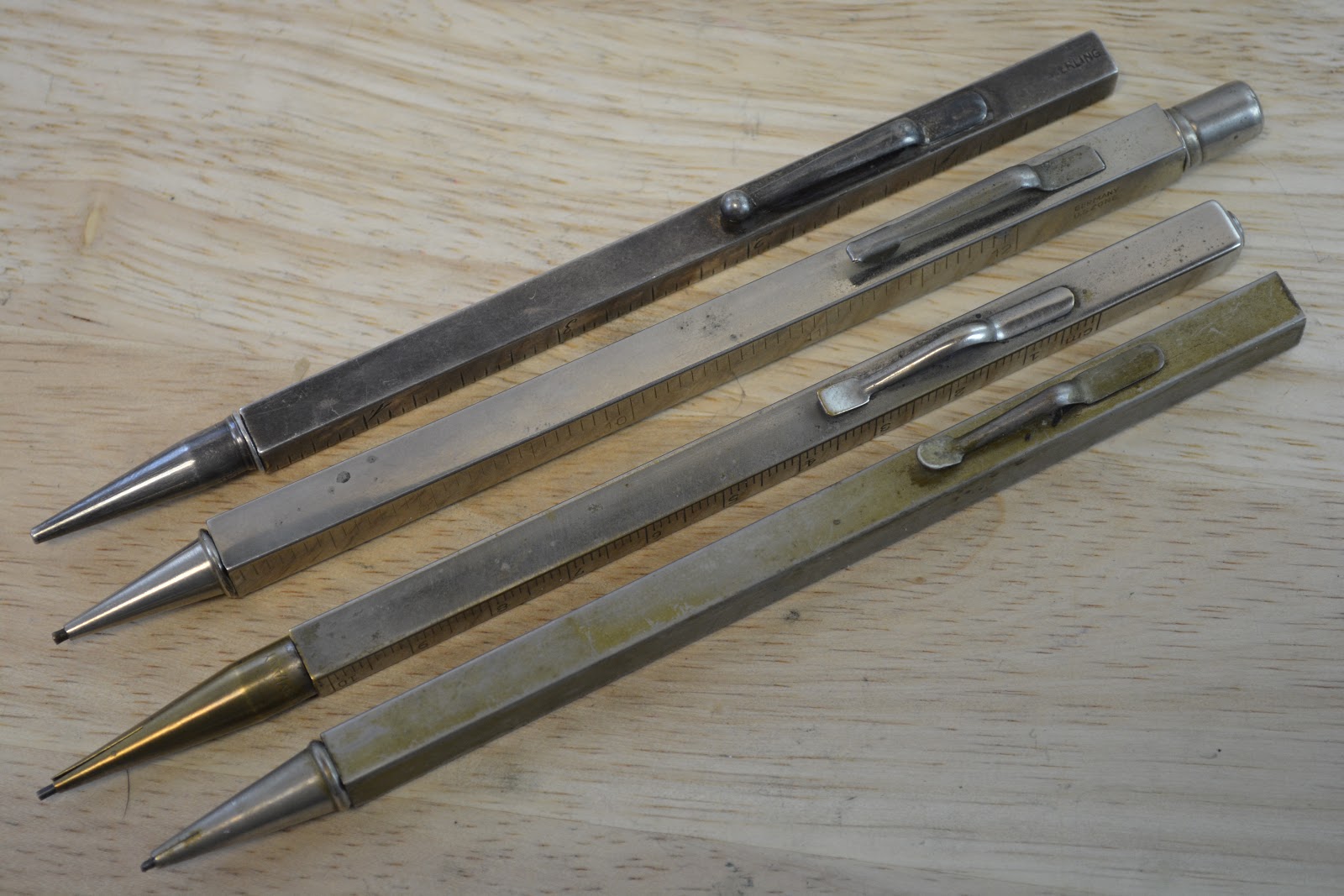
However, there’s no known association between Edward Todd and these:


These have a long, straight clip similar to what you might find on a Hutcheon:


But the imprints are for a firm known more for kitchy novelty pencils, not high-quality writing instruments:


I’ve written about the Pen-N-Pencil Co. of New York here in 2012, in connection with the company’s “Marvel” line of lower-quality pencils with lucite magnifiers as well as in connection with another lower tier pencil with a smoker’s toolkit stowed away inside the barrel:


The floodgates were open.  After World War II, the ruler pencil was further appropriated for production in post-War Germany:


The top example is our sterling Pen-N-Pencil, but the other three are German productions.  One of these is marked Bavaia and “Rofeco,” and that’s the most prevalent variation.  Maybe as a fig leaf to discourage copycats, it bears an imprint including “Des. No. 68281,” a reference to Todd’s 1925 design patent.


One is marked only “Germany / US Zone,” a reference to allied occupied Germany, before it was formally referred to as West Germany:


And the third, marked “Pilgrim Novelty Company New York,” is also made in Germany:


And . . . horror of horrors . . . it includes a scale in the metric system!


Wednesday, January 25, 2012

Just One Point on these, but It's a Good One

Since I got onto the subject of the Pen-N-Pencil Co. yesterday, this is a good time to explore another one of the manufacturer's interesting offerings:  here's a pair of magnifier pencils made by the company, shown with yesterday's "Smokers Companion" pencil . . .

NOTE:  This article is now included in the print version of The Leadhead's Pencil Blog, available anywhere you buy books, or also from The Legendary Lead Company.

To order, here's the link:  Volume 1 at Legendary Lead Company


Tuesday, January 24, 2012

My Forehead's a Little Bit Flatter After This One

In The Catalogue, there's a listing for the "Pen-N-Pencil Co." of New York.  Here's the picture, from page 119 . . .

NOTE:  This article is now included in the print version of The Leadhead's Pencil Blog, available anywhere you buy books, or also from The Legendary Lead Company.

To order, here's the link:  Volume 1 at Legendary Lead Company