Showing posts with label LT & Son. Show all posts

Tuesday, June 1, 2021

Tasty Crow

This article has been included in The Leadhead's Pencil Blog Volume 7, now available here.

If you don't want the book but you enjoy the article, please consider supporting the Blog project here.

When Steve Watts teased out some pictures of this pencil on Facebook in February, I was convinced he was a huckster:


In my defense, the pictures he shared did not show the entire pencil, just the clip.  It was marked only 14k he said, and some commenters had peppered in that from that turned up ball clip, it looks like a W.S. Hicks.  So far, so good. 

Things went sideways, however, when Steve suggested it might be available, and he gave a precise weight for the amount of gold it contained.

I was suspicious.  I illustrated how these Hicks pencils come apart back in Volume 4, page 207:


The solder holding the barrel on to the mechanism of this stockbroker’s pencil has broken.  If this guy knows how much gold he has, I reasoned, the pencil is broken . . . and if he’s gotten that tip off of there somehow, he didn’t do it without leaving plier marks.  That might explain why his pictures didn’t show the tip.

So I asked how he knew how much gold he had.  He responded by saying he just unscrewed the tip and slipped off all the gold for weighing.  

Game on, I thought.   Bolstered by a couple Scottish friends of mine (of the single malt variety), I publicly called out the charlatan.   No way did he do any such thing, I said.

Steve then shared a picture to illustrate exactly how he did it:


My jaw dropped.  Steve was absolutely right, and I was absolutely wrong.  I admitted my mistake publicly, then messaged him to apologize privately.

Fortunately, Steve is a man after my own heart, who knows that the biggest man is the one who can admit it when he is wrong.  We had a lengthy conversation about the pencil, collecting and life in general and became friends.  I also agreed to pay him the price he asked for the pencil, partly to eat a healthy portion of crow.

Partly.

Even with my aversion to buying solid gold, this one had significance to me which made it . . . well, literally worth its weight in gold to me.  I’ve only seen one other pencil that was anything like this one, and you’ve seen it here before (see Volume 3, page 19-22):


That other one is a Hicks repeating pencil - the only one like it that I’ve ever seen, and it has a patent number:


Patent number 2,028,855, as I explored in my previous article, was issued to Arthur Winter of Weehawken, New Jersey on January 28, 1936, and in the second installment of that article (Volume 3, page 20), I also showed the only other pencil I’ve seen with that patent number: a later, crappy, Chicago-era Conklin:


When Steve’s pencil and the Winter patent Hicks are shown disassembled, the conclusion is inescapable: the clip suggested Steve’s pencil might be a Hicks, but what’s inside confirms it:


There’s more.  

Arthur Winter’s address in Weehawken, New Jersey might not be just a coincidence.  In the 1933-1934 directory, William Hicks’ Sons is still located at 15 Maiden Lane, New York - but the firm was being run by H. Monroe and Warren R. Larter.


Winter’s patent was issued in 1936, and in the 1940 Manhattan directory, Hicks is still listed but with a new address: 88 Parkhurst Street, Newark, New Jersey:


Google street view shows that the Parkhurst building is still standing, although it is much worse for wear than it was when Hicks occupied it.  What is noteworthy is that this is clearly a site used for manufacturing, so I have little doubt that my Hicks repeating pencil was manufactured within its walls:


Six years later, Hicks shows up again in the 1946 directory, but at a different location: 10 Austin Street, Newark, New Jersey.


That’s the house next door and around the corner from 88 Parkhurst.  Judging from the cracks around the garage door, that house appears to have been there since at least 1946 – and it is definitely not a location suitable for any manufacturing:


Now consider this: Steve’s pencil is only marked 14k.  There’s no indication who made it, and there’s no reference to Arthur Winter’s patent:


That might mean a couple of things.  One possibility is that Hicks made it, but didn’t bother to mark that it was made by Hicks or that it was made pursuant to Winter’s patent.  I don’t think that’s the case, because Hicks almost always marked its stuff, and those crappy Conklins illustrate Winter’s patent was still kicking in the 1940s, when those were made.

So here’s the other possibility: Steve’s more modern version of the Hicks repeater was made by someone else, after the Winter patent expired in the 1950s, using Hicks’ old machinery.

That someone else, I believe, was Louis Tamis.  

When I put all the clues together, I believe the answer emerges.  By the time Edward Todd & Co. was faltering in the late 1920s, Hicks was making Edward Todd’s products and likely acquired whatever machinery Edward Todd was no longer using.  Hicks continued on for a time, making pens and pencils on its own account as well as for other customers, including Louis Tamis & Son and perhaps even earlier, when the company was known as Schanfien & Tamis.  Sometime between 1940 and 1946, Hicks ceased manufacturing and, when the company cleared out of 88 Parkhurst, the company sold whatever equipment remained – to Tamis.

This squares with Larry Liebman’s story, that Tamis wound up with Edward Todd’s equipment.  It also squares with a longstanding assumption that somehow, Louis Tamis & Son became the heir apparent to both Edward Todd and Hicks.  How Louis Tamis wound up with everything, however, appears to have been a longer way around the barn than previously thought.

It almost – but doesn’t quite – square with earlier articles I posted here, sporting commemorative inscriptions from 1947 (Volume 3, page 230) and 1958 (Volume 4, page 210).  

Maybe.  The inscriptions only suggest when they were engraved for the customers that purchased them, not when they were manufactured – if Tamis bought whatever remained of Hicks’ manufacturing capabilities in the 1940s, it might well have also purchased any leftover stock.  Any other dealer who had leftover stock made by Hicks might have done the same – these pencils just didn’t go out of style, so engraving a pencil made years earlier and selling it wouldn’t have been outside the realm of possibility.

Monday, May 31, 2021

Narrowing the Gap

This article has been included in The Leadhead's Pencil Blog Volume 7, now available here.


If you don't want the book but you enjoy the article, please consider supporting the Blog project here.

This pencil was not properly described at all in a recent online auction:


It didn’t have to be.  I knew exactly what it was from that clip:


When it arrived, however, I wanted to see that tiny little mark:


Yep.  That’s the hallmark for Edward Todd & Co., and it’s tough to find ones like this, made in the last few years of the company’s existence.  Todd’s “Everpoint Magazine Pencils” were advertised in the February 5, 1919 issue of The Jewelers’ Circular – that’s the same issue that includes historical sketches of all the New York pen and pencilmaking firms:


These are scarce enough that I would have picked this one up even if I had five just like it – but I don’t.  This one needed to be photographed alongside its gold filled brother:


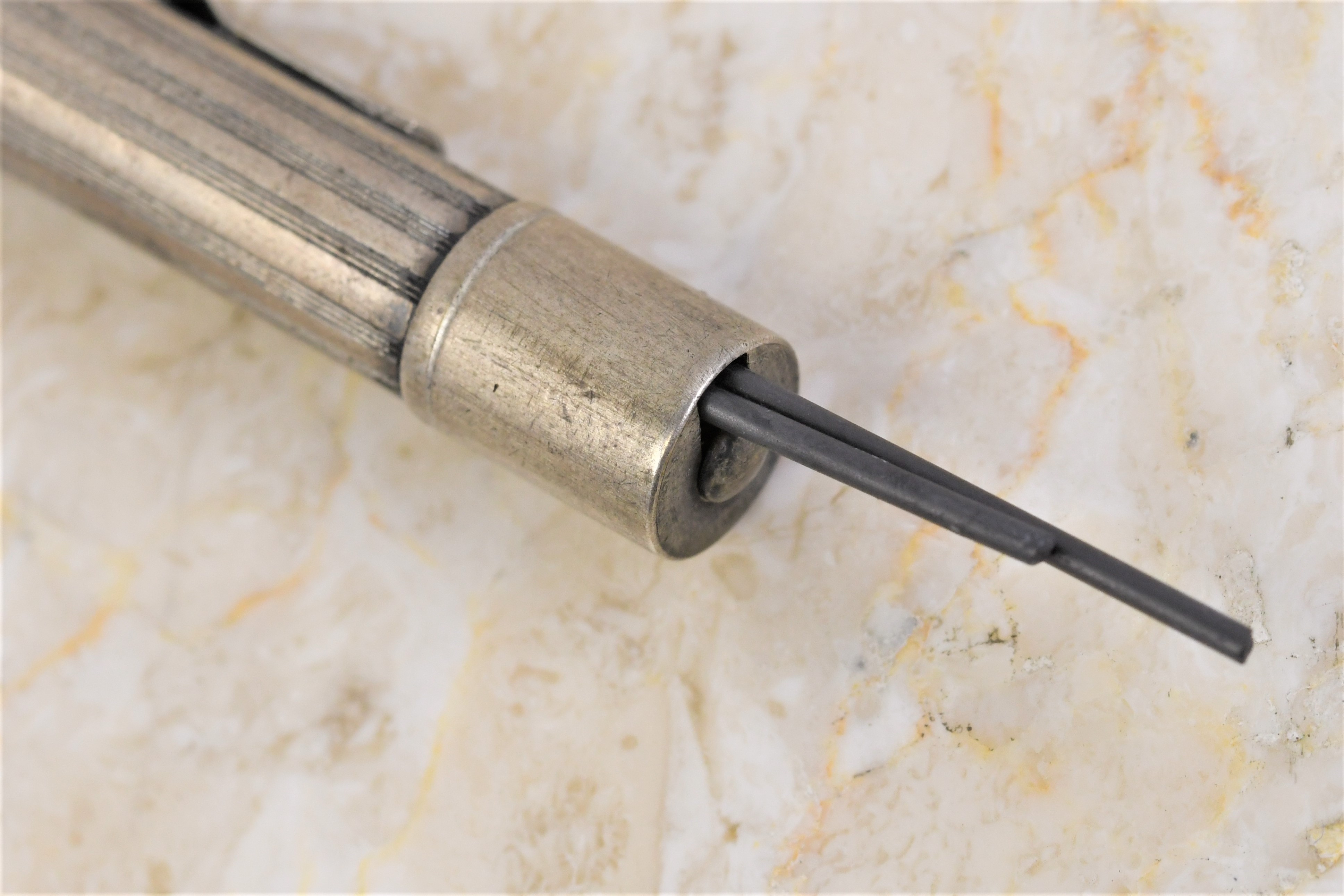
“Magazine pencil” suggests that these had a space inside the pencil to store spare leads, and after this new one arrived, I took a closer look at the top end, with that little raised bump in the middle:


I fiddled around with it a little bit and learned that it twists to reveal an opening . . . and voila:


Kind of neat, and a really unique feature on an Edward Todd.

I stumbled across another later Edward Todd during a “cabin fever” escape Janet and I made to get out a little bit over the long winter of 2020.  We made our way west to the Springfield antique malls flanking Interstate 70.  The staff was shorthanded, of course, and after I had bothered one poor guy half a dozen times to open cases (I even bought something overpriced that I didn’t want out of guilt), he was getting a little weary of running back and forth – and he had noticed a pattern in the things that interested me.

“You know, there’s a guy on the back wall with a lot of pens and pencils,” he said.  “Why don’t I just take you back there now?” 

He was not wrong on both counts.  There were a lot of pens and pencils in that showcase, and yes, I would have been calling him back again to paw through them.  Most of it was ordinary stuff in not-so-great condition, but so starved I was for any live-action hunting in the wild that I pawed through everything like a man rescued from the desert on the verge of expiring from thirst.   And I did find this:


It was on a different shelf from all the other stuff, probably because it was more special than the other things on display by a blue mile - and I nearly missed it.  Again, the clip announced what it was before I picked it up . . . and without hesitation, said I’d take it.

These might have been offered by Edward Todd at the same time as the firm’s Magazine Pencil, but the only reference I’ve found to them being advertised was a couple years later.  It appeared in The Jewelers’ Circular on November 30, 1921:


I just knew how nice it would look alongside one I had at home:


Both are in flawless condition.  Note that while the sterling silver example has the very distinctive Edward Todd clip, the other has a more rounded one - more like a Hicks.


While my gold Magazine Pencil is gold filled, my Everpoint is the real deal.  I remember it was my big splurge at The Ohio Show a few years back, and it was one of the few times I knew I would have to pay gold value and was eager to do so – there’s a lot of gold in that one:


As companies like Edward Todd fizzled out, the information that’s available becomes sparse.  In an earlier series here (“From Bagley to Todd,” starting in Volume 5 at page 174), I mentioned that Edward Todd, Jr.’s obituary, which ran in the Brooklyn Daily Eagle on December 24, 1937, is the only surviving obituary for the firm that bore his father’s name: “his business was discontinued in 1932,” it states (Volume 5, page 180).

I’ve mentioned Larry Liebman’s family connection to the Louis Tamis family here before, and Larry reports that LT & Son acquired Edward Todd & Company’s machinery and tooling.  There is some truth to that, but it did not occur in 1932 and it may not have been acquired directly from Edward Todd.

The 1933-1934 New York City Directory contains information which was likely gathered near the end of 1932, and it includes a listing for Edward Todd & Company.  The company had withdrawn to the 8th floor of the building at 100 6th Avenue, New York – without a ground floor presence, the firm must have been on its last legs:


I also wonder how the firm’s equipment would have made it up to the eighth floor – perhaps it had already been sold off, and the company existed in name only or marketed products manufactured by somebody else.  That might explain why some Edward Todd pencils are identical to those made by W.S. Hicks.

However, if Edward Todd’s equipment was sold in 1932 or earlier, Louis Tamis & Son was not the buyer, strictly speaking.  Although the firm’s account of its own history states that it was founded by Louis Tamis in 1909, that isn’t accurate.  The earliest reference I found to Tamis’ involvement in the jewelry industry was on July 26, 1910, when The New York Tribune reported that space had been leased at 38 Maiden Lane to a new partnership, Schanfein & Tamis:


The firm first appears in Trow’s Copartnership Directory for 1911, identifying the partners as Louis Tamis and Bernard Schanfein:


The 1933-1934 directory still reports Louis Tamis as being associated with Schanfein & Tamis, and there is no mention yet of the establishment of Louis Tamis & Son:


The 1940 Manhattan directory reflects that at some point between 1933 and 1940, Schanfein and Tamis had parted ways.  Schanfein is listed as a goldsmith at 64 West 48th Street:


Louis Tamis & Son and Louis Tamis are listed at 36 West 47th Street.  There’s no residence address listed for Louis, and his son isn’t listed at all:


By the 1930s, the New York City Directory had become just too cumbersome, and more manageable, separate directories emerge for each of the five boroughs.  Perhaps, Tamis and his son lived in one of those other boroughs.  Maybe, however, they lived across the river in New Jersey, like Ephraim Johnson. 

If that’s true, some things I’ve found might make a little more sense.

Thursday, April 2, 2020

The Footnote That Was In the Mail

This article has been edited and included in The Leadhead's Pencil Blog Volume 6, now on sale at The Legendary Lead Company.  I have just a few hard copies left of the first printing, available here, and an ebook version in pdf format is available for download here.

If you don't want the book but you enjoy this article, please consider supporting the Blog project here.

Call it “Leadhead’s Luck” . . . these little coincidences that seem to pop up as I’m writing things here.  Time and time again, just as I'm getting ready to post about something, something else I haven’t thought about jumps out at me and provides another missing piece of the puzzle I was working on.  It almost looks like I’m doing it on purpose, but I’m not.

At the time the ruler pencils series was publishing here, I was waiting for what I thought was an unrelated pencil from an online auction I had won on a lark.  I wasn’t looking for anything specific at the time, just idly looking at auctions for mechanical pencils sorted by those “ending soonest” –


The auction pictures were terrible and showed the pencil head-on, so I didn’t even know the barrel was square.  There’s no ruler on the side and there’s no telescoping sections if you tug on the nose, but it certainly calls to mind the ruler pencils from those articles.  Here it is, alongside the Cartier from part two of the series:


The reason I decided to throw in a small, last-minute bid on this one was because the seller had identified it as a Georg Jensen – a brand I haven’t thought about for a long, long time.  My one and only other article about Jensen ran here back in 2015 (the full article is still live and is at https://leadheadpencils.blogspot.com/2015/02/later-than-you-think.html).  Pencils marked “Georg Jensen Inc. USA,” my research found, indicates production between 1941-2 and 1950, although the company had offices in New York from the 1920s.  World War II had made importing silver from Europe impossible for the Danish firm, so Jensen added “USA” to the imprints.

And this little pencil is so marked, with what looks like remnants of red enamel in the lettering:


As I was unpacking this one on arrival, I found it wrapped in a little felt baggie that I almost threw out – sellers frequently ship pencils in all sorts of little bags for a bit of added protection, and I normally don’t see a need to keep unmarked packaging since so much more arrives here than departs.  Fortunately, just as I was about to pitch it I happened to glance down – and I noticed an added bonus that wasn’t shown in the pictures or mentioned in the description for the listing:


A nice, original Georg Jensen felt carrying bag with the company’s New York address of 667 Fifth Avenue, New York!

So, you may be asking yourself, neat as all this is, how does this tie in with “Leadhead’s Luck?”  First, I had no idea when I bought this one that it was square (the pictures were really THAT bad) . . . and I was just talking the other day about Edward Todd Junior’s design patent number 68,281 for such a design (https://leadheadpencils.blogspot.com/2020/03/everybody-and-their-brother-part-two.html):


Notice that Todd’s patent isn’t for a ruler pencil necessarily – it’s for a square one.  If Todd’s design patent had any teeth (and as I mentioned in that last article, that’s debatable), it’s a pretty good indication that my Georg Jensen pencil, sans ruler and small in stature, was nevertheless an Edward Todd product.

Or a progeny of Edward Todd, I should say – recall that Jensen didn’t start using this imprint until 1941 or 1942 . . . if Louis Tamis & Son acquired all of Edward Todd’s machinery and equipment after the firm closed in 1932, then perhaps LT&Son made my Georg Jensen.

Which means . . .


The middle two pencils in this picture are the Georg Jensen pencils I showed in my 2015 article.  Look at those clips . . . the upper one has that long, straight ball clip just like the top pencil in this picture, which is the Pen-N-Pencil Co. ruler pencil I just wrote about last Friday.  I characterized that clip as “Hutcheon-like” and I thought – but didn’t say out loud – that these were made by someone other than Edward Todd.  Now I’m thinking Pen-N-Pencil might have upped their game a bit for their ruler pencil production, sourcing it from either Edward Todd or LT & Son.

Meanwhile, the other Jensen in this picture, the broker pencil third from top, has a clip which is a dead ringer for the one on the bottom -- which is that “Victorian” from Monday’s article (see https://leadheadpencils.blogspot.com/2020/03/victorvictorian.html).  Score another point in the column for the Victorian being another brand manufactured by Louis Tamis!

Monday, March 30, 2020

Victor/Victoria(n)

This article has been edited and included in The Leadhead's Pencil Blog Volume 6, now on sale at The Legendary Lead Company.  I have just a few hard copies left of the first printing, available here, and an ebook version in pdf format is available for download here.

If you don't want the book but you enjoy this article, please consider supporting the Blog project here.

I finally got to meet Steve Lehman at the Baltimore Show this year.  Well, that’s not entirely correct – I had met Steve at several shows to chat pencils and we are Facebook friends, but since he doesn’t have his picture on his Facebook profile, I didn’t associate his face with the name until the Baltimore Show this year.   Steve had his one in his pocket to show me, and whether he intended to part with it or not, he was at my table to pick up his copy of my new book, A Century of Autopoint.


Yeah, sometimes I spend books rather than selling them.

This one looks a lot more modern than the sort of stuff that usually interests me, but it’s a missing piece to a puzzle I’ve been working on for years.  The accommodation clip on this sleek, modern looking broker’s pencil is marked “Victorian”:


Sort of an odd, traditional and frilly name on a modern skyscraper of a pencil . . . and the composition – that two-tone mix of chrome-plated steel and nickel silver at the nose.  One might think at first this has been hacked together from parts, especially coupled with an accommodation clip that might have been swapped over from something else.  I don’t think so, however:


The Victorian name also appears on the nose, a very traditional place to find a maker’s mark on a broker’s pencil, even though “nickel plate” isn’t a very traditional material at all for this sort of thing.

“Victorian” is a maker that I’ve had a hard time finding decent examples to add to the museum.  On the whole, they tend to be made from thinner materials, so they dent more easily.  The plating is also thinner, so they tend to look a little cruddier.  I did find this example, a stubby (four inches or so) broker pencils – I think Paul Erano had it:


Note the long, straight ball clip with two rivets, classic design elements you’ll see on other pencils in the Hutcheon/Todd/Hicks family.  And this one also has a very traditional imprint:


. . . accompanied by a cute little crown for a hallmark:


What I’ve always wondered is if there is some connection between the Victorian and the gold filled example in this next shot:


The sterling silver example bears LT & Sons’ hallmark:


The imprint on the gold filled one reads U.S.A. “Victor”:


Both share the turned up ball clips, which LT & Sons inherited from Edward Todd and Hicks.


So does the Victorian trace its lineage honestly back to the Edward Todd/Hicks progenitors of this family?  Was it originally named the “Victor” then later modified to “Victorian” to give it a bit more traditional feel?  Even later, was it given the appearance of something modern with an outer shell made from newer (and cheaper) materials and a sleeker (and cheaper) accommodation clip?

It’s like something new, impersonating something old, impersonating something new.  Huh.  If you haven’t seen the movie “Victor/Victoria,” look it up – the title of this article wrote itself.