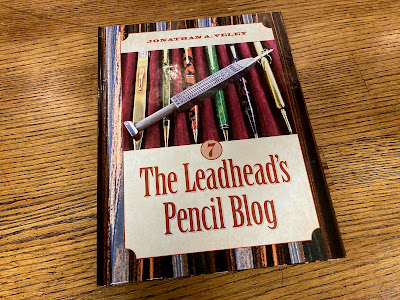
This article has been edited and included in The Leadhead's Pencil Blog Volume 6, now on sale at The Legendary Lead Company. I have just a few hard copies left of the first printing, available here, and an ebook version in pdf format is available for download here.
If you don't want the book but you enjoy this article, please consider supporting the Blog project here.
“Yes, Virginia.”
I’ve used that archaic turn of phrase more times than I can count, and I’ve been asked many times over the years what that means, who Virginia is, or why my comment is directed just to one state. I’ve generally summarized it as synonymous with “believe it or not” or “contrary to conventional wisdom.”
And then I smile inside, because I know it’s more than that. It means those two words have taken root so firmly in folk’s heads that out of all the words I’ve said here, that curious little phrase having nothing to do with the subject of this blog is what compelled them to seek me out and ask.
That means what I’m about to write today might stick in your heads too, and that gives me . . . hope.
“Yes, Virginia” came into my vocabulary through one of my law school professors, Morgan E. Shipman – a tall Texan with a booming voice who without fail wore a jacket and tie every day, even on beach vacations. Teaching was his solemn calling, which required that he command an authoritative presence and respect before his students. No one questioned his knowledge nor doubted that it extended to both horizons.
In the summer of 1990 or 1991, workers were jackhammering off the back wall of the law school to add onto the building, making it impossible to hear even the most forceful speakers. When Ohio State failed to provide alternate accommodations, Professor Shipman made arrangements to conduct his classes in one of the hole-in-the-wall bars on High Street before the bar opened each day (or more accurately, just after it closed from the previous one). His oratory in those surroundings was no less brilliant as he paced behind a bar table, punctuating his thoughts with grand gestures while obviously reluctant to touch anything sticky in his formal attire. Illumination laced with the smell of stale beer.
Professor Shipman was full of memorable witticisms, related to us in his measured, Southern drawl. He called environmentalists “birds and bunnies people,” and he generally attributed Ninth Circuit Federal Court decisions with which he didn’t agree (the Ninth includes California, for non-lawyers in the audience) to the fact that the country must have tilted so much that all the nuts rolled to one end.
And he prefaced nearly every important point he made with the words, “Yes, Virginia.”
Professor Shipman passed away in 2008 on his 75th birthday, but the “Yes, Virgina” part of him has passed on to everyone who heard him speak . . . just as it had been passed on to him. The phrase didn’t come from Professor Shipman; it roared through him like a twister.
Because it is something we need.
In 1897, eight-year-old Virginia O’Hanlon of New York City asked her father whether there is a Santa Claus. In an obvious attempt to dodge the question, Mr. O’Hanlon suggested that she write a letter to the editor of The New York Sun to ask. Taking that advice, and perhaps with her father’s assistance, Virginia penned the following:
“Dear Editor,
“I am eight years old. Some of my little friends say there is no Santa Claus. Papa says ‘If you see it in the Sun it’s so.’ Please tell me the truth, is there a Santa Claus?”
The letter landed on the desk of Francis Pharcellus Church, an editor at The Sun and former war correspondent who had reported first-hand the horrors of the American Civil War. Church’s response to Virginia’s letter was published in The Sun on September 21, 1897, and it has become (according to Wikipedia) “the most reprinted newspaper editorial in the English language.”
“Virginia, your little friends are wrong,” Church began. “They have been affected by the skepticism of a skeptical age. They do not believe except they see. They think nothing can be that is not comprehensible by their little minds. All minds, Virginia, whether they be men’s or children’s, are little. In this great universe of ours man is a mere insect, an ant, in his intellect, as compared with the boundless world around him, as measured by the intelligence capable of grasping the whole of truth and knowledge.
“Yes, Virginia, there is a Santa Claus. He exists as surely as love and generosity and devotion exist, and you know that they abound and give to your life its highest beauty and joy. Alas! how dreary would be the world if there were no Santa Claus. It would be as dreary as if there were no Virginias. There would be no childlike faith then, no poetry, no romance to make tolerable this existence.”
To make tolerable this existence . . . heavy words uttered to an eight-year-old, but they resonate with me whenever I read them. It is an anthem for all who seek good in our world.
That was why I started writing these articles again, to bring us together at a time when this pesky bug was keeping us apart. Little did I know how much more important that effort would become as the civil unrest erupted which now threatens our ability to see each other as human beings.
I’m proud of the friends I have who wouldn’t have much to say to me if it weren’t for pencils. Recently, I liked a comment one such friend made in an online debate about guns and gun violence; the fact that I liked it must have alarmed him greatly since we are so far apart in our positions, so he edited his comment and sent me a private message to let me know that I should reread it to be sure my “like” was still accurate.
I reread it and I still liked it. We both want a better world, I told him, and it was that sentiment with which I agreed. Our only disagreement is how we get there.
Yes, Virginia, it is possible to discuss sensitive issues and find things on which you can agree.
Could we have had such a discussion if there was no “glue” of brotherly love holding us together? I doubt either of us could. Without a reason to respect each other – a reminder inside each of us to see the other as a caring and intelligent human – it likely would have been just another gun toter arguing with another gun grabber, cast in contrasting colors and positioned like inanimate pawns on opposite sides of a chess board.
Or like stripes and solids on a billiards table, which brings me (via “the long way around the barn,” as we say around here) back around to pencils. In fact, it brings me all the way around to the beginning of one enormous circle – to that very first article about Oscar Tweeten’s billiards business and his bowling score pencils, made by the Tweeten Fiber Company (see Volume 1, page . . . well, of course, page 1):
I’ve revisited my old friend Oscar a few times over the years, including the time I wrote about a curious unmarked example of what looked like a Tweeten, but marked “Taylor Made Pencil Co.” on the accommodation clip (Volume 3, page 15).
The connection between Tweeten and Taylor Made remained unclear, until a chance online find brought a box of Tweeten leads to my doorstep, confirming that at some point – maybe before, maybe after, maybe the whole time – the Taylor Made Pencil Company in South Bend, Indiana made Tweeten’s pencils:


Jim Stauffer, who collaborated with me on A Century of Autopoint, has recently taken an interest in these, dragged into liking them gradually . . . first by noting that the tips on Listo pencils are very similar to those seen on Autopoints and Realites. This in turn led to a fascination with Listo’s marking/grease pencils, which led to an all-consuming interest in things along these lines. I’m not the only one who gets caught in such quagmires.
While Jim was researching a fine article he recently posted at his website,
vintageautopoint.com (
"Other Grease Pencils"), he stumbled across the articles I’ve posted here. After Jim finished his article, he asked me for my comments and mentioned that there was a blue Tweeten currently listed by a friend of his in an online auction.
Ooooo . . . a blue one . . . and the same seller also had a red one . . . and some boxes of red and blue leads for them . . . my enthusiasm was transparent and immediate, but Jim cautioned me that the blue example had some heat damage caused when the seller tried to take it apart.
I read the auction description, the damage was properly noted, and I still didn’t care. I bid on all the Tweeten listings except the red one, because I wanted to check the museum to see if I already had one. Then, of course, I forgot to go back and bid on it.
I won the blue pencil and one of the boxes of black leads, but I was outbid on the red leads. That surprised me – someone else must have known how hard those are to find! Oh well, I thought . . . they didn’t just make one box. I’ll catch the next bus when it rolls by, and I’ll buy a more expensive ticket when it does.
A few days later, the package containing my blue Tweeten arrived, along with a flurry of other little packages that drew an eye roll from Janet. When I opened it . . .

Since I’m not the sort to rejoice in the receipt of an illicit bonus, I rechecked my purchase history to verify I didn’t forget that I forgot to bid. No red Tweeten was expected, so I sent the seller a message to let him or her know that I had received someone else’s pencil. All I needed was the seller’s mailing address – I had been in such a rush to clear the kitchen table of that day’s arrivals that I had hastily disposed of the incriminating packaging before domestic eyes rolled once again. The trash man had come and gone, taking this envelope with him.
The seller, Dr. Ibrahim Abousaad, is an Associate Professor of Economics at Lone Star College in Houston. No, he replied, he meant to send the red one as a thank you for my hard work at the blog all these years, and he had included a nice note to that effect with the pencils.
I beat myself up a bit that I’d thrown it out, because I’ve saved all those little notes I’ve received over the years. No worries, he said, adding that he was refunding what I paid for the leads and added a bonus to that second shipment, which arrived a day or so later:

Although I don’t bowl and this is more of Oscar’s leads than I’ll consume in a lifetime, two boxes of these in my collection is in fact twice as good as one! Ibrahim and Jim might have talked, and because of that glue that binds the two of them together, maybe a little bit of it stuck to me. Then Ibrahim went just a little bit out of his way, making a bit of new glue to bind us together.
I have no idea what Ibrahim thinks about the economic effects of this pandemic or whether we have chosen a wise course to deal with it in this country. I don’t know what he thinks about guns, or Black Lives Matter, or how we have evolved from two genders to twenty six or so. I don’t see the need to bring it up. But if these or any other topic comes up between us, whether over scotch and cigars at a pen show or in a fiery online debate, I know that if we ever have such a discussion, we will speak to each other with respect.
�Yes, Virginia, it is possible to connect with your fellow man, regardless of how many miles and how many viruses may separate you.
Yes, Virginia, you can disagree with others peacefully, as long as you see human beings as equals rather than obstacles to making what you believe will be a better world.
Yes, Virginia, on this July 4th we can and we must find ways like this to hold our country together, one person at a time.
This blog has been my chosen medium to do that. The pencils matter, at least to me, but what matters more is manufacturing the glue within our tiny circle of enthusiasts to bond us, one to another, where it might not otherwise exist. If everyone went a little out of their way to find something – anything – to remind each other that we are all we, rather than us and them, our world will right itself.
I neglected many other projects to research and write this series of articles, and I think it is time to turn my attention back to them. Now that A Century of Autopoint has won an independent book award, some of my non-pencil projects are rapidly moving to the front burner. When I feel the need I may come back to post other articles here, but I hope that urge will come primarily from whatever goofy pencil has moved me to do so, with building community as an incidental yet invaluable bonus.
I am uncertain, as we all are, what 2020 and the years beyond it will bring. Maybe this stupid virus will come knocking on my door, and maybe that will be the end of me. Perhaps we will be plunged into a civil war and I, along with many of my friends on either side, will be claimed as casualties.
I hope not. But should these be my last words here, I want the message to reflect that I have in some small way done what I could to prevent it.
And yes, Virginia, I still believe we can.