Showing posts with label Eversharp 4 Square. Show all posts

Tuesday, April 6, 2021

Impulse Buys

This article has been included in The Leadhead's Pencil Blog Volume 7, now available here.

If you don't want the book but you enjoy the article, please consider supporting the Blog project here.

The main reason I drove all the way to Chicago for the Fred Krinke auction was for the all-stainless Eversharp Skyline.   There was one other item in that auction I was really hoping to bring home, although it was in distant second place:


In another article, widely read mostly because of the harsh criticism it generated (Volume 3, page 29), I suggested that perhaps the lack of cutouts in these bands had something to do with the pens they were meant to accompany.  Eversharp-made Gold Bond pencils had cutouts in the band if they accompanied piston-filled Gold Bond pens and lacked them if they accompanied less advanced lever-fillers, so I suggested Eversharp may have done the same thing on its regular line.

The illuminati descended, with several people saying they had cutout-band caps on many a lever-filler.  I don’t recall anyone saying they had plain-band pens with piston fillers, but someone might have.

Never mind it’s easy to switch caps.  Never mind that in the late 30s, Eversharp wasn’t particularly consistent - maybe they intended that at some point then abandoned the idea.  And of course, never mind that there is no known documentation to say either way whether I was right or wrong.  Meh . . . you know what opinions are like, and I have one, too.  Some might say I am one.

My purpose in chasing this one, though, wasn’t to rehash old arguments . . . even though I know I just did (maybe I’m nudging the illuminati a bit to see if anything’s turned up in the years since to prove me right or wrong).  I wanted this one because I’ve never seen one in black before - all the other examples I have seen are green or burgundy:


And that, as Forrest Gump would say, is all I’m going to say about that.

But with travel expenses and a day out of the office, I planned to buy more than just these two items if they were going cheap, for resale to offset some of the cost of attending.  The auction included many lots of Eversharp pencils, and many did in fact go very cheap - most of my bids were for friends, and they did very well, but there were three lots I took home for myself. The first was this group:


There was only one pencil in this group that interested me at the time - I knew I didn’t have an Eversharp Four Square in that weird grayish/bluish marble with red pinstripes on the corners:


I have scads of these in different colors (see Volume 5, page 130 for the full story - the article also appeared in The Pennant), and I’m always keen to find another color.  This example is from the height of Eversharp’s gimmickry in the series, with the supposedly more ergonomic tip and the reversible eraser cap that neatly conceals the eraser when not in use.  It also sports the viewing window on the back side, with the red spot indicator to show how much lead is left inside:


As well as a curious imprint - perhaps a shop model number – 43438 B:


Something I neglected to mention in my last article on these was that Eversharp also had a thin model of this pencil, without the indicator window and with hexagonal barrels:


I’ve got a few of these, and the one I found with an orange cap tells me there may be other variations out there to explore:


These smaller versions also sport the patent number for Eversharp’s reversible eraser cap:


As I pawed through the other items that came with that lot, I noticed there were two variations of the brown pencil – one with ribbing only halfway up the barrel, and the other ribbed all the way to the top:


I ended up adding both to the collection:


I’d noted the fully-ribbed variant here before when that black one found its way to me (Volume 3, page 89), imprinted with the name of Edd Dawson, the legendary pioneer of pencil collecting.  Time will tell whether the red and blue ones also exist with fully ribbed barrels!

Another lot which was going cheap during the auction included these two Doric repeating pencils, which I bought for resale:


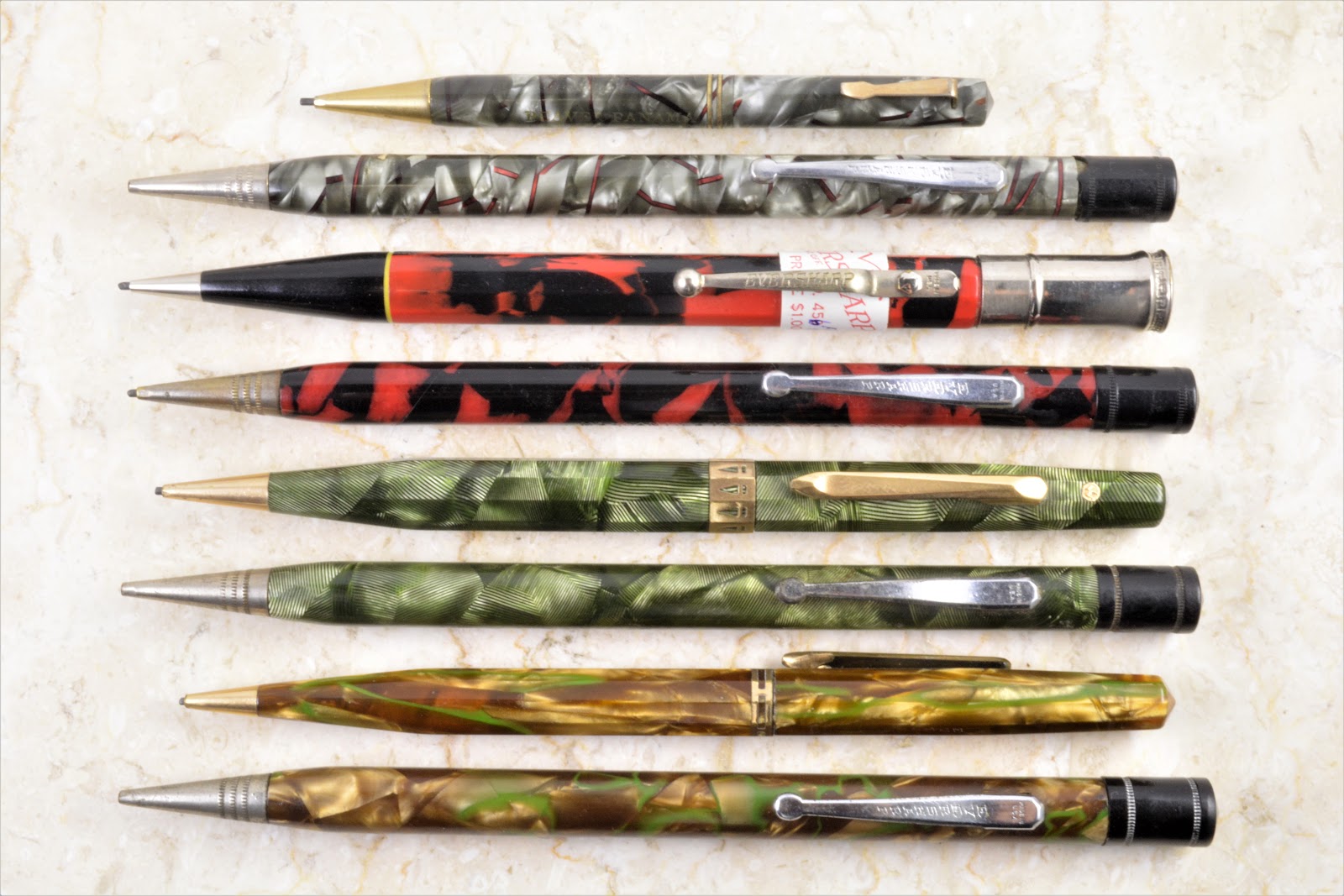
I knew - or thought I knew - that these were duplicates after checking the rudimentary pictures in my “World’s Largest Eversharp Collection” post (Volume 5, page 32).  Here’s a better shot of the Type IV band examples:


Eversharp must have had trouble with the brown celluloid - note that one has a brass replacement sleeve, likely added to replace deteriorated material, and the other one is starting to go, too . . . even though it’s as NOS as they get, complete with a price sticker.  Incidentally, Eversharp Doric repeaters also come with Type III bands:


Note the rudimentary brass button on the green example?  All the green ones I have found like this have been advertisers, and all have sported that button.   Maybe the green ones were reserved as lower-cost advertisers  . . . maybe I just haven’t had the luck to find a regular issue example with matching button.  

Even though the examples from the Krinke auction appeared to be duplicates, I always make it a habit to compare anything that comes my way to what is already in the collection.  Dang it, I guess these aren’t inventory after all . . . this is something I’ve noticed before, but I don’t think I’ve ever mentioned it here at the blog.  There’s two types of imprints on these, and both of the ones from the Krinke auction have the other one from what is represented in my collection:


Some sport the simple Eversharp imprint found on all twist-model Dorics, but others feature a more elaborate imprint reading “Genuine Eversharp Patented / The Wahl Co. Made in USA.”  Judging from all of the Type III and Type IV repeaters in my collection, neither imprint is more rare than the other, and I don’t know which came first or whether both were offered at the same time.  

Perhaps it’s silly to keep these just because of that little difference, since all they will do is invite me to start chasing alternate imprints on all the other ones . . . but for now, given how little they cost me, here they stay for the time being.

One other lot I wasn’t planning to bid on was a sleeper:


These Skyline-based repeating pencils didn’t have a matching fountain pen to my knowledge, so they haven’t enjoyed the same attention as Dorics and other Eversharp lines that did.  On page 75 of The Catalogue, I lump them in with the “Press Clip II” family - that’s the group with a stapled-on clip and one narrow band mid-barrel.

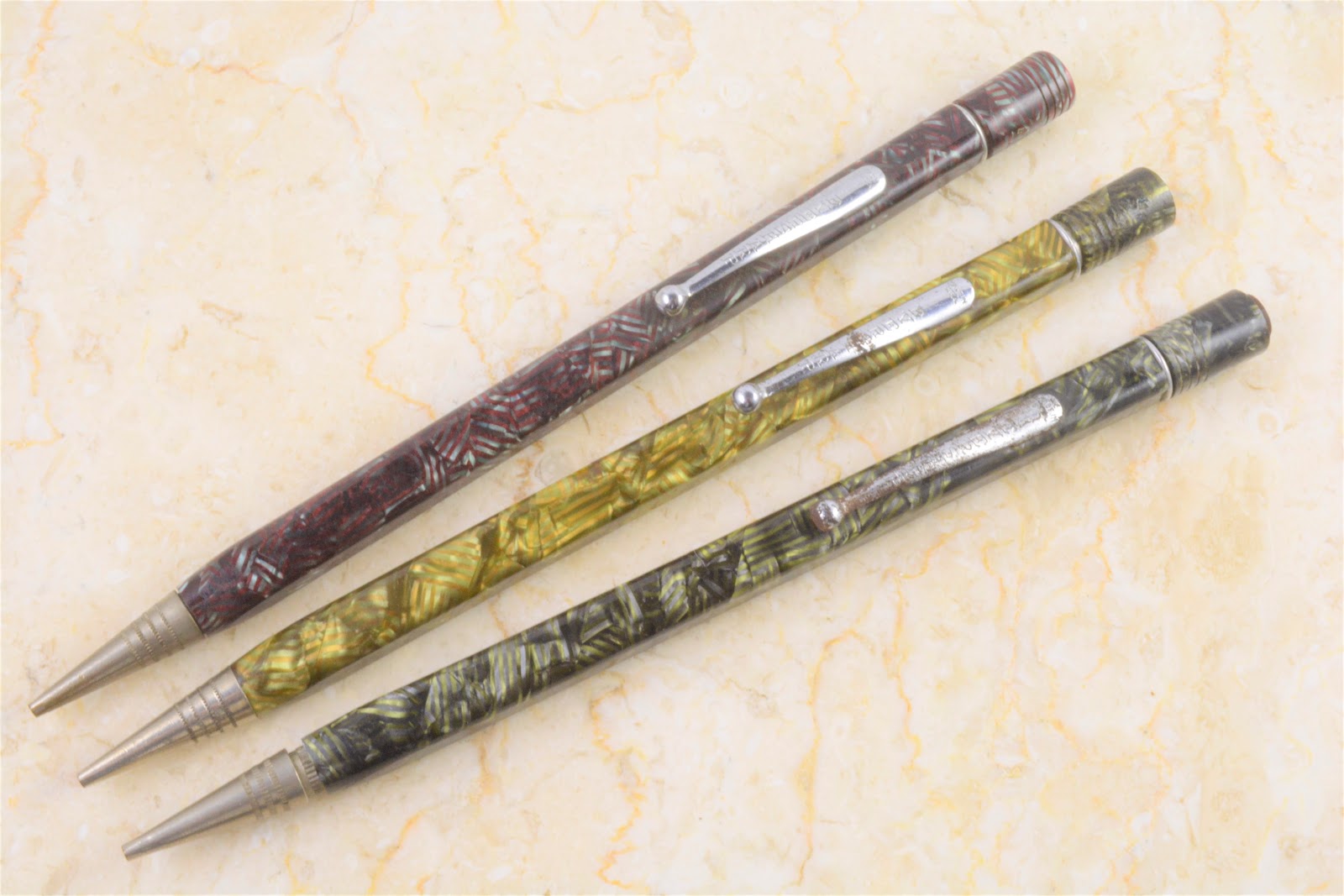
Mechanically, these built every bit as well as all the other repeaters Eversharp made, and that pearl top – “mother of toilet seat” as it is derisively referred to in some circles – gives it a bit of extra interest.  However, Eversharp skimped a bit on the aesthetics: the trim on these is usually badly corroded, and the gold plating is so thin that it’s often tough to tell whether one of these has chrome or gold trim.  Many of these were advertisers, and while the screen printing is usually partly worn away, at least what’s left is easily removed to make them look nicer.  Grading these new ones on a bell curve, I’d rate their condition near the top of their class:


I haven’t delved into this series since The Catalogue was written, so I’m long overdue to post a current family photo:


The burgundy example from the Krinke auction is a new one for me, and note that there’s both chrome trim and gold wash (I can’t even bear to call it “plated”) trim examples.  I separated two examples from the rest of the herd to address separately:


Some of these have a much darker, yellow top.  I think the color is too even to be age discoloration . . . perhaps it’s just a different dye lot, and perhaps some late 40's/early 50's catalog will establish that customers could choose either white or yellow pearl.

Three lots bought on a whim, anticipating 12 pencils for resale . . . and I’m keeping 7 of the 12.  This investing thing is going in the wrong direction!

Sunday, June 21, 2020

Party On, Jack

This article has been edited and included in The Leadhead's Pencil Blog Volume 6, now on sale at The Legendary Lead Company.  I have just a few hard copies left of the first printing, available here, and an ebook version in pdf format is available for download here.

If you don't want the book but you enjoy this article, please consider supporting the Blog project here.

I’ll admit to having more fun than usual on eBay during this whole virus thing.  With no pen shows to go to, no flea markets to attend, no Springfield Extravaganza . . . gotta get my fix somewhere, I suppose.

I’ve taken a bit of lighthearted heat from the wife whenever a little pile of packages appears on my doorstep.  In the days when I would arrive home before Janet, it was easy to have all the packages opened, the boxes discarded and the pencils squirreled away into the museum before I’d hear the garage door go up.  These days, however, she’s working from home and whenever all my little packages don’t fit in our mailbox, the dogs announce the arrival of our mailman right outside her “office” window with every load of illicit goods.

Not that I’m doing anything wrong or spending all that much money . . . I’m just on the receiving end of a comment here and there regarding how many pencils one might “need” in order to survive a nuclear holocaust and repopulate the planet’s shirt pockets with adequate writing gear.

I’m relieved whenever I get to tell Janet that not all these boxes are crazy little trinkets upon which I’ve squandered the kids’ inheritance, and lately there’s been a lot of other packages arriving.  Without the usual socialization at shows, people have been sending pencils to fix, stuff to photograph – not everything that arrives is completing a one-way trip to Leadhead’s Leadquarters.

A couple weeks ago, however, one package arrived that was making a one-way trip – but it wasn’t anything I was expecting:


Apparently a few stragglers didn’t keep up with the march of the penguins, and there were a few other things in Don Jacoby’s stuff that Jack Leone wanted to catch up with the rest of the flock (if you're just now tuning in and that doesn't make sense, see "Penguins in the Barnyard").  “Party on!” Jack instructed.

“Party on, Jack” I titled the email to thank him, along with the observation that if I had not FINALLY  gotten a long, long, LONG overdue haircut the preceding day, I would be playing air guitar and headbanging to Bohemian Rhapsody right along with him.

For all you kids out there who have no idea what I’m talking about . . . sigh . . . just go ask your parents.  I keep forgetting what’s obvious to me is inevitably becoming the wisdom of the ancients.

There were a couple neat things in Jack’s care package worth sharing.  First is this pair of Eversharp “4 Square” pencils (these actually have the imprint on the caps) – see "Making Sense of the Square 4" for the full rundown on these:


Well look at that – this subseries came in both nickel plated and gold filled trim!  My example, in nickel plate, wasn’t nearly so nice, so both of these have found a comfortable place alongside their counterparts.  

The rest were a few lower-level Parkers - Parkettes and such.  Nothing much to write home about here, although I’ve had a single band example like that lower one which has been missing a clip:


I’ve had a green one just like that one which has that same clip, but I was never comfortable it was right.  Now that Don’s example has made it to me, with the same clip as found in the wild (or to carry on the theme of the weekend, waddling around in the barnyard), I happily invited this one into the fold.

And then there’s that Parker Liquid Lead pencil . . . there’s something a little bit odd about it.  It took me a while to find where I keep my other Liquid Lead pencils to compare it.  What I remembered them looking like was more along these lines:


I think the ones like that lavender example were later, though . . . or maybe for the lower tier lines, like to match the 21 or such.  I dug a little deeper and found a few Parker 51 Liquid Lead pencils, and they share that same shorter, ribbed tip:


And in the case of that lower example, a hefty price tag of $10!  

As you’ve probably guessed by now, I’ve settled into an uneasy peace with Parker’s grand experiment to load up a ballpoint cartridge with graphite paste and call it a “pencil.”  Yeah, I’ll keep them around the museum as “close enough to being a pencil” (after all, look how hard I stretched to accommodate those chalk holders the other day).  But no, I just haven’t been able to get too excited about them because the damned things never work (but then again, look how many goofy ideas that never worked well are proudly represented in the museum).  

I’ve come to adopt the Don Jacoby philosophy.  I like them just because I do, and I don’t like them just because I don’t.  So sue me.  

I will admit that on those rare occasions when you find one that works, they are kind of cool - lead flowing out of a pencil like ink and all.  Plus, that cartridge looks a bit shorter and different from the other Liquid Leads I’ve got around, so I thought this might have been some weird experimental thing Parker did that may have worked a bit better.  I turned Jack’s “Party On” instruction sheet over to see what it would do . . . 


Whoa.  It works, but I’ve never heard of a Parker Liquid Lead that wrote in purple!  Of course that meant I had to take it apart . . . 


From the other room Janet heard me burst out laughing.  Yes, Virginia, you can fit an ordinary Pilot ballpoint cartridge in a Parker Liquid Lead pencil and it will work just fine as a pen – thanks to Don Jacoby I finally have a way to bring all those dead Liquid Lead paperweights back to life!

Party on indeed, Jack.  Party on, Don!  Climb on into that blue AMC Pacer and crank it up . . . 

(Dooo do do doo do-do-do . . doo doo do dooooo... oh come on, I know you know this song.  Bang your damned head!)

Wednesday, December 27, 2017

Making Sense of the "Square 4"

This article has been edited and included in The Leadhead's Pencil Blog Volume 5; copies are available print on demand through Amazon here, and I offer an ebook version in pdf format at the Legendary Lead Company here.

If you don't want the book but you enjoy this article, please consider supporting the Blog project here.

Note:  This article - well, most of it anyway - appeared in the fall, 2017 issue of The Pennant.  

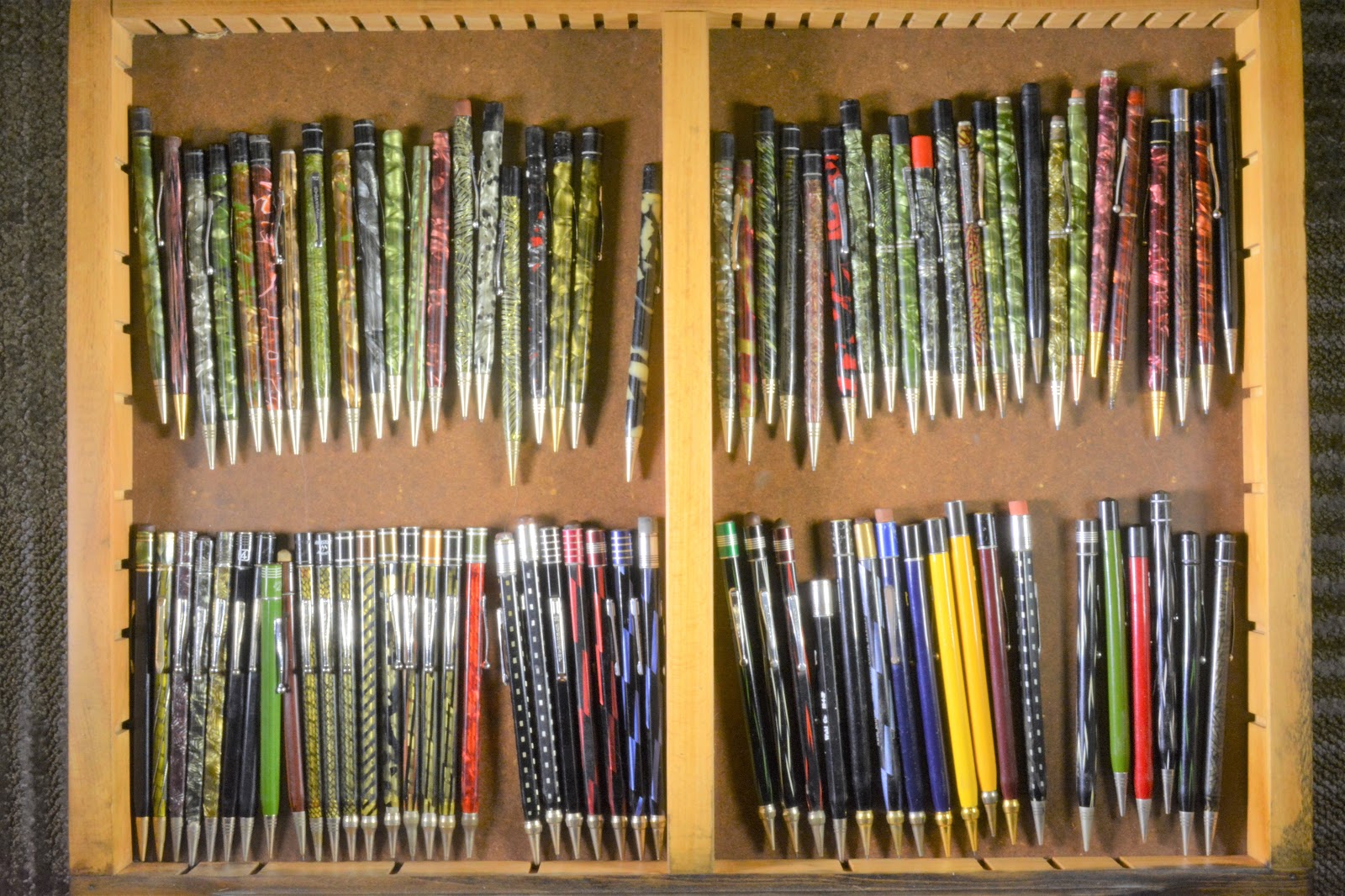
During the 1930s, Wahl Eversharp introduced a line of long, slender pencils designed to use leads that were square and four inches long. These pencils were produced in great numbers and in a wide range of features and colors, and their availability and variety makes them popular with collectors today.

A portion of the author’s collection of what he has referred to – until now – as “Square 4” pencils.  
Until now, however, not much has been known about them. The Depression presents a challenge for researchers, because pen companies as a whole cut back on the production of catalogs to showcase their offerings. The PCA’s online reference library includes Wahl’s full 1932 catalog, a sharply scaled-back 1935 catalog, and a “Fall Promotion” brochure that must be from 1937, as it includes a page of the company’s “new” repeating pencils, which were introduced during that year.

None of the available catalogs shows these long, slender pencils. Since some have imprints on their caps that appear to read “Square 4,” I referred to them generally by that name in my book, The Catalogue of American Mechanical Pencils, and for better or worse, the name has stuck. 

Detail of caps showing various imprints, all of which suggest that the name for this line of pencils was the “Square 4.”
Recently, I learned that while these “Square 4” pencils were not illustrated in Wahl catalogs, they were heavily promoted in newspaper advertisements across the country. These advertisements show that Wahl added and dropped different features of these pencils over the course of several years, allowing us at last to precisely date the different variations.

These advertisements also reveal that Eversharp referred to these pencils by several different namesbut unfortunately, they were never called the “Square 4.”

Eversharp’s ill-conceived square leads were invented by Robert Back, who applied for a patent on August 24, 1932, and was awarded patent number 1,916,199 on July 4, 1933. The idea, according to Back, was that square leads would fit in a wider range of pencil tips without jamming. The leads never worked very well in practice, though: lead dust generated by the corners shaving off inside the pencils frequently caused them to clog, especially in humid conditions.

Robert Back’s patent number 1,916,199 for square lead, issued on July 4, 1933.
In February 1934, advertisements appear for a new pencil, which Eversharp introduced as a promotion for its new square leads, in extra-long, four-inch lengths. The best illustration of this new pencil was found in a Gimbel’s advertisement published in the Philadelphia Inquirer on February 13, 1934, indicating these new pencils came “in black only.” Stock advertisements that ran in several newspapers also describe this same pencil as “unbreakable black pyralin,” suggesting that like Henry Ford’s famous statement about the Model T, you could have any color you wanted, as long as it was black. Identical but slightly shorter pencils in different colors are sometimes encountered, and were probably introduced later in 1934.

One of the earliest advertisements for Eversharp’s new line of pencils promoting 4 inch long square leads, published in The Philadelphia Inquirer on February 13, 1934.
This stock advertisement appeared in several newspapers in early February, 1934, suggesting that the new line of pencils was only available in black when it was introduced.
The black Eversharp pencils at the top in this picture were originally introduced in February, 1934; slightly shorter and more colorful models such as the others shown in this picture might have been introduced shortly thereafter.

In late February, several advertisements were published that provide a name for the new pencil, and these advertisements prove that the author has had it backwards for all these years: the pencil was called the “4 Square,” not, as the imprint suggests, the “Square 4.” One such advertisement in the Edwardsville Intelligencer (Illinois) on February 18, 1934, suggests the name was derived not only from the four-inch square leads they accommodated but also from the fact that the pencils wrote four times as long, included four extra erasers and also came with four extra leads. Whatever the inspiration, the name didn’t last: by May 1934, advertisements referred to the pencil as the “4-in-1 pencil."

The author has had it backwards all these years . . . this advertisement from The Los Angeles Times on February 18, 1934, calls these pencils the “4 Square,” not the “Square 4”  when they were introduced.
Beginning in May, 1934, advertisements such as this one, which ran in the May 17, 1934 edition of the Davenport (Iowa) Daily Times, had renamed the 4 Square to the “4-in-1 pencil.” 

The 4 Square or 4-in-1 pencils had square barrels and a neat feature that isn’t immediately apparent. Some examples appear to have cap imprints that are upside down, and some appear to have exposed erasers while others have a smooth metal top. These are not in fact different variations: the cap is reversible. Kenneth Garvey applied for a patent for this feature on May 4, 1932, and it was issued as number 1,943,792 on January 16, 1934.  

Kenneth Garvey’s patent 1,943,792, issued on January 16, 1934.  Note that the design contemplates either a dual eraser or the smooth metal end found on the 4 Square pencils, and the cap as Garvey envisioned it was bell-shaped, not straight.
All but one of the examples in my collection have Garvey’s patent number stamped on the metal bushing under the cap; that last example, a sole example of the black pencil matching the earliest advertisements lacks this stamp.

Garvey’s reversible cap in operation.  Nearly all of the 4 Square have his patent number assigned in January, 1934 imprinted on the metal portion under the cap, further supporting a date of introduction in February, 1934.  The black example at center, however, lacks this imprint.

Each of these is imprinted “4 Square” on the cap; the ball clip and lack of features seen on the later “Red Spot” pencils suggest late 1934 production.

For 1935, Eversharp added new features to the 4 Square: the barrel was made transparent, and the mechanism sported a red line to indicate how much lead remained in the pencil. Eversharp renamed it the “Red Spot Pencil.” Most of the advertisements had very low quality artwork, but one in particular, which ran in the Muncie Evening Press (Indiana) on February 14, 1935, clearly shows brick-patterned lines on the barrel, Garvey’s patented reversible cap, and a curious arrow on the tip, pointing towards the top of the pencil. The suggested price was increased from 47 cents to 49although some advertisements indicated it was “made to sell for $1.” 

Advertisement from the Muncie Evening Press on February 14, 1935, with a detailed illustration of Eversharp’s “Red Spot” pencil.

Surviving examples of the 1935 Eversharp “Red Spot” pencil.

Detail of “Red Spot” barrel showing marking to indicate remaining amount of lead.

The arrows on the tip match those seen in the Muncie Evening Press advertisement.
At the beginning of 1936, Eversharp added one more feature to its “Red Spot” pencil: an awkward, bulbous tip that Eversharp marketed as a comfort finger rest. The price remained 49 cents, which provided the pencil with its new model name: the “Forty-Niner.” 

Left:  Advertisement from the January 24, 1936 issue of the Hazleton (Pennsylvania) Plain Speaker, showing comfort finger rest added.  Note that the advertisement refers to a “Red Spot,” but doesn’t identify the pencil by that model name.  Right:  Advertisement from The Baltimore Sun on January 25, 1936 for “Eversharp’s New ‘Forty-Niner.’”

The “Forty Niner” of 1936 was the high water mark of gimmickery for this series:  fully transparent barrels, red spot lead indicator, reversible cap and comfort finger rest.
For 1937, Eversharp abandoned the fully transparent barrels in favor of colored barrels with white, red, or green streaks and a clear window on the back side. To add further confusion to the names for these pencil, they were advertised sometimes as “Red Spot” pencils, sometimes as “Forty Niners,” and still others as the “Red Spot Forty Niner.” 

One of the few magazine advertisements for the series, from the February 22, 1937 issue of Life.

The “Red Spot Forty Niner” of 1937

Reverse of the “Red Spot Forty Niner” of 1937, showing the transparent lead indicator window.
In 1938, a new clip was introduced, and a black barrel with white squares appears to have been the only color offered. The price was increased to 59 cents, and it was marketed only as the “New Eversharp” with a “Red Spot Indicator.” 

Advertisement for the “New” Eversharp with “Red Spot Indicator,” from the Decatur Daily Review on February 9, 1938.

The front and back of the “New” Eversharp of 1938, showing the transparent “red spot indicator” window.

Beginning in 1939, the red spot indicator was abandoned and the barrel shape was changed from square to hexagonal. The finger rest and reversible top, however, were retained. 

Advertisement from the February 13, 1939 edition of Life.

The Eversharp of  1939.
I have a shorter version of this pencil imprinted with a date of December 4, 1939: in addition to being shorter, this shop piece is missing the finger rest tip but still has the reversible eraser top.

A production 1939 Eversharp next to a shop prototype dated December 4, 1939; note the absence of a comfort finger rest.

Imprint on Eversharp prototype.

If Eversharp continued to follow its pattern of making changes to this line annually, as the company had done since 1934, the Eversharp of 1940 was essentially unchanged from 1939, except the barrels were made round. 

Eversharp pencils, circa 1940.

Sometime after 1940, both the finger rest and the reversible top were discontinued, and the barrels were made slimmer; however, what the product line lacked in technical innovation it more than made up for with a bewildering range of colors. 

Later Eversharps (possibly late 1940 or early 1941) with narrow barrels, no finger rests and no reversible caps.  The plastics suggest these were carryovers from the 1940 line.

In addition to the more usual marbled colors, Eversharp borrowed plastics used on other lines, such as the silver with colored flecks seen on the company’s Bantam line, “bumblebee” plastic from the earlier dollar lines, and plastics found on the Doric series. There are also pencils made from distinctive plastics typically found on Sheaffer WASP pencils (the Lahn and birdseye or “howling souls” pattern) and Waterman’s gray with red flecks.

Later Eversharps with plastics matching other Eversharp product lines; from top, the Bantam, Dollar pencil in “bumblebee” plastic, and the Doric.

Eversharps made from plastics better known as having been utilized by other companies.  From top:  green and grey "howling souls" plastics more commonly found on Sheaffer's WASP line; green "lahn," also seen on Sheaffer WASPs, and a grey with red flecks usually seen on Watermans.

Finally, there are pencils matching this last incarnation of the model that are marked “W-Square” and “Olympian.” Perhaps the ball clips they sport suggest earlier production lacking any of the gimmicks found on the Red Spotsort of a budget version of an already budget line. Perhaps also they were made later, using up older parts on hand without using the Eversharp name.

The “W-Square” and “Olympian.”

Detail of W-Square and Olympian clips.


Hunting the different variations of these pencils is a lot of fun, and different, previously undocumented variations and materials continue to turn up.  The question remains, though, concerning what is a good catch-all name for a line of pencils that has been called the 4 Square, the 4-in-1, the Red Spot, the Forty-Niner, and the Red Spot Forty-Niner? Perhaps anything other than what I’ve been calling them!