Showing posts with label Knapp. Show all posts

Wednesday, May 6, 2020

Knapp's Progeny

This article has been edited and included in The Leadhead's Pencil Blog Volume 6, now on sale at The Legendary Lead Company.  I have just a few hard copies left of the first printing, available here, and an ebook version in pdf format is available for download here.

If you don't want the book but you enjoy this article, please consider supporting the Blog project here.

There was something really interesting about that Knapp’s 1857 patent pencil I showed you on Monday:


Although “Knapp’s Patent” for this one was a design patent, covering only the outward appearance of the pencil as a cannon figural, the way it works is really interesting.  Twisting that middle band is what moved the pencil forward.  I mentioned that I’d only seen that on one other pencil, and it wasn’t a Victorian.  It was these:


These are “Center-Turn” pencils (that’s the official model name) made by the Listo Pencil Company of Alameda, California.  Whenever one has crossed my path over the years, they’ve been just cool enough that they have been diverted into a special drawer to await the day I would take a picture like this.  Most are along these lines, with a two-color scheme and a middle nut that turns to advance the lead.

American Writing Instrument Patents Volume 2: 1911-1945 proved particularly indispensable in following up on this lead, and I’m not just saying that because I wrote the damned thing.  I wrote the book because I needed that research tool – and this was the perfect application for that tool.

The brains behind the Listo Pencil Company was Charles E. Wehn – a name that gave me fits as I was writing the book because auto-correct was constantly trying to change his last name to “When.”  His first patent for a pencil along these lines was this one, which he applied for on December 3, 1918 and which was issued as number 1,302,999 on May 6, 1919:


He patented an improved version, applied for on February 9, 1920 and which was issued August 23, 1921 as number 1,388,536:


Both of these early designs had holes in the barrel which exposed a center knurled nut which turned to advance the lead – exactly like an early Slencil, but with a bit more barrel material around the middle part.  Wehn was soon looking for ways to make those holes on the sides of the barrel go away, and his next patent along these lines shows a band concealing the screw drive.  This one was applied for on July 31, 1923 and was issued on June 9, 1925 as number 1,541,085:


My friend Jim Stauffer posted an article on Listo last year, and he’s just finished updating his article with new research on the company.  Jim’s interest in these started with the tips on the pencils, which have relief slits cut in them in order to grip the lead – that’s an important feature found on Autopoints, his main focus (Jim, in case you don’t know, was a major contributor and collaborator on my latest book, A Century of Autopoint).  Jim’s latest research is at http://vintageautopoint.com/Listo_essay_v11bPL.pdf and is well worth your time.

In fact, there’s just one degree of separation between Autopoint and Listo: prior to founding Listo, Wehn was a sales representative for the Joseph Dixon Crucible Company – the company Charles Keeran hired to make his newfangled leads in a diameter of .046 inches.  Did Dixon’s good customer Keeran and Wehn cross paths, perhaps at the Pan-Pacific Exposition in San Francisco in 1915?  Hmm... that’s an intriguing thought, completely devoid of any substantiation to date, but worth poking around a bit one of these days, methinks.

Many of the examples Jim Stauffer shows off in his article are consistent with what I’ve turned up.  I’ve also found ringtop examples:


I’m loving that gold overlay “executive” sort of thing (that’s my words, not official Listo-ese).  Gold filled trim accents appear on full sized models, too:


The examples with exposed erasers are different, but not as graceful in my view.  Note also that several of these are stamped “Patent” on the barrel.  The accommodation clips on most of these are something you’ve seen here before, just a couple weeks ago in fact – it’s the same “Holyoke B” clip Swanberg used.  They were marketed by Van Valkenberg in their 1931 catalog, but they were introduced earlier than that:


However, you’ll note that a couple of these Listos have a different, more graceful clip:


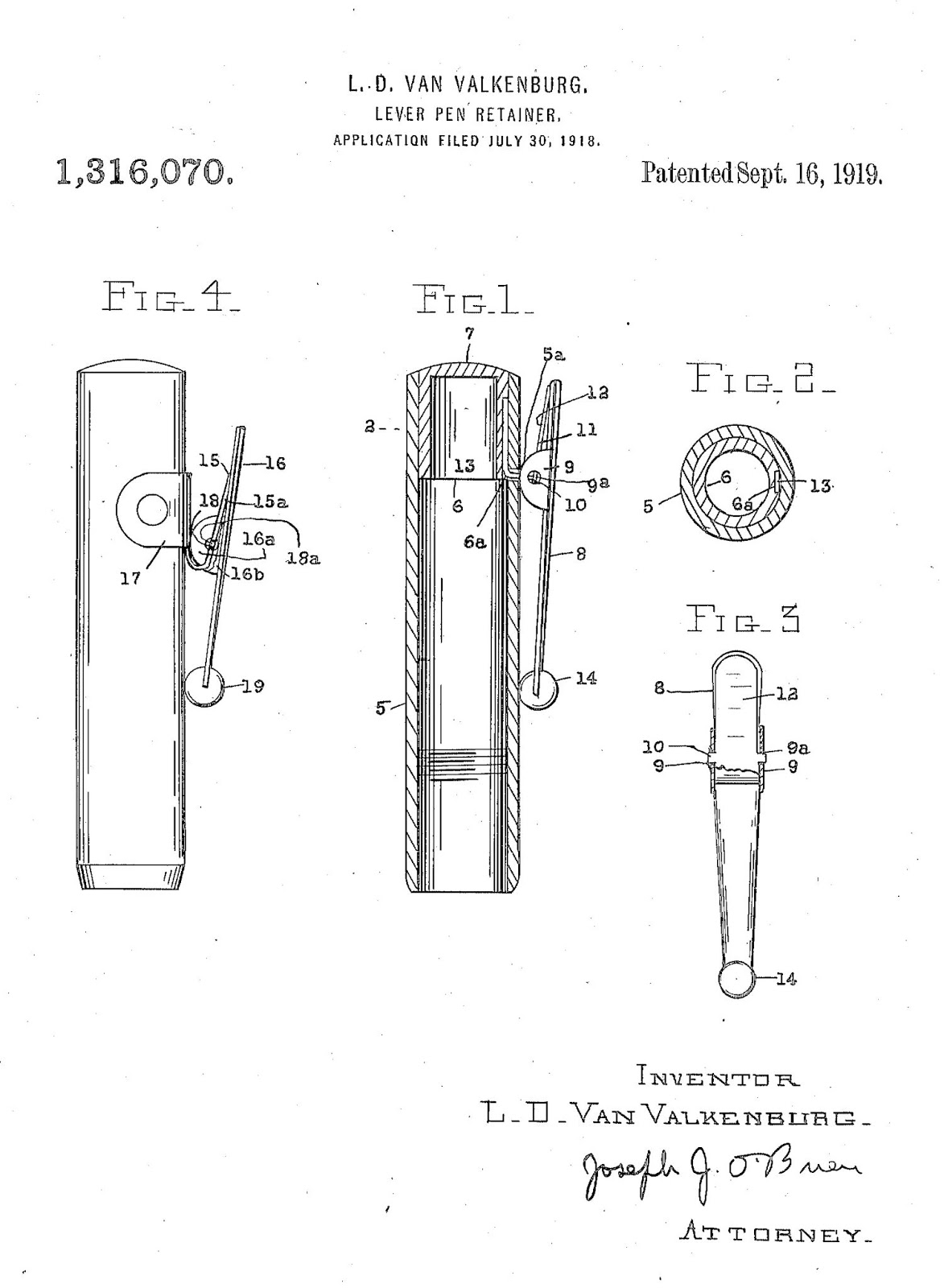
Inconspicuously stamped underneath the back part of the clip is another little bit of information – a patent date of September 16, 1919:


Levi Van Valkenburg was awarded two patents on that date; this clip was covered by patent number 1,316,070, which he applied for on July 30, 1918:


Not surprisingly, these are also found in the same Van Valkenburg in which the Holyoke B clips were advertised.  These were marketed as the Van Valkenburg “Security” clips:


As I mentioned earlier, Jim Stauffer does a great job outlining Listo’s history, but here’s the cliffnotes version.  The company was founded in 1920 by Charles E. Wehn in San Francisco, California; as early as October, 1920, the company was announcing plans to introduce a new pencil, and Office Appliances reported that the company’s first pencils would be out “within two months” in April, 1921:


The Bookseller and Stationer reported, in an account dated June 16, 1921, that the company was planning to build a factory in Alameda.  Perhaps the economic slump of 1921 slowed things down a bit for the company:


The plant’s first pencil was turned out on August 30, 1921, according to the Oakland Tribune:


The following month, notice was published that the company would formally relocate to Alameda:


In December, 1921, the Oakland Tribune ran a nice story about the fledgling company, including a picture of Wehn:


“The two special features of this pencil are the location of the mechanism for propelling the lead in the center of the pencil instead of the end, and the material from which the pencil is made, a light, flexible compound that makes the article scarcely heavier than wood,” the article states.

“Listolite,” the company called that material - others called it Pyralin, but it was celluloid – that makes the Listo well ahead of its time, years before LeBoeuf popularized the substance for use in pen and pencil barrels in the mid-1920s.  Jim dug up this article in Du Pont Magazine from November/December 1922, in which the company praised Listo (Spanish meaning “ready”) for the forward thinking use of Listolite:


While I haven’t seen examples of Wehn’s earlier designs, by the time this advertisement was published in 1924, they were in the same form as the examples pictured above:


Now that I know what I know, that drawer these pencils have been living in simply won’t do. I’ve got to move things around on the wall o’ pencils for the Listo Center-Turn  – pencils that are earlier than they look and far more innovative than I have given them credit.

Even if they do use the same mechanics as my Knapp’s 1857 patent pencil!

Tuesday, May 5, 2020

A Footnote Expanded

This article has been edited and included in The Leadhead's Pencil Blog Volume 6, now on sale at The Legendary Lead Company.  I have just a few hard copies left of the first printing, available here, and an ebook version in pdf format is available for download here.

If you don't want the book but you enjoy this article, please consider supporting the Blog project here.

In yesterday’s article, I referred back to my very brief summary regarding John H. Knapp, an early associate of John Mabie (founder of Mabie, Todd & Co.).   All I knew about Knapp at the time (actually, until I sat down to research this article) came from David Moak’s outstanding book, Mabie in America.  Moak’s work is among my favorite pen/pencil books; however, Knapp was only an incidental character in the Mabie Todd story, so Moak had no reason to cover the Knapp story in more detail.

Much of Moak’s account is based on John Mabie’s obituary, which was published in The American Stationer on January 14, 1892:


Moak writes on page 11, “In 1853, Mabie forms a new company, Mabie, Knapp & Johnston at 15 John.  A listing in the 1994 catalogue for the April Bonham’s vintage pen and pencil auction first alerted the author to the existence of Johnston, though some of the information in the listing appears to be incorrect or miss-typed (sic).  The mention of a Mabie, Knapp & Co. in the biography is an apparent error.”

There’s good reasons to be confused.  Unfortunately, “John H. Knapp” is a name which is just common enough to make him difficult to track (a contemporary lumber magnate from Wisconsin was just one of the many John Knapps muddying up the search results)  I can’t definitively identify any of the other Knapps I came across as being our guy prior to 1851, and Doggett’s New York City Directory for 1850-1851 shows no listing for him.

So, since all sources point to a “Mabie, Knapp and Johnston” emerging by 1853, I started there and worked backwards.  I found John Mabie in the 1850-1851 directory, making pencilcases at 35 Cortlandt:


That is consistent with Moak’s history, and John Mabie’s obituary on which it is based, which report that John Mabie had been working with John Rauch since 1843, eventually becoming a partner in Rauch & Co.  Mabie “retired” from Rauch & Co. in 1851 to a farm in Fairview, Bergen County, New Jersey “on the advice of his doctor,” according to Moak’s book (pages 1 and 2).   The 1851 Doggett’s directory lists John Rauch at the same address as John Mabie, at 35 Cortlandt:


That same directory also lists an “Alexander Johnston,” who was making pencilcases at 6 Liberty:


Wilson’s Business Directory for 1852 lists Johnston at 75 Nassau:


Johnston was running an independent operation, according to this listing, but things might have changed due to turmoil in Johnston’s life.  On March 14, 1852, Alexander’s wife, Mary, passed away – she was just 27 years old:


Within a year, Alexander Johnston sailed for Glasgow, as reported on January 16, 1853.


Maybe.  This passenger list includes an “Alexander Johnston,” but there was also a Scottish geographer by the name of Alexander Keith Johnston running around at the same time, so it might have been the famous geographer returning to the motherland . . . more common names.  However, while Johnston appears as a pencilcase maker in the 1853-1854 directory (which would have been published before his wife died), he disappears from the directory entirely for 1855.  Whether or not this was our Alexander Johnston sailing off to Scotland, after 1853 he sails out of our story for good.

In the meantime, a block or so away from where Johnston and Mabie were making their pencils, two merchants named H.D. Ward and Edwin Ward had decided to part ways.  To continue the business, Edwin Ward associated himself with a John H. Knapp and moved to 117 Maiden Lane to sell “fancy goods, brushes, etc., etc.” as Ward & Knapp.  These notices began in March, 1853, and continued to be published on a regular basis into the second half of the year:


This is the first mention I can find of a John H. Knapp who might be our man is this notice, which doubled both as a copartnership notice as well as an advertisement (note the last line: “Please favor us with a call when you come to the city”).  The firm remained in business under the same name for some time, appearing in the 1860 edition of Trow’s New York City Directory at 64 Maiden Lane:


But this might not be our guy, believe it or not.  Could there really be two guys named John H. Rauch that close together?  The 1860 directory has two listings for John H. Knapp – the listing at the same address as Ward & Knapp reflects a residence in Brooklyn, while the John H. Knapp who is clearly our pencil man shows a residence on Second Avenue:


The same is true in the 1853-1854 directory, which would have been published right around the end of 1852, the time all the characters in our story were coming together:


Meanwhile, John Mabie had recovered from whatever had ailed him and was back in New York by the end of 1852.  Under “Mabie” in the 1853-1854 directory, we find a listing for Mabie, Knapp & Johnston, at the same address as Knapp’s pencil operations.  John Mabie is listed there as well:


Alexander Johnston’s last appearance in our history is in this same directory, also at the 15 John address.  I found no formal notice of the formation of Mabie, Knapp & Johnston, but the partnership, which appears to have been informally put together after the death of Johnston’s wife in 1852, was short-lived.  Notice of dissolution, by the withdrawal of Johnston, was published on May 31, 1853, just a few months after Alexander Johnston sailed off to Scotland.  Johnston was replaced by John McGovern, and the firm was renamed Mabie, Knapp & McGovern:


The term of the partnership agreement for Mabie, Knapp & McGovern ended on December 31, 1855, and notice of dissolution was published on January 7, 1856.  Knapp took with him the firm’s name and wound up the partnership at 58 Nassau, while Mabie and McGovern stayed at 15 John:


From that point on, Moak’s book ably documents the evolution of John Mabie’s partnerships into what became Mabie, Todd & Co.  Knapp, however, falls from Moak’s radar completely (and rightly so, as he was a tangential character in the story Moak was writing).  As mentioned yesterday, Knapp obviously remained in business for many years after parting ways with John Mabie, as evidenced by the many examples of magic pencils which bear his 1872 patent date.  The year those patents were granted, he was still at 17 John Street, according to the 1872-1873 Trow’s directory:


He was still at that address in 1877, when a confidence man claiming to have been sent by a local jeweler to pick up merchandise relieved him of a half dozen gold toothpicks:


In 1899 he was listed at nearby 23 John Street as a manufacturer of both pen cases and pencil cases, according to Seeger and Guernsey’s Cyclopaedia of the Manufacturers and Products of the United States:


In 1903, Knapp purchased a new residence, at 424 W. 160th Street:


In 1905, he is listed at 2 Dutch;


In the 1915 directory, Knapp’s residence on 160th Street still appears, but the listing for his business suggests he was no longer associated with the firm which continued to bear his name.  The listing indicates that Jacob and Charles Miller were producing “pen mountings” as John H. Knapp Co., at 102 Nassau Street:


In 1920, The Commercial Register reported Charles Miller at 102 Nassau, still making pens.  But there’s no mention of Jacob:


The last mention I found was in 1921, when The American Stationer reported Knapp as among those firms making gold nibs:


From there, the trail ran cold.  I found several obituaries for guys named John H. Knapp, but none contained any details connecting them definitively to our man – and you would expect, with such a long career as a pencilmaker, that there would be at least some mention of it.

If finding “John Knapp” was challenging in a city as large as New York, looking for a “Charles Miller” after 1921 proved immensely daunting, so I don’t know how much longer Miller remained in business or continued to use Knapp’s name.  However, now we know that John H. Knapp, who never warranted more than a footnote in the early history of Mabie, Todd & Co., had a career that continued at least fifty years after he and John Mabie parted ways, and Knapp’s successor, Charles Miller, continued under that name for at least fifteen years after that.

Monday, May 4, 2020

Shot Heard 'Round the Museum

This article has been edited and included in The Leadhead's Pencil Blog Volume 6, now on sale at The Legendary Lead Company.  I have just a few hard copies left of the first printing, available here, and an ebook version in pdf format is available for download here.

If you don't want the book but you enjoy this article, please consider supporting the Blog project here.

Loyal Knight and fellow motorcyclist Brian Holstine and I catch up every year in Chicago to chat pencils and bikes, and in between we’re emailing a few times a year, discussing things we’ve found.  A few months ago he emailed me to ask me if this was something which might find a good resting place at the museum:


He sent it to me on approval, and I approved - we found a price that we were both happy with, given that the pencil part has long since gone missing.  He knew I’d like it, and he was right, because of the imprint on the side:


“Knapp’s Patent / Jan 6 1857.”  I’m always a sucker for a patent date not represented in my collection, and that was one with which I was unfamiliar.  John H. Knapp himself, though, is someone with whom I am well acquainted:


His patent – or rather patents – of February 6, 1872 are a familiar sight on “magic” pencils (that’s the breed of pencil which advances the pencil in one direction by pulling back on the other end . . . as if by magic, by Victorian standards).   His patents from February 6 were number 123,485 and 123,486:


It’s been years since I’ve had occasion to write about John H. Knapp.  In 2013, I wrote an article about several pencils I picked up at the Philadelphia Show that year, from all different makers (The Leadhead’s Pencil Blog Volume 2, page 121).  Since that article covered pencils by several makers, I didn’t spend much time talking about Knapp.  All I said about him was this:

“John H. Knapp was an early partner with John Mabie (Mabie Todd & Co.). According to David Moak’s book, Mabie in America, Mabie, Knapp & Johnston was formed in 1853; a year later, the name was changed to Mabie, Knapp & McGovern. By 1856, Knapp and Mabie had gone their separate ways, but as this pencil indicates, Knapp remained active in the business long after his association with John Mabie ended.”

That account is consistent with John H. Knapp’s patent accomplishments.  His first patent, number 15,660, was issued on September 2, 1856, right after Knapp parted ways with Mabie.  It was for a pencil which could be advanced in either its short form or extended outward:


But the patent relevant to our discussion today was his second patent, design patent 861:


Knapp’s patent was for the design – the outward appearance of the pencil – rather than for the mechanics inside it.  It was “made in the form of a cannon,” as the text of his patent indicates:


Yet there is something unusual about Knapp’s cannon pencil.  I wish I could show you the pencil advanced, but as I mentioned, the pencil mechanism has long since gone missing.  From these remains, though, I know that the center band of the pencil isn’t just decorative, it’s functional – that band rotated to advance the pencil into position.  That configuration is something I haven’t seen in only one other pencil, and they weren’t from the Victorian era.

I’ll get into those mechanics in a couple days.  In the meantime, my curiosity was reignited to learn more about John H. Knapp, that nearly forgotten footnote in the history of Mabie, Todd & Co.  That story tomorrow . . .