Showing posts with label Eversharp (Heath-clip). Show all posts

Tuesday, September 16, 2025

Of Radios, Pencils, and a Migraine

I have known about these pencils for years, but it wasn’t until the last year or so before I finally acquired one. 


All that I remember is that I caught this one “fishing with hand grenades” – that is, I bought a whole bunch of crap and this one happened to be in it. The clip reads “Cunningham Radio Tubes”:


That clip explains why these always seem to go for more money than I could justify paying. Collectibles that sit at the intersection of different disciplines tend to be valued more highly – in this case, pencil collectors and radio aficionados both chase them, and the radio guys are more likely to spend the bigger money. This example, like all of the others I have seen, is in a great lapis color with distinctive red bands, and on the side of the barrel, there’s also a metal plaque offering birthday greetings to “O.D.M.”


Cunningham Radio Tubes were marketed by Elmer T. Cunningham, who founded the Audio Tron Sales Company in San Francisco in 1915. Cunningham was a slippery character who fought off numerous patent infringement claims and went through a number of different business organizations – it is a fascinating history, but if I attempted to lay out the entire saga here (1) I doubt I would do the story justice, especially for any radio enthusiasts in the audience and (2) it would take me so far out into left field that I fear I would never get around to the story I’m telling today. 

For our purposes, by 1931 the most recent incarnation of the Cunningham Radio Tubes business, by then going by “E.T. Cunningham, Inc.,” had been purchased by RCA. The distinctive letter C on the clip is drawn from Cunningham’s handwritten signature, as shown in this magazine advertisement published in 1925 or so:


I don’t believe the makers of Cunningham Radio Tubes got a wild hair and went into the pencil business (even though the Tri-Pen Company, makers of Triad pens and pencils, did exactly that). This is the only color and configuration in which I believe these are found, and if Cunningham had started a pencil business I’d expect to see more than one variation. I believe this is a specially commissioned advertising pencil, complete with a figural cap made to look like one of the company’s radio tubes.

My best guess as to who might have manufactured these pencils is Mabie Todd & Co., which used that same color celluloid, offered colored bands like these on some models, and Mabie Todd pencils share that slender front end and elongated metal tip. In the absence of any manufacturer’s marking, that is just my best guess. 

That guess took a weird left turn recently. Unless Mabie Todd did some really weird stuff like what I’m about to show you, and I don’t think it did, Elmer Cunningham must have sourced pencils from other manufacturers, as well.

And who that manufacturer might have been is just fascinating . . . 


Bob Speerbrecher (known by eBay shoppers as Speerbob) sometimes sends me pictures of things he is getting ready to list to ask for my input about what they are and what a reasonable price might be to ask. In this case, I told him not to bother listing it, because he had already found his buyer. Neither of us knew what a reasonable price for it might be, so we agreed that I’d find some extra pencils laying around to send him in trade (and that trade, I’ll tell you at some point, was an entire story all its own).

There are three weird things about this pencil I have to show you. The obvious first question concerns that cap - I don’t remember whether I made the connection while Bob and I were discussing the pencil by email, but by the time it arrived I understood exactly what it was:


Yes, Virginia . . . that’s Elmer’s distinctive handwriting all right. Although the pencil is not otherwise marked, the shape of the cap and the letter stamped on top of it are all I need to identify this as another Cunningham Radio Tubes advertising pencil.


I took another look at my lapis Cunningham Radio Tubes pencil because I didn’t recall that same treatment, but it does share that same letter C on top of the cap. It was so faintly stamped that I hadn’t noticed it before.


Speerbob’s Cunningham pencil is enigmatic. It is an early repeater pencil, and its resemblance to a Presto is both uncanny and just a little bit off.


The lead is significantly thicker on the Cunningham pencil, while all of the Presto repeaters I have seen have been uniformly equipped to accept ordinary 1.1 millimeter leads. If Presto was commissioned to make a special order pencil, in this case they made one that was really special. The oddities continue inside:


The internal workings of Presto repeaters are as consistent as the lead size they used, but this Cunningham repeater is built a little different, with a nose cone that screws into the threaded end of the barrel and different proportions of the brass inner parts. The Presto was derived from Abraham Pollak’s patent number 1,592,502 issued on July 13, 1926.


Pollak’s patent is famous because it was invalidated after the Gilfred Corporation (makers of the Everfeed, descended from the Presto) sued Eversharp for infringement of this very patent. I discussed the Gilfred v. Eversharp litigation in one of  my earliest articles here, long since wiped from the Internet but surviving in print form - see “My Find of the Year” (December 31, 2011: Volume 1, page 63). The story was also reprised in Eversharp: Cornerstone of an Industry, at page 314.

In my opinion, this Cunningham pencil is so similar to a Presto repeater that they must have been made by the same manufacturer. At the time, with Pollak’s patent fresh on the books, anyone else copying his design this closely would have treaded in perilous waters indeed.

Unless . . . 

I told you earlier there are three weird things about this pencil: the Cunningham connection and this pencil’s weird, close-but-not-exact relationship to the Presto are two of them. The third weird thing about it is that unusual clip:


I have never seen a clip like that on a Presto, but I have seen it . . . and so have you:


That’s our Cunningham posed alongside an early Ever Sharp made between 1913 and 1915. Charles Keeran’s earliest Ever Sharp pencils (“Eversharp” was two words in those days) were manufactured by George W. Heath & Co., and they sported clips patented by brothers George and Alfred Heath, who applied for patent 1,145,583 on June 12, 1912. Their patent was granted on July 6, 1915:


There is no question that what we see on this Cunningham pencil is this same patented Heath clip, with a ball added at its terminus. On Ever Sharp pencils, these are invariably stamped “Pat. App. For”; Keeran had hired the Wahl Adding Machine Company to take over production of his Ever Sharp in October 1915, and no Ever Sharp pencils are known to exist with the actual patent date stamped on the clips.


However, this Cunningham pencil has no markings on the clip, sending my thought process in an entirely new direction. In the mid-1920s, when this Cunningham pencil was likely made, Heath’s clip patent was still very much in force – unless someone else succeeded in court to invalidate it, but I haven’t seen any evidence for that. Maybe someone acquired the rights to the patent, or maybe someone deliberately copied it.

No love was lost between Heath and the makers of the Eversharp after production of the Ever Sharp was turned over to Wahl - Heath apparently refused to allow Wahl to license the clip, so Keeran and John Wahl scrambled to design new clips (first the spade or “trowel” clip, followed quickly by Wahl’s ubiquitous tombstone-shaped version). I have no idea why the Wahl Company would have any interest in acquiring Heath’s clip after coming up with its own.

Yet, I can’t shake this feeling that this is more than a coincidence. This is the second connection I’ve found between the Presto and the Eversharp: the Gilfred v. Eversharp litigation in 1940 is one, and this Presto-ish pencil’s use of the Heath clips Ever Sharp pencils once used makes two.

There may be three.

Back in 2013, I compared Presto’s earlier, metal repeating pencils to engine-turned Wahl Eversharps. I found them to be so similar that I theorized The Wahl Company may have been the actual manufacturer of those early metal Prestos. See “Presto! A Revelation!” (August 15, 2013: Volume 2, page 214).


There’s more. While Presto did not to my knowledge offer pencils using fatter leads like this Cunningham, The Wahl Company offered several models equipped for .075" leads, just like the Cunningham pencil. In addition, one repeating pencil with thick lead and a shaky Wahl connection also comes to mind:


This is the John C. Wahl “120,” which was not a product of the Wahl Company exactly, but by John C. Wahl, Inc. John was still connected with Wahl at the time the John C. Wahl 120 was made; for whatever reason the company that bore Wahl’s name did not pursue the project but apparently allowed him to produce the pencil on his own – see “Not Just to Show Off” (February 10, 2015: Volume 3, page 221). 

Wahl’s patent for what I believe was the John C. Wahl 120 was applied for on June 19, 1939 and was issued on August 6, 1940 as number 2,210,845.


John Wahl’s design is a bit different from what we see on the Cunningham pencil, which in turn is a bit different from the Presto. While E.T. Cunningham, Inc. had been sold to RCA by the time the John C. Wahl 120 was introduced, RCA was still advertising radio tubes under the Cunningham name.

All I know at this point is that my head hurts.

Sunday, August 8, 2021

Square Pegs Are the Best

This article has been included in The Leadhead's Pencil Blog Volume 7, now available here.


If you don't want the book but you enjoy the article, please consider supporting the Blog project here.

In “To Out-Heath Heath” on July 19 (https://leadheadpencils.blogspot.com/2021/07/to-out-heath-heath.html), I wrote about Charles Keeran’s decision to change suppliers for his Ever Sharp pencils in October 1915, from the George W. Heath Co. to the Wahl Adding Machine Company.  Keeran claimed the move was to increase production - he had no qualms about the quality of Heath’s work, but Heath wasn’t able to keep up with the demand for Ever Sharp pencils.  

The transition appeared to be a clean break, with no overlapping production.  Heath did not license Wahl to use Heath’s patented clips, so the earliest Wahl-made Ever Sharp pencils sport Keeran’s hastily improvised “spade clip,” for which Keeran applied for a design patent he applied for a patent on April 4, 1916.  After Keeran’s clip proved too labor-intensive in production, John Wahl applied for the familiar tombstone-shaped clip found on millions of Eversharps on March 8, 1917 (note: Wahl contracted “Ever Sharp” to “Eversharp” in 1918).  

As mentioned in my July 19 article, Wahl also had to cook up engine-turned patterns for the barrels on these pencils from scratch.   “Apparently, Heath wouldn’t share tooling or otherwise allow Wahl to make the same patterns for Keeran’s Eversharps, either – the patterns found on Heath-clip Eversharps are generally not found on pencils made by Wahl,” I wrote.

I narrowly avoided being wrong.  Scratch that . . . maybe I should say I narrowly avoided drilling a round hole, into which today’s square peg doesn’t fit.  I thought, but did not say, that Wahl made everything in-house from day one and did not source any parts from Heath.

After that last article ran, Douglas Heinmiller, who contributed several images to A Century of Autopoint, emailed me some pictures of an Ever Sharp that fits within the article I wrote, but not within what I was thinking when I wrote it:


This example sports one of John Wahl’s patented tombstone clips – which I should think means it was made after Keeran made the move to Wahl in October 1915, and even after Wahl abandoned Keeran’s spade clip.  There’s one H of a problem, though.  Two “H’s,” actually . . .


Both the cap and the barrel are stamped with George W. Heath’s hallmark.  Heath’s mark is included in American Writing Instrument Trademarks 1870-1953 – not as a Federally registered mark, but in the appendix, illustrated in the 1904, 1915, and 1922 editions of Trademarks of the Jewelry and Kindred Trades:


Douglas’ pencil is fascinating, because it does not square at all with the completely consistent story we thought we knew.  It is the first example of an Ever Sharp I have seen with Heath hallmarks; not even those earliest Ever Sharps with Heath’s patented clip bore these markings (Heath-made Ever Sharps are identified solely by Heath’s patented clip and distinctive metalwork).  

The mark suggests that Heath supplied at least this cap and barrel to someone else, and the obvious buyer would be the Wahl Adding Machine Company . . . that possibility seems less obvious, however, upon closer examination of the pencil.  Eversharps that sport John Wahl’s patented clip have a very clean, precise tombstone cutout into which these clips fit, as shown in Wahl’s patent drawings: 


Douglas’ pencil has a more rough-cut opening to accept the clip, with gaps that are uncharacteristic for pencils made by Wahl; perhaps it was a retrofit, made by cutting out the area which would have been punched for a Heath patented clip:


One interesting possibility I considered is that Wahl’s patented clip might actually have been an innovation which originated in Heath’s facility rather than in Wahl’s.  According to the patent application, John Wahl was actually the co-inventor of the clip, along with William H. Odlum, also of Chicago:


This was Odlum’s only writing instrument patent; much later, he patented several other innovations in machinery, but none were assigned to Wahl.  Could Odlum have invented a version of Wahl’s clip earlier, while he was working for Heath?  I found no evidence to support that theory, so that is just bare speculation.

One logical explanation is that Heath had leftover barrels after production of Ever Sharp pencils was transitioned to Wahl; that might also explain why the Ever Sharp imprint is double-stamped.  Perhaps Heath re-stamped retrofitted barrels to add the company’s hallmark before offloading them to Wahl:


Although this explanation seems to be the simple answer, it has its problems.  Why would Wahl, firmly established in manufacturing pencils by the time the Wahl-clip pencils were in production, have any interest in crudely retrofitted barrels stamped with Heath’s hallmark – especially plain barrels with none of Heath’s superior metalwork? 

There’s one other possibility.  In Charles Keeran’s 1928 letter to Wahl's directors, he accused Wahl of muscling him out of his ownership in the Eversharp Pencil Company; on the other hand, Wahl’s version of the story is that Wahl accepted Keeran’s stock in the company in lieu of payment for pencils sold on credit when it became apparent Keeran would be unable to pay for them.  Wahl’s version is likely the accurate one.

There was probably a time, sometime in 1916, when Wahl declined to supply Keeran with any more Ever Sharps until some arrangement had been made to pay for the stock Wahl had already delivered to him.  Perhaps Keeran scrambled to find another supplier, knocking once again on Heath’s door to see if the company would make his pencils.

The timeline for this possibility both fits and doesn’t fit.  The patent for Wahl’s clip wasn’t filed until March, 1917 – long after Keeran had been divested of his shares in the Eversharp Pencil Company, which doesn’t fit.  

However, when the patent application was filed is telling.  By March, 1917, Keeran’s relationship with Wahl was strained, and within a couple months he would be ousted from Wahl entirely.  During that tense time, Wahl might have filed the patent application for this clip months after it was developed, perhaps by Odlum and perhaps with Keeran’s input, after it was clear Keeran was on his way out.

If Odlum had developed this clip earlier, while Wahl was still supplying pencils for Keeran rather than making them on its own account in 1916, Keeran might have considered the innovation a “work for hire.”  He might have felt entitled to take Odlum’s clip with him over to Heath, to see if they could make one like it, which Heath did – although somewhat crudely – repurposing leftover parts.  After Wahl acquired Keeran’s stock in the Eversharp Pencil Company, Wahl would most certainly have put a stop to that.

All three of these possibilities are interesting.  Maybe Heath actually developed what we now refer to as the “Wahl clip.”  Maybe Heath dumped its leftover parts on Wahl.  Maybe Charles Keeran re-engaged Heath briefly just before he lost a controlling interest in his Eversharp Pencil Company.

All of these theories are thin.  However, any one of them might some day prove true, and any one of them would add an interesting footnote to the early history of the Ever Sharp.

Tuesday, May 25, 2021

Still Not Done . . . After Three Tries

This article has been included in The Leadhead's Pencil Blog Volume 7, now available here.


If you don't want the book but you enjoy the article, please consider supporting the Blog project here.

The “Redypoint” is among the earliest pencils made by DeWitt-LaFrance (better known as manufacturers of the “Superite”), for Boston stationer Samuel Ward Manufacturing Company.  

I first started shooting some photographs of my Redypoints when the one at the bottom of this picture came my way:


The top example is the Redypoint which unraveled the whole story of “Wahl, Sheaffer and the Race for Boston” (Volume 4, beginning on page 300) - it is identical to an early Sheaffer Sharp Point pencil, and the pattern engraved on the barrel is unique to early Sheaffers.

Other than the name on the side and some really weird, heavy wear on the crown, this new one was the cleanest example I’ve found:


And I thought I was done.  Kind of a short article, so I didn’t do anything with it.

Then along came another example, in sterling, with something else that I’ve been itching to delve into a bit more:


As mentioned earlier, the only Redypoint I’ve found in a pattern also used by Sheaffer is that Sharp Point lookalike – but that checkerboard chasing on this example is closer to a Sheaffer pattern than any other I’ve seen to date.  Of course, it’s also close to a pattern found on pencils made by another character in the Wahl/Sheaffer story:


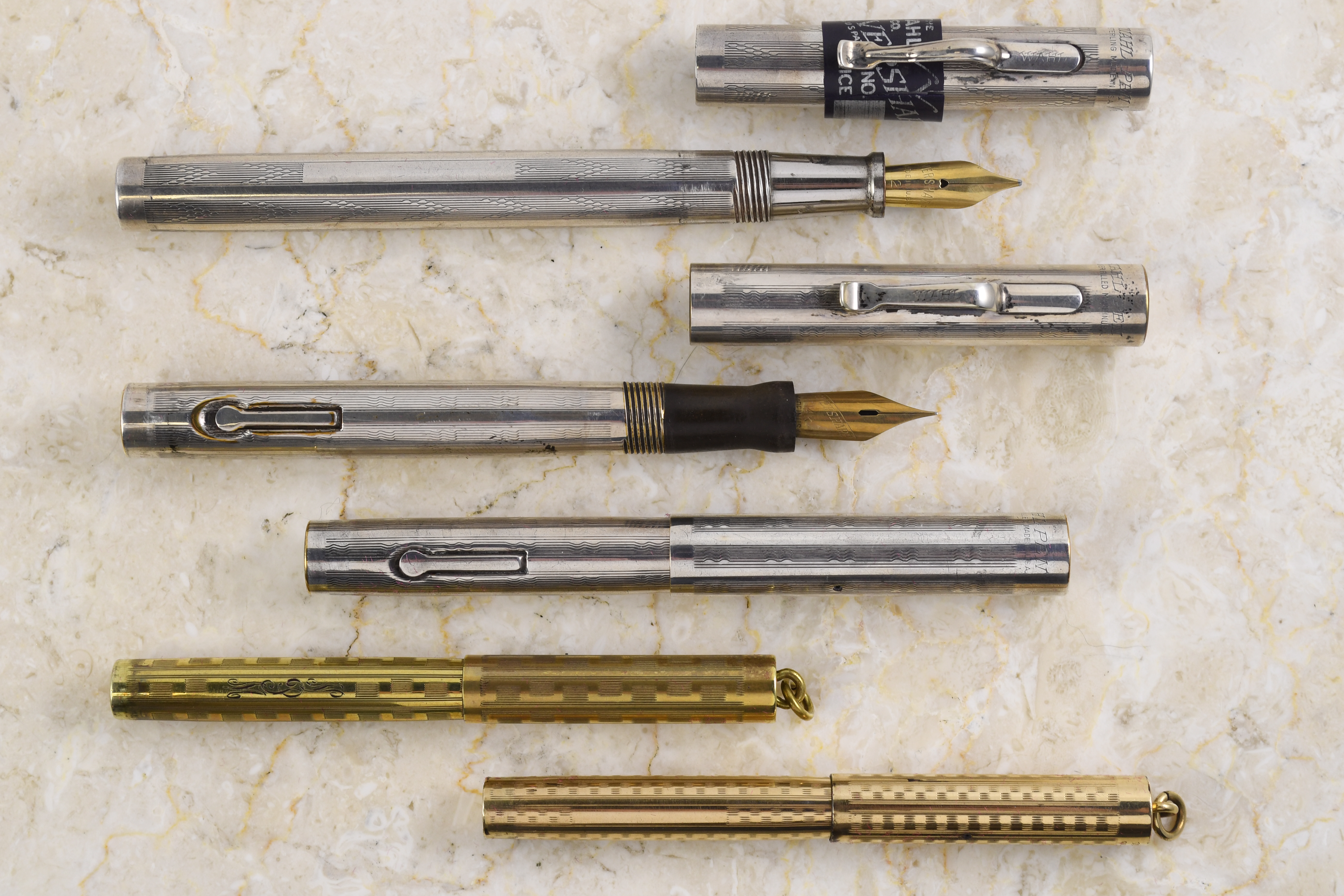
The silver Redypoint is shown here flanked above by an early Heath-clip Ever Sharp made by Heath for Charles Keeran before Wahl started making his pencils.  Below it are two Sheaffer Sharp Points - the one with the broken clip has a normal gauge barrel, while the bottom one is much lighter and thinner, more like the GF (General Fireproofing) pencils I’ve speculated about.  

Here’s a closeup of the Redypoint and the Ever Sharp:


They are close - on both, you can see how the chasing blades bounce a little with each cut.  However, the Redypoint has squares consisting of four lines, while the Ever Sharp has five.  

The more refined of the two Sharp Point pencils has squares consisting of six lines, and the engraving is more even:


While the other example with the thinner barrel has more pronounced lines like the Redypoint, but in squares of five lines:


And with that, I thought I was done with this article . . . again.  All I have to report is that this latest Redypoint has engraving which is similar to both a pre-Wahl Ever Sharp and two Sheaffer Sharp Points, but not identical to either.

Then I received an email that a package was being shipped to me from David Nishimura’s Vintage Pens, LLC.  Curious, I thought: I hadn’t ordered anything from David’s website, and all I was expecting from him was a check for the things I bought for him at the Krinke auction.  Maybe he was sending me one of those really big checks as a gag or something, I thought.

Nope.  A normal-sized check arrived in a box accompanied by a small “thanks for bidding for me” gift . . . one David knew would grab my attention:


There’s another Masonic emblem, the third to arrive since John Hall passed.  I swear my buddy is pestering me from the hereafter:


However, there is no manufacturer’s mark, which is infuriating since it is a dead ringer for a General Fireproofing pencil:


That’s a ringtop GF pencil in the same pattern, and the lighter Sheaffer Sharp Point.  As to the GF, I mean the same pattern, not a similar one –  boxes made up of four lines, just like on my new sterling Redypoint:


The last time I was muddling around with GF pencils, it was to discuss an example I had found that shared the same triangle/dot pattern found on my Redypoint/Sharp Point lookalike (see Volume 6, page 197).  I was so close to proving that the GF pencils were made by DeWitt-LaFrance in 1917-1919 that I could taste it: “All we need now is documentation to establish when General Fireproofing began offering pencils for sale,” I concluded.

You can see lettering on the barrel of the Masonic pencil . . . could this be the missing piece?


“Wieland - No. 714 / 1871-1921.”  Geez . . . this pencil is almost what I’ve been looking for in so many ways.  It’s almost a General Fireproofing pencil, but without any markings there’s no way to know for sure.  It almost fits within the timeline, but just a couple years too late – after Sheaffer had set up its pencil manufacturing plant in Fort Madison.  

And the embossing for that commemorative inscription?  Raised lettering rather than stamped is something I haven’t found on a GF, a DeWitt-LaFrance pencil or a Sheaffer.

Almost . . . almost . . . almost.  I’ve taken three swings at this article, and I still haven’t found the answers I’m seeking!

Monday, April 5, 2021

The Tail that Wagged the Dog

This article has been included in The Leadhead's Pencil Blog Volume 7, now available here.


If you don't want the book but you enjoy the article, please consider supporting the Blog project here.

After an eight-hour drive, it only took me an hour or so to preview the auction lots I specifically came to see at the Krinke auction – the two pencils I needed to preview (the stainless Eversharp Skyline as well as another one I’ll tell you about later), plus a dozen or so other things my friends wanted me to look over before they decided how much to bid for them.

Oh, but there were thousands of other things there to look at, too, and this was the closest thing to a pen show I had been able to experience for a year . . . it would be such a pity not to geek out over the rest of the auction fare, just for kicks.  So I kicked.

One curious lot that I didn’t think I needed was this Eversharp/Wahl Pen store display:


“Curious,” I thought, in how it was being offered for sale.  The display had been in Fred Krinke’s Fountain Pen Shop since it opened in 1922, according to legend, and it was being sold as one lot, complete with its contents.  However, there was no reason to include the what was in the box – yes, it was fully stocked with fountain pens, pencils, and leads, but this clearly wasn’t the original stock.  


Those red, white and blue lead containers in the upper left cubby hole are V-Mail leads from World War II, and the plastic lead containers in the next cubicle are from the late 1930s.  Similarly, the pens and pencils span at least a decade . . . the only thing these items had in common was that Fred Krinke thought they all looked nice together in this case.  As for the leads . . . well, I’ve got a few of those to spare already.

From what I could tell online, I didn’t see anything I’d want to add to my collection . . . just inventory for the next pen show, whenever that happens.  A closer examination confirmed that assessment . . . with the exception of just one item:


If it looks a little bit fat, good eye – this is a rare oversized Eversharp metal pencil.  If you noticed the pattern – “wave,” the company called it – bonus points.

If you noticed that it’s an oversized Eversharp metal pencil with the wave pattern . . . well, you must read this blog a lot.  I’ve found just a handful of these oversized pencils over the years.  Some take .075" lead, some take standard .046" lead, but all of the ones I have found have either plain metal barrels or the “Grecian Border” pattern: 


The last time I visited the subject of the oversized metal Eversharp (Volume 4, page 96), I mentioned that the gold filled example is illustrated in the 1928 Wahl catalog but the Oxidized Grecian Border (silver filled over brass, with the brass exposed by the chasing) was not.  That’s technically correct, but I should have been more clear – 


The catalog shows the gold filled oversized pencil, second from left, with the grecian border pattern, designated model J414 (the regular full-length pencil to its left was model 14, and I’m betting J means oversize, and 4 means .046" lead).  Immediately to the right of the oversized is the standard diameter model, made to accommodate .075" lead and designated model 714 (the prefix “7" must mean .075" lead), so I’d bet that an oversized Grecian Border pencil with .075" lead would be model J714.  Oversized pencils with plain barrels are not found in the 1928 catalog – neither in silver plate nor gold filled.

The wave pattern, however, isn’t cataloged in any size at all in 1928.  Unfortunately, the PCA library doesn’t include catalogs for 1927 or 1926; a low-quality copy of a 1926 dealer’s flyer shows a “New Big Barrel, Big Lead Eversharp,” but it looks like that is the typical mottled hard rubber or jade celluloid model, not an all-metal one.  The 1925 catalog illustrates wave pencils, but only in ringtop and standard diameter clip models:


According to this, the standard issue wave pencil was model 35, which would make this oversized example a model J435 if Eversharp was consistent (I know that’s a mighty big if – we’ll see if a catalog ever shows up to substantiate this).   Here’s the oversized model shown next to the standard issue model 35, for comparison:


Whatever it was called, I had to have it if possible . . . but it was the only item in that case that interested me.  Even the case itself didn’t particularly interest me, since I have an entire double printer’s cabinet which houses my “world’s largest” Eversharp collection, with still a third of the drawers vacant:


I messaged Trevis Young, a metal Wahl pen fanatic, to see how much he might pitch in for the pens if I gave chase during the bidding, then sat on pins and needles.  The auctioneer’s only other pause in the bidding to hype up an item was for this lot, but his pitch focused on the fact that this case had been in Fred’s shop, allegedly since it was founded in 1922, and that it was offered intact, just as it had been left until this auction.  No attention was drawn to the items inside.

The opening bid was $500.00, and they had that bid from the online peanut gallery.  I bid $550.00, and for a moment bidding stalled . . . long enough that Trevis told me later he nearly jumped in, just in case I was sleeping at the switch.  Just before the hammer fell, someone else jumped in, but at the end of the day I was the highest bid, at $950.00.  

The price was mighty steep for one pencil and a case I didn’t really need, but Trevis was true to his word and he took a few items to help defray some of the cost.  Back in my hotel room, I went through what was in the case, and when I took out my prized new pencil, I found something I didn’t notice during the preview:


The pencil is fitted with one of the price “wafers” Eversharp used in the late 1920s, and unlike most of these the lettering isn’t worn at all.  And . . . a second pristine price wafer was in one of those cubby holes with the leads!

But there’s a problem.  The pencil also has a price band, with no model number, and neither of the wafers has a model number matching what I suspect the number would be for the pencil.  Also, those holes with side cutouts were generally used on ringtop models, so they slide over the ring to secure on the barrel end, and the spare one is bigger than the pencil’s diameter.

I hit the books looking for any reference to these numbers, and I found them in the 1929 catalog.  As I suspected, the wafer on my pencil was added later, just for a bit of NOS goodness, or maybe just as a convenient place to keep it.  Model 5212w designated a ringtop pen in jade green (“w” in Eversharpese meant “with ring”):


While Model 6412w designated the larger, gold seal Personal Point ringtop, also in jade:


That was a bit disappointing, but not a total loss – I’m confident there’s an Eversharp collector or two out there who needs these rings to add some correct NOS flavor to these exact pens, and that will also help offset the cost!

My apologies to any underbidders who wanted to see and handle the contents of this case intact, before they are separated to the four winds into my hands, Trevis, and other collectors.  As a consolation, Trevis and I agreed that before I shipped him his pens, I’d take the time to shoot better pictures of what was included, exactly as it came to me.  First up are the pens:


The top example has interesting flourishes on either side of the imprint that I haven’t seen before:


Two of the ringtops are earlier models, carrying over design features from the Boston Fountain Pen Company, which Wahl acquired in 1917:


Next are some Eversharp metal pencils, including two post-1924 model in “ripple” with the matching engraving on the works inside:


The second one from the bottom also had another neat feature on top:


An instruction sheet found in the case would have been correct for those post-1924 models, as it illustrates the “New, Perfected Wahl Eversharp.”


The last four pencils in the case are relatively unremarkable:


However, the one with the price banded is an upgrade to the one I have, and I’ll also keep that enamel-over-aluminum pencil in an unusual color I haven’t seen before, something close to Parker’s “Pompeiian.”

As for the case itself . . . well, now that it’s here, I have put it to good use.  I’ve long thought it a shame to confine my early Heath-clip Ever Sharp pencils to that printer’s cabinet, and this cabinet is early – not as early as the Heath-clip pencils of 1914-1915, but note that the “S” in Eversharp is a bit bigger:


That is only found on very early Wahl stuff – after the Boston pen acquisition at the beginning of 1917, but perhaps a transitional step from “Ever Sharp” (two words) to the truncated Eversharp of 1918.

Nevertheless, my earliest and most prized Ever Sharp pencils now reside comfortably in Fred Krinke’s case.  I’ve kept the leads in there for now, as a nod to his legacy, as well as the small slip of paper I found inside:


Thanks, Fred.