Showing posts with label Pearce. Show all posts

Tuesday, June 15, 2021

Rounding Up the Victorians

This article has been included in The Leadhead's Pencil Blog Volume 7, now available here.

If you don't want the book but you enjoy the article, please consider supporting the Blog project here.

The collecting universe seems to have a cyclical rhythm.  When I piddle through online auctions, my search is usually for “pencils” rather than for any particular breed or vintage – yet from unrelated sellers, like pencils of similar feathers will flock together to my doorstep.

The image at the beginning of yesterday’s article grouped together a cluster of Victorians that landed here within a fairly short time, from random sources.


For starters, here are three interesting John Hollands:


Represented here from top are a dip pen, a combination dip pen and pencil (based, incidentally, on John Mabie’s October 3, 1854 patent discussed yesterday), and a magic pencil.  


Still, the holder is marked Holland, and as a proud Ohioan, it’s nice to see the Cincinnati maker’s mark:


And then there’s that nib . . . a big, gorgeous, and tougher-to-find Number 6 “horseshoe” nib


The combo is a tiny little thing, with a much smaller Holland Number 2 nib that needs a little bit of work:


What really attracted me to this one is the barrel composition: sterling and rose gold on the barrel, with yellow gold ends and slider ring – two-tone Victorians you’ll find from time to time . . . but tri-tone?  


That third Holland looks like an ordinary magic pencil, but there’s something special about it:
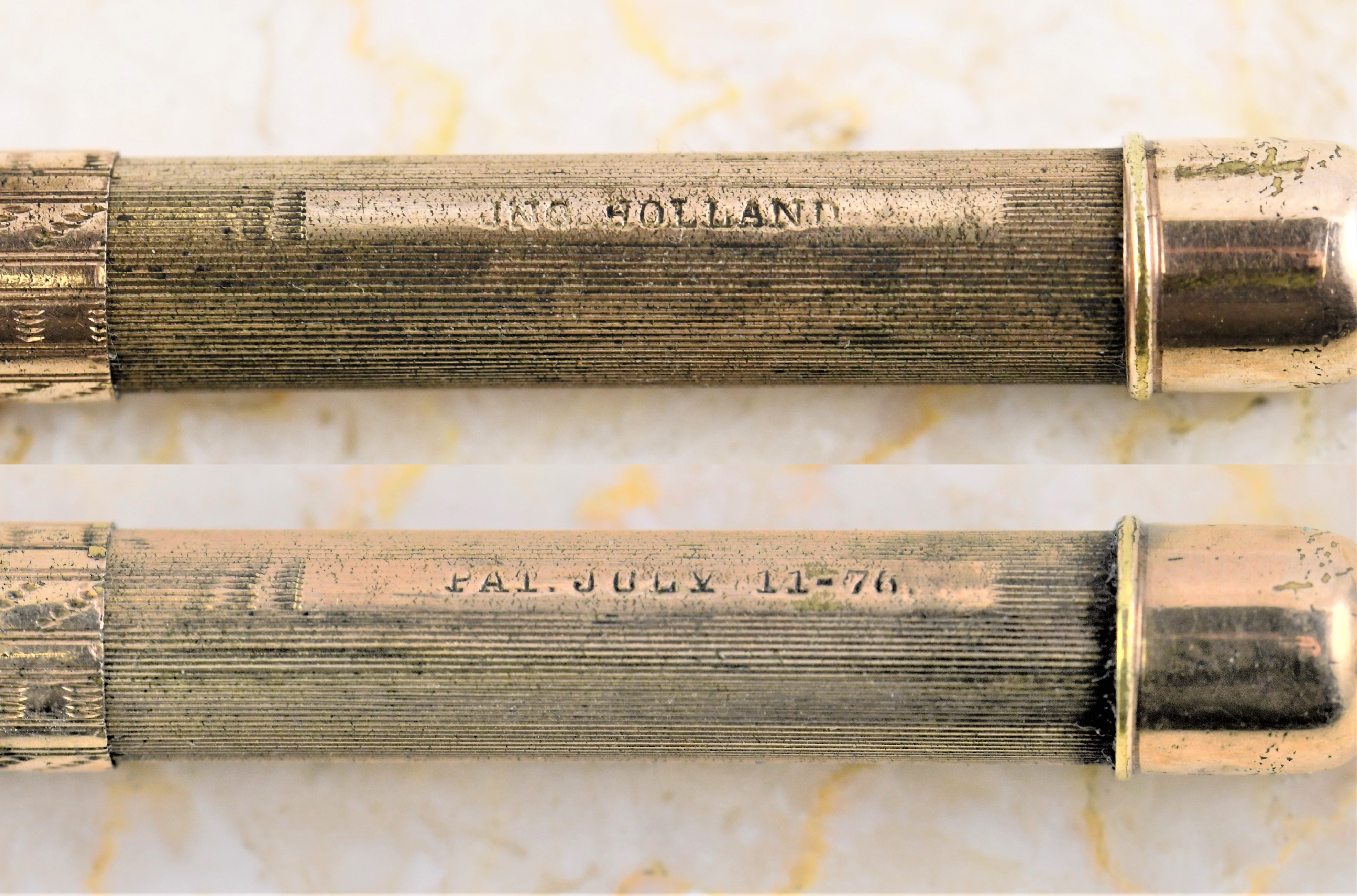

The extender reads “Jno. Holland” on one side, and “Pat. Jul 11 - 76" on the other – and I didn’t have a writing instrument with that patent date in my collection.  It’s listed in American Writing Instrument Patents 1799-1910: patent number 179,743 was applied for by Edward Tyrell of Cincinnati, Ohio on June 8, 1876.  It was issued with lightning speed in just over a month, and assigned to John Holland:


Next to find its way to me is this large slider pencil, sporting handsome engraving reading “Sophia S. Brown 1853";


Lettering on the other side of the barrel is much smaller but speaks louder, at least to me:


I described it as a “large” slider pencil, and you might not think it is until I tell you it’s a Rauch & Co.  By Rauch standards, it’s a behemoth:


Next up is one of those large “convertible” pencils – you can either extract the pencil leaving the case hooked to a watch chain or use it in the case:


It resembles other pencils I’ve written about here before:


Those other three are a Simmons, a Cross (AXT, for A.T. Cross), and a Mabie Todd:


This one, however, is marked U.S. Fountain Pen Company, predecessor firm to the U.S. Victor Pen Company:


I’m not sure where to file this next one away in my collection.  It has two interesting tells: that distinctive rose gold, and the odd placement of the joint for the twist mechanism, farther towards the end rather than right in the middle:


The seller described it as a Bailey, Banks & Biddle, which was true . . . but it also bears a patent date of June 27, 1865:


I recently wrote about the history of the Philadelphia jewelry firm of Bailey, Banks & Biddle (see Volume 6, page 119).  I’ve also written about the man who received that 1865 patent, a little-known inventor named Frederick W. Cox (Volume 4, page 175).   My only other example of the Cox patent is in black hard rubber, and may have been made by Mabie Todd:


After much agonizing, I decided the two Cox pencils go together . . . and I’m noting that here mostly to remind myself where on earth I put that other Bailey, Banks & Biddle!

Finally, this last one was described in an online auction, as not in working order.  I was feeling a little frisky, so I threw in a nominal bid thinking it might be fun seeing if I could do anything with it. 


I was pleasantly surprised when it arrived to find that the pencil was operating just fine – that was half the battle, anyway . . . 


The nib slider, however, wouldn’t budge at all.  I used the old lighter fluid trick to see if that might loosen things up a bit, and it did – I got it to move forward just far enough that the tip of a nib emerged from the end, and I was able to pull it out: a cheap steel fountain pen nib that had nothing to do with a Victorian (the Holland nib with the horseshoe cutout earlier was an exception -- Victorian dip pen nibs typically don't have breather holes).  

With the nib out, I tried the slider again – no more progress, so I hit it with more lighter fluid, then a little dab of oil in the slit, and the tip of another cheap steel nib peeked out.  


Good Lord . . . how many clowns were going to pop out of this car?  With the second nib extracted, I got my answer as the slider freed up at last.  There were three nibs in this one, and the third was a whopper:


Miraculously, the original F.T. Pearce & Co. nib was undamaged by all the junk that had been shoved on top of it.  Best of all, I didn’t have a Pearce nib in my collection – the closest thing I have is an interesting Pearce & Hoagland from Frank T. Pearce’s earlier partnership (Volume 3, page 3).

Monday, April 26, 2021

The Back Story

This article has been included in The Leadhead's Pencil Blog Volume 7, now available here.


If you don't want the book but you enjoy the article, please consider supporting the Blog project here.

Last August, I was in the garage behind my office when I should have been at the DC Pen Show.  The door was up and I was sitting at a folding table, editing the proofs for The Leadhead’s Pencil Blog, Volume 6 while I watched the world drive by on Cherry Valley Road and listened to locusts.  I love summer afternoons in Ohio.

I took a break to check my email, just to be sure nothing important had come up, and there was an email from Roger Leenerts.  Roger said he had a couple of pencils and he wanted to know if I was interested in them:


He left his phone number, so I gave him a call.  He said he was scheduled to take these to a taping of Antiques Roadshow, but he wasn’t game for an unrehearsed, surprising reveal on television.  So, he started poking around a bit on the internet to see who might know a thing or two about old mechanical pencils.

Guess who he found.

His original thought was to get an opinion of how much they might be worth, but once he stumbled onto the weird little universe I’ve created, he found himself sucked into reading article after article, until he decided I probably valued these things more than he did and certainly more than any host of Antiques Roadshow would.

He said that he inherited the two pencils from a distant relative, and that according to his family lore a pair of twin sisters somewhere back in his family tree had received these matching pencils as graduation gifts when they graduated from high school in the mid-teens.  The relations were distant enough that he did not know their names, and the pencils lack commemorative inscriptions to add further provenance to the story.

I liked the story, but I liked the pencils even better:


Both are marked with a “B” with “G.T.” nested in the top loop and “Co.” in the lower one, the hallmark for the George T. Byers Co.  Better still, those snake clips were imprinted on the back:


“Pat. Jan. 6, 1914 / G.T. Byers Co., N.Y.”  That imprint both excites me and makes my blood boil at the same time.  George T. Byers tried to pull a fast one, since he liked the clips Frank T. Pearce was using over in Providence; he found the supplier that made those snake blanks, ordered a bunch, and then tried to file a design patent so Pearce couldn’t use them anymore.

The story was told in greater detail here in “The Snake that Wasn’t Wrapped Around the Pencil” (Volume 3, page 260).  

But wait . . . there’s more.

The Byers story came up again here to open Volume 4 (page 1) with an Eversharp that had been pimped to include fishscales or snake scales, as well as a similar snake clip:


Same patent date on the clip, but “G.T.Byers” is abbreviated, as it usually is on these clips, to “G.T.B.”


That’s why I couldn’t wait for the twins’ pencils to arrive, to shoot the two Byers pencils alongside my pimped out Eversharp


But wait . . . there’s just a little bit more than that.

Meanwhile, Myk Daigle teased something over on Facebook and fortunately, he was looking to trade it to me for something I had – he had no idea how much I wanted what he was dangling out there for the world to see:


This one is similar to the Byers and the F.T. Pearce leadholders, with a crown that turns one way to release the lead and the other to clamp down around it.   When the mechanism is released, the Salz imprint is revealed:


You’ve seen one like this here - with a slightly more menacing clip:


That Salz dragon clip appeared here in Volume 2, at page 273:


And now the serpentine family picture has filled out nicely:


From top, these are an F.T. Pearce Co., the Byers-modified Eversharp, the two Byers pencils, the two Salz pencils, and a sterling silver stockbroker’s pencil made by A.T. Cross.


Saturday, April 10, 2021

My Hogeless Pal

This article has been included in The Leadhead's Pencil Blog Volume 7, now available here.


If you don't want the book but you enjoy the article, please consider supporting the Blog project here.

This one, also from the Krinke auction, made me chuckle when I read the online descriptions, and I had to preview it just to be sure it was what I thought it was.


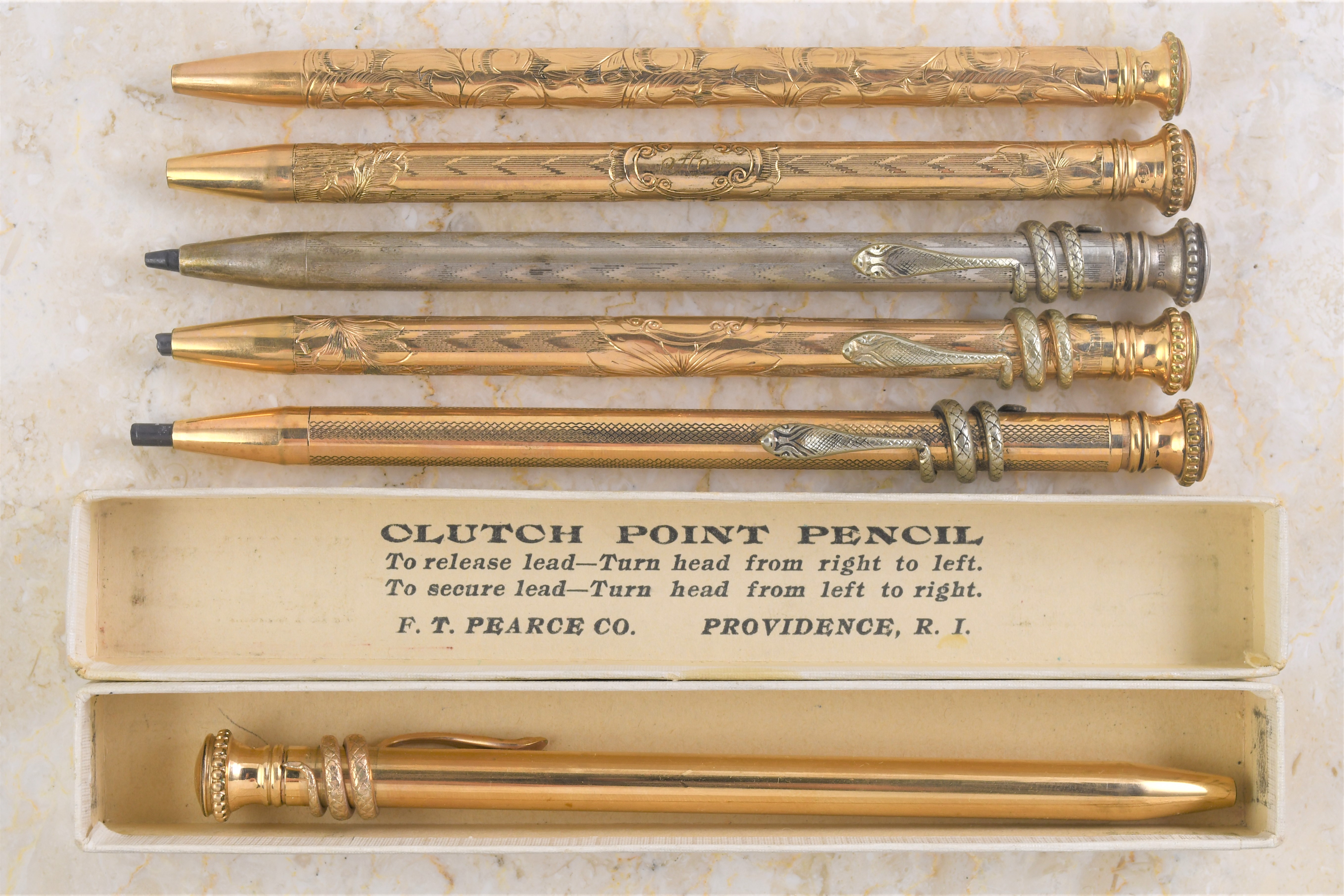
Whoever was writing up the descriptions aptly read what was on the box lid and described Lot 2338 as a “Hoge Mfg. Co. Stock Broker Gold Filled Pencil.”  The notion of the Hoge Manufacturing Company making that pencil was absurd to me – from all appearances, that was a leadholder made by the Frank T. Pearce Company, like these:


I had shot this latest family portrait of Pearce leadholders only a couple weeks before the Krinke auction, in anticipation of writing an article about that top example, which has a couple interesting new wrinkles worth mentioning:


The first wrinkle was my motivation for buying it.  It’s the first time I’ve found an example with a fraternal emblem on top. 


Although it’s damaged a bit, the John Hall connection warmed my heart.  As a Mason, John was also a member of the Shriners – what he called the “drinking Masons.”  We’ll just call this a “Shriner’s Pour” of cache added to my collection.  However, when this one arrived and I examined it up close, there was a second detail I found curious:


Instead of the familiar “FTP” in an oval for Frank T. Pearce Co. (the oval is actually the letter C, with a tiny “o” nestled on the right side for “Co.), this one was marked simply “Sterling” with no trace of the typical Pearce hallmark.

Frank Pearce died tragically in 1914; more tragic was that his only male heir who would carry on the firm, Aldridge Pearce, died very shortly thereafter.  The firm was apparently absorbed by Pearce’s former employer, the A.T. Cross Company, which continued to use this snake clip and later streamlined it for use on pencils into the 1930s.

(Note: for the full story on Pearce, George T. Byers and the patent litigation over the clip, see Volume 3, page 260.  For Pearce’s snake clip on a humongous Cross stockbroker pencil, see Volume 6, page 113).  

Both the fraternal emblem and the lack of a Pearce hallmark – two features I’ve not encountered on these – suggests that this was actually turned out by Cross, very shortly after absorbing what was left of the company.  

There was something else that struck me about this recent addition.  With only one exception, all the larger models I’ve turned up have been in gold fill, with only one example coming my way in sterling:

On the other hand, without exception all the smaller ones I had found are made of sterling.


I stopped short of writing the article which would have ended right there.  An intervening Hoge connection between the Pearce years and Cross, while extremely unlikely, would be fascinating.  Since I was planning to attend the Krinke auction anyway, I couldn’t wait to examine this “Hoge Stockbroker” in person, to see what interesting twist it might add to the story.

The preview was disappointing.  The box barely squeezed into the square plastic container in which the auction house packaged individual items - so tightly that some of the lettering on the box lid might have been wearing off a bit every time it was removed.  I removed the pencil for examination as gently as I could, but a couple pieces of the fragile paper inside came apart, so I couldn’t read whatever it contained.  There would only be one more opportunity to carefully flatten it out to see what it said, although I could make out “The Hoge Mfg. Co.” at the bottom end.

And then there was the pencil, badly dented with pliers at the nose end by some nimrod who apparently thought you turned the nose to make it work (I’m sure it wasn’t Fred Krinke - just someone with whom this pencil had an unfortunate encounter in its 100-year lifespan).  At the crown, all was revealed: whoever wrote the description apparently looked no further than the box to see whether the pencil had anything to do with it:


Yep.  It’s a Pearce.  Not a shred of evidence supported any connection with Hoge – unless that fragile paperwork established some previously undocumented connection between the two companies.

Damage aside, I still thought it might be worth a roll of the dice.  I notified the auction house of what I found during the preview, but no announcement was made during the auction of the discrepancy between what the pencil was versus how it was described in the catalog.  I had to pay more than I wanted to, but my new, worse-for-wear Pearce did add a wrinkle to the story I had planned to write:


This is the first time I’ve found a smaller sized example in gold fill, so I’m able to amend my third observation from the article I was going to write earlier: most of the smaller Pearce leadholders I have found were sterling, not all of them.

Now, for a closer examination of that paperwork . . .

Sunday, May 17, 2020

Lazy Sunday Throwback

This article has been edited and included in The Leadhead's Pencil Blog Volume 6, now on sale at The Legendary Lead Company.  I have just a few hard copies left of the first printing, available here, and an ebook version in pdf format is available for download here.

If you don't want the book but you enjoy this article, please consider supporting the Blog project here.

I’ve been posting a lot of articles lately about “broker’s pencils,” those metal pencils sporting impossibly, overcompensatingly large leads from the likes of Hicks, Edward Todd and others.  As I was thumbing through my archive of old pictures I never got around to using, I thought it was kind of a shame not to share this one with you:


Snake clips are always a crowdpleaser, and this one probably tips you off who made this one:


That clip, identical to clips used by Frank T. Pearce, were later picked up and put into production over at A.T. Cross.  Frank Pearce was a former employee of Cross who, after a few years in friendly independent competition (but more collaboration), died unexpectedly – sadder still, so did his son, and Cross appeared to absorb what remained of the organization.

There’s been a couple articles here about those snake clips, and George T. Byers’ attempt to usurp them from Cross by filing a bogus design patent after Pearce was already using them and then suing for infringement – check out http://leadheadpencils.blogspot.com/2015/03/the-snake-that-wasnt-wrapped-around.html.

At the top, there’s confirmation that this is a Cross – and another opportunity to point out that “AXT” represents A. T. Cross (seems like no matter how many times I say that, the meaning of those letters somehow continues to elude a lot of people).


And it is enormous, a big honkin’ baseball bat of sterling.  Here it is, next to an average-sized Cross pencil:


Note that the regular sized pencil has a plain clip, snake-like but without animal features.  These were produced, I believe into the 1930s.  The elaborate clips Frank Pearce was using in the early 1910s, however, had long since been discontinued by that time.

I’m not sure why I never used these - I think I had a lead on a gold-filled example that never panned out, and I thought they would look so nice shot alongside each other that I decided to wait and see if a gold filled example came my way.  All these years later, guess it never panned out, although a gold filled Cross stockbroker did make it into the blog back in 2012 when I featured the example Jim Rouse had with him at the Baltimore Show that year (see The Leadhead’s Pencil Blog Volume 1, page 190).


Eh - if another one ever finds its way over here, we’ll make another lazy Sunday out of it.