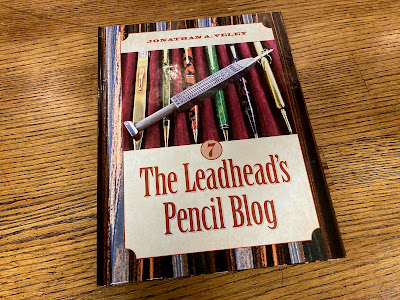
This article has been edited and included in The Leadhead's Pencil Blog Volume 4; copies are available print on demand through Amazon here, and I offer an ebook version in pdf format at the Legendary Lead Company here.
If you don't want the book but you enjoy this article, please consider supporting the Blog project here.
Note: this is the second installment in a five-part series. Part one begins at http://leadheadpencils.blogspot.com/2016/12/wahl-sheaffer-and-race-for-boston-part.html.
The Chicken Rancher’s Next Move
On New Years’ Day, 1916, less than two weeks after Colonel
Smith was lounging alongside his poultry without a care in the world,
The Bookseller, Newsdealer and Stationer
announced that Smith was emerging from his short retirement to sell pens for
The Boston Fountain Pen Company in fourteen states, with his headquarters in
Chicago.
[i]
Charles Keeran comments in his 1928 letter that the Chicago
department store “Marshall Field & Co. also featured this [Boston Fountain]
pen above all others,” so Smith’s sudden association with a distant company is
not as random as it might initially appear; it is also possible, if in fact
Smith expressed dissatisfaction with Sheaffer to Keeran at their dinner on
September 17, that Keeran suggested that Smith look into selling Boston
Fountain Pens as an alternative. If Keeran had anything more to do with Smith’s
association with Boston, he would have taken credit for doing so; he didn’t, so
it is likely that the recently unemployed and resourceful Smith developed his
relationship with The Boston Fountain Pen Company on his own.
[ii]
 |
| Figure 13. This advertisement in the September 20, 1916 issue of The Chicago Daily Tribune establishes that Marshall Field & Co. was carrying both Boston Fountain pens and Ever Sharp pencils . . . alongside Waterman Ideals. |
No record has surfaced to date of where Smith’s Chicago
offices were located, but he must have spent some time at Keeran’s offices in
the Lytton Building: just a week after
the initial announcement that Smith was handling the “Boston Safety Pen
Company,”
The American Stationer announced
that Smith added a pencil to his Boston pens: Keeran’s Ever Sharp
[iii] The account states that Smith’s contract to
sell Eversharp pencils was with “Keeran & Co.” in the states of Ohio,
Indiana, Michigan and Kentucky. Keeran &
Co. was the separate company Keeran formed to distribute Ever Sharps
manufactured by his “Eversharp Pencil Company.”
While Keeran indicates in his 1928 letter that at some point around this
time – by mid-1916 -- Wahl’s officers had purchased a majority of the shares in
the Eversharp Pencil Company, Keeran remained in control of his distribution
company.
The state of Illinois is conspicuously absent from Colonel
Smith’s Ever Sharp territory (whether this is because Keeran had lost control
of that state by virtue of Wahl’s control of Eversharp, or because Keeran
wanted to keep it for himself). However,
in four states, William Smith’s sole writing instrument lines were Boston
Fountain Pens and Ever Sharp pencils. Whether
Smith offered the pair together in one box or not, it was Smith – and neither
Wahl nor Sheaffer – who thought that a fountain pen and mechanical pencil would
“fit in very nicely” together and made it happen.
Smith, the former Waterman man, Sheaffer man and chicken
rancher, was masterfully orchestrating his next marketing stunt. With trade announcements in The American Stationer still hot off the
press, he was poised to take the Midwest by storm. In just a couple weeks’ time, all of the
major players in the Midwestern stationer’s industry would be gathered together
in one room, ripe for Smith to make a big impression and even bigger sales, at the
black-tie event around which the industry’s year revolved, and in which Smith
reveled: the 1916 Chicago Stationers’ Dinner.
Black Ties and Red Faces: The
Unreceptive Corner at the Stationers’ Dinner
As mentioned earlier, William Smith was an annual fixture at
the Chicago Stationer’s Dinner, held in January each year. “It was an occasion that brought forth all
that goes to make up good fellowship of the right kind,”
The American Stationer reported in 1914. “It was a moment when men, away from their
business cares for a short time—gathered for their annual festivities—listened
to words that had in them the ring of truth and the elements of weight.”
[iv] Smith had attended for many years; in 1914,
he had missed it due to his falling out with Waterman; in 1915, he returned
triumphantly on Walter Sheaffer’s arm. The
fourteenth annual banquet, to be held on January 15, 1916, would be
different: for the first time, “the
ladies were invited.”
[v]
Smith capitalized on the event: after the introductions and a chorus of
“America,” the menus were presented, and each of the ladies found on their
plate a Boston Fountain Pen in sterling, engraved with their name and
accompanied by Colonel Smith’s card.
[vi]
The Colonel’s publicity stunt was a significant breach of
etiquette, on an evening during which the men were supposed to be “away from
their business cares”: while The American Stationer’s annual reports
were very detailed year after year with respect to who was present and with
whom they were associated at the time, there had never been an occasion such as
this when an attendee used the event to promote their individual products – and
there is no indication that Smith similarly promoted Waterman’s or Sheaffer’s
pens in previous years.
The “officer” and a gentleman Smith doubtless left the wives
in attendance swooning, and the fact that Smith escaped rebuke for his stunt is
a testament to his status in the Chicago stationer’s community. Not everyone would have been Even though – all perhaps, except for one. “W.A. Sheaffer, of the W.A. Sheaffer Pen
Company, came on from Fort Madison, Ia.,” the account reports, “and was busy
doing his share of the entertaining during the evening.” Fred Seymour from Waterman was also on hand,
“kept very busy shaking hands during the course of the evening.”
[vii]
The recently jilted Walter A. Sheaffer must have been
blindsided by Colonel Smith’s “clever stunt,” and it is difficult to imagine how
a Boston Fountain Pen inscribed with Mrs. Sheaffer’s name would have survived
the evening. It is, however, easy to
imagine what Sheaffer’s “share of the entertaining” must have been as he
watched his former Chicago manager steal the show that evening, perhaps
commiserating with Fred Seymour, the Waterman executive who had just a couple
years earlier been dispatched to Chicago to escort the wayward Colonel Smith
back to Waterman’s Chicago office.
 |
| Figure 14. Walter Sheaffer shakes hands – and likely his head – while Col. Bill Smith steals the show. |
Smith might as well have thrown his drink in Walter Sheaffer’s
face. Sheaffer was still in the midst of
a bad breakup with former business partner George Kraker, and for the second
time, he was watching a close and important business associate abandon him and
turn competitor. In the case of Kraker, Sheaffer retaliated
with protracted patent litigation over the rights to the lever-fill pen design
both were using. Smith, however, would
be a different matter – all he was doing was selling someone else’s pens. If Sheaffer wanted to shut Smith down, his next
logical move would be to acquire Boston.
If the
deeply personal conflict between Walter Sheaffer and William Smith were not
enough for Sheaffer to think about attacking the Boston Fountain Pen Company,
the events which unfolded in the first half of 1916 guaranteed that
Sheaffer would do so.
The Race for Boston Is On
The gregarious Colonel Smith was a pied piper of pen
salesman, and as his Boston Pen/Eversharp pencil business gathered steam, other
prominent salesmen from Chicago stationers’ houses soon found themselves within
his gravitational pull. On January 26,
1916,
The American Stationer reported
the resignation of Eddie Dick, the fountain pen and “clasp pencil” department
head of Stevens, Maloney & Co. “It
is whispered that Eddie will assist one of the well-known salesman in the
fountain pen business in this territory,” the article reported.
[viii]
Smith’s success also appeared to lured William H. Newhall
away from Shea Smith & Co., although reports are somewhat conflicted as to
whether Newhall’s relationships with either Shea Smith or Colonel Smith were
exclusive. In April, 1916, both
Geyer’s Stationer and
The American Stationer reported that
Newhall and Smith had formed a new company, the Newhall-Smith Company.
Geyer’s
reported that Newhall-Smith’s offices were on the seventh floor of the
Harris Trust Building at the corner of Monroe and LaSalle; while the company
had a “good-sized” display room for their samples (which were expanded to
include Solidhead Tacks, Featherweight Eyeshades and Gordon Brown’s china
markers, called the “Perfect Paper Pencils”), the company’s presence in the
upper floors of an office building suggests that Newhall-Smith’s business model
was supplying stationers rather than competing with them.
[ix] Eddie Dick, of course, turns up shortly
thereafter “assisting” Newhall-Smith.
[x]
As for Charles Keeran, Newhall-Smith’s success in promoting
his pencils was equal parts blessing and curse.
The increased demand fueled by Newhall-Smith caused Keeran to pressure
Wahl to increase production and build up inventory, but in the process Keeran
overextended himself. According to a
1921 account by C.A. Frary, “the owner of The Eversharp Pencil Company found
himself at the end of his resources. He
could not pay his bills. We, as a result
of being his manufacturers, were the chief creditors. Consequently, it seemed that the ‘easiest way
to get the money due was to take over the nearly-defunct company.”
[xi] Some of Wahl’s directors had acquired a
controlling interest in Eversharp, and Keeran’s offices were relocated to the
Peoples Gas Building in Chicago.
The Boston Fountain Pen Company was prospering from its
relationship with Colonel Smith, in more ways than one. Not only was Boston enjoying increased sales
in the Midwest, but Boston had the best intelligence available as to what
Walter Sheaffer’s plans would be. Smith
would certainly have understood that while only one man would be left standing
as between Kraker and Sheaffer, the basic idea of a lever-filled fountain pen
would not only survive, but would be fair game.
As Waterman was demonstrating with the introduction of its PSF line of
lever fillers in 1915, anyone could produce a lever filler, as long as the
pitfalls of those improvements peculiar to the Sheaffer, Kraker and Craig patents
were avoided.
[xii]
The extent to which Smith influenced the Boston Fountain Pen
Company’s direction is unknown, but if
Smith had some insight into Walter Sheaffer’s plans and if Smith left Sheaffer because he thought the lever filler was a
smashing idea upon which he would be better off capitalizing with another
company, then what happened next makes perfect sense:
The Boston Fountain Pen Company developed its own version of
a lever-filler.
The patent application for Boston’s version was filed on May
1, 1916 by David J. LaFrance, who had been Boston’s superintendent since 1905. LaFrance’s version neatly avoided all of the arguments
in the Sheaffer litigation over how to attach a compression plate to the barrel
of the pen in the most elegant way: it
wasn’t attached at all. Rather, Boston’s
compression plate hung by a spring from the lever itself, so that lifting the
lever stretched the spring and deflated the sac; when the lever was released,
it would snap shut and be held flush with the barrel by the tension of the
spring.
 |
| Figure 15. David J. LaFrance’s patent number 1,209,978 for a lever-filling fountain pen, applied for on May 1, 1916. Note the date the patent was issued: December 26, 1916. |
Boston and Colonel Smith wasted no time rushing the new pen into
production and to market. On July 8,
1916,
The American Stationer reported
that Newhall and Smith had returned from a trip to Boston, and a week later
reported that W.H. Newhall claimed that Eddie Dick owed him a new pair of pants
due to Dick’s “zeal” in demonstrating how a Boston Safety is filled. Meanwhile, Colonel Smith had embarked on a
three-week long sales trip, long even by Smith’s standards, in which he would
visit such far-reaching places as “St. Louis, Kansas City, Omaha, Des Moines,
St. Paul and Minneapolis.”
[xiii]
 |
| Figure 16. Boston lever-filling fountain pens, from the collection of Roger Wooten. |
Whether or not William Smith had anything to do with
Boston’s development of a lever-filled fountain pen, the fact that Boston did
so, and when they did so, worked out perfectly for Smith. At the end of 1915, Smith was branch office
manager for a company making pens that were selling like wildfire . . . but which
may or may not survive, depending on the outcome of pending litigation. By July of 1916, he’s free of Sheaffer, doing
the same job selling fountain pens that worked like and looked like a Sheaffer,
with none of Sheaffer’s baggage inside – and with a companion pencil, to boot.
It was at that precise time, just as everything was taking
off for Newhall-Smith and the Boston Fountain Pen Company, a little birdie told
Charles Keeran the Boston Fountain Pen Company might be for sale. Colonel Birdie, we’ll call him.
The Pieces of the Puzzle Come Together
Once the Boston Fountain Pen Company’s new pens emerged as a
litigation-free alternative to Sheaffer’s enormously popular lever filler,
Boston was in the same predicament in which Keeran had found his Eversharp
Pencil Company the previous year – the company itself became a valuable
commodity practically overnight. Although
Charles Keeran’s 1928 account of the events which followed does not contain many
of the dates, working his timeline backwards it appears that the wrangling
began in mid-1916.
[xiv]
The chain reaction which resulted in the sale of the Boston
Fountain Pen Company is speculative, but the preceding well-documented story
suggests it likely began with overtures, threats or a combination of the two
from Sheaffer. All of the other
characters were satisfied with the status quo:
Smith was happy selling the pens, not making them, and neither Keeran
nor Wahl would have had any motivation to disrupt what was becoming a very
profitable enterprise.
Walter Sheaffer, on the other hand, had strong personal
reasons for attacking the company, if not from the moment Smith resigned, then
certainly the morning after that fateful Chicago Stationers’ Dinner in January. Smith’s success distributing of Boston
Fountain Pens and Ever Sharp pencils in early 1916 would have added a business
motivation to any desire Sheaffer might have had to settle a personal
score. Add to these factors Boston’s
introduction of a competing lever-filled fountain pen, and acquiring Boston
would become a necessity if Sheaffer was to preserve his domination of the
lever-filled pen market.
Smith had always landed on his feet before, but he had
reasons to be very concerned about a possible Sheaffer buyout of Boston. He had burned bridges with both Waterman and
Sheaffer, investing himself and likely his resources heavily in his new Smith-Newhall
enterprise. Smith would have known to a
certainty that if a sale of Boston to Sheaffer went through, he would be back
on his chicken ranch in ten minutes flat.
William E. Newhall likewise had a lot riding on Smith’s fate. News reports at the time are somewhat
ambiguous as to whether Newhall had entered into the Newhall-Smith partnership
in addition to or instead of his association with the established Shea Smith
& Co., but the fact that Newhall-Smith was wholesaling pens, pencils and
other products to other stationers suggests that Newhall’s ability to actively
represent Shea Smith’s interests was severely compromised. If all of Smith’s eggs were in one basket
(pun intended), it wouldn’t be an enviable basket for Newhall to share if
Walter Sheaffer came in to clean house – especially given Sheaffer’s history of
suing even those who were only tangentially involved in an alleged infraction.
Since both Smith and Newhall had an interest in keeping
their existing product lines intact, it isn’t surprising that one or both of
them would try to find a friendlier buyer for Boston. Wahl, whose directors now controlled Keeran’s
Eversharp Pencil Company, would have been the obvious choice. If Wahl directors owned both The Boston
Fountain Pen Company as well as the Eversharp Pencil Company, Smith and Newhall
would be assured they would keep Boston Fountain Pens paired with Keeran’s Ever
Sharp pencils.
Keeran reports that C.S. Roberts, Wahl’s vice president and
the man he attempted to persuade to buying Boston, was hesitant -- with good
reason. The Eversharp Pencil Company’s
relationship with Newhall-Smith was not an exclusive one, and Ever Sharp
pencils were selling briskly with or without the Boston Safety Pens,
particularly on the west coast. In
addition, Boston’s newfound success was a double-edged sword: while Wahl’s executives found it relatively
easy and cheap to acquire Keeran’s startup company, the Boston Fountain Pen
Company was an established business, and their slick new lever filler would
doubtless make Boston on the one hand profitable yet on the other, more expensive
to acquire.
Besides, Roberts might legitimately have thought, although Sheaffer
might want to buy Boston, whether to settle a score or for whatever other
reason, in July, 1916, he might have assumed Sheaffer wasn’t in any position to
do so. The Courts had yet to determine
the outcome in Sheaffer’s patent litigation, and if Sheaffer lost, there likely
would be no Sheaffer Pen Company and business would continue as usual. Wait and see, Roberts might legitimately have
thought.
Roberts, Keeran, Smith and Newhall didn’t have to wait long. On August 23, 1916, the United States Patent
Office determined the “priority” of Sheaffer and Craig’s respective patents, determining
that it was Sheaffer, and not Craig, who invented Sheaffer’s “double bar” lever
filler. This was not the end of the Sheaffer-Kraker-Craig
litigation, which was running on two parallel tracks: the case in which Walter Sheaffer had been
testifying throughout 1915 was the infringement litigation, filed as the
parties continued to scuffle in the Patent Office over whose invention came
first. The patent office decision in the
interference case didn’t end the infringement litigation, but it did preordain
one of the outcomes: since each of the
parties was suing the other for infringement, the Patent Office decision meant
that Sheaffer could not have infringed on Craig, but Craig must have infringed
on Sheaffer. All that was left for the
court to do in the Sheaffer litigation was decide the remedy for what was now
found to be the wrong.
 |
| Figure 17. The patent dispute between Sheaffer and Craig was not finally decided until 1918, but the Patent Office decision announced in August, 1916 made Sheaffer’s ultimate victory inevitable. |
The patent office decision in the Sheaffer case added
urgency to the pleas of Smith, Newhall and Keeran for a friendlier buyer, now
that Sheaffer would clearly survive and would have the capital to pursue Boston
with greater ferocity. According to
Keeran’s letter, this is when C.S. Roberts finally agreed to send Keeran to
Boston “to look into the matter.”
The decision likely would have softened Charles Brandt to
the idea of selling, too. Even though
Boston’s patent appeared to stand on very solid footing, Sheaffer’s success in
patent litigation stood in stark contrast to Boston’s bad luck, beginning when
Brandt founded the company in 1905 and Brandt’s petition for a trademark for
“Boston Fountain Pen Company” was denied solely because the mark spelled out
the word “Company” but his petition was signed with the word Company abbreviated
as “Co.”
[xv] Just two years before Sheaffer’s 1916 victory,
The Boston Fountain Pen Co. lost an infringement action it filed over pens made
by the Sanford & Bennett Co.; to add insult to injury, the story in
The American Stationer reporting the
outcome of the litigation on April 18, 1914 appeared on the same pages as a
sizeable advertisement for Sanford & Bennett’s allegedly infringing pens.
[xvi] Any threat of litigation from Sheaffer, no
matter how hollow, would have been cause for concern to Brandt.
According to Keeran, he traveled to Boston one afternoon in
September, 1916, met Charles Brandt for the first time at 4:00 p.m., and “in
one hour bought the whole works for $50,000.00.” Working backwards from Keeran’s timeline, when
his second sixty-day option period expired on January 10, 1917, this meeting would
have occurred around September 12, 1916.
[xvii]
No other documents have been found to substantiate Keeran’s
account, and it seems highly unlikely that Keeran met Brandt for the first time
and negotiated the purchase of his entire established business in an hour. When Keeran arrived in Boston in early
September 1916, he would have needed some introduction if he was to have any
credibility. He had one. On September 16, 1916,
The American Stationer reported that “W.H. Newhall, of the
Newhall-Smith Company, made a trip to Boston last week on business.”
[xviii]
The price Keeran says he negotiated, $50,000.00, is the
equivalent of more than $1.1 million in 2015.
Keeran didn’t have that sort of cash, and since he was no longer in
control of his Eversharp Pencil Company, he couldn’t speak for the company,
either: all he could do was negotiate an
option for sixty days at whatever price Brandt would accept and take it back to
the decision makers back in Chicago.
Wahl’s management did not give his deal the warm reception Keeran
anticipated, and as the sixty-day option was running out, Wahl “was not yet
ready” to exercise the option. With the
option set to expire around November 10, 1916, Keeran reports that he traveled
to New York (and not Boston), where Charles Brandt met him and, “after a long
conference in his attorney’s office,” Keeran was able to persuade him to extend
the option for another sixty days.
Neither Keeran nor any other source indicates who Charles
Brandt’s attorney in New York was, but a good guess is an 1891 graduate of
Columbia, who had offices at 99 Nassau Street and 319 West 87
th
Streets: Charles Brandt, Jr.
[xix] The elder Brandt’s reluctance to extend Keeran’s
option may have been nothing more than his desire for a professional opinion or
a family meeting with Charles Brandt, his son George (who managed the works),
and Charles Jr., the attorney; after all, his initial option to sell “the whole
works” was negotiated in the span of an hour, when Keeran and Newhall had shown
up unannounced. However, Brandt’s
hesitation may also have been because Brandt sensed he may be able to get a
better deal – and the evidence suggests that pressure from Sheaffer had likely been
building since Keeran first paid Mr. Brandt a visit.
The Kugel Maneuver
In mid-September, at almost exactly the same time Keeran
reports that he negotiated the initial option to purchase the Boston Fountain
Pen Company, Sheaffer’s New York office manager, B.T. Coulson, abruptly
resigns.
The American Stationer and
Office
Appliances both attributed Coulson’s resignation to nothing more than “ill
health and a much-needed rest” and indicated that “[h]e will still retain his
interest in the company as well as his official connections.”
[xx]
It is likely true that Coulson’s health was
deteriorating: pneumonia eventually claimed
his life in February, 1920.
[xxi] However, the report in
Geyer’s Stationer indicates there may have been more to the story,
announcing that while Coulson would retain his official title of Vice
President, he “in fact severed his active association with the company.”
[xxii] Was Coulson quietly relieved of duty because
he failed to consummate some sort of a deal with the Boston Fountain Pen Company? The evidence suggests that he was.
Concurrently with the announcements of Coulson’s retirement
was the announcement that upon Coulson’s departure from New York on October 1,
he would be replaced by “an old fountain pen man,” The Parker Pen Company’s
former Chicago office manager, Arthur L. Kugel (misspelled as “Kudel” in the
Geyer’s account).
[xxiii] Kugel, who was being brought into New York
from Chicago to replace an office manager forced to resign ostensibly due to
his health, would obviously attend first to the most pressing matters affecting
Sheaffer’s New York office.
Thanks to
the
The American Stationer, we know
what that most pressing matter was. According to a news
report published in the October 7, 1916 edition, Kugel spent his first week as
Sheaffer’s New York representative . . . in Boston.
[xxiv]
A Different Sort of Nor’easter
It took some talking in November, 1916, but Keeran says he
was able to persuade Brandt to extend his option for an additional sixty days,
ending on January 10, 1917. Keeran is silent, however, on what happened in
between the time he negotiated this extension and December 26, 1916, when he
and C.S. Roberts boarded a train for
Boston to exercise the option. The deal
was apparently all but done in the minds of Newhall and Smith, who disbanded
their company: the last reference to Newhall-Smith
is in connection with Newhall’s trip to Boston in September, 1916, and a month
later,
The American Stationer
reported that Smith attended the convention of the National Association of
Stationers and Manufacturers in Atlanta – no longer on behalf of the company
which bore his name, but representing The Eversharp Pencil Company.
[xxv]
As for Newhall, he returned to his
former position at Shea Smith & Co., and a 1922 biographical sketch in
Office Appliances makes no reference to
his former involvement with Smith. If
Newhall burned any bridges when he left Shea Smith, all was quickly forgiven
and forgotten.
[xxvi]
It is possible that Wahl’s directors dispatched C.S. Roberts
and Keeran to Boston on the day after Christmas to exercise the option for
accounting reasons, hoping to close out the transaction and spend the cash
before the end of the fiscal year.
However, there is a more attractive theory for the sudden urgency: on
December 26, 1916, the Boston Fountain Pen Company became significantly more
valuable.
On that very day, the United States Patent Office awarded
David J. LaFrance his patent for Boston’s version of a lever-filled fountain
pen.
Walter Sheaffer and his boots on the ground, Arthur Kugel, would
have known the same thing. If someone
else had patent rights to make a pen which, for all practical purposes, looked
just like the ones Sheaffer was making, would the public necessarily care what
was inside, so long as it worked? In
Sheaffer’s fight with Kraker, there could be only one winner: with that struggle all but won in late 1916,
Sheaffer was now facing another, more difficult challenge. He had to find a way to maintain his near monopoly
on lever-filling pens, this time against a competitor whose design didn’t
violate his patent rights.
At that crucial moment, Sheaffer caught a break when C.S.
Roberts pulled a stunt which nearly killed the deal for Wahl. According to Keeran, Roberts believed that
Keeran had agreed to overpay for Boston, so Roberts did not bring the
agreed-upon $50,000.00; instead, he only brought a check for $25,000.00, hoping
to talk Brandt down by half when they arrived.
That’s half a million, in today’s dollars.
Roberts’ timing could not have been worse, because Brandt
was not in a bargaining mood. According
to Keeran, “the owner not only wouldn’t take twenty-five, but he wouldn’t take
fifty thousand.” And why should he? Brandt’s stock had increased dramatically in
value when the patent was awarded (the modern equivalent would be a tick up in
value for a pharmaceutical company on the day a patent is awarded to it), and Sheaffer
was probably nipping at Brandt’s heels, with either a competing offer, legal
threats, or a combination of the two.
Keeran says that after he and Roberts consulted with an
attorney, they were advised that if they wanted to force the sale, they needed
to tender the full agreed price; Roberts, who by this time realized his
miscalculation, hastily contacted Chicago and had the remainder of the money wired. Keeran and Roberts then went back to Brandt,
who refused a certified check for
$50,000.00. Remember, that would be more than a million dollars today.
So, according to Keeran, he and Roberts settled into a
nearby hotel for two weeks to play rummy, while “the lawyers” worked things
out. During this time, Keeran says, “Mr. Brandt offered me $20,000.00 if I’d
let him off.” In 2015 dollars, that’s
nearly half a million! There is only one
explanation for this: Walter Sheaffer was
offering Brandt a lot more money, probably in excess of $70,000.00.
Brandt and his lawyers finally relented, and when the
transaction closed, Keeran reports, “[Roberts] was really enthused for the
first time.” Roberts, the same man who so
reluctantly brought a check for $25,000.00 to Boston on December 26 was
“enthused” two weeks later to spend twice that amount? Of
course he was. Sheaffer was prepared to
pay much more, and Roberts was now convinced he had gotten a deal.
No direct evidence has yet surfaced establishing what was
negotiated during those two weeks of rummy games. However, as any lawyer who has been in the
trenches for any length of time will tell you, there is rarely a clear, black
or white, win or lose. Charles Brandt
did not simply see the light, thumb his nose at Walter Sheaffer, agree that
selling his company pursuant to his agreement with Charles Keeran was the right
thing to do, convince Sheaffer to go quietly into the night, close the deal and
have everyone live happily ever after.
What everyone involved got in January, 1917 was something less than what
they wanted. Among attorneys, there’s a
well-known saying: the perfect
settlement is one with which no one is happy.
The surviving physical evidence clearly points to what the
terms of that settlement were.
The Compromise, Part One: as to Fountain Pens
For many years, collectors have noted that the earliest Wahl
pens have Sheaffer levers rather than Boston’s lever system. A century later, one of the theories for this
apparent anomality is that the Boston lever wasn’t as effective as the Sheaffer
“double bar,” but that opinion is based on the performance of Boston’s levers a
century later than when they were made.
At the time they were made, Boston’s springed compression bars may well
have had significantly greater “spring,” and may have been every bit Sheaffer’s
equal in effectiveness.
 |
| Figure 18. Identical pens, one stamped with a Boston Safety Fountain Pen imprint, the other with a Wahl Tempoint imprint. From the collection of Roger Wooten |
However, all of the evidence of the gathering storm which
surrounded Boston’s purchase suggests that one of the terms of Walter
Sheaffer’s surrender of the Boston Fountain Pen Company to Wahl was to saddle
Boston with an obligation to use Sheaffer’s levers on all of its lever filled
pens before the company was sold, subject to this obligation, to Wahl.
 |
| Figure 19. The levers of both pens shown in Figure 18, when lifted, each have a patent date of November 24, 1914 stamped on the side – a reference to Walter Sheaffer’s patent number 1,118,240. From the collection of Roger Wooten. |
Cliff Harrington, in the spring, 2001 issue of
The Pennant, revealed the details of a 1918
Wahl catalog he discovered, which had been annotated by C.W. Thornton, Wahl’s
cost accountant, with detailed production costs for the pens. Among these costs, Thornton indicated, was a
five cent per lever license fee. “It was
not clear whether this was paid to Sheaffer or to some other rights holder,”
Harrington stated,
[xxvii]
but when all the events described in this article are put together, there can
be no doubt now.
 |
| Figure 20. Walter Sheaffer’s patent date was also stamped on some early Wahl pens with the familiar Wahl lever. From the collection of Roger Wooten. |
[i] The Bookseller, Newsdealer and Stationer, January
1, 1916, at page 30.
[ii]
While Keeran states that he had seen and admired Boston Safety Pens being sold
at Wanamaker’s New York in 1913, it is noteworthy that Keeran – who was
extolling his contributions to Wahl – did not take credit for giving Smith the
idea to sell the Boston Fountain Pen.
[iii] The American Stationer, January 8, 1916,
at page 32.
[iv] The American Stationer, January 17,
1914, at page 3.
[v] Geyer’s Stationer, January 20, 1916, at
page 10.
[vi] The American Stationer, January 22,
1916, at page 41.
[viii]
The American Stationer, January 26,
1916, at page 26.
[ix] Geyer’s Stationer, April 20, 1916, at
page 11.
[x] The American Stationer, April 22, 1916,
at page 36.
[xi]
Frary, C.A., “What We Have Learned from Marketing Eversharp,”
Printers’ Ink, August 11, 1921, at page
3. Frary indicates that the buyout
occurred by virtue of an exchange of stock after the end of the holiday season
in 1916, but the acquisition must have occurred earlier in 1916; an increase in
production in anticipation of Newhall-Smith’s sales is the only likely cause.
[xii]
Barnes’ 1903 patent for a lever filler of a different design assured that
Sheaffer would never acquire a monopoly on the basic concept of a pen with a
rubber sac deflated with the use of a lever.
[xiii]
The American Stationer, July 15,
1916, at page 32.
[xiv]Keeran
reports that his renewal of his option to purchase the company, for another 60
days, ended on “about” January 10, 1917; therefore, his original option would
have expired around November 10, 1916 and he would have negotiated his deal
with Charles Brandt around September 10, 1916; prior to that, he says he tried
to persuade Wahl “for months” after hearing from Bill Smith that the company
was available.
[xv] Ex Parte Boston Fountain Pen Co., Official
Gazette of the United States Patent Office, June 27, 1905, at page 2531.
[xvi] The American Stationer, April 18, 1914,
at page 34.
[xviii]
The American Stationer, September 16,
1916, at page 8.
[xix] The Catalogue of Officers and Graduates of
Columbia University (1916), at page 616.
[xx] The American Stationer, September 16,
1916, at page 25 and
Office Appliances,
October, 1916 at page 164.
[xxi] Office Appliances, April, 1920, at page
61.
[xxii]
Geyer’s Stationer, September 14,
1916, at page 12.
[xxiv]
The American Stationer, October 7,
1916, at page 18.
[xxv] The American Stationer, October 21,
1916, at page 112.
[xxvi]
Office Appliances, September, 1922,
at page 24.
[xxvii]
Harrington, Clifford M., “Early Wahl Production Costs.”
The
Pennant, Spring, 2001, at page 29.