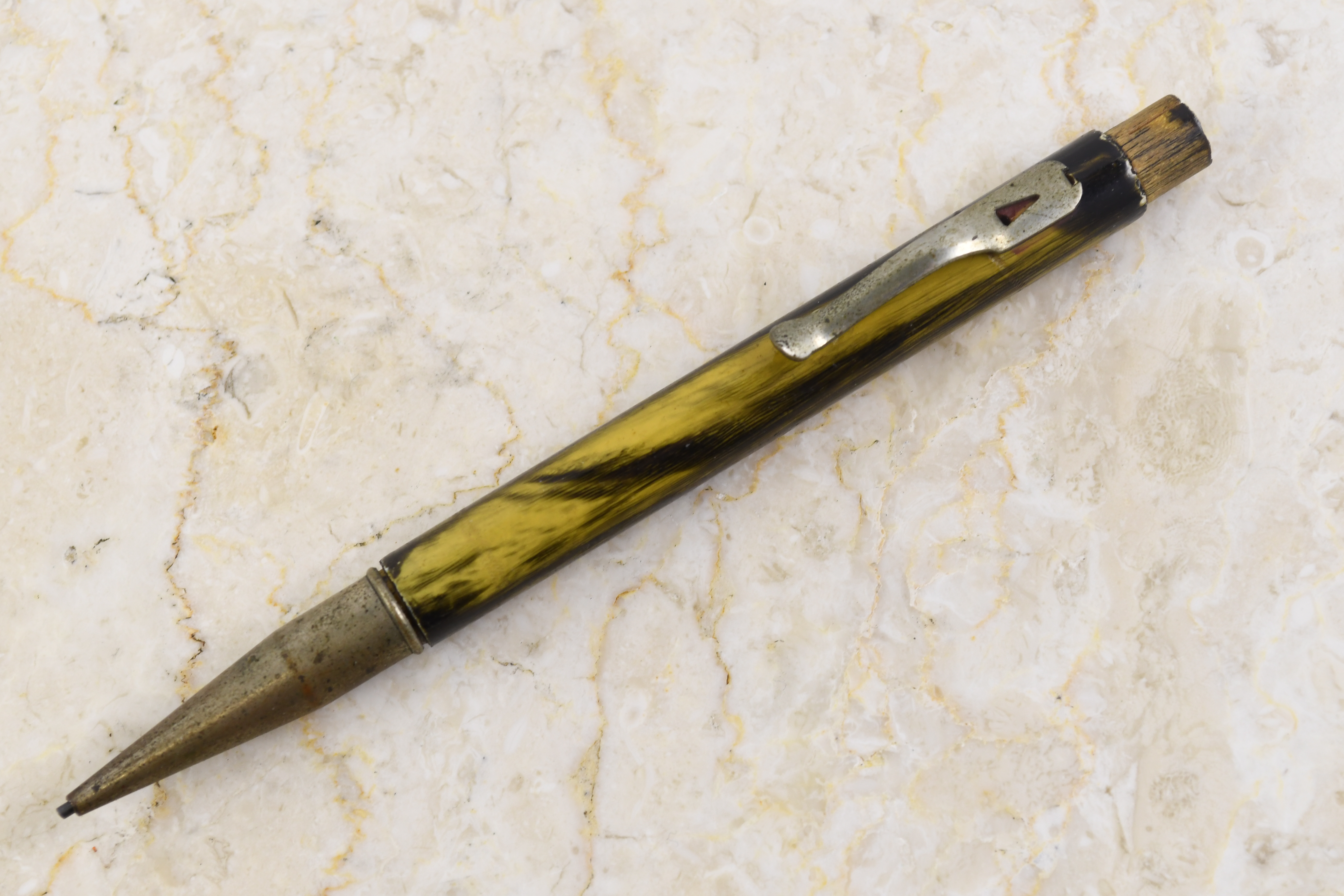
Showing posts with label Sheaffer Sharp Point. Show all posts

Thursday, August 28, 2025

Gabriel's Lot

In yesterday’s installment, I intended to tell you about all of the boxed pencils that Gabriel Galecia Goldsmith parted with:


The back story and the added discussion about Dunn Pen and Pencil, Inc. was more involved than I thought it was going to be when I sat down to write the article, so I decided to take a break and revisit the rest of them in a second installment. Each of these has significant “charm,” as Dr. Isaacson likes to say, starting with a brand near and dear to the good Doctor’s heart:


The lettering on the box lid is significantly worn, but I don’t care: “Sharp Point Pencil,” it reads, accompanied by a picture of a hand holding a pen.


The Sharp Point was the first pencil offered by the W.A. Sheaffer Pen Company, as detailed in Chapter One of my 2023 book, A Field Guide to Sheaffer’s Pencils. The Sharp Point was introduced in 1917 and the name was phased out in 1921. Due to mechanical problems with the pencil, Sheaffer offered to take back Sharp Point pencils in exchange for a free propel-repel-expel pencil in 1924, leaving precious few of these out there.


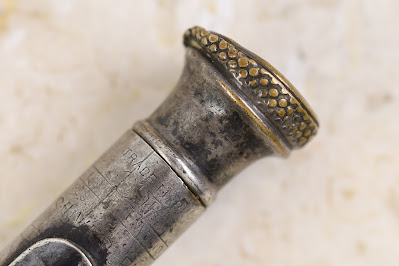
This example has what I call a “bowler clip” due to its shape, the second clip used on Sharp Point pencils introduced in 1918 and replaced by the familiar “Sheaffer’s” ball clip in 1919. Most with a bell cap have  Walter Sheaffer’s patent date of November 5, 1918 imprinted on them, as this one does:


As rare as Sharp Point pencils are, that wasn’t what had me jazzed about this example: after all, I have several examples with the combination of “bowler clips” and bell tops, as shown on page 9 of the book. I was grateful for the opportunity to catch up with Pat Mohan a bit:


Pat was a member of my “dream team” of advisers who helped me with the Sheaffer book; since I did not have a 14k Sharp Point, he was kind to contribute an image of his examples, which appear at the bottom of page 11. Early Sharp Point model designations were a two-letter code: A for silver plated, B for sterling, C for gold filled, and D for solid gold. The second letter denoted the pattern, with the letter A denoting a plain barrel. That makes this a model DA Sharp Point made in 1918 or early 1919, identical to Pat’s example as shown in the book.

Yeah, I always say I’m just as happy to have a picture as I am owning an example. Sometimes I lie a little.

The next example in this group is a very mint Moore hard rubber pencil:

This is a really pristine example of Moore’s 1925 patent pencils, and the price tag identifying it as Model 190, retailing for $1.50, sent me straight to the Pen Collectors of America’s online library:


The PCA has Moore’s 1925 catalog available, in which there is a page dedicated to the company’s hard rubber pencils.


On the left is model 190, with a price tag of $1.50 – just like my pencil – but notice that my example has groups of vertical lines (Eversharp referred to that pattern as “ribbon,” but Moore probably called it something else) while the catalog illustrates a wavy design Waterman called “rickrack” (again, Moore probably called it something else).  Judging from the catalog, Moore referred to any pencil lacking trim bands along these lines as a Model 190 “Varsity” (Model 290 in ringtop configuration), while everything else was the “Colonial” (not to be confused with Eversharp’s “Colonial” pattern which, of course, Moore called something else).

I’ll circle back to Moore soon - there’s a lot more to delve into on the subject.

Next is something I had to have, just because I’ve never seen a box for one:


I can’t rule out the possibility that maybe one flew right past my head at some point, because it is very difficult to read the printing with that blue background. It is a LeBoeuf “Unbreakable” ringtop pencil, and if you know what that box lid is supposed to say, you can find the words:


“Unbreakable” surrounded by “LeBoeuf Fountain Pen Company, Springfield Massachusetts.” On the end of the box is an interesting sticker marked “NY.” I don’t know if it means this was part of a lot destined for sale in New York, or if it was a model designation, or if it was something else:


I fibbed a bit earlier - there were two reasons I had to have it. While I do have another example (it was pictured here in “The Silent Cue” alongside a Keeran Pencil on August 9), if you look closely at the image of that one you’ll see the cracking that is fairly common on these.

Unbreakable, my butt. This new example, however, is clean. I’m not sure that string is a factory addition, but I see no harm in leaving it intact for now.

Sigh . . . this always happens. Yesterday I thought I would be doing a brief show and tell, introducing some neat new old stock pencils in their original boxes. Today, I thought I’d finish the job, but there’s one last one in this group to tell you about. It opens so many cans of worms that I’ll be back tomorrow to unpack all the information it provides.

Sunday, July 4, 2021

That's All I'm Going To Say About That

This article has been included in The Leadhead's Pencil Blog Volume 7, now available here.


If you don't want the book but you enjoy the article, please consider supporting the Blog project here.

When I sit down to write one of these articles, my method of picking the topic of the day is very non-scientific:  I open the file folder containing all the pictures I’ve taken, and I scroll through until I find something that I think would be fun to write about.  As the more meaty subjects get pulled out and placed in the “published” file, what's left behind are the brisket tips -- good stuff, worth photographing and definitely worth noting here, but more of an appetizer than a meal.  While each of these notes might not be enough for a complete article, today I'll string a few of these little notes together into a little tune.  

The Colorgraph:

I haven’t written about the Colorgraph for some time, most recently in Volume 2, page 95.  Since I’ve found so few of these duplex pencils over the years, it’s one of those brands I’ll chase even if I think I already have one, in the hopes there will be some tiny difference that will add to the story.  Recently, I chased and caught an example in black:


Unfortunately, it was identical to my other examples (and I still haven’t found an intact earlier model, with the longer nose).  So . . . all I have to tell you is that they also come in black.


The Ruxton:

The 1,000th post here at the Blog (Volume 4, page 351) covered the Ruxton well, including the company’s archive of prototype and shop models as well as production examples – including some boxed ones.  I bought this one because the box was different - the other examples in my collection are dark blue with black lettering, but this one you can actually read:


The pencil is extremely clean, but unfortunately there’s nothing different about it from what I’ve shown you already:


The Welsh Manufacturing Company:

This one was in a box lot of junk that came my way, and it wasn’t my intended target.  


From the clip and the nose, I knew it was made by the Welsh Manufacturing Company of Providence, Rhode Island.  Here it is shown alongside other variations on the theme:


I would have just put it in the Welsh drawer without photographing it, except for one small detail:


This one has a painted wood barrel.


The “Arrow Double”:

I’d never heard of this one before:


It nearly identical to one already in my collection, with two exceptions:


First, it lacks that great arched “14kt Gold Plate” imprint on the clip:


And second, the producer’s imprint on the top is different.  I say producer, because I don’t know who manufactured either one:


The one I had is an Ajax; this new one is marked “Arrow Double.”  I haven’t been able to discover anything about the Arrow Double in the year since I found it.


The Bridge Set:

I had such high hopes for this next find:


This nice box contained a beautiful set of sterling pencils marked with card suits:


I wrote about a similar set in a recent article about bridge pencil sets in Volume 6, page 194.  On page 196, I showed an English set by William Manton along the same lines that Joe Nemecek had given to me; it was newer than I had hoped, bearing a hallmark dating it to 1979.


This set appears to be older, and I expected hallmarks that would be a bit more . . . well, a bit more vintage than me, anyway.  Alas, there are no hallmarks and it appears to have been made for export to the United States, marked only “Made in England / Sterling Silver.” 


An Interesting Sheaffer Sharp Point:

This Sheaffer Sharp Point is on the early side of production, with a bowler clip and that zigzag-with-dots pattern:


What’s inside isn’t what I would expect.


The earliest Sharp Points look like this inside (see Volume 4, page 324):


While later Sheaffers (early 1920s on) look like this:


I’m not sure where this one fits in.


Cross-Built:

Here’s three very similar pencils . . . the bottom one is a typical Cross Century:


Two are marked on the clip: the Cross, and one marked “Swank.”


The Swank brand appeared in Volume 1, page 345 – on a ruler pencil/tie clip pencil.  Swank, Inc., as reported in that previous article, survives as a division of Randa Accessories.  The third pencil has a plain clip, but a nice imprint on the barrel:
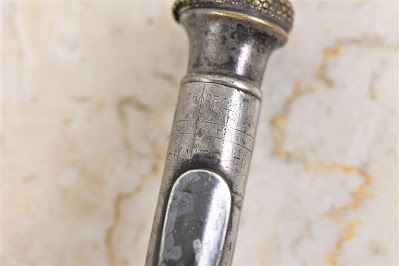

It’s a “PAT One Twenty.”  PAT was a trademark of Ketcham & McDougall, Inc., better known for making those pencils attached to a pin by a retractable chain.  The company claimed to first use the mark on September 18, 1936, according to the trademark registration:


All three of these pencils share very similar features, and my suspicion is that Cross made all three.  The Swank and PAT One Twenty share another element - that black plastic ring in the middle:


Welty’s

At the Krinke auction, one of my impulse buys was this fountain pen, complete with the box but with a conspicuously absent pencil:


The imprint is on the barrel, concealed under the cap when closed:


The pen was made by DeWitt-LaFrance, and I wasn’t planning on chasing it until I saw how small it was:


I wrote about the Welty’s DeWitt-LaFrance pencils in Volume 3, page 158; I came across the pen at some time since.  If the matching Welty’s pencil surfaces, it would be about the smallest DeWitt-LaFrance pencil I’ve seen.


The Baby Jumbo:

The Baby Jumbo is in Volume 1, page 373, and it’s not really “mechanical.”  A wood pencil is wedged in the neck of a glass bottle containing candy:


There was another example up for bids at the Krinke auction; I took “just in case” pictures of it before the auction started, because this one had the original paper label on it:


It would have been nice to bring this one home, but the pencil was identical to what I had, and the only thing the label provided was a cute admonishment to “Write your mother a letter today.”  When the bidding got a little crazy on this one, I couldn’t justify spending what it would take - so my “just in case” picture will have to do!

Wednesday, June 17, 2020

Flashpoint

This article has been edited and included in The Leadhead's Pencil Blog Volume 6, now on sale at The Legendary Lead Company.  I have just a few hard copies left of the first printing, available here, and an ebook version in pdf format is available for download here.

If you don't want the book but you enjoy this article, please consider supporting the Blog project here.

In "Wahl, Sheaffer and the Race for Boston" I laid out the case that Sheaffer’s earliest Sharp Point pencils were invented by David J. LaFrance, even though the patent was issued in Walter Sheaffer’s name.  Some nagging questions linger:   as I mentioned the last time I wrote about the Sharp Point in April, “I never found the evidence to prove whether it was the Boston Fountain Pen Company before Wahl purchased it, or David J. LaFrance on his own, or LaFrance working a fledgling pencil program for Sheaffer.”  See "When the Point Was Sure".

And then there’s Charles Keeran, the man who invented the Eversharp and who helped orchestrate Wahl’s purchase of the Boston Fountain Pen Company.  He was abruptly and mysteriously ousted from Wahl shortly after the purchase was consummated in early 1917, and almost immediately after Sheaffer’s Sharp Point was introduced in mid-1917.  

Was Keeran forced out for incompetence, because he failed to scoop up LaFrance’s pencil design along with the rest of the Boston Fountain Pen Company, or was he suspected of actively collaborating with LaFrance and/or Sheaffer with establishing a pencil program in 1917?

One thing is certain: between 1917 (when the Sharp Point was introduced) and 1919 (when Sheaffer set up its own pencil manufacturing works in New York), the same hands were making Sheaffer Sharp Points and Redypoints for Samuel Ward.    

My last article in April concluded with very similar pencils marked GF (for General Fireproofing of Youngstown, Ohio) and how they fit into this mix.  I didn’t bring them up in “Wahl, Sheaffer and the Race for Boston” because their connection wasn’t quite as direct – “a tremendous amount of smoke, but no fire yet.”
  
And, with the April article done and in the can, I did what I always do . . . scoped around a bit to see if there were any other examples of General Fireproofing pencils out there that I might want to scoop up.  

There were two.

And both add significantly more smoke:


The silver filled one was in a bunch of parts pencils in an online auction, and I didn’t notice until the package arrived that it was from Richard Lott, accompanied by a nice note that he hopes we see each other at another pen show soon.  This one was in the bunch because the cap is a bit scrunched on one side:


But, I suppose it can share custody with the cap from one of my early Sheaffer Sharp Points.  The parts are interchangeable:


To be honest, I thought from the auction photos it might be an unmarked Sharp Point, since the GF imprint is so faint:


But there it is – and here it is, posed between the Redypoint and Sharp Point pencils from “Wahl, Sheaffer and the Race for Boston,” proving the connection between the two:


I was disappointed that the Redypoint was clipless, since that would have provided one more nexus for comparing the two.  This one does, but you might argue it proves nothing, since it terminates in a flatter, more spoon-shape tang rather than the Sharp Point’s more graceful, pointed terminus:


But . . . that’s just one style of Sheaffer clip.  Another style (the one I call the “bowler clip,” since it looks like a bowler hat at the top) has an identical tang:


Advertisements at the time suggest that the bowler clip, at least on Sharp Point pencils, came after the earlier, more pointed clips.  General Fireproofing pencils, however, might never have had the same clips . . . or at least, not enough of them have surfaced to know.  But at last I’ve got a General Fireproofing pencil that was indisputably made by the same hands that crafted the Redypoint and Sharp Point:


From the top, these are the Redypoint, the General Fireproofing, the Sharp Point and the later Sharp Point – and note also that those double bands at either end of the barrel were dropped by Sheaffer.
And what of that gold filled example of the GF?


It has a very distinctive pattern on it, and when I compared it to all my other Sharp Points – all my other Sheaffers, t00 – it isn’t even close to anything else I’ve found.  Yet it looked so familiar . . . I was sure I’d seen it somewhere . . . 

Wait a tick . . . you don’t suppose . . . 


A checkerboard pattern on most of the barrel – very close.  The GF has squares comprised of four lines, while the match I found has blocks of five lines.  And on the front, a cartouche pinched in the middle like a peanut:


That’s the GF at the top.  Note that like the checkerboard pattern, it isn’t identical, but it clearly evokes the same lines.  Line up fifty, or a hundred, or what the heck .... all my other metal pencils with cartouches like this, and you’ll see: there is no question that the pattern on this GF pencil deliberately, but admittedly feebly, copied the pattern on this other pencil.

And that other pencil is . . . 


A Heath-clip Eversharp, made by the George W. Heath Company for Charles Keeran’s fledgling Eversharp Pencil Company before Keeran contracted with Wahl to make them for him in October, 1915.  This pattern was never made by Wahl.

And then here’s the kicker: the pattern is also found on Sheaffer Sharp Point pencils.  Jerome Lobner had this one recently – unfortunately, I was so preoccupied with writing that I didn’t see it, but he let me use his picture:


Time to step back and string the clues together.  Between 1917 and 1919, one manufacturer was making Sheaffer Sharp Point Pencils, Redypoint pencils for Samuel Ward & Co. and pencils for General Fireproofing.  The Redypoint ties in with David J. LaFrance, the pencil’s inventor.  LaFrance was working for Boston when Keeran helped arrange the sale of Boston to Wahl.    Keeran admittedly neglected his duties at Wahl after the sale to attend to patent disputes “etc. etc.” in New York.  The GF pencil that just turned up and Jerome's Sheaffer Sharp Point copy a pattern Charles Keeran used on his Eversharps before he became involved with Wahl, which his current employer was not using.  Keeran is relieved of his duties after the introduction of Sheaffer’s Sharp Point is made public.

What we need is documentation to establish when General Fireproofing was offering pencils for sale.