Showing posts with label Dixie. Show all posts

Friday, March 16, 2018

As Kraker Neared the End of the Line

This article has been edited and included in The Leadhead's Pencil Blog Volume 5; copies are available print on demand through Amazon here, and I offer an ebook version in pdf format at the Legendary Lead Company here.

If you don't want the book but you enjoy this article, please consider supporting the Blog project here.

Yesterday’s article (https://leadheadpencils.blogspot.com/2018/03/unfinished-business.html) included photographs of Dixie, Monogram and Belmont branded flattop pencils, all of which were made by the Michael-George Company, and given the imprint on my Dixie, were made at least through 1929, when the company relocated to Libertyville.

A lot happened in the pen industry in 1929.  After decades of squared-off pens, Sheaffer’s new Balance line (introduced in 1928) became all the rage, leading pen manufacturers to taper the ends of their writing instruments to the greatest extent allowable by law.  Sheaffer held design patents on the new shape, which the company aggressively protected through threats and litigation, most notably the company’s lawsuit against the Worth Featherweight Pen Company - see https://leadheadpencils.blogspot.com/2017/01/the-one-pennant-rejected.html and Daniel Kirchheimer’s excellent article on the subject, published in The Pennant but also maintained by the author separately at https://danielkirchheimercom.files.wordpress.com/2017/01/featherweight-vs-heavyweight.pdf.

Michael-George was no exception, but with the Depression closing in and the firm’s bankruptcy looming ahead in 1932, it was a very narrow window of time within which the company produced more streamlined pens and pencils.

Note the differentiation between “made” in the first paragraph of this article and “produced” in the third.  Dennis Bowden’s series of articles on Kraker and Michael-George, which ended on a cliffhanger just as the company was relocating to Libertyville in 1929, documented how the company had significant tooling and was clearly manufacturing its own product until that time.  However, was Michael-George able – during the onset of the Depression – to retool and make more streamlined-looking pens and pencils?  And to what extent would he dare to do so, going head-to-head once more against Walter Sheaffer in a patent dispute?

I think the answer is that he dared a little bit, but he couldn’t retool.  I do not believe pencils like this Pencraft were made by Michael George:


The celluloid isn’t much help in identifying who might have made it for them, since I’ve never seen this striking blue and white plastic on anything else:


However, the imprint provides a good clue:


The large imprints on the lower barrels have been abandoned in favor of a block-print imprint on the upper barrel, opposite the clip.  Another company’s imprints were very similar: the Moore Pen Company.  In fact, compare the top ends of the Pencraft and one marked Moore:


Same trim bands, both in size and in placement.  Same location of imprint.  And notice those same white swirls in the plastic, rendered in brown rather than blue.  Since Pencraft was Kraker’s flagship brand in the post-Sheaffer litigation years, is it safe to say that the Michael-George Company’s last product lines were made by Moore?

Maybe.

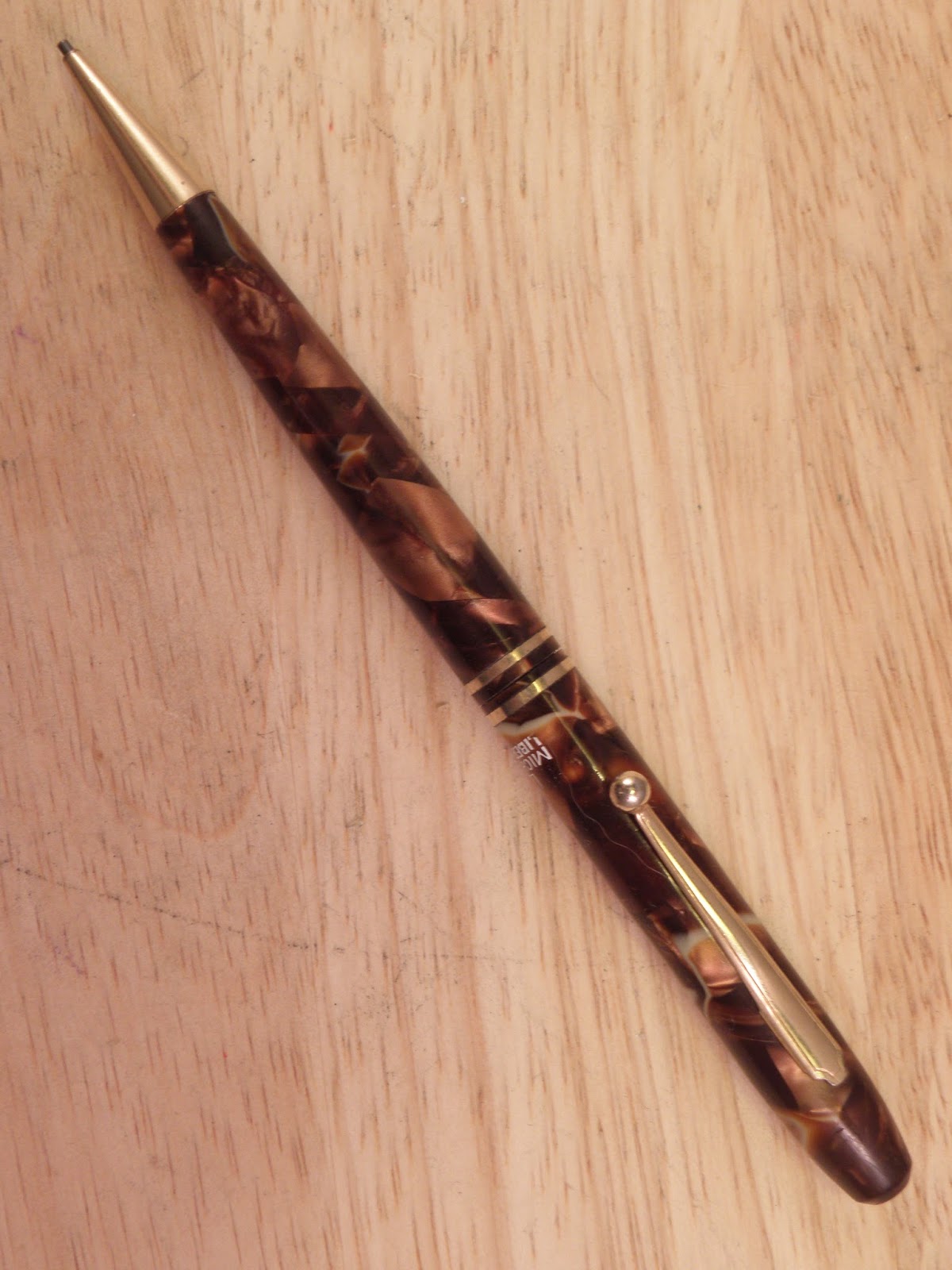
A few years back, I compared a Dixie which is similar to today’s Pencraft to a Belmont and an Eagle (see https://leadheadpencils.blogspot.com/2013/08/quite-bit-north-of-mason-dixon-line.html).


I had concluded at the time that Eagle made my Dixie . . . perhaps placing too much emphasis on the similarity of the plastic and not noticing that the clips on the Belmont and the Dixie are identical to clips used on a Moore (I also placed great emphasis on an Eagle patent appearing on a box of Belmont leads).

The confusion is warranted, because Michael-George, Moore and Eagle keep turning up together, dancing in the same very small circles.  I’d noted in The Catalogue at page 25 that some Belmonts were clearly made by Moore, and others were clearly Eagle-made:


Maybe it isn’t so clear.  Earlier metal Pencraft pencils mimicked Eagle’s patented Simplex, and both of my Pencrafts are stamped “Patented” (see https://leadheadpencils.blogspot.com/2011/12/other-pencraft.html and https://leadheadpencils.blogspot.com/2012/02/eight-days-week-eagle-simplex.html).   Moore’s pens and pencils were at one time very distinct - you’d never confuse one like the one I posted about here the other day for an Eagle -- but with later Moores such as these, you easily could.

Could it be that Moore, like Michael-George, had Eagle manufacture some of its products for a time?

Thursday, March 15, 2018

Unfinished Business

This article has been edited and included in The Leadhead's Pencil Blog Volume 5; copies are available print on demand through Amazon here, and I offer an ebook version in pdf format at the Legendary Lead Company here.

If you don't want the book but you enjoy this article, please consider supporting the Blog project here.

Here’s another one that came home by way of Jerome Lobner:


In addition to being just freaking gorgeous, with those wine-colored veins, it’s got a great imprint for a brand I’ve been hunting for some time:


“Dixie / Non-Breakable / Libertyville, Ill. Pat.”  A few years ago I had a Dixie fountain pen with this enormous imprint, and I always thought it would be cool to have one of the pencils.   Note the reference to a patent on the imprint-- the pens have the same imprint, and there’s nothing really unusual about the way this pencils works, so I don’t know what that’s all about.

The Dixie was a brand produced by the Michael George Company, named (in reverse) for its namesake, George Michael Kraker - that’s the same Kraker that got himself sued by Walter Sheaffer over the patent for the lever-filler fountain pen.   Kraker’s companies had several of their own house brand names - Pencraft was his earliest, dating to 1918, followed quickly by Yankee and also Dixie.

Kraker also manufactured pens and pencils for The United Drug Company’s Rexall stores, such as Monogram and Belmont.  These house brands shared elements of the Dixie imprint, but manufacture of these would have started while Michael-George was still in Grand Haven, Michigan:


With Kraker’s involvement in the company, several of my friends have written so much about his movements that most of the research I was going to do for this article has already been done.

The best reference is a series of articles the late Dennis Bowden and Jineen Heiman wrote for The Pennant, part one of which was published in the spring 2010 issue and part two in the fall 2010 issue.  Bowden documented in great detail Kraker’s activities after Sheaffer’s legal victory over him in 1917: first in Chicago in 1918, where he organized the Pencraft Company in 1919, then in Minneapolis from 1921 to 1923, then (briefly) back to Chicago, where the Michael-George Company name is first found, then to Grand Haven, Michigan until around 1929.

But there’s one last chapter to the story, reflected in the last paragraph of Bowden’s second article: “Part III of this article will discuss George Kraker, the Michael-George Company and its pens in Libertyville, Ill. 1929-1932.”

That, unfortunately, would be Bowden’s last words on the subject: he passed away suddenly in December, 2010, leaving the Libertyville chapter of the Michael-George story undocumented.  Given Bowden’s research from the first two articles in this series, I can only assume he had a similarly detailed amount of information to share about the company’s Libertyville years.  Unfortunately, if that research was ever committed to writing, I don’t know what became of it.

So, I’ll try to pick up where Dennis left off.

Bowden’s article indicates that corporate paperwork planning Kraker’s move to Libertyville was finalized in September, 1928, but his cliffhanger suggests that he had not moved until 1929.  The earliest reference I found to the Michael-George Company being in Libertyville was a classified ad the company placed seeking a gold pen grinder, which appeared in the Chicago Tribune on April 17, 1929:


I found a post-mortem reference that the company’s factory was located on East Church Street in Libertyville.  The product lines offered were initially the same as those the company manufactured in Grand Haven, Michigan - all of the pencils I’ve pictured above match the ones Bowden shows in the second of his articles.

As for the Dixie, I know from my own experience it was offered as both a fountain pen and a pencil.  However, I found a reference from 1931 that it was also offered as a combo pen and pencil, “as modern as air travel,” which was given away as a prize according to this ad, from the November 17, 1931 edition of the Sikeston (Missouri) Standard:


Bowden suggests that Michael-George’s run ended in 1932, and that’s consistent with what I’ve been able to find.  On October 20, 1933, The Pittsburg Press included an advertisement by Gimbels offering “Bankrupt Stock Michael George Co.,” blowing out leftover Pencraft pens for 99 cents:


Three years later, a new tenant moved into the factory building formerly occupied by Michael-George:


I find no references to indicate that Michael-George survived bankruptcy in 1932, or that George Kraker continued in the pen business after its failure.  What I have found is evidence that in Michael-George’s last days, the company was no longer manufacturing its own products.

Note:  this story continues at https://leadheadpencils.blogspot.com/2018/03/as-kraker-neared-end-of-line.html

Tuesday, August 20, 2013

Quite a Bit North of the Mason-Dixon Line

I stumbled across this one at the Chicago Show at Bob Everett’s table.  When I picked it up, I was sure I knew what it was, but again I was reminded that I won’t learn anything new if I assume I know what something is:


That brown marbled plastic with white streaks in it is very distinctive, and that’s what had me convinced I was looking at an Eagle.  Here it is, in between an Eagle and a Belmont:


To learn more, this full article is included in The Leadhead's Pencil Blog Volume 2, available at Amazon, Barnes & Noble and everywhere else you buy books, or you can order a copy signed by yours truly through the Legendary Lead Company HERE.