Showing posts with label Western Pencil Company. Show all posts

Sunday, September 14, 2025

Still Starving

I haven’t searched the online auctions as carefully as I have in the past lately: between my new fascination with dip pen wells and a massive influx of new pencils piled up in the musuem, waiting to be photographed and documented, I haven’t had as much of an appetite to bring a bunch more home.

I said I didn’t have as much of an appetite. I didn’t say I was dead.

It had been a couple weeks since I had logged into eBay, but when I did the infinite well sprang anew. One of the first things I saw was this lot:


The pencils are all unmarked, and other than their distinctive 1920s look there was no way to know who made them . . . unless, of course, you read this blog. 

I knew exactly what they were, because I’ve written about them. These were made by the Western Pencil Company, which was set up to succeed the Dollarpoint Pencil Company, which had failed in early 1925. Western Pencil Company was alive, at least in name only, until its remaining assets were sold at auction in 1938. I last visited the brand in “Diamonds Amongst the Rough” (April 30, 1921: Volume 7, page 73), an article in which I noted how starved I am for more information about these:


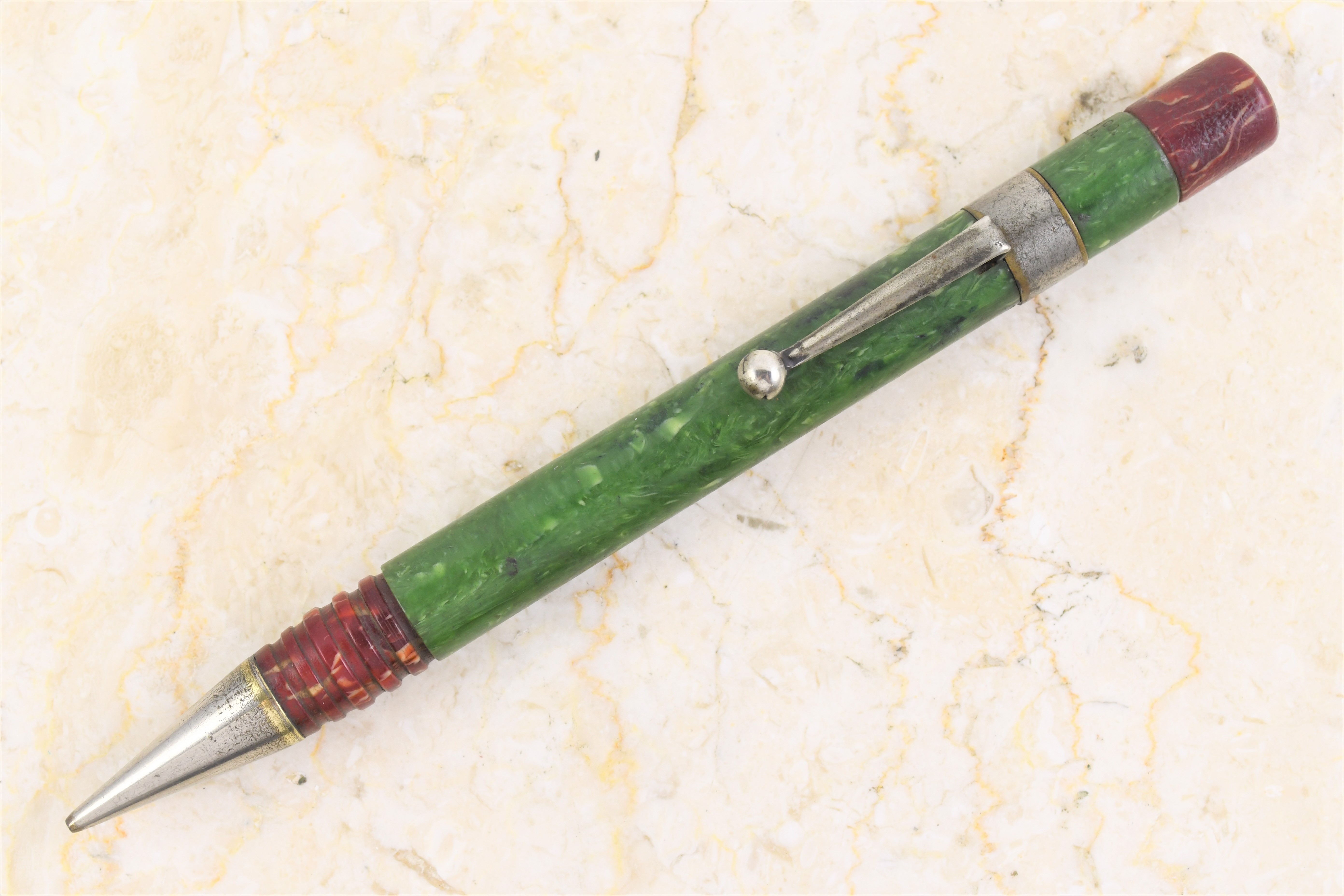
The primary reason for that last article was the two-tone example that had recently turned up, in jade with those red marbled end pieces. Some, like the top three shown here, have a deeply ribbed tip with a longer metal section, mimicking the appearance of the earlier metal Dollarpoint and Artpoint lines. Later examples have a much shorter metal tip and a smooth, celluloid nose. The bottom two have no markings, other than an advertiser’s imprint on the red one.

One of the things I wondered at the time was rather there were all-red marbled examples out like the blue one at top, and whether the solid red examples like that bottom one were all advertisers (I have seen a couple others since, and all have had advertising imprints . . . for the same company, in fact: Columbia Varnish Company. I was unable to establish any connection between Columbia and the Western Company, by the way.


All I really wanted out of this new bunch was just one of the red marbled examples, but I wanted it badly enough that I didn’t mind bringing home seventeen others along with it. Heck, I rationalized, there might be other things I can learn from them. My competition, I thought, might be people who just appreciate good-looking flattop pencils from the 1920s, but I figured they wouldn’t want to pay much. 

The more fierce battle would come from people who knew what they are, probably from reading this blog, and I had visions of one of them coming up to my table at the next show to do a “nana nana boo boo” dance. That had me bidding the stupid money, because I had to know whatever there is to know from these. Two other bidders tried in the last few minutes, but it wasn’t enough. One of them, I knew from the masked handle, was someone I know. I’ve since shared the wealth with him. The other I have not yet heard from.

My victory lap when they arrived was on our kitchen table, where I first did a close examination to see if any had imprints or any other markings, no matter how faint, and none of them do - not even the red marbled ones, which look to be on the earlier end of production when all were marked.

Then it was time to see whether the two-tone example residing in my collection was something that could be easily mixed and matched from parts of different pencils. I’ve wondered whether it was factory. After a bit of mixing and matching, I was more confused than before:


The green ends fit on the red marbled, but not the other way around . . . the nose won’t fit over the wider pushrod.  So I tried some other combinations:


The red and jade examples swap nicely, but that red marbled nose won’t fit on the orange one, either. It was time to abandon the kitchen table for the museum, where better lighting and a macro lens might explain what is going on here. I took apart my two-tone example and compared it to a solid jade one, and there was the answer:


At top, the two tone example has a plain pushrod to advance the lead, just like the earlier Dollarpoint and Artpoint pencils. It pushes the lead forward, but it doesn’t pull it back – the lead is held in place by friction. The jade example at bottom is a little later, and it has a wider, hollow rod that holds a piece of lead. It advances and retracts because the tip is bored out enough to allow the lead to pull back in.


That had me checking under the hoods of all of the examples I have found, and I notice a pattern . . . mostly . . .


Those with the longer metal tips all have simple pushrods, and out of these all but these new red marbled ones have Western Pencil Company imprints. Fifth from top is a black and pearl example, which has a shorter tip and a barrel imprint. The bottom three lack any barrel imprints, and all three are equipped with that wider, propel-repel feature. 

That means, and I confirmed it, that I could make two-tone pencils by mixing and matching red marbled with that black and pearl example, since it is equipped with a propel-only action:


With black and pearl examples in hand equipped with either the propel only or propel-repel feature, I was back at the kitchen table checking what was inside all of the other jade and orange examples that had come in. All had the propel-repel feature except for one jade example, but . . .wait a tick . . . there was something stuck in the nose of that one. When I pushed out the obstruction . . . 


The propel-repel feature was created in the simplest way possible: a hollow rod was forced over the solid push rod that had been in use, which holds a piece of lead at the other end. I checked the other examples, and none of these pieces are soldered in place - they all simply pull off . . . say, if you wanted to “make” a two-tone red marbled and jade example like the one I found earlier. Or maybe this:


No, all of this is just irresponsible. I’ll leave my two-tone red marbled and jade example as it came to me, because I think it might be factory: as rare as these Western Pencils there are, junk box provenance suggests it is unlikely that some random prior owner combined parts of two pencils, and it would make sense as the end of Western Pencil approached in 1938 someone may have salvaged remaining parts by pulling the propel-repel rod off at the factory. In the future, documentation may surface to confirm that the two-tone thing was actually a thing.

Otherwise, I’m not going to start mixing things up by swapping parts in the absence of evidence they were ever intended to be combined in such a fashion. They are fun to look at, but for now, all parts have been returned from whence they came.

Friday, April 30, 2021

Diamonds Amongst the Rough

This article has been included in The Leadhead's Pencil Blog Volume 7, now available here.


If you don't want the book but you enjoy the article, please consider supporting the Blog project here.

Sometimes the circumstances in which a pencil is found suggests its authenticity – “junk box provenance,” I call it.  An online auction brought this one to my doorstep:


I knew what I would find imprinted near the top when it arrived: “Western Pencil Co. / Los Angeles - USA.”  It was a bit beat up, but I didn’t mind:


I haven’t seen a two-tone Western before (we won’t count that mismatched jade from the article in Volume 6, page 141).  Someone remarked that the red ends resemble Waterman’s mahogany plastic used on some Model 94 pens and pencils during the 1930s.  I think this has more red in it:


I also think it was made earlier - too early for that Waterman plastic.  The Western Pencil Company was organized by the buyers of the Dollarpoint Pencil Company, also of Los Angeles, which made metal Dollarpoint and Artpoint pencils using the same mechanism in the early 1920s.  Dollarpoint’s entire operation was sold at auction on February 12, 1925 (see Volume 4, page 267); while Western continued to exist at least in name until 1938, the ribbed front section and longer nose on this new addition indicate earlier production than the later ones with smooth, short-tipped noses:


The noses on these are removable, which begs the question whether this was built as a two-tone or whether parts have been replaced – that’s where the junk box provenance comes in.  First, you’d need to find spare Western parts, and as hard as these pencils are to find, that would be a tall order.  Then, consider the other things that accompanied the Western in that lot:


Rough?  Yes, they are . . . but finding a Western in the company of four Artpoints in any condition (let alone what’s left of the harder to find gold filled and “statuary bronze” models) strongly suggests that this bunch came from a source close to the company.   I wouldn't mind finding a Western in all red, but I think it was supposed to be like this.

But speaking of all red Westerns . . . this one slipped under the radar, in another online auction from a different sort of junk box:


Surrounded by kitsch, a “Duofold-red” Western lay amongst the weeds.  It cleaned up fairly well, although much of the plating on the clip band was gone:


Just as was the case with the later jade examples in my previous article, this one also lacks a manufacturer’s imprint near the top.  The imprint on the side appears to be an ordinary advertiser’s imprint, for Columbia Varnish Company, “Paint Makers”:


Columbia was located in southern California - a period glass paperweight indicates the company had offices in Fresno, Beverly Hills, and Los Angeles . . . hmmm, Los Angeles, just like Western.  The company was founded by Osmund Olsen, who according to his obituary, published in the North Hollywood Valley Times on August 9, 1954, was a Chicago native who moved to California and founded Columbia Varnish in 1915.  Help wanted ads from Columbia indicate the company’s plant in Los Angeles was located at 2460 E. 24th - not a match for either the old Dollarpoint location (1001 W. 16th) or where the Western Pencil Company was doing business when it was liquidated in 1938 (1821 E. Randolph).

I am so starved for more information about the Western Pencil Company that I’m tracking down an advertiser’s address just to be sure there’s no connection with the company.  No stone has been left unturned, so it’s time to file this one away . . .


. . .  until the next example turns up.


Sunday, May 31, 2020

Not the Story I Was Hoping to Tell

This article has been edited and included in The Leadhead's Pencil Blog Volume 6, now on sale at The Legendary Lead Company.  I have just a few hard copies left of the first printing, available here, and an ebook version in pdf format is available for download here.

If you don't want the book but you enjoy this article, please consider supporting the Blog project here.

There are times when I see something online and I get so excited that I know exactly what it is, I forget to check to see how it compares to the things in my collection.  Like this one:


At a cheap Buy it Now price under ten bucks, there was no question this one was going back to Ohio (cue the Pretenders: “but my city was gone . . .” and you’re welcome for the earworm that you won’t get rid of for a week).

There’s no markings at all on this pencil, but I know exactly what it is: a pencil made by the Western Pencil Company in Los Angeles, and probably made from leftover parts after the company folded, hence the lack of the typical imprint on the cap.

Sat down I did to write about this.  Went down to the museum I did to find that I already had one.


Read my own darned blog I did to see that I’ve already written about the one already in my collection.  The article, “The Handoff to Western," details my theory that these celluloid pencils, identical mechanically to the Dollarpoint and Artpoint metal pencils which preceded them, suggest that when all the assets of Dollarpoint were sold at auction in February, 1925, everything was sold to one buyer, which reopened as the Western Pencil Company.

Oh, a big pencil like these with a Dollarpoint imprint, or a metal pencil marked Western, would just clinch that one, wouldn’t it!  Alas though, this pencil is unmarked – and both have tips that are a color mismatch for the rest of the pencil!


But . . . wait a tick . . .


Twenty years to find six examples of the Western Pencil . . . calculate the odds of finding a part that’s a better color match, let alone making two well-matched examples with a spare!

Thursday, November 24, 2016

The Handoff to Western

This article has been edited and included in The Leadhead's Pencil Blog Volume 4; copies are available print on demand through Amazon here, and I offer an ebook version in pdf format at the Legendary Lead Company here.

If you don't want the book but you enjoy this article, please consider supporting the Blog project here.

“Junk Box Provenance” is a term I use to describe those instances when the circumstances in which an object is found suggests something about the object itself.   The two Artpoint pencils from yesterday’s article came from that bunch:


And each of these shares something interesting.  As I’ve mentioned in earlier articles on the subject, when you are able to wrestle off the cap of an Artpoint, what you will usually find – if there’s anything – is the same imprint:


But when I remove the caps from these two examples, there’s nothing to be found:


I’m also hoping that one of these days, the initials “JEY” will prove significant, since this is the first time I’ve seen one with nice engraving on the top of the cap like that.

The absence of a Dolarpoint imprint suggests that these were not made by Dollarpoint – since I found advertisements from late 1923 suggesting the company might have started using the name “Artpoint Pencil Company” when it attempted to reorganize,  maybe the manufacturers stopped using the Dollarpoint imprint then.   The auction notice from February, 1925 clearly indicated that the assets sold were those of the Dollar Point Pencil Company, though.  I believe it’s more likely that Artpoint pencils lacking an imprint at the top were made by whomever purchased the assets and equipment of the company, using all of the existing tooling on hand.

There are two other pencils that came out of that DC show collection, which I believe supports this conclusion and indicates who that likely buyer was:


Over the course of more than fifteen years of collecting, these two examples nearly doubled my collection of pencils from the “Western Pencil Company.”  Here’s the other three I’ve found, all of which were pictured in The Catalogue on page 172 when I published the book five years ago.  It’s been that long since I’ve found any other examples:


Note that there are two different tips styles on these.  Normally I would think that the ones with the longer tips and straighter barrels are earlier, since the machining is more complicated to make the tapered barrels with a shorter tip:


But that’s just a theory based on observation of similar models.  One thing all three share is the same imprint:


“Western Pencil Co. / Los Angeles - USA” My new black and pearl example is identical to the one I’ve had for awhile, with the same imprint:


The jade example, however . . . is unmarked.

Here’s where the junk box provenance comes in.  That makes four pencils you don’t normally find – two of which I haven’t turned up in more than five years – in one collection.  I think they came from a common source.

There’s plenty of other reasons to suggest that Dollar Point was acquired lock, stock and barrel by a purchaser which resumed operations, turning out Artpoints using the existing tooling (without, of course, the Dollarpoint imprint) and later converting that same mechanism for use with celluloid barrels as brightly colored celluloids supplanted metal pencils towards the end of the 1920s.  Notice how similar the two are:


Unfortunately, I don’t have any direct evidence concerning who this mysterious purchaser might have been – but I do have one solid clue as to who was running the show by the end of 1927:


On December 3, 1927, the Los Angeles Times reported that a fire had destroyed the building “of" (doesn’t say “owned by”) the Western Pencil Company, which was located at 1101 Venice Boulevard, Los Angeles.  Otto Gamball, the factory superintendent, saw a batch of celluloid catch fire when it was overheated in an oven, and in his attempt to remove the burning celluloid from the building he sustained life-threatening burns.  I never found a follow up article indicating whether he survived.

The other clue in the story is a name associated with Western Pencil: “Mrs. H.L. Zimmerman,” who is reported to be “the wife of the owner of the factory.”  Following the conventions of the day, I believe this means the owner of the factory was H.L. Zimmerman, and I believe that means the owner of Western Pencil, not just the building in which it was housed (note that she was injured attempting to rescue the books and records of the company – something a mere building owner would not have risked life and limb to preserve on behalf of a tenant).

Did Western Pencil itself survive the blaze?  Maybe, for a time.  After the report of the fire, the only other mention I found of a “Western Pencil Company” was a notice that all of the firm’s machinery and equipment – even three cars – were being auctioned on February 22, 1938:


The year 1938 seems late for the examples of the Western Pencil Company I’ve found to date.  Maybe that’s why the company folded, as its squared-off flattop pencils became passe and the company failed to keep up with the times.  Maybe the company stopped marking its products, as my new jade example suggests it might have done, and there’s other unmarked, more streamlined pencils out there we just haven’t known to attribute to the company.

But maybe, of course, there’s streamlined pencils out there marked “Western Pencil Company” which would prove that Western not only survived the fire but continued to flourish for another decade.  That’s why, even after I’ve amassed thousands of mechanical pencils, the hunt continues.

Friday, October 17, 2014

So Long To Some Old Friends

Note:  this is the last installment in a series of five articles.  The first part was posted here:  http://leadheadpencils.blogspot.com/2014/10/artfully-to-point.html.

Until recently, I’d never heard of any of the people involved in the Dollar Point Pencil Corporation story. However, there’s been enough written about them that now that I’ve researched these articles I almost feel like I know them, including many details of their lives outside of Dollar Point.

Wade W. Moore, the inventor of the mechanism inside the Artpoint, never patented any other writing instruments or any other inventions, either. When I first started researching this article, I thought that was odd – most inventors with more than one patent don’t just quit. But after I read this historical account of Moore’s life in the 1926 History of Contra Costa County with Biographical Sketches, it made sense:


To learn more, this full article is included in The Leadhead's Pencil Blog Volume 3, available at Amazon, Barnes & Noble and everywhere else you buy books, or you can order a copy signed by yours truly through the Legendary Lead Company HERE.


Wednesday, October 15, 2014

What's Going On In That Phone Booth?

Note:  this is the third installment in a series of articles.  The first part was posted here:  http://leadheadpencils.blogspot.com/2014/10/artfully-to-point.html.

In 1924, just as brightly colored celluloid pencils were about to render all-metal pencils out of style, the Dollar Point Pencil Corporation and J. E. Roach & Co., both of which claimed to manufacture Artpoint and Dollarpoint brand pencils, apparently vanished. What made these pencils distinctive, in addition to their heavy, durable construction and spot-on styling, was the patented mechanism, invented by Wade W. Moore and assigned to Jesse E. Roach:


I have never heard of or seen an Artpoint or Dollarpoint in celluloid, so one possible explanation for the company’s disappearance is natural extinction - a failure to adapt to the new trend in writing instruments. But then I remembered another brand that I’ve thought about for a long time:


To learn more, this full article is included in The Leadhead's Pencil Blog Volume 3, available at Amazon, Barnes & Noble and everywhere else you buy books, or you can order a copy signed by yours truly through the Legendary Lead Company HERE.