Showing posts with label Selfeed. Show all posts

Sunday, October 26, 2025

The Wild Geese Come Home

I cringe and smile at the same time when I reread articles that posted during the first year here at the blog. The writing was crude – most of its rudimentary articles were dashed off in an hour or so just to introduce something I had found that wasn’t included in The Catalogue. The research tools were also crude: internet research tools were comparatively less developed than they are now, and I hadn’t yet written the patent and trademark books on which I rely so heavily. 

But I smile at the exhuberance. Everything was new at the time, and The Catalogue had just unleashed an avalanche of interest in mechanical pencils. That first volume introduces many of the people who are now old friends, and whenever I thumb through Volume 1, I relive the excitement of learning things that are second nature now, and meeting people that have become old friends.

Towards the end of that first volume, I was just beginning to engage in deeper research dives to learn the history behind these pencils rather than just showing off the pencils themselves. “One Wild Goose Chase” (November 1, 2012: Volume 1, page 401) is a good example of the transition from an update service for The Catalogue into the ongoing research project it is today. 

In that article, random observations about Selfeed repeating pencils led me to an eBay auction that had closed four years previously. At the time, eBay’s search tools still allowed random strangers to identify buyers and sellers in past auctions, and with the help of several new friends I learned that the seller was Michael Kidd, who had bought a group of Selfeed pencils from Rob Bader. I knew Rob, but Michael was a stranger with whom I forged a new friendship; he snapped this picture of what he had bought from Rob, which was included in the 2012 article:


A few weeks ago, Michael sent me an email to offer me a few pencils before he listed them in the online auctions. Although he has followed the blog all these years, it had been so long since we last conversed that I didn’t remember where I had seen some of them.


Michael mentioned that I had seen what was on that instruction sheet, but I thought he meant that I had seen a Selfeed instruction sheet – not this exact one.


I had forgotten that these were the very same pencils I had written about so long ago, and their addition to the museum is an ever-present reminder that none of us, myself included, really own these things. We are only privileged to be their caretakers for a time.

There were some other items in that care package Michael sent me that I will tell you about later, but one bears mention here: Michael said he was including a pencil that he had grown weary of trying to figure out. He didn’t send a picture of it, but when it arrived I was able to tell him exactly what it was:


The short ringtop is shown here alongside the “Rite Away” pencil I just wrote about here on September 30 in “A Long-Lost Cousin.” The two are identical – even the noses are interchangeable. I scoured the barrel with a loupe looking for any imprints, and there’s nothing there that I can see.


Perhaps this is another Rite Away, but without a barrel imprint. Perhaps, as I theorized in that last article, this is an unmarked Eagle Pencil Company product.

Perhaps, in another thirteen years or so, some random stranger will answer that question for me!

Monday, April 13, 2020

Selfeed Roundup

This article has been edited and included in The Leadhead's Pencil Blog Volume 6, now on sale at The Legendary Lead Company.  I have just a few hard copies left of the first printing, available here, and an ebook version in pdf format is available for download here.

If you don't want the book but you enjoy this article, please consider supporting the Blog project here.

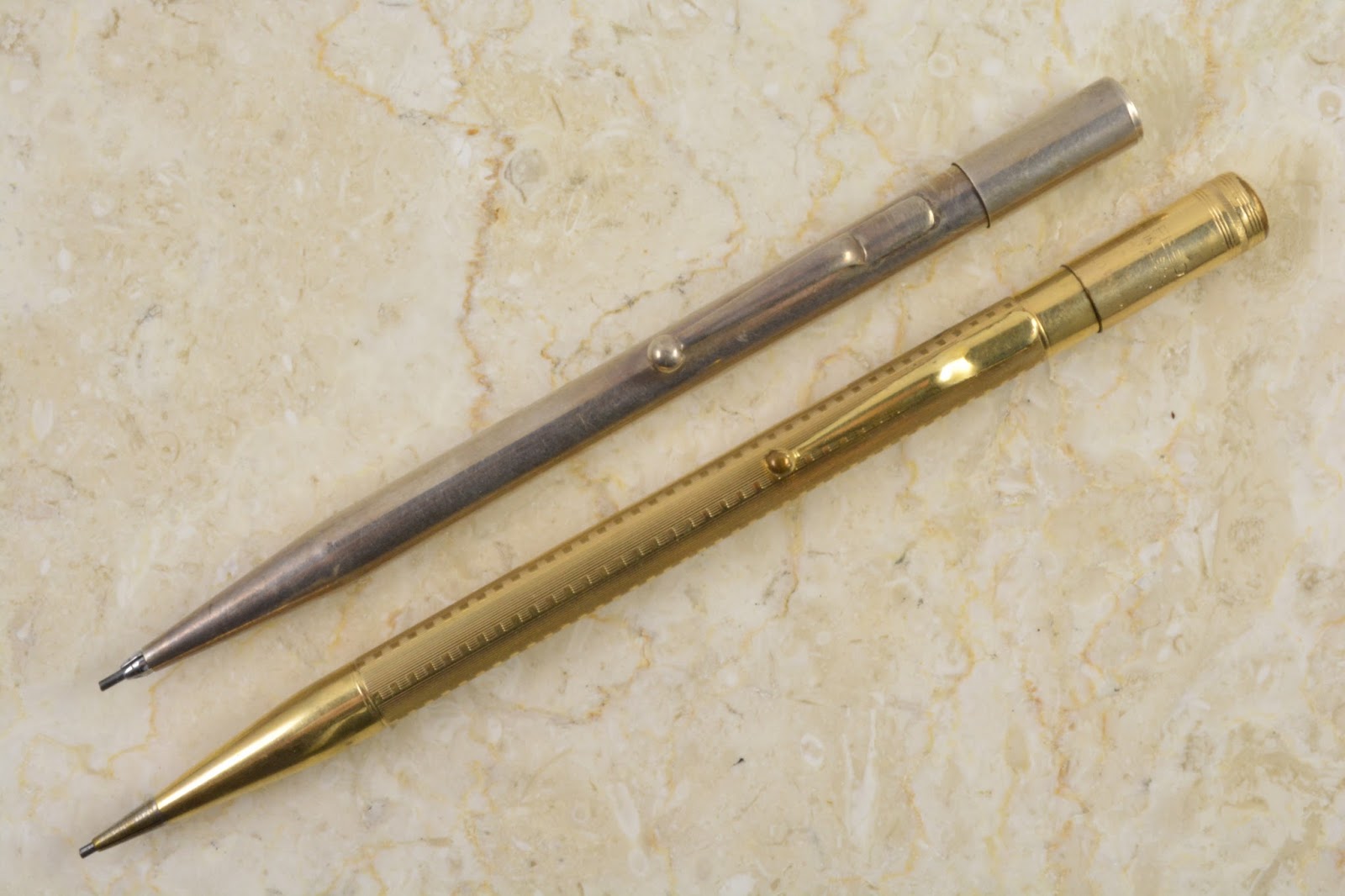
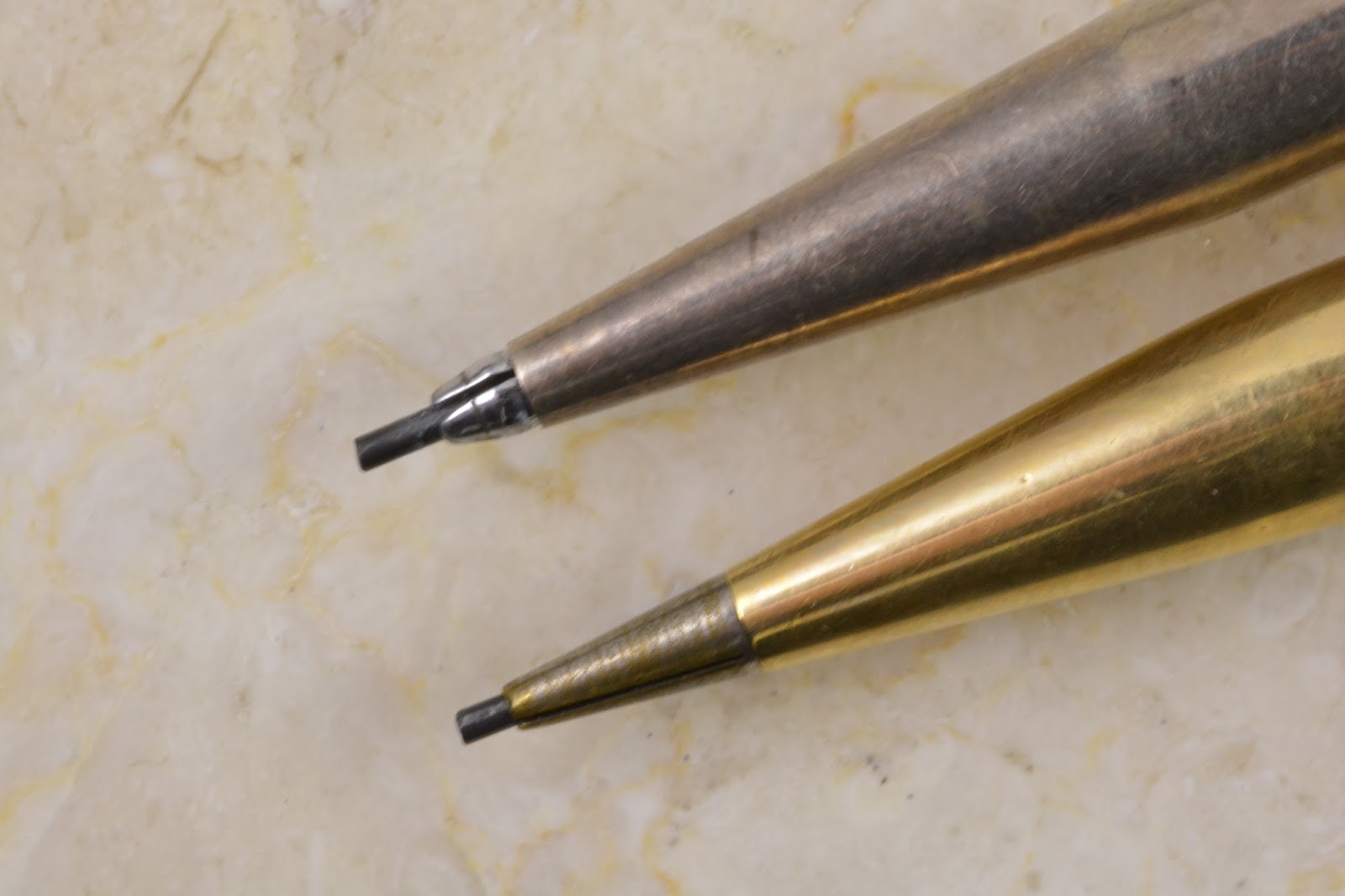
Two separate auctions brought these to my doorstep in recent weeks:


These add to the minty NOS part of my Selfeed collection:


It’s been far too long since I’ve talked specifically about the Selfeed, because the articles I’ve done more recently have focused on similarities between the Selfeed, the Dunn and the early Esterbrook PS repeating pencils.

Selfeed metal pencils were introduced first, in the first half of the 1920s - at least, 1925 was the earliest advertisement I could find for these “new” propelling pencils:


Although these price tags just slide on, I don’t have any reason to think these are not as they were intended – after all, finding a Selfeed in any condition is a challenge, so it isn’t likely someone would just happen to find a Selfeed price band and also happen to have an unrelated Selfeed pencil handy to accessorize:


Model 10M on the short example in base metal; Model 200A on a longer sterling model with a straight lined pattern.

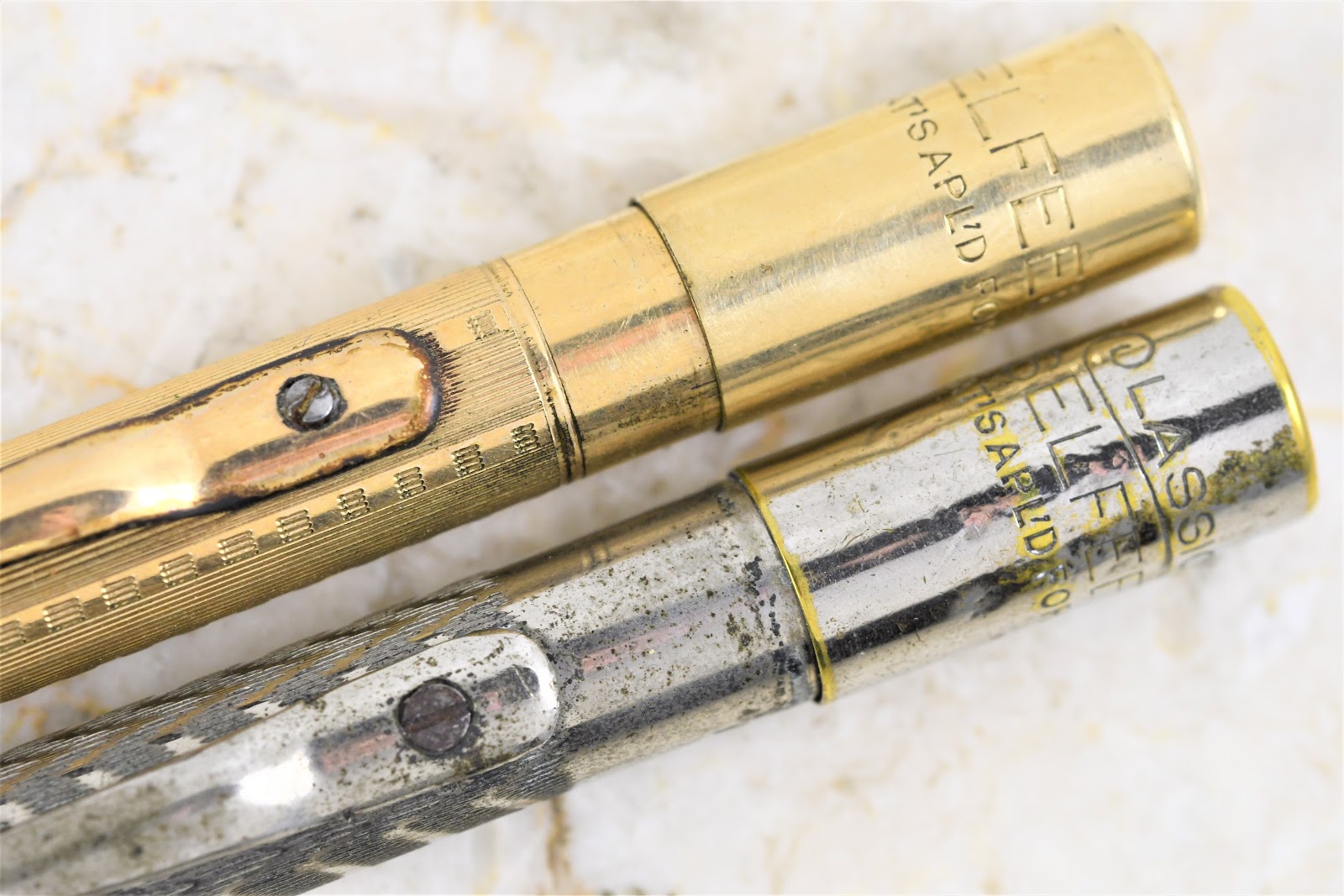
There’s a couple interesting nuances concerning the metal Selfeed pencils worth mentioning.  First, there are two distinct types of caps:


The shorter, stubbier caps are sometimes marked “Classic Selfeed” rather than just “Selfeed” in plain block text, as shown here.  I theorize that the “Classic” preface was added to the metal pencil line after the larger hard rubber and plastic models were introduced.  And then there’s the clips:


Screws added to clips for additional support appear only on the stubbier caps, but not all the time.  Note that the stubbier caps are imprinted “Pats” (plural) applied for, while longer, earlier caps indicate only one patent had been applied for.

There were also ringtop models, sporting a ring that’s a dead . . . “ringer” for the rings found on Dunn pencils:


One of the ones I have sports commemorative 1925 engraving, consistent with the loose timeline I’ve been able to put together:


Then along came larger pencils in attractive colors (as stated above, I think metal Selfeed pencils marked “Classic” were to distinguish them from the later-introduced plastic models).


These earlier ones had lots of problems, as you can tell from this selection, and it’s difficult to find examples of these that are completely intact and working.  Of this small sampling, only the top two are all there and doing their things.  The third appears to have a barrel made of casein, which must have gotten wet at some point.  The red hard rubber one has a crack in a barrel that was made far too thin for this construction, and the black one at bottom – well, just goes to show that the clips were fragile and the metal tips frequently go missing.  Over the years I’ve hoarded Selfeed parts and, at least until these are all back up to 100%, I’ll continue to do so.

Note that these earlier examples have a cap much like the metal pencils, that fits over the top.  This next grouping of oversized pencils, which includes today’s new find, has a redesigned cap that works slightly better and slides down inside the barrel top rather than over it:


I don't know what to make of the weird clip on that one second from top.  The new red hard rubber example was designated Model 3000 and carried a $3.00 price tag:


In addition to the fact that these work better than the group in the preceding picture, another reason I suspect these are later is that the imprints have been supplemented with “Reg. U.S. Pat. Off.,” a reference to the registration of the Selfeed trademark:


However, the trademark itself doesn’t fit within this timeline, since it indicates that it was registered in 1924 – earlier even than the metal ringtop with the commemorative date shown above.  I still think it’s correct, though, to say that these are a later incarnation of the Selfeed.

The trademark registration application was signed by John Wall of the Wall-Stieh Company.  For those of you who haven’t been reading this blog for several years, I’ve already clarified something I said about the Selfeed in The Catalogue.  On page 134, under Selfeed I indicate only “see Kemper Thomas.”  I had mistakenly thought Kemper Thomas might be the sole proprietor of the Selfeed on the basis of this instruction sheet, which accompanied that boxed metal example:


I didn’t get it wrong in the Catalogue - on page 92 I mention that Kemper Thomas seemed unlikely, since it was a calendar manufacturer like Osborne rather than a writing instrument company.  However, I probably should have kept all the Selfeed stuff listed under Selfeed and just made a note under Kemper Thomas that they sold some of them, too.  Grist for the second edition . . . if there ever is one . . .

The Wall-Stieh connection turned up in the first year of the blog here (the article has been archived, but it’s in The Leadhead’s Pencil Blog (Vol. 1) at page 401.  It took a lot of collaboration among collectors to connect Wall-Steih, an obscure fountain pen manufacturer, with the Selfeed.  According to what surfaced, Wall-Steih eventually set up a Selfeed Pencil Company to manufacture the pencils in around 1927.

The title of the article was “One Wild Goose Chase,” and it all would have been avoided if I had the lead container from that first picture in hand when I wrote The Catalogue:


There it is – Wall-Steih, plain as day.

Wednesday, October 26, 2016

The End or the Beginning?

This article has been edited and included in The Leadhead's Pencil Blog Volume 4; copies are available print on demand through Amazon here, and I offer an ebook version in pdf format at the Legendary Lead Company here.

If you don't want the book but you enjoy this article, please consider supporting the Blog project here.

Regardless of how things turned out for Dunn, the repeating pencil it likely acquired from Wall-Stieh was innovative for the time.  One wonders – or at least pencil nerds like I wonder – how the Selfeed could have just disappeared when the surviving number of examples suggests that the brand achieved significant commercial success in its day.

It didn’t.  Disappear, that is.

Nearly five years ago, I wrote an article here concerning a boxed Esterbrook set complete with instructions (the article was at http://leadheadpencils.blogspot.com/2012/02/its-more-in-family-than-i-thought.html).  The instructions listed two patent numbers:


Both patents were traced to Robert Ingersoll, formerly of the Robert Ingersoll & Bro., makers of the Ingersoll “Dollar Watches,” which failed in 1921.  The first patent, number 1,702,780, was applied for on July 7, 1925, and it took so long to wind through the patent office that it wasn’t issued until February 19, 1929, by which time Robert Ingersoll had died and his executors assigned the patent to Robert Ingersoll, Inc.:


The second, number 1,725,585, was filed on May 1, 1926, and was issued on August 20, 1929.


I observed the similarities between this second patent and the Selfeed and Dunn pencils:


But I wasn’t prepared to connect Ingersoll to the Selfeed and Dunn yet: the Esterbrook, I’d noted, looked nothing like the Ingersoll pencil pictured in the patent drawings, and I just didn’t know enough about the Selfeed or Dunn to line up the histories.

I do now.

Research into the Selfeed and Dunn lines establishes that Wall-Stieh began selling Selfeed pencils on April 15, 1924, just as the old Dunn Pen Company failed.  The revived Dunn Pen and Pencil, Inc. offered pencils virtually identical to the Selfeed beginning in late 1924 or early 1925 – but the existence of the revived Dunn was so tenuous and so brief that the only explanation is that Wall-Stieh supplied Dunn, which was gone – maybe – by late 1926.

Both Dunn and Selfeed pencils are marked “Pat. Pend.” and “Pat. Appl’d For,” and none are marked “Patented,” indicating that they were made after the patents were applied for, but before they were issued.  That is consistent with the history of the Ingersoll patents.

Wall-Stieh set up the Selfeed Pencil Company to manufacture Selfeed pencils in December, 1925; the Selfeed Pencil Company relocates to 267-271 Mt. Pleasant Avenue, Newark, New Jersey after purchasing that location in August, 1927.

And then . . . this appears in the early 1930s:


These have the same plain cap as a Dunn pencil, a clip almost identical to the Selfeed and bear an imprint under the cap:


“Sterling Esterbrook / Made in USA.”  Esterbrook referred to this as model “PS” - it was in the company’s lineup of “Push” pencils, in Sterling (hence the PS).  The earliest reference found to this pencil being offered is in an Esterbrook catalog, alongside more familiar plastic cap-actuated Esterbrook pencils.  The catalog was reproduced in The Fountain Pens of  Esterbrook book by Paul Hoban, and he dates the catalog to 1938 or 1939; however, Esterbrook maven Brian Anderson dates the catalog to 1934.  By 1934, sterling pencils such as the PS had largely become passe, so it is likely that Esterbrook introduced the pencils earlier, continuing to offer them after the company made the design its own with plastic barrels.

The Esterbrook PS is nearly identical to the Selfeed:


The only significant difference is that the PS uses the version of Robert Ingersoll’s pencil with the clutch extended through the end of the barrel, while the Selfeed and Dunn pencils use the version in which the clutch is concealed within the barrel:


The Esterbrook PS may be the clincher for the notion that the Selfeed Pencil Company did not survive the Depression and was sold, including the rights to its still pending patent applications, to Esterbrook.

Maybe.  There’s a curious detail I’ve noticed in my research that suggests another possibility.  Dunn Pen and Pencil, Inc. was in New York and Selfeed started in New York, relocating to Newark, New Jersey in 1927.  Esterbrook was located in Camden, New Jersey.

References to the Dunn Pen and Pencil and the Selfeed Pencil Company in the historical record are fleeting, but there’s a pattern: in October 1926, when Dunn Pen and Pencil advertised that Dunn pencils were being blown out (picturing a pencil with a clip that resembles a Selfeed or Esterbrook PS, not a Dunn), that advertisement didn’t appear in New York papers – it appeared in the Philadelphia Inquirer, right across the river from Camden, New Jersey:


In August, 1926, when the Selfeed Pencil Company advertised for sales representatives, the advertisement appeared also in the Philadelphia Inquirer:


Does this suggest Esterbrook made both the Dunn and Selfeed pencils all along, picking up the patent rights and continuing to manufacture them on its own account after Dunn and Selfeed had both failed?  Maybe.  Gimbel’s, which advertised the Dunn blowout, would have been much closer to the source of an overrun of Dunn pencils if they were warehoused just across the river, and sales representatives of the Selfeed wouldn’t have needed to go very far to pick up their inventory if that were true, either.

Monday, October 24, 2016

Dunn and Done

This article has been edited and included in The Leadhead's Pencil Blog Volume 4; copies are available print on demand through Amazon here, and I offer an ebook version in pdf format at the Legendary Lead Company here.

If you don't want the book but you enjoy this article, please consider supporting the Blog project here.

A while back, the subject of Dunn pens came up on Facebook, and I felt compelled to take a family portrait of the examples in my collection:


That bottom one was missing the cap, by the way.  These came in a nice range of patterns:


Each is marked on the cap with simply the words “Dunn / Pat. Pend.”:


Looking at these pencils got me to thinking again, about how much they resemble another early repeating pencil – the Selfeed:


Selfeeds – at least all of the ones I’ve seen – are marked “Selfeed / Pat. Appl. For,” and they have very similar caps, with just a bit of added embellishment:


In 2011, I had noted the similarities between the two brands in The Catalogue; but I had also attributed the Selfeed to the Kemper Thomas Company based on an instruction sheet for the Selfeed I had found.  I’ve since debunked the Kemper Thomas connection myself in an article I wrote a year later (see http://leadheadpencils.blogspot.com/2012/11/one-wild-goose-chase.html), in which I wrote how the Selfeed was the product of the Selfeed Pencil Company, Inc., which had been established on Decmeber 21, 1925 by the Wall-Stieh Company, a pen company which set up the subsidiary to market and sell the company’s pencils.  Daniel Kirchheimer had turned up an advertisement from May, 1925, in which Wall-Stieh’s “new” pencils were introduced.

I have finally tracked down the trademark registration for the Selfeed mark, which claims a date of first use of April 15, 1924:


The timing fits perfectly into the Dunn story.  The Dunn Pen was introduced in 1921, and while the company advertised heavily, there’s no mention of the company producing (that’s “producing,” not manufacturing) pencils through 1924, when the company failed.  Since Teddy Roosevelt’s son, Kermit Roosevelt, was on the company’s board of directors, his examination by the bankruptcy trustee was big news in early April, 1925:


John Gerdes, President of the newly formed Dunn Pen and Pencil, Inc., was quick to do damage control, announcing that the newly reorganized Dunn Pen and Pencil had nothing to do with the failed Dunn Pen Company.


As a side note, this leads me to correct something in the Pen Collectors of America’s library: the Dunn brochure in its library is attributed with a date of 1920, but since the letter which accompanies it is from John Gerdes as President of Dunn Pen and Pencil, we know it could not be earlier than May, 1924.   The letterhead also lists other officers: James H. Scarr, Vice President, C.B. Bentz, Secretary and Walter S. Rockwell, Treasurer:


It is only after Dunn Pen and Pencil rises from the ashes of the Dunn Pen Company that there is any mention of pencils being offered.  There’s a page in the PCA Library’s brochure which shows them:


The new management faced a dilemma in reorganizing: the single greatest asset they acquired from the Dunn Pen Company was the brand name recognition of the company’s pen, but the financial misdealings of the predecessor firm left the name tarnished.  Whether the reputation of the name “Dunn” was irreparably damaged during the bankruptcy proceedings, or whether the new management was no more capable than the old, the new venture appears to have been as unsuccessful as the earlier one – by late 1925, Dunn pencils were being blown out at discounts, advertised not in the New York press, but in the Philadelphia Inquirer:


Note that this advertisement ran in the October 16, 1925 issue of the Inquirer, and remember that the Selfeed Pencil Company was established by Wall-Stieh on December 21, 1925.  And there’s another detail in this advertisement which, even accounting for a bit of artistic license in the drawings, I consider important to this story.  Look closely at the clip:


That’s not the flat clip of a Dunn pencil, as seen on all of the surviving examples I’ve seen as well as in the Dunn catalog at the PCA Library.  That’s the ball clip you’ll see on every example of a Selfeed:


After 1925, it appears Dunn Pen and Pencil winds up and goes out of business; advertisements after that date are discounted and discontinued blowouts of the company’s pens.

When I string all of these clues together and overlay the history of the Dunn Pen Company, Dunn Pen and Pencil, Inc. and Wall-Stieh together, the complete story floats to the surface:

1.  The Wall-Stieh Company, founded in the late teens, develops a new repeating pencil in early 1924, which it begins marketing as the “Selfeed” on April 15, 1924.

2.  The Dunn Pen Company, which only made fountain pens, fails in April, 1924.

3.  Dunn Pen and Pencil, Inc. buys all of the assets of the discredited Dunn Pen Company.  In order to better capitalize on the market (and differentiate itself from its tarnished predecessor), the new company decides to offer a companion pencil with its pens.  The new company has no means to make one of its own and there is no evidence that it ever tried.

4.  Dunn Pen and Pencil, Inc. contracts with the Wall-Stieh company to supply the new company with Selfeed pencils, made with plain caps and stamped with the Dunn name, sometime during 1924 or early 1925.

5.  The added production demand causes Wall-Stieh to set up the Selfeed Pencil Company to manufacture pencils on its own account as well as to supply Dunn in December, 1925 – just as Dunn Pen and Pencil folds.  

Wednesday, January 28, 2015

One Last Bit to Add

Solving the Selfeed puzzle was one of my proudest moments. Not only was the long-lost history of who made these pencils finally brought to light, but the convoluted path leading to that history was a story in itself (the article was published at http://leadheadpencils.blogspot.com/2012/11/one-wild-goose-chase.html).

There was just one last little nagging issue that I couldn’t shake. Here’s the pencil that kick-started that story:


I couldn’t help thinking that there might be a piece missing from the top, and those suspicions were confirmed when this one showed up in an online auction:

To learn more, this full article is included in The Leadhead's Pencil Blog Volume 3, available at Amazon, Barnes & Noble and everywhere else you buy books, or you can order a copy signed by yours truly through the Legendary Lead Company HERE.


Thursday, November 1, 2012

One Wild Goose Chase

Today’s story started for me a few weeks ago when I found this pencil at the Springfield Antique Show.  When I pulled it out of a dollar junk box, I thought it was probably a Presto that I could use for parts. However, my expectations were exceeded when I looked at it more closely:  "Selfeed Made in USA Reg.U.S.Pat.Off." Now that’s different!  Here it is next to what I normally think of when it comes to an oversized Selfeed . . .

NOTE:  This article is now included in the print version of The Leadhead's Pencil Blog, available anywhere you buy books, or also from The Legendary Lead Company.

To order, here's the link:  Volume 1 at Legendary Lead Company