Showing posts with label Holland. Show all posts

Tuesday, September 23, 2025

A New Flavor

A few days ago, I mentioned that Paul Erano had sold me that last bag of John Holland pencils and parts. Now I’ll tell you why I was so eager to buy it. At the Raleigh Show a few months earlier, I bought a few other John Holland items from Paul, including this one:


That barrel looks like marbled celluloid at first, but I think it’s hard rubber that has been painted or stained to look that way - note at the nose end, the marbling stops where the material is stepped down:


As with many of the other items that came from Bob Johnson’s collection, this one has a nice price sticker indicating the original price was $3.50.


The barrel is stamped “John Holland” right above the clip, which has Holland’s tulip logo impressed into it:


Paul and I examined it together, and we agreed this one is a little off of the beaten path for a John Holland. I didn’t want to pay much for just part of a pencil, but Paul reassured me: he had a whole box filled with John Holland parts, and he would bring them to me in DC so I could finish putting this one together.

He forgot to bring them along to DC, but at the Ohio Show in November all those parts went from box to bag to Jon. There were a lot of great stuff in there . . . unfortunately, the pieces I needed to finish putting this one together were not among them. That left me trolling through my parts bins at home trying to find what I needed to complete it.  

I started with my stash of Rex Manufacturing Company parts, thinking perhaps it might be one of these with a different style cap and clip:


Nope, those parts don’t work at all. Rex patent pencils have noses that screw onto the end of a threaded barrel rather than slip over the end of an unthreaded one. I settled for taking the preceding pictures and filing it away. The answer will come to me at some point, I hoped.

It did – only because I finally got around to rearranging things at the museum. The addition of two printers’ cabinets gave me the chance to finally get all of my John Holland stuff spread out but in one place . . . it had previously been scattered – er . . . carefully grouped – in three areas, with the Victorian stuff in one place, the Rex patent pencils with the other Rex stuff, and the “everything else” part crowded onto the wall o’ pencils. As things went into the drawer, I noticed that I did have an intact John Holland pencil along these lines.


There’s that same cap and clip, and I know the pencil I got from Paul had a two-stage smooth tip – assuming, of course, that all John Holland pencils like this looked the same, but I think that’s a fair assumption. I started pulling things off the shelves in other areas of the museum, looking for things to compare.


Here’s the John Holland next to a maroon Grieshaber pencil at center, and a LeBoeuf “Unbreakable” parts pencil I picked up for peanuts at the Don Scott show because it is . . . well, it’s broken. Note that both of these have a very similar two-stage tip, and there is a reason for that: both the Grieshaber and the LeBoeuf were built around mechanisms supplied by Cross and used on the Cross Alwrite line of oversized pencils.


I was really hoping that LeBoeuf would be able to breathe its last making my John Holland whole, but when I attempted to transplant the nose I ran into a problem.


The tip unscrewed easily and fits like a glove on the threaded end of the John Holland, but I wasn’t able to wrestle the gold filled section from the LeBoeuf barrel. I was able to get it budge just a little, enough to see that the diameter of the stepped down section on the barrel is narrower than my John Holland. Even should I resort to barbaric means of parts removal, it wouldn’t fit my Holland.

I really didn’t want to scavenge a perfectly good Grieshaber, but I wondered if that might be the same nose . . . 


Nope.  Grieshaber sections screw into the barrel. No worries for now; most of my John Holland will reside comfortably in the museum, awaiting the day that the front half of the right pencil comes along . . . 

. . . or Paul finds another bag of parts.


Tuesday, September 9, 2025

Occam's Junk Box

 I still credit Roger Wooten with adding “Occam’s Razor” to my vocabulary – it sounds so much more smart than saying “the simplest explanation is usually the correct one.”

I made an offhand remark the other day that I was convinced the cap on the pencil at the top of this next image is original, even though you can see the Rex Manufacturing Company’s “Four Horsemen” patents peeking around from the left side of this image and the pencil itself has none of those patented features:


The Rex Manufacturing Company is well known to have supplied the John Holland Pen Company with pencils during the early to mid-1920s. Here are a few examples:


These examples all originated from one source: Paul Erano and David Isaacson had partnered on a large collection that included a great many John Holland items, and while the collector’s identity was a secret for some time, it has since been confirmed to have belonged to the late Bob Johnson, the organizer of the DC Supershow. Paul wound up with boxes upon boxes of stuff, and over the course of several shows I bought up a large number of John Holland items. 
Bob’s collection had been unceremoniously boxed up in no apparent order and housed for many years in an attic over his garage, without any climate control. Exposure to the South Carolina heat and humidity was not kind to his collection. 


Still, a sticker is a sticker, and the information is there:


Most of these pencils have all four of the Rex patent dates on the caps – the “Four Horsemen” patents as I’ve called them over the years (for the full rundown, see Volume 2, page 103).


(Incidentally, I still haven’t found the large size pencils in Holland’s robin-egg blue - the only one I’ve seen was Jack Leone’s, which I photographed several years ago.)


Occam’s first slice neatly cuts this down to the bone, doesn’t it? We have well-documented Rex patent pencils made for John Holland with the same caps found on our mystery example; ergo, the simplest explanation is that a Holland cap from one of these just happened to find its way onto something else.

Sort of. 

Remember that Occam’s Razor only gives deference to the simplest explanation; it doesn’t specify what makes one explanation more or less simple than another. There is another, equally simple explanation rooted in a corollary I’ve made up to the rule: “junk box provenance” can at times provide the most simple explanation. 

“Junk box provenance” is a term I have used over the years to describe cases when the circumstances, manner, and condition in which items are found can tell us something about the items themselves. As an example, consider whether it is reasonable to conclude that the price stickers on those Rex-made John Holland pencils are original and correct. The answer is that it is far less likely that someone would take the time to carefully add price stickers to them, only to throw them into a box and stuff them up in a hot, humid attic.

In the case of Bob Johnson’s collection, we have junk crates rather than just a box, and Bob was collecting back in the 1970s when he still lived in the Cincinnati area – right where John Holland was located. Tales have been told about when the John Holland factory was cleared out and thousands of new old stock items were dispersed.

Here is a large cache of apparently new old stock John Holland items, which wound up in the attic of a collector who was very active in the Cincinnati area around the time. Occam agrees with me – these must be part of what was cleared out of the Holland factory when it closed for good, and these are the price bands that were on them when they came into Bob Johnson’s possession.

All of this leads up to where I’m going with this article. After a few shows of pawing through Bob Johnson’s stuff, Paul Erano told me that he would be bringing the last of the pencil stuff with him to the 2023 Ohio Show for me to “look at” (that is a euphemism meaning “I will at that time tell you how many dollars you will give me and I know that you will do so”).

Negotiations were as brief as usual, and I brought back a quart-sized Ziploc bag full of goodies back to my table. I didn’t have time to go through them until after the show, when I found a few last, great John Holland items. There was one of the later Holland pencils with the large white Holland tulip above the clip, made just around the time the wheels were coming off the company, while John Holland was still doing some nice things:


There were also a number of these later Hollands from the late 1930s. Yes, this was after the quality had sharply declined, but they are still desirable for an Ohio collector such as myself.


Besides, the wider band and streamlined top are a little unusual, and that double ender? I’ve never seen one. There were also a total of twelve similar pencils with no names on the clips – I thought the number of them was significant and suggests a box or store display containing an even dozen had been dumped into the box before going into storage:


Only one of the twelve was marked at all - just a simple John Holland Co. imprint on the barrel:


You get the point: these things are hard to find, and they are not anything a serious collector would be likely to take the time to curate, collect, and organize . . . only to stuff them in a box and condemn them to decades in an attic. At some point Bob Johnson came into a large number of John Holland new old stock, likely from the factory when it was cleaned out.

Now that the stage is set, here are the last two John Holland items that were included in that last lot:


In addition to the thicker pencil this article started with, there is a thinner example which is also missing its nose. It has the familiar John Holland logo stamped on the cap:


This is a Rex patent pencil - the earliest incarnation, as originally patented by George McNary on February 19, 1924. Here it is shown alongside an identical pencil marked “Franklin,” another Rex brand:


Occam’s junk box is making some sense here: two unusual John Holland items, both missing their noses, in a box which also included a bunch of new old stock John Holland stuff. Sure, it’s possible this is all a coincidence, and Bob or someone else put a Rex cap on the wrong pencil at some point over the last hundred years ago. However, I think what is just as likely is that a pile of Holland stuff was sitting at the old shop as it was being cleaned out and these, for whatever reason, were among the odds and ends hauled off.

If this is a legitimate piece, it might tell us a little more about what happened to the Rex Manufacturing Company. We know that in 1929 Rex was engaged in litigation with the Parker Pen Company over Parker’s patent for the washer clip. We know that after 1929, Rex’s customers were sourcing pencils from other manufacturers – so Diamond Medal pencils at Sears were coming from Parker and Gold Bond pencils over at Montgomery Ward were made by Wahl and Waterman.

One possibility is that Rex lost the dispute and the company was ruined, like what happened to the Kraker Pen Company after Sheaffer won its infringement case over Sheaffer’s lever-filled pens. Another possibility is that Rex limped along for a time after the case was over, surviving by making components or complete pencils which did not violate Parker’s patent.

It would make perfect sense, if Rex was keeping a low profile during its heyday and quietly supplying huge mail order operations with their pencils, Rex would do its best to stay invisible after 1929. What would also make sense is for Rex to use up any leftover parts any way they could, even if those parts had Rex’s disgraced patents already stamped on them. 

Did Rex make pencils with tops like these, so often found unmarked?


At this point, Occam would agree after reviewing all of this: that explanation is as simple as the alternative, so it is no more or less likely than not.


Sunday, September 7, 2025

The Key to the Keystone

I strive to make clear the difference between what I know and what I have deduced from what I know. In “Banker and the Specialty King” I offered proof that James Kelley, the slick self-described “Specialty King,” marketed pens and pencils under the names “Banker,” “New Banker,” and “Keystone Banker.”

I never said that James Kelley was the only one to use these trade names. To the contrary, with a character like James Kelley it is more likely than not that others used the same or similar names, given Kelley’s penchance for “lifting” names when nobody was looking. After all, any claims Kelley himself had to use the name were so shaky that anyone horning in on that territory would have just as much right to do so.

The follow up articles to “Banker and the Specialty King” were published the following two days in “All the King’s Horsemen, Part One” (July 26, 2021: Volume 7, page 290) and Part Two (July 27, 2021: Volume 7, page 293). Those two articles dragged other lower-quality brands into James Kelley’s orbit, including “Master” (another name lifted from the original Banker Pen Company, which marketed a “Master Pen”), Nassau, Packard, and Keystone. There may be others – in fact, given James Kelley’s antics, there probably were.

My attribution of the “Keystone” name to James Kelley was only in relation to pencils along these lines:


Then there are these, which are marked “Banker” but which were referred to in Kelley’s advertising as the “gothic” or “Keystone Banker.”


No, I did not say that James Kelley was the only person on this big blue marble to call his pens and pencils the “Keystone.” In fact, I noted one puzzling detail in that previous article: the word “Keystone” was registered as a trademark with respect to pens and pencils, but not by James Kelley:


The Blaisdell Pencil Company, by its president A.C. Berolzheimer, had applied for registration of the Keystone mark on October 27, 1921, and it was granted registration as number 153,408 on March 21, 1922. In the registration, Berolzheimer claimed the mark was first used in commerce around January 1, 1911.

Both the mark’s first use and its trademark registration  occurred before James Kelley entered the picture in 1925 or so, so I don’t believe any of Kelley’s activities hastened Blaisdell’s application to register the mark. The ten-year delay in filing the application was more likely the result of the evolving and complicated relationship between Blaisdell and the Eagle Pencil Company, the latter of which was founded and run by the Berolzheimer family.

Blaisdell and Eagle had spatted back and forth over patent infringement claims beginning in the 1890s; in the early teens, Blaisdell was still a separate entity, but as the Keystone trademark shows, the Berolzheimer family controlled Blaisdell by 1921. Blaisdell formally became a subsidiary of the Eagle Pencil Company in the 1930s.

All of this means that by the time James Kelley started selling “Keystone” pens and pencils in the mid-1920s, the Keystone name was already reserved essentially to the Eagle Pencil Company. Did Eagle make James Kelley’s Keystone-marked products? I don’t think so; if anything, they look more like something David Kahn, Inc. might have made (Kahn is better known for its flagship brand, Wearever).

But there’s another bit of evidence on this point that recently surfaced . . . unintentionally.


This fountain pen turned up at one of the shows I attended this year; it is marked “Worth” on the clip:


When I say it provides an “unintentional” bit of evidence, that’s because I bought it for reasons having nothing to do with today’s subject. I bought it because I suspected that it proved the Eagle Pencil Company might have supplied Worth with at least some of its pens, due to its uncanny similarity to other Eagle metal fountain pens:


More on that tomorrow. Suffice to say that when I bought it, it was so cheap that I did not even bother to see if it had a nib in it. But when I did . . . 


While it clearly isn’t “gold filled” to the brim, the Keystone part hit me squarely between the eyes. Blaisdell’s trademark registration for the Keystone name had established that Eagle had at least some rights by representation to the name, but I was unsure whether that was found only on wood pencils or something else – say fountain pens – that might be a bit outside of my normal area of expertise. 

Am I backtracking on my earlier attribution of the use of “Keystone” to James Kelley? No – in fact, James Kelley was exactly the sort of slippery character who had few reservations about appropriating someone else’s name, even without the legal right to do so. I think both Blaisdell (Eagle) and James Kelley were both using the mark, one with and one without the legal authority to do so.

My friend Stan Klemenowicz and I discussed my earlier Keystone article, and he questioned whether an example in his collection, which strongly resembles something branded for Morrison, might suggest that the Keystone was a Morrison brand rather than a James Kelley production.  He posted an article at his blog, “stan’s pens” titled “Kahnstone, Kelleystone, or Keystone?” (posted here) to address other examples, including a few examples that appear to have been made in France.

I don’t disagree that at least some of the examples Stan shared in his article were likely not James Kelley productions – or Eagle’s either, for that matter. One of the most fascinating parts about collecting these things is the connections they establish between manufacturers, producers, and suppliers, and surprising connections turn up all the time. Consider this one:


Stan pointed the online auction for this example after he published his article, and once I saw it I felt the need to buy it. The missing pen might have been useful in providing a more definitive analysis of who was responsible for this one, but the paper on both the pencil and the matching warranty sheet was all I needed for the point I’m making today:


The makers of this “Famous Keystone” had some serious cajones reminding buyers to “Beware of Imitations,” since this looks like nothing made by either Blaisdell or Eagle, the rightful owners of the name. The top, though, is a familiar sight:


When these turn up, they are typically unmarked  – as is this one, other than the fortuitous price band. I’ve only found a few examples marked with a producer’s name:


The two complete examples are marked “E-Z Rite,” one on the cap and the other on the clip:


The third, however, provides another possible, surprising connection:


John Holland? Now wait a minute, my sharp-eyed peanut gallery might say . . . that might be a cap from a Rex Manufacturing Company pencil (you can just make out the “four horsemen” patent dates to the right of the name). Rex is well-known to have supplied pencils to John Holland, so isn’t that just a convenient replacement? Bear with me on that . . . there is sufficient “junk box provenance” with this example to suggest that this cap accompanied this pencil from whomever might have manufactured it and yes, I think that “whomever” might have been Rex.

More on that later, because this web is already sufficiently tangled. The question of the day is this: who made the Keystone? The answer is simple: anybody who thought they could get away with it without being prosecuted by Blaisdell, Eagle, or the newly-minted Federal Trade Commission.

That last sentence, combining the words “Eagle” and “prosecuted,” leads nicely into what I was going to tell you about the Worth Featherweight Pen Company. That story tomorrow.

Tuesday, June 15, 2021

Rounding Up the Victorians

This article has been included in The Leadhead's Pencil Blog Volume 7, now available here.


If you don't want the book but you enjoy the article, please consider supporting the Blog project here.

The collecting universe seems to have a cyclical rhythm.  When I piddle through online auctions, my search is usually for “pencils” rather than for any particular breed or vintage – yet from unrelated sellers, like pencils of similar feathers will flock together to my doorstep.

The image at the beginning of yesterday’s article grouped together a cluster of Victorians that landed here within a fairly short time, from random sources.


For starters, here are three interesting John Hollands:


Represented here from top are a dip pen, a combination dip pen and pencil (based, incidentally, on John Mabie’s October 3, 1854 patent discussed yesterday), and a magic pencil.  


Still, the holder is marked Holland, and as a proud Ohioan, it’s nice to see the Cincinnati maker’s mark:


And then there’s that nib . . . a big, gorgeous, and tougher-to-find Number 6 “horseshoe” nib


The combo is a tiny little thing, with a much smaller Holland Number 2 nib that needs a little bit of work:


What really attracted me to this one is the barrel composition: sterling and rose gold on the barrel, with yellow gold ends and slider ring – two-tone Victorians you’ll find from time to time . . . but tri-tone?  


That third Holland looks like an ordinary magic pencil, but there’s something special about it:


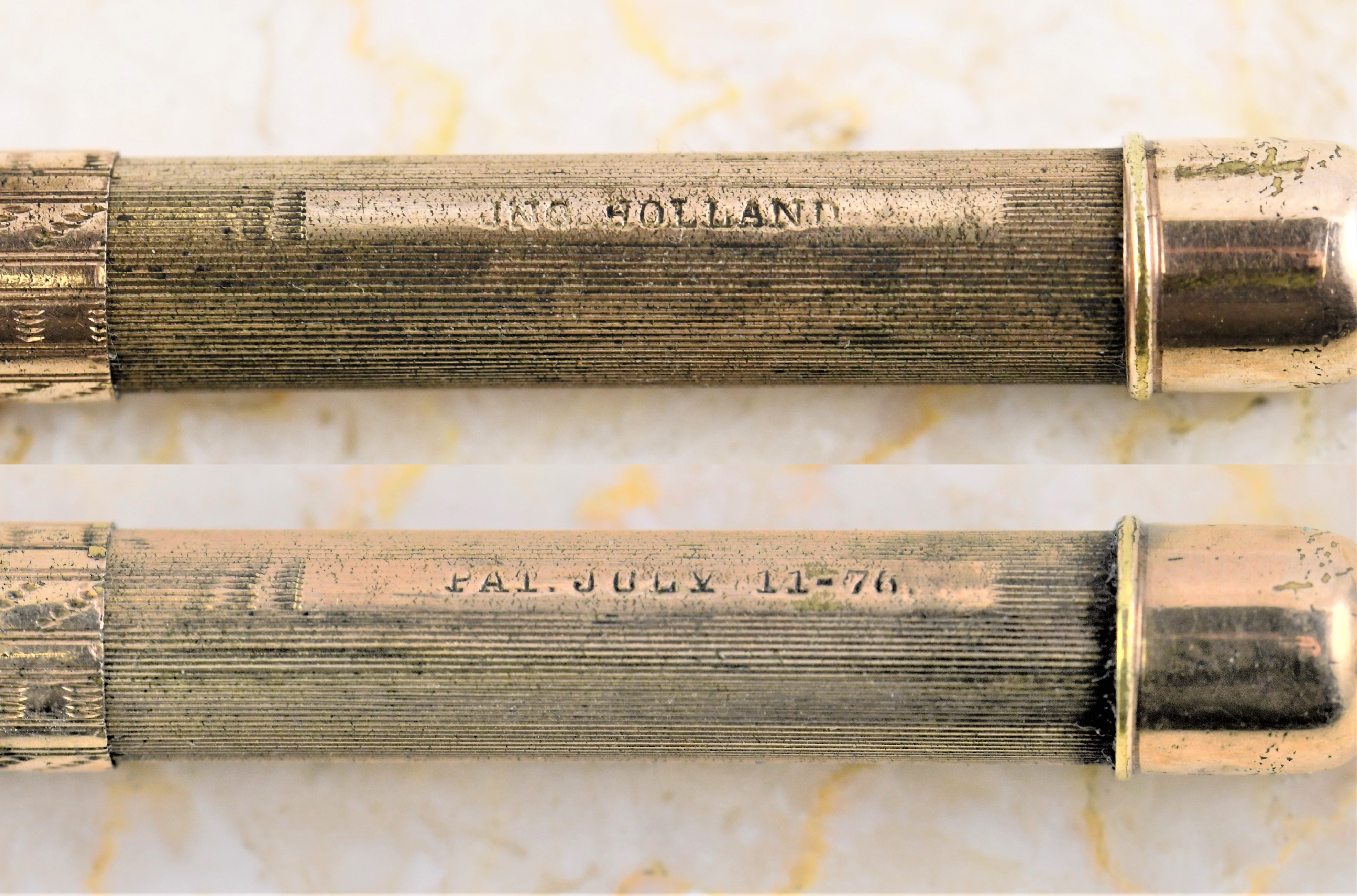
The extender reads “Jno. Holland” on one side, and “Pat. Jul 11 - 76" on the other – and I didn’t have a writing instrument with that patent date in my collection.  It’s listed in American Writing Instrument Patents 1799-1910: patent number 179,743 was applied for by Edward Tyrell of Cincinnati, Ohio on June 8, 1876.  It was issued with lightning speed in just over a month, and assigned to John Holland:


Next to find its way to me is this large slider pencil, sporting handsome engraving reading “Sophia S. Brown 1853";


Lettering on the other side of the barrel is much smaller but speaks louder, at least to me:


I described it as a “large” slider pencil, and you might not think it is until I tell you it’s a Rauch & Co.  By Rauch standards, it’s a behemoth:


Next up is one of those large “convertible” pencils – you can either extract the pencil leaving the case hooked to a watch chain or use it in the case:


It resembles other pencils I’ve written about here before:


Those other three are a Simmons, a Cross (AXT, for A.T. Cross), and a Mabie Todd:


This one, however, is marked U.S. Fountain Pen Company, predecessor firm to the U.S. Victor Pen Company:


I’m not sure where to file this next one away in my collection.  It has two interesting tells: that distinctive rose gold, and the odd placement of the joint for the twist mechanism, farther towards the end rather than right in the middle:


The seller described it as a Bailey, Banks & Biddle, which was true . . . but it also bears a patent date of June 27, 1865:


I recently wrote about the history of the Philadelphia jewelry firm of Bailey, Banks & Biddle (see Volume 6, page 119).  I’ve also written about the man who received that 1865 patent, a little-known inventor named Frederick W. Cox (Volume 4, page 175).   My only other example of the Cox patent is in black hard rubber, and may have been made by Mabie Todd:


After much agonizing, I decided the two Cox pencils go together . . . and I’m noting that here mostly to remind myself where on earth I put that other Bailey, Banks & Biddle!

Finally, this last one was described in an online auction, as not in working order.  I was feeling a little frisky, so I threw in a nominal bid thinking it might be fun seeing if I could do anything with it. 


I was pleasantly surprised when it arrived to find that the pencil was operating just fine – that was half the battle, anyway . . . 


The nib slider, however, wouldn’t budge at all.  I used the old lighter fluid trick to see if that might loosen things up a bit, and it did – I got it to move forward just far enough that the tip of a nib emerged from the end, and I was able to pull it out: a cheap steel fountain pen nib that had nothing to do with a Victorian (the Holland nib with the horseshoe cutout earlier was an exception -- Victorian dip pen nibs typically don't have breather holes).  

With the nib out, I tried the slider again – no more progress, so I hit it with more lighter fluid, then a little dab of oil in the slit, and the tip of another cheap steel nib peeked out.  


Good Lord . . . how many clowns were going to pop out of this car?  With the second nib extracted, I got my answer as the slider freed up at last.  There were three nibs in this one, and the third was a whopper:


Miraculously, the original F.T. Pearce & Co. nib was undamaged by all the junk that had been shoved on top of it.  Best of all, I didn’t have a Pearce nib in my collection – the closest thing I have is an interesting Pearce & Hoagland from Frank T. Pearce’s earlier partnership (Volume 3, page 3).