This article has been edited and included in The Leadhead's Pencil Blog Volume 3; copies are available print on demand through Amazon here, and I offer an ebook version in pdf format at the Legendary Lead Company here.
If you don't want the book but you enjoy this article, please consider supporting the Blog project here.
An article I posted a week ago discussed the Rex Manufacturing Company and a lower-tier set marked only on the pencil with “S&K” (the direct link to the article was http://leadheadpencils.blogspot.com/2015/06/nailed-it-pretty-much.html).

I wasn’t happy with either of the possible answers - “Settles and Kritikson” didn’t seem to fit, since all evidence indicates the latter took over for the former, and the two were never in partnership. Daniel Kirchheimer offered up Skinner and Kennedy, a St. Louis stationer, but neither of us could turn up anything to prove they offered a house brand of writing instruments and, for an early 1920s obscure manufacturer like Rex just getting started, St. Louis seemed pretty far afield.
Michael Little posted a comment at the blog last night, suggesting another possibility for a company located in New York, which even had a connection – albeit an ignominious one – to Eclipse. In my opinion, his suggestion is the right answer.
Shatkum & Kahn was a partnership formed in 1896 by Benjamin Shatkun and one David Kahn – that’s right, that’s the same David Kahn who later established David Kahn, Inc. and started manufacturing pens and pencils marked Wearever. Here’s some early letterhead showing the date the partnership was established:

And here’s a 1937 advertisement for Wearever’s which appeared in Life Magazine. Note the “Est. 1896" reference at the bottom:

I’m not finding any instances where the firm marketed pens or pencils under the trade name “S&K,” but I am finding reasons why, around 1924, the company wasn’t using their full names. In November, 1921, Office Appliances reported that the newly established Federal Trade Commission had filed charges against the partnership.

The company was imprinting boxes with a $3.00 price tag, never intending that their pens would sell for that much (between 16 and 35 cents was the actual price they were selling for). The FTC reasoned that the company was attempting to mislead consumers into the belief that they were getting a real deal on pens.
When I researched the reports of the Federal Trade Commission, I found that there were actually two complaints filed. The first, number 604, alleged that the company was deliberately fitting pens with nibs reading “14k / Gold / Plate” in such a way that the word “Plate” was concealed by the feed, misleading consumers to believe its nibs were actually gold:

Note that the FTC spelled Shatkun’s name wrong, making this reference a little tougher to find (I found it through a 2007 thread on Fountain Pen Network). On this earlier charge, Shatkun and Kahn were eventually cleared in 1922:

Note that the FTC got Shatkun’s name right in the exoneration, but misspelled Kahn as “Kalin.”
The other complaint against the firm, number 664, is even more interesting. Three cases were filed simultaneously:

The first was against Marx Finstone (note: with no company association), the second was against Benjamin Shatkun and David Kahn, trading as Shatkun & Kahn, and the third was against Abraham Shatkun, of the United States Novelty Company. All three cases resulted in identical injunctions against them, as reported in Volume 4 of the Federal Trade Commission’s decisions, beginning on page 163:

The language is harsh: words such as “fictitious, exaggerated or misleading prices” must have been devastating to whatever reputation these firms enjoyed. By the time my S&K set (imprinted with a 1924 patent date), Shatkun and Kahn would have had every reason to keep their full names off of their products. By 1928, the firm is replaced by David Kahn, Inc., who registers the trademark "Wearever."
As for Marx Finstone, note that his name is not associated with any firm in the FTC complaint or decision. The company he founded, Eclipse, was established in 1903, according to conventional wisdom. However, I find no reference that he marketed products under the Eclipse name prior to the Federal Trade Commission’s injunction against him personally. Instead, I find that right around the time Finstone’s name was discredited:

A question appeared in The American Stationer’s Q&A pages:
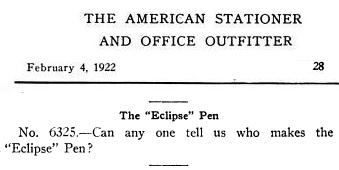
And no one knew the answer, suggesting that Finstone adopted the name “Eclipse” in the aftermath of the decision.


