Showing posts with label Hoge Manufacturing Co.. Show all posts

Saturday, September 20, 2025

A Few New Pals

I can’t help the fact that I like the Hoge Manufacturing Company’s cheap line of “Pal” pencils. They are just . . . fun. 

In an era dominated by the Eversharp, Hoge’s handy little workaday models were offered in just a few configurations and in just a couple patterns. I still chuckle at Hoge’s weird attempt at creating a fraternal Elk Lodge pencil, as pictured in “And the Award for Worst Representation of an Elk Goes To . . .” (December 18, 2016: Volume 4, page 291).


David Nishimura’s article about the Pal, published in January 2016, remains the most valuable resource detailing the history of these pencils (it remains live here). I last visited the Hoge Manufacturing Company in 2021, after I found and acquired an early 1920s company catalog that answered a few questions and of course, raised a few others. See “One of Us Needed to Do It” (April 12, 2021: Volume 7, page 25). Since then, I have found a couple of examples in their original packaging:


That top example did cost me more than three dollars, in case you were wondering. I’ve left the one wrapped in tissue paper alone, but I did unfurl the instructions included with the other example, just to document them before carefully refolding them and tucking them back underneath the pencil:


The pencil was the usual fare, so much so that I forgot to take a picture of it while it was out of the box. No matter . . . that usual fare is not what I’m excited to share with you today. That early 1920s catalog included all of Hoge’s usual suspects, including these, but one page showed some unusual suspects:


Pal pencils are almost always found in either a silver or gold finish, but this page shows the No. 55 Pal, a utility model with an exposed eraser and offered in several enameled colors.

If these were produced, it must not have been in very large numbers. In fact, I would have doubted they were ever made at all, were it not for something I found at a Don Scott Antique Show – in the first aisle of vendors, and for just a dollar or two:


That long, graceful nose is soooo irresistible to a guy who loves 1920s pencils. And this one adds even more cache to the mix:


The barrel is embossed with lettering reading “Pal Jr.” My 1920s catalog makes no reference to any Pal Jr., but yes Virginia . . . there are Pal pencils out there like the No. 55 with enameled barrels. There’s one other clue worth mentioning in connection with this one: the cap reads “Pat. Applied For.”


I have not yet been able to determine what patent this refers to, if one was ever issued - that might provide further insights as to when it was made and any possible connections with other inventors or manufacturers. Since I haven’t been able to disassemble it (and I don’t want to break the only example I have found), I’ll have to wait for another day to find more answers . . . 

. . . maybe after I find a fully stocked store display of No. 55 enameled Pal pencils. After all, never say never.

Monday, April 12, 2021

One of Us Needed to Do It

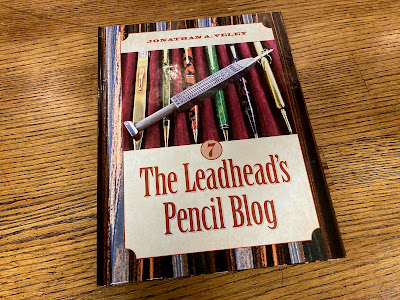
This article has been included in The Leadhead's Pencil Blog Volume 7, now available here.


If you don't want the book but you enjoy the article, please consider supporting the Blog project here.

A few years ago my good friend and Loyal Knight David Nishimura penned a nice article for his blog about the Pal line of pencils made by the Hoge Manufacturing Company (the article is posted at https://vintagepensblog.blogspot.com/2016/01/pal-pencils.html).  

To sum up, the Pal line was introduced in early 1921, and while David indicates a snippet view indicates there’s a reference to Pal pencils as late as 1928, suffice to say that metal pencils were out of style by the end of the 1920s, replaced by brightly colored celluloids.

American Writing Instrument Trademarks 1870-1953 confirmed what David wrote: the “Pal” mark was registered, and the certificate reveals that the Hoge Manufacturing Company first claimed to use the mark on January 12, 1921:

The “Modern,” also manufactured by Hoge, was introduced only the previous year  as mentioned in yesterday’s article (see also “Enough with the Musing” in Volume 3, page 169) . . . at least, that’s the No. 500 propelling Modern.  As my previous article on the brand mentioned, before the Hoge Manufacturing Company delved into propelling pencils, the company offered clutch leadholders under the “Modern” name.  From that earlier article, here’s an advertisement for Hoge’s clutch “Modern,” from The American Stationer on January 2, 1915:


I mentioned recently that it only takes two idiots to set the market in an auction.  Between my interest in the humble budget line of Pal pencils and David’s well-presented article, that makes two potential idiots who might well have set a distorted market for this when this showed up online:


An original catalog of the Hoge Manufacturing Company’s offerings turned up unexpectedly, and David and I both appreciated how unusual it was for one to surface.  We both needed to see what additional details it could add to the story we knew, but we kept our wits about us: either of us would have been happy with a clean, high-quality scan of the catalog, and both of us have the equipment to make such a scan.  Only one of us needed to bid - I was tapped for the job.

I bid the stupid money on the chance that there might be a third idiot out there.  There wasn’t, and I was relieved as the opening bid carried the day.  The catalog is brief – after all, Hoge was largely a one-trick pony, with the Pal as its prized steed:


The catalog is undated.  The “Modern” isn’t listed, and neither are the Pal pencils I suspect were referred to in 1928 (I’ll get to that at some point).  The artwork matches that initial flurry of national advertising Hoge generated when the pencil was introduced, so I’m inclined to believe (1) the “Modern,” introduced in 1920, was discontinued quickly for whatever reason and (2) the catalog dates to the early 1920s.

And that is what makes it so fascinating.

As with most trade catalogs of the period, there’s an introductory page which provides a bit of company backgrounds, similar to an “About Us” tab on a modern webpage (modern, that is, in the general sense). The Hoge introduction includes just enough information to piece together something I’ve suspected – but never been able to prove – for years:


According to the company’s own contemporaneous account of its history, it was founded in 1912 (that bucks a bit of information floating around in several places on the internet, which states that Hampden Hoge founded the company in 1909 – we’ll get to that in a minute).   The catalog identifies Hoge’s location at 157 Fulton Street, New York, which is consistent with what we already knew about the company.  But then there’s a curious detail:  “Established factories in Connecticut were subsequently acquired,” it states.

Curiouser and curiouser, the account becomes.  “For example, it is not generally known that forerunners of the highly developed ‘Pal’ line of all-metal propelling pencils were first made in this factory fifteen years ago,” it states.

The timeline does not appear to line up at first.  If Hoge was founded in 1912 and this catalog is from the early 1920s, that means these “forerunners” were manufactured in Connecticut by someone other than Hoge.  Fortunately, these “proto-Hoges” were still in production when the catalog was published:


Unmarked clutch pencils such as these are ubiquitous, and I would have trumpeted my suspicions that they were Hoge products a long time ago – if I had not already attributed them conclusively to someone else here at the blog many years ago.  Someone in Connecticut.  In fact, someone in the “Naugatuck Valley,” where Hoge’s snazzy, “most up-to-date” manufacturing facilities were located:


This image is from an article I wrote here at the blog very early on, in Volume 2 at page 255.  The bulk of the article delved into the meaning of the odd face on the accommodation clip, over which the word “UWANTA” is embossed.  After a bit of digging I concluded this was an American Indian’s face, and the clip advertised “UWANTA” cigars:


However, before I became sidetracked with the neat story behind the clip, I’d noted something else about these UWANTA pencils – a patent date of June 22, 1915:


Which, I explained, was a reference to patent number 1,114,082, issued to Harry Clarence Welton and assigned to the Mattatuck Manufacturing Company of – you guessed it – Waterbury, Connecticut:


Welton’s patent date doesn’t appear on very many of these, likely because the patent was later invalidated.  After all, there isn’t really anything new about the pencil he devised - Heath was making nearly identical leadholders much earlier, and the Faber “Pony Clip” is exactly the same thing, but with innards made of wood rather than metal.

There’s more.

Hoge’s “Pal” line must have been the tail that wagged the Mattatuck dog for a number of years, given how common they still are today, but metal pencils outside luxury models made by Hicks and the like had largely gone the way of the dodo by 1930.  Hoge reinvented itself, as a manufacturer of stamped metal toys and model trains.  

The histories of collectible toys and trains have been much more heavily documented on the internet than writing instruments, and while I haven’t tracked down the original source documents to substantiate the story, all sources agree that the Hoge Manufacturing Company’s toys were manufactured by the Mattatuck Manufacturing Company.

I also found a biographical account of Stuart Edwards Judd, which states that Hoge became a wholly owned subsidiary of Mattatuck in 1940.  Judd, according to this account, served as secretary and treasurer of both companies from 1940 on, becoming the sole owner of Mattatuck when he bought out all of the other shareholders in 1946.  Hoge’s toy lines were discontinued in the late 1940s, after which Hoge served only as a distributor of Mattatuck products until Hoge was finally dissolved in 1958.

Finally, with the missing pieces of the puzzle presented in this Hoge catalog, the entire story is clear.  The Hoge “Manufacturing” Company was a spin-off, set up in 1912 to pursue the exciting new opportunities in the field of writing instruments made in Mattatuck’s factories.  After a few years of spectacular success, Hoge reinvented itself as a toy manufacturer, enjoying additional successes for a couple more decades before folding back into the company from which it originated.  

Pencils to toys, dust to dust.

Sunday, April 11, 2021

Hogey Goodness

This article has been included in The Leadhead's Pencil Blog Volume 7, now available here.


If you don't want the book but you enjoy the article, please consider supporting the Blog project here.

One school of thought, when you encounter wadded-up paperwork that’s more than 100 years old, is that it should be left alone.  “Do no harm” is a common sentiment when it comes to messing with things that might be lost forever if disturbed.

I interpret “do no harm” from a different perspective.  If a piece of paper is disintegrating from age anyway, I feel the only benefit to leaving it alone is to enjoy a fading glimpse of how a box’s contents looked a century ago.  Fading, and inevitably nearing its end.

That, in my opinion, is its own sort of harm.  Given a choice, I think there is more value in preserving the information a piece of paper can pass on than in the paper itself.  Document, document, document is my mantra – if a piece of paper is falling apart anyway, I think it is best that it disintegrate while giving its last full measure to pass on whatever message it contains.

With the contents of this Hoge box, this was going to be a challenge.  As I mentioned yesterday, no amount of care during previewing could prevent more bits of the paperwork from breaking off like snow.  It had at best one last unfolding to see what it said. Here is the paperwork as it appeared in the catalog:


I keep letter-sized, PVC-free document holders on hand for just this purpose, but wrangling old pages into them to flatten them out is always difficult, particularly when they are deteriorated this badly.  I hold the open end of the plastic frame open, then starting from the bottom of the paper, I slide it in as far as possible, working little folds out as I go.  This paper was nearly torn in half and much of the top was already gone, but after ten or so tense minutes (taking nary a breath), I was finally able to exhale, as it flattened out enough to reveal its contents:


The paperwork, like the box, had nothing to do with the Pearce pencil around which it was wrapped . . . but fortunately, it had everything to do with the box.  “Modern” in this context had nothing whatsoever to do with A.A. Waterman, which at one point adopted the name “Modern Pen Company” (the full story on that clarification appeared here in Volume 3, page 169).

As illustrated in that previous article, Hoge’s “No. 500 Modern” propelling pencils were introduced by the company in Geyer’s Stationer on July 15, 1920:


The announcement indicated that as of that writing, Hoge was already “making deliveries” of the No. 500 in silver finish, but that “Their full line of pencils, consisting of different finishes and styles, will be ready not later than September 1st.”

I’ve never seen a Hoge No. 500 Modern in anything other than a plain, nickel plated barrel, nor in different sizes or configurations from what is shown.

As for the paperwork - now that it is in its protective case, it’s possible to remove it but I am doubtful I could do it in one piece.  It has now served its purpose - communicating a little information, now to be preserved electronically as well as in books.  It now has legs and will still convey its message long after I’m gone, for much longer than it would had I left in that box to decay into oblivion.

With respect to the box, I have now installed a No. 500 Modern inside it . . . 


And it now rests comfortably in the “M” section on the wall o’ pencils, a carryover from the days when I wasn’t sure where to put the “Modern” other than alphabetized by the name on it:


Maybe I should move it to the “H” section for Hoge, or at least down to the “P” section alongside its better known Hoge product, the “Pal” line of pencils.

Hmmm... that reminds me that there’s something else I need to show you ...

Saturday, April 10, 2021

My Hogeless Pal

This article has been included in The Leadhead's Pencil Blog Volume 7, now available here.


If you don't want the book but you enjoy the article, please consider supporting the Blog project here.

This one, also from the Krinke auction, made me chuckle when I read the online descriptions, and I had to preview it just to be sure it was what I thought it was.


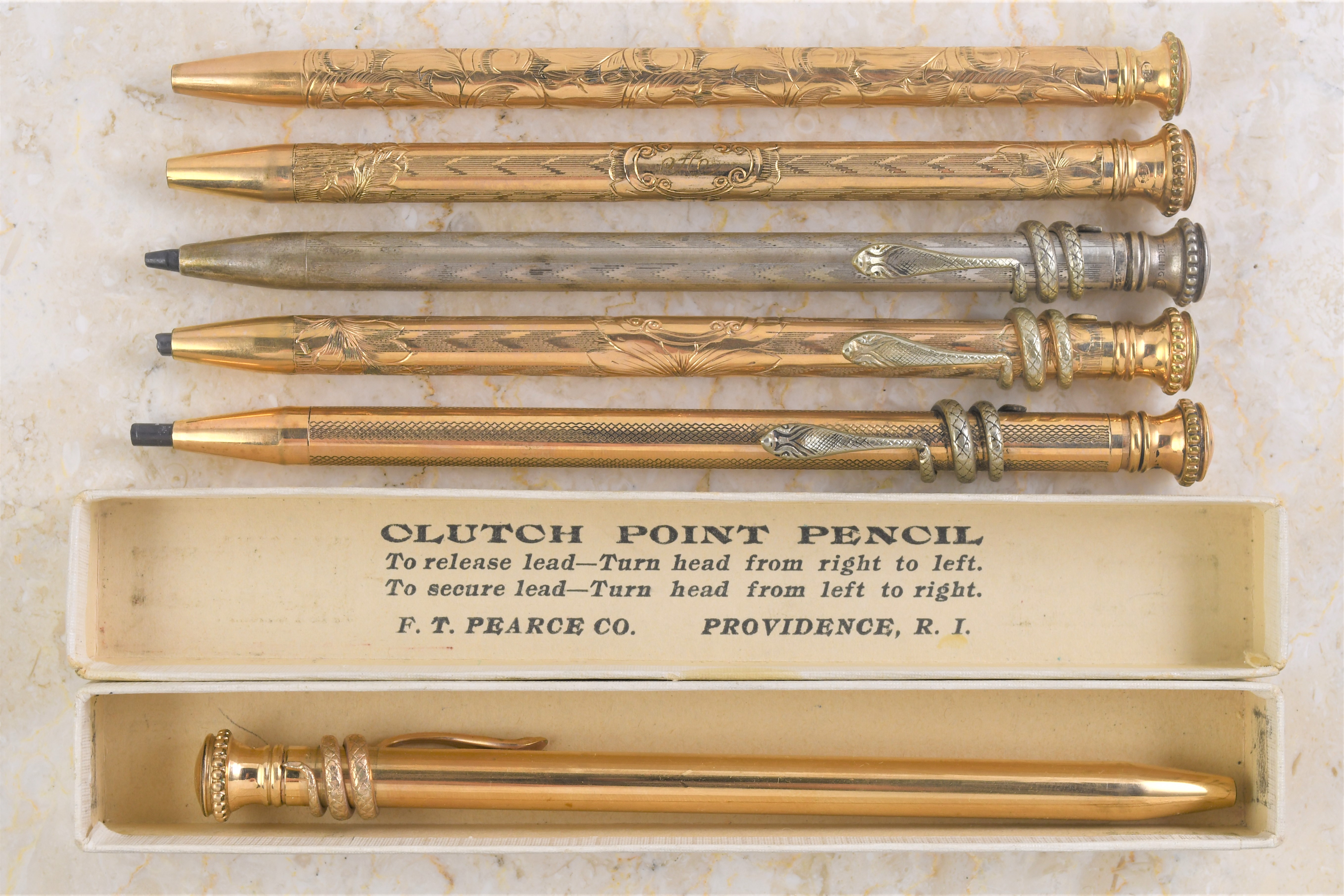
Whoever was writing up the descriptions aptly read what was on the box lid and described Lot 2338 as a “Hoge Mfg. Co. Stock Broker Gold Filled Pencil.”  The notion of the Hoge Manufacturing Company making that pencil was absurd to me – from all appearances, that was a leadholder made by the Frank T. Pearce Company, like these:


I had shot this latest family portrait of Pearce leadholders only a couple weeks before the Krinke auction, in anticipation of writing an article about that top example, which has a couple interesting new wrinkles worth mentioning:


The first wrinkle was my motivation for buying it.  It’s the first time I’ve found an example with a fraternal emblem on top. 


Although it’s damaged a bit, the John Hall connection warmed my heart.  As a Mason, John was also a member of the Shriners – what he called the “drinking Masons.”  We’ll just call this a “Shriner’s Pour” of cache added to my collection.  However, when this one arrived and I examined it up close, there was a second detail I found curious:


Instead of the familiar “FTP” in an oval for Frank T. Pearce Co. (the oval is actually the letter C, with a tiny “o” nestled on the right side for “Co.), this one was marked simply “Sterling” with no trace of the typical Pearce hallmark.

Frank Pearce died tragically in 1914; more tragic was that his only male heir who would carry on the firm, Aldridge Pearce, died very shortly thereafter.  The firm was apparently absorbed by Pearce’s former employer, the A.T. Cross Company, which continued to use this snake clip and later streamlined it for use on pencils into the 1930s.

(Note: for the full story on Pearce, George T. Byers and the patent litigation over the clip, see Volume 3, page 260.  For Pearce’s snake clip on a humongous Cross stockbroker pencil, see Volume 6, page 113).  

Both the fraternal emblem and the lack of a Pearce hallmark – two features I’ve not encountered on these – suggests that this was actually turned out by Cross, very shortly after absorbing what was left of the company.  

There was something else that struck me about this recent addition.  With only one exception, all the larger models I’ve turned up have been in gold fill, with only one example coming my way in sterling:

On the other hand, without exception all the smaller ones I had found are made of sterling.


I stopped short of writing the article which would have ended right there.  An intervening Hoge connection between the Pearce years and Cross, while extremely unlikely, would be fascinating.  Since I was planning to attend the Krinke auction anyway, I couldn’t wait to examine this “Hoge Stockbroker” in person, to see what interesting twist it might add to the story.

The preview was disappointing.  The box barely squeezed into the square plastic container in which the auction house packaged individual items - so tightly that some of the lettering on the box lid might have been wearing off a bit every time it was removed.  I removed the pencil for examination as gently as I could, but a couple pieces of the fragile paper inside came apart, so I couldn’t read whatever it contained.  There would only be one more opportunity to carefully flatten it out to see what it said, although I could make out “The Hoge Mfg. Co.” at the bottom end.

And then there was the pencil, badly dented with pliers at the nose end by some nimrod who apparently thought you turned the nose to make it work (I’m sure it wasn’t Fred Krinke - just someone with whom this pencil had an unfortunate encounter in its 100-year lifespan).  At the crown, all was revealed: whoever wrote the description apparently looked no further than the box to see whether the pencil had anything to do with it:


Yep.  It’s a Pearce.  Not a shred of evidence supported any connection with Hoge – unless that fragile paperwork established some previously undocumented connection between the two companies.

Damage aside, I still thought it might be worth a roll of the dice.  I notified the auction house of what I found during the preview, but no announcement was made during the auction of the discrepancy between what the pencil was versus how it was described in the catalog.  I had to pay more than I wanted to, but my new, worse-for-wear Pearce did add a wrinkle to the story I had planned to write:


This is the first time I’ve found a smaller sized example in gold fill, so I’m able to amend my third observation from the article I was going to write earlier: most of the smaller Pearce leadholders I have found were sterling, not all of them.

Now, for a closer examination of that paperwork . . .

Wednesday, October 10, 2018

A Fascinating Suggestion

This article has been edited and included in The Leadhead's Pencil Blog Volume 5; copies are available print on demand through Amazon here, and I offer an ebook version in pdf format at the Legendary Lead Company here.

If you don't want the book but you enjoy this article, please consider supporting the Blog project here.

When this one popped up online, I questioned whether I know too much about this stuff or nothing at all:


The pencil itself is easy to identify – it’s identical to the “Modern,” made by the Hoge Manufacturing Company, makers of the ubiquitous “Pal” line of pencils (not to be confused with A.A. Waterman’s “Modern Pen Company” – for that full story, see Volume 2, page 159-161).


What’s curious is the price band: Redipoint Ingersoll, model 210E.


The band is easy to date with some precision, given the history of the Redipoint brand.  In 1922, Brown and Bigelow associated with William H. Ingersoll, recently
out of a job after the failure of the Ingersoll Watch Company.  Shortly after, The Ingersoll Redipoint Company was organized, and Redipoints were offered under this label until January, 1926, when Herbert Bigelow reacquired the brand after his release from federal prison (for more on that story, see Volume 4, page 335). 

Redipoint price bands aren’t adhered to the barrel, so I suppose a random Ingersoll Redipoint band could have been swapped over to a Hoge “Modern” if some unscrupulous seller wanted to enhance the value of an otherwise ordinary pencil – but I don’t think that’s what happened.  First, I gently moved the band down a bit and noted decades of grime built up around it - if this band was added to an unrelated pencil, it was added a good long while ago.


Then there’s a curious detail concerning the pencil itself.  While every other example of the Modern I’ve seen has this same imprint:


My Redipoint-banded example lacks any markings whatsoever:


Finally, while I have several Redipoints with price bands, none are identified as model 210E.

Something clicked in my head.  The accommodation clips found on the Hoge Modern are just like what you’ll find on early Redipoint pencils . . . and I’ve never been able to pinpoint who made those early examples (although I’ve always doubted a calendar and advertising specialty company would have done so on its own – at least, at first). 

Does this example suggest that the Hoge Manufacturing Company made those first Redipoints for Brown and Bigelow, and after the Redipoint became a hit, Ingersoll Redipoint acquired its former supplier and sold remaining Hoge stock under the Redipoint name? 

It’s thin, but I’ve seen thinner. 

Saturday, June 17, 2017

Both Shoes

This article has been edited and included in The Leadhead's Pencil Blog Volume 5; copies are available print on demand through Amazon here, and I offer an ebook version in pdf format at the Legendary Lead Company here.

If you don't want the book but you enjoy this article, please consider supporting the Blog project here.

There are times when I see something and I know right off the bat what the title of the article is going to be.  The title of this one was going to be “The Other Shoe,” because I was so sure I had written about it before:


The pencil is made by the Eagle Pencil Company, and this one has one of those great names I love to see on an early Eagle: this one is the “Eagle Rocket”:


So as I sat down to start this article, title already firmly planted in my head, the first thing I did was open up the blog and scroll down to the Eagle Rocket.  Eagle Prestige, Eagle Ritaway . . . Eagle Russett . . . wait, where did I put that article?  I went back to the general Eagle category, in which non-model specific Eagle articles are filed . . . nothing there, either.

Huh.  Where did I put that article?  I went back through the picture archive for the blog, and it wasn’t there, either, so as a last resort, I opened a vast file folder on my laptop titled “pencil pictures,” a nearly bottomless pit of images into which I dip a digital bucket from time to time, drawing inspiration and material for the articles I write here.  Fortunately, since last winter I invested a week or so to go through and renamed all the images by brand, it isn’t as much the wilderness it used to be. Within a few minutes I’d found the pictures I took – and never used – of the Eagle Rocket.  They were pretty bad, taken in the days before friends had introduced me to the wonders of aperture priority and spot metering, so I had to reshoot them.  

I digress.  The point is that I abandoned the article and my unfinished research.  How in the world could I not post about something as cool as the “Rocket,” made in the days of Jules Verne or Orson Wells?  It has to do with that odd-looking accommodation clip:


“Pat. Nov. 9th 1920,” the imprint reads:


Turning to that outstanding resource on the subject (shameless plug), American Writing Instrument Patents Vol. 2 1911-1945, within two shakes I found a patent on that date by Eagle’s prolific inventor-in-residence, Claes Boman, number 1,358,511, and . . .


That isn’t it.  Not even close.

Huh.

Fortunately, according to that most excellent resource, I know there were two patents issued for clips on November 9, 1920.  The other one, number 1,358,338, is a dead ringer for this one . . .


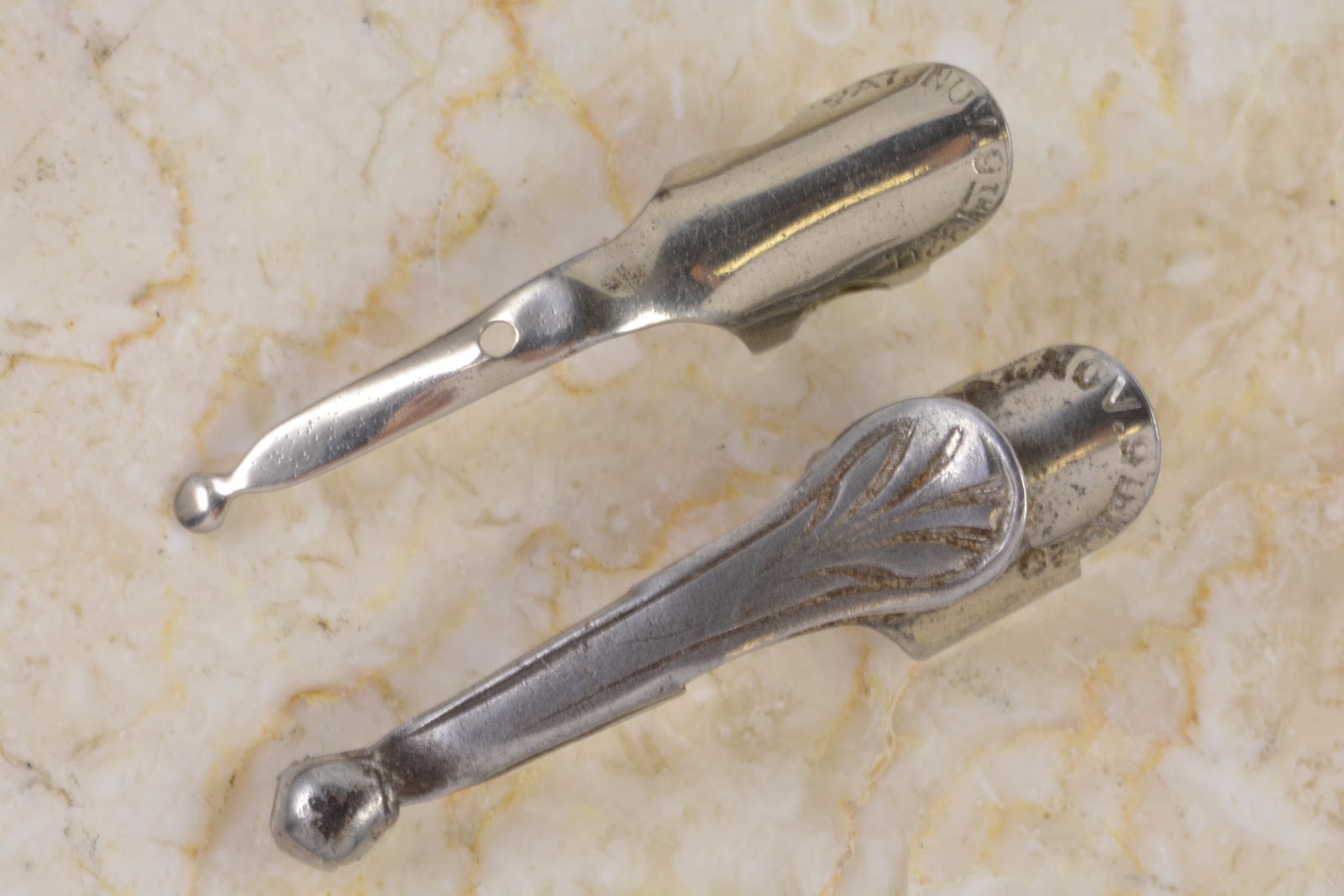
Ok, maybe half a dead ringer.  The drawings show a two-piece clip featuring an outer cover, from which the ball of the clip is pressed, wrapped around an accommodation clip with that same goofy shape and a hole in it:


The patent was applied for by William M. Saunders of Waterbury, Connecticut on January 15, 1920, and it was assigned to his company, the Hoge Manufacturing Company, makers of the ubiquitous “Pal” pencils as well as an interesting pencil called the “Modern” (not to be confused with A.A. Waterman’s “Modern Pen Company” – see http://leadheadpencils.blogspot.com/2015/01/enough-with-musing.html).

That’s when I remembered why and how the uber-cool Eagle Rocket slipped quietly into the dead letter office.  I thought it was a bit lame to write about half an accommodation clip, and I figured maybe someday the other shoe would drop.

Yesterday the mailman arrived, and there it was . .  thump.


I bid on this lot for the pen case that came with it.  The auction listing indicated that it was for a collection of pencils “with case,” but since the case wasn’t shown in the first picture, I guess nobody noticed.  I got everything for $15.50 . . . with free shipping.  I didn’t even care about the pencils.

Still, there were a couple interesting things in there.  The one that really caught my attention was that grey and red one with the weird silver cap – now that I have it in hand, I know it’s just a dumb ol’ Cavalier with something stuck in place of the right cap that happens to fit really well.  That gold one I’ll probably write about, so I’m going to keep it under wraps for the time being.  In the top row, there’s a Parker Challenger with a broken lower barrel badly superglued back together, and a crappy Essex.

And then there was that last one . . . I recognized it as probably being a Biltwell with the clip broken off and replaced with some random accommodation clip, which is exactly what it proved to be . . .


But what a clip!


It took a lot of wrestling to get that clip off the Biltwell, but fortunately the half a clip on the Rocket slipped off easily:


And the Rocket “rocketed” from uber-cool to . . . whatever you want to call something a few steps above that:


I have no evidence that the Hoge clip is correct on the Eagle Rocket, but I find it an extraordinary coincidence that Saunder’s patent was issued the same day as a clip patented by Eagle, and the first of only two I’ve seen turned up on an Eagle . . . when Eagle had a 1915 patented accommodation clip that might have been used just was well.

Who knows . . . maybe someday, something will turn up proving that Hoge supplied Eagle with clips and this pairing is the real deal.

That will be the third shoe.