Showing posts with label Autopoint. Show all posts

Monday, November 10, 2025

A Diamond Something from Autopex

Jim Stauffer was one of the most active Autopoint enthusiasts in the world. His personality was prickly, though – he did not suffer fools gladly, and he was quick to lump people into that category whenever they said something with which he did not fully agree. I’ve always said if nobody gets offended by anything you say, you aren’t saying anything, and since I say a lot, it was inevitable that I would run afoul of Jim’s sensibilities.

Jim took visceral and personal offense to my inclusion of one pencil in the Autopoint section of The Catalogue in 2011. Although I had included it only for whatever it was worth, with the benefit of hindsight Jim was right – it was a marriage of unrelated parts and not an Autopoint. When I asked Jim if he wanted a copy of The Catalogue anyway, he said no - he just wanted copies of the pages about Autopoint.

That was Jim.

Jim liked my Dad though, and I was eventually able to claw my way out of his fool’s dungeon while Dad and I worked on A Century of Autopoint, which was released in late 2019. Jim contributed a lot of information and pictures of things in his collection for the book, and while he did not fully agree with everything I wrote in the book, he agreed with enough to accept a free copy.

That, also, was Jim. 

Unfortunately, Jim was diagnosed with cancer after the book came out, and by early 2023 it was clear he was living on borrowed time. None of his family members were interested in his pencil collection, so Jim had made the difficult decision to liquidate his collection while he was still well enough to name his price and find the appropriate caretaker. He emailed me to ask if I would like the opportunity to acquire all or parts of his collection – he said he wanted me to have the first opportunity to acquire the things he had photographed for me and which I included in the book.

I later found out that I received that first opportunity after two dealers had already turned him down.

That, again, was Jim.

Even if I had known that I was Jim’s third choice to look at his collection, that wouldn’t have mattered to me. Of course, I wanted to visit Jim. Of course, I wanted to at least see his collection before it was dispersed to the four winds. Of course, I would be interested in buying a few things, if they were available and reasonably priced. 

I called Dad, who had remained in closer contact with Jim than I had, and we decided that since Jim lived in Lancaster, Pennsylvania, what made the most sense was to split our time at the Philadelphia Show that year. We’d spend some time at the show on Friday, commute to Lancaster to spend the day with Jim on Saturday, then scurry back to the show. 

Wear warm socks, Jim warned us before we arrived – he had set up tables on his enclosed patio, where he had lights set up to give us the full tour. “Autopex,” read the sign he had printed and placed on the table for his one-man show.


Jim and his wife brought tray after tray from his printer’s cabinet into the room, and he had Dad and I pick out the things we wanted. As we went, Jim ask us to name what we thought were fair prices for each item – we assumed that when we were finished seeing everything, Jim would total up those fair prices and factor in an appropriate discount for everything. When we had gone through everything, though, Jim totaled up all of our fair prices and that was what he said we owed him.

That, yet again, was Jim.

I had to pare back my pile, since Janet and I had agreed in advance the maximum amount I could spend on Jim’s stuff and still have a place to sleep when I got home. Dad gulped a bit and did the same. Still, I was able to bring home many of the things that were pictured in the book.


Towards the end of our visit, Jim was down to the non-Autopoint items in his collection – random things that he had picked up over the years just because they interested him. One of them was this:


All that I knew when I was putting this in my pile was that this pencil didn’t look like any Diamond Point pencil I had ever seen. Its closest relative in my collection is those 1924 McNary patent Rex pencils, like the Franklin in my recent article:


However, note that Jim’s pencil lacks the telltale banding you’ll usually see on the nose of McNary patent pencils, and it’s a bit bigger. The nose doesn’t pull off, so it isn’t an early Autopoint or Dur-O-Lite . . . although the similarity is probably what attracted Jim to this one in the first place. I did not unfurl the fragile instruction sheet that was inside the box until I got home, and it had something more along the lines of what I expected to see in a Diamond Point box.


Diamond Point’s first mechanical pencils were made by the Pencil Product Corporation, which also made the metal Salz Sta-Sharp on which these pencils were based. These first Diamond Point pencils, introduced  in 1920 were branded as the Auto-Sharp. See “Whew” (March 2, 2013: Volume 2, page 75).


I’ve found a few of these Auto-Sharp pencils in a nice array of different patterns:


In 1922, the New Diamond Point Pen Company rolled out a new mechanical pencil that was branded with the Diamond Point name and sported a distinctive top cap.


Note that this short announcement refers to “the manufacturer,” without specifying that Diamond Point was actually making them as opposed to sourcing them from Pencil Products or from someone else. They are distinctive enough that I’m inclined to believe they were actually manufactured by Diamond Point, and since they weren’t offered in as wide a range of patterns, I haven’t had to reshoot them since The Catalogue was published; here’s the image from page 39 of The Catalogue. 


This distinctive shape is what we see on the printed instructions which accompany Jim’s mystery pencil. 


Diamond Point, like most other manufacturers, switched from metal pencils to larger pencils made with brightly colored celluloid in the mid-1920s, providing us with a fairly narrow window during which these instructions were printed - probably between 1922 and 1925. As for Jim’s pencil, I’d estimate about the same date range, but that’s as far as I can go with my analysis.

Monday, August 11, 2025

The Four-Trick Pony

 I dropped a teaser the other day when I included a picture of that tray from Jon Martenson (ex Susan Wirth) that included two examples of The Keeran Pencil:


The Keerans are on the right; second from left is a Autopoint 1925 Model with the early “spoon clip” (by 1927, the clips on these terminated in a round ball). That one is no slouch, but it wasn’t the reason I took this picture.

The other pencils in this tray come from the Swanberg Manufacturing Company, in their hard rubber, Keeran Pencil-derived incarnation. A rough outline of Swanberg (named for Julius Swanberg, inventor of the Shur-Rite pencil) was laid out in “Cult Collection” (April 4, 2018: Volume 5, page 214). When I started collecting, I thought Swanberg was a one-trick pony, since the most common examples from the brand are those thin aluminum pencils, branded either with the Swanberg or “Tubit” name.


More on these later. These next pencils, I later learned, were the second trick from this particular pony . . .


. . . or so I thought. Most examples along these lines are made of hard rubber. Some earlier examples, including those featured in A Century of Autopoint on page 78, were made of celluloids carried over from the Keeran Pencil, but apparently Swanberg wasn’t as effective in procuring these materials as Charles Keeran had been –  most of these straight-top models are made from hard rubber. Here’s the image of some of them, which was also included in Volume 7:


Most, that is . . .


That center example is made from an interesting celluloid, not derived from one of LeBoeuf’s exclusive materials but something quite different. 


Note also that the bottom example is branded as a “Swanberg Special,” a crown top example of which was featured here in that last article, as well.

Even the relatively mundane example in black adds an extra backflip to Swanberg’s usual routine: gold filled trim on these utility models is out of the ordinary, and this one sports a shop imprint near the top: “150" might denote a model number, but it also might have referred to a suggested retail price of $1.50:


All three of these are minor variations on Swanberg’s second trick. But there is something interesting about this tray: those random bits and pieces are not so random when examined closely. All are Keeran or Swanberg parts, and if Swanbergs and Keerans are scarce as hen’s teeth, spare parts for them are unicorn feathers.


Over the years I’ve coined the phrase “junk box provenance” to describe those cases in which the circumstances in which something is found suggest there is something more than initially meets the eye going on. In this case we have a tray full of items which have a clear but obscure connection: Charles Keeran, Autopoint, and Swanberg. They were found all in one place, and while they were in the possession of Susan Wirth – a towering figure in the pen community – I believe they were kept together as they came into her possession.

Susan Wirth was many things, but organized was not one of them. She appreciated pencils, but her primary interest was pens; assembling a grouping like this would have required years of dedicated and focused hunting. Besides, Susan had acquired large portions of Autopoint’s factory archive, which would reasonably be expected to have acquired whatever remained of Swanberg and The Keeran Pencil. I have no doubt she would have recognized the value of keeping these things together, but I believe she acquired them in one go, close to the source.

And what a go it must have been! There was another tray I haven’t shown you yet that was in Jon’s possession:


As John Cleese would say, “and now for something completely different.” These aren’t some pitcher who only throws fastballs eeking out an additional couple miles per hour . . . this is Bugs Bunny suddenly “perplexing ‘em with a slowball” and striking out the Gashouse Gorillas, all at once with one pitch.

For starters, consider the aluminum examples which look at first like someone might have just stuck colored caps on them:


Wait a tick . . . those caps are the right shape for Swanberg’s plastic models, but those colors? I’d never seen them before. But wait again . . . there’s more . . . each is loaded with a lead matching the color of the cap, and what leads they are!


These are .075" “Checking” (as they were called by Eversharp) or “thick” (as Autopoint referred to them) leads, something I haven’t seen on any Swanberg before. This would not be a simple modification to existing tooling: with screw drive pencils, the entire mechanism would have to be retooled from scratch.

There are other interesting things about these aluminum checking pencils. Note the clips:


These were sourced from Van Valkenberg, which sold generic unmarked accommodation clips and referred to these as the “Holyoke B” model in Van Valkenberg’s 1931 catalog, preserved in the Pen Collectors of America’s online referenced library. 


Among the three otherwise pedestrian aluminum pencils, there’s another variation worth noting, the top example in this next image:


That top example also features a Holyoke B clip which granted, could have been added at any time. Not so easily explained are the steel tip, which has been substituted in place of the usual brass, and two additional knurled bands:


Now for a closer look at those last three in this tray:


The top example isn’t too far off the beaten path, although I haven’t seen this model in mottled hard rubber before:


The bottom one, however, is another matter entirely . . . a fat pencil in a striking, subtle olive-swirled plastic. It is the only example I know of in this size and in this material, and the bottom two sport specially marked accommodation clips I haven’t seen on any Swanberg before:


These were also sourced from Van Valkenberg - these were the company’s flagship “Security” clips as shown in the 1931 catalog:


Given the unusual twists and turns in this tray, it appears these were Swanberg’s last gasps . . . although the word “prototype” is overused, the absence of surviving examples of any of these “in the wild” suggests either very limited production or experimental pieces, perhaps acquired by Autopoint and later passed on to Susan Wirth before finally being passed on to me . . . with no notes to explain why or when they were made. 

Therefore, the search for additional documentation continues . . .  and so does the hunt for this particular pony’s fifth trick!

Wednesday, August 6, 2025

The Craftsman Conundrum Solved

In 2014, I wrote an article titled “The Doomed Craftsman” (November 13, 2014: Volume 3, page 97), concerning the only example I had found of the Craftsman: 


The Craftsman was introduced in the stationers’ press in July 1922, and according to those announcements, what set these pencils apart was the material used to fashion their barrels - Redmanol.


That is what led me to describe the pencil as “doomed.” I knew that around that time the Redmanol Corporation lost a patent infringement case brought by Leo Baekeland and his Bakelite Corporation. I had assumed that any product made of Redmanol would have gone extinct once that material was no longer available. 

Realite pencils, introduced in the fall of 1922, were also made of Redmanol; I assumed that Realite only avoided a similar fate by substituting Bakelite for Redmanol, from which Realite and Autopoint pencils (after the two companies merged) would be made for decades to come.  I reasoned that the makers of the Craftsman were unable to negotiate a similar arrangement and therefore went the way of the dodo. 

I was close. Actually, I wasn’t really all that close, but at the time, this was a reasonable interpretation of what facts I knew. As I researched and wrote A Century of Autopoint, however, I learned a few more key facts that proved I was dead wrong.

Chapter Four in the book, “The Plastic War,” unveils the details of the Redmanol story.  Adolph Karpen, a furniture manufacturer by trade, was interested in the development of a more durable substitute for furniture varnish. Dr. Lawrence V. Redman developed a phenol-based substance he marketed as Redmanol, and he and Karpen established and owned the Redmanol Corporation.

Here’s the rub: yes, Leo Baekeland would sue Redmanol Corporation for patent infringement, and Baekeland would ultimately win. However, the judge’s decision against Redmanol was rendered in July 1921 – a full year before the Craftsman pencils with Redmanol barrels were introduced.

Contrary to what I believed back in 2014, Redmanol’s defeat in court was not a death knell. Redmanol was not the first competitor Baekeland had sued: the first was Condensite Corporation, which used a similar substance to make phonograph records for Thomas Edison. Condensite also lost, but after its defeat the company negotiated a license with Baekeland and continued in operation. Leo wanted royalties, not conquest.

By the beginning of the 1920s, Condensite’s fortunes looked bleak. Edison would only permit the production of records which suited his personal tastes in music – and Edison disapproved of that newfangled jazz that was taking the industry by storm, causing rapid losses in market share. While the patent litigation against Redmanol was pending, Adolph Karpen quietly bought up options to purchase Condensite’s shares from the company’s anxious shareholders.

As soon as the ink was dry on the judgment entry holding Redmanol liable for patent infringement, Karpen sprung his trap: he exercised his stock options and acquired a controlling interest in Condensite, so that what Karpen could not do through Redmanol he could continue to do as a Condensite licensee. Leo Baekeland was forced to the negotiating table, and in May 1922, the Bakelite Corporation was founded as a holding company which wholly owned the Redmanol Corporation and the Condensite Company. The three companies were formally merged in 1924.

The Craftsman pencil was introduced in July 1922, at a time when the Redmanol Corporation was operating with the full blessing of Leo Baekeland as a subsidiary of the Bakelite Corporation. The Craftsman pencil was in no way “doomed” by virtue of the material used in its construction. 

The Craftsman makes an appearance in A Century of Autopoint on page 45, but at the time the book was published I still was unsure how the pencil fit into this bigger picture. It would have been helpful to take apart my example of the Craftsman to see what was going on inside, but my only example had deteriorated so much that I feared any attempt to disassemble it might destroy it. 

The Craftsman looks Keeranesque, but I had ruled out Charles Keeran as a suspect since he had signed an exclusive contract with Realite on July 15, 1921 and the Craftsman did not debut until a year later. Therefore,  all I could say in A Century of Autopoint was that the Craftsman “bore more than a passing resemblance to Autopoint’s ‘50-cent’ number [invented by Keeran], but as of this writing no connection between the two is known.”

Again, I was close. Sooooo close . . . 

No, there is still no surviving direct evidence which connects Charles Keeran to the Craftsman Products Corporation. The 1922 Illinois Secretary of State’s Corporations lists the president as “H.K. Neinn” of Wilmette, Illinois, and the treasurer was P.W. Rice of Chicago. Both of these leads were dead ends. All trade announcements and the Illinois Secretary of State indicate the company was located at 668 Washington Boulevard, Chicago - another dead end, since that address has been wiped from the face of the Earth and is now in the middle of I-94. 

Now, the evidence I sought has finally come to light, tying together all the loose ends that have bugged me about the Craftsman as neatly as I could have ever hoped.

At the Chicago Show in 2023, Susan Wirth’s longtime companion John Martinson was liquidating much of what remained of Susan’s hoard. One of several boxes I purchased from John included was another example of the Craftsman. This one is in much better condition and has a slightly different top end:


Unlike my other example, this one disassembled easily, and what lies inside answers many questions. Here it is with the insides removed, shown along an early Autopoint “50-cent number”:


The Craftsman is an Autopoint 50-cent number wrapped in a Redmanol barrel. Now, laying out all the clues I’ve found in chronological order, we have a very different picture of what happened:

1.  Charles Keeran was ejected from the board of directors at Autopoint in April, 1921 (A Century of Autopoint, page 29).

2.  Keeran signed his exclusive contract with Realite through Michael M. Kaufmann, Frank C. Deli and John Lynn on July 15, 1921 (the contract was reproduced on page 34).

3.  On July 13, 1922 Keeran and “Kaufman” filed a patent infringement suit against Autopoint, according to a report published in The United States Patent Office Official Gazette on April 24, 1923.


“Kaufman” is almost certainly a mispelling of Michael M. Kaufmann, one of the original principals of Realite. The patents sued over were number 1,372,354, issued to Keeran on March 22, 1921 (just weeks before his ouster) and 1,400,362, issued to Keeran and Kaufmann on an application filed in 1919 (the mechanism inside the original Autopoints, including the 50-cent number).


Patent 1,400,362 was issued on December 13, 1921, after Keeran had been ousted from Autopoint and had joined Realite. I did not report the patent infringement suit in A Century of Autopoint, because I did not know how it fit into the story.

4.  The Craftsman is introduced in the stationers’ press in August, 1922 – one month after Kaufmann and Keeran filed suit, according to the notice in the Official Gazette.

Now it all makes sense. Keeran had invented the 50-cent number for Autopoint, and there was a dispute over who owned the rights to manufacture the pencil. A new company, the Craftsman Products Corporation, was established to make the disputed pencil . . . certainly not on behalf of Autopoint, but as a direct challenge to Autopoint’s claims.

Of course the Craftsman Products Corporation had no identifiable connection to Realite or Charles Keeran – had the maneuver failed, it would be Craftsman and not Realite or Charles Keeran that would take the fall.

Realite’s rapidly expanding business led it to seek out better manufacturing facilities by 1922, and there was no easier way than to take over Autopoint’s plant. Realite increased its capital dramatically in November, 1922, shortly after the Craftsman’s warning shot over Autopoint’s bow.

In April, 1923 the stationers’ press announced that Autopoint and Realite had merged; the surviving company was renamed the Autopoint Products Company, and its first president was Charles Keeran (A Century of Autopoint, page 50).

With the full story laid out, the Craftsman was indeed “doomed,” but not for the reasons I thought back in 2014. The Craftsman was doomed by its rapid success as a sacrificial pawn, forcing Autopoint into a merger. In 1923 and 1924, the Autopoint Products Company offered both rebadged Realite pencils and the original Keeran Autopoints (including 50-cent numbers), but there is no evidence that the Craftsman remained in production. With the introduction of the new Autopoint Model 1925, Keeran’s 50-cent number was discontinued.

Tuesday, June 22, 2021

For My Amusement

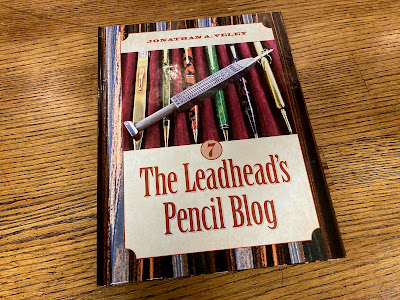
This article has been included in The Leadhead's Pencil Blog Volume 7, now available here.


If you don't want the book but you enjoy the article, please consider supporting the Blog project here.

When Michael Krut sent me the black and pearl Eversharp Doric I wrote about a few weeks ago (see "My First Love"), he included a few stowaways – bits and pieces of things that he thought I might enjoy, just for fun.  One of them was this:


My initial thought when it popped out of the box was that it might be an unusual smaller version of the Autopoint Model 466 – from that awkward transitional period in 1931 when the noses had been changed from the long metal ones to Bakelite, but before the top end was redesigned to include a matching plastic cap.


These Autopoint transitional models are tougher to find, even though they were offered in Autopoint catalogs through 1936 – for more information, see A Century of Autopoint, page 112.

I’ve never seen a smaller model, and this one looked like it had a replacement cap, from a Dur-O-Lite.  Good luck finding the right cap, I thought . . .


But then I noticed the imprint, and this little guy went from amusing to fascinating faster than you can say Dur-O-Lite or Autopoint:  Keen Point (only two syllables – that’s why it’s faster).  


The Keen Point was also discussed in A Century of Autopoint, due to its connection with the inventor of the original Autopoint, Charles Keeran (see Chapter 7 in A Century of Autopoint).  After Keeran’s second ouster from Autopoint, he engaged in a series of associations with other manufacturers.  In 1927, he filed his trademark registration for the Keen-Point logo:


The earliest Keen Points were made by Dur-O-Lite, as illustrated on page 83:


On that same page, I illustrated a Dur-O-Lite (top) compared to a Keen Point (bottom) with their noses removed, to show how they are different inside.  As I noted in the book, very few Dur-O-Lites, probably very late production during the flattop series, share that same barrel end treatment:


This new example shares similar barrel end treatment:


As I mentioned when I restarted this blog, I’m writing these articles while I’m taking a break from writing a book about the history of Dur-O-Lite titled Dur-O-Lite: The Clandestine Company.   I delve more heavily into the Keen Point in its pages, and I now know that by the time Dur-O-Lite relocated from Chicago to Sycamore, Illinois in 1931, the mark no longer belonged to Charles Keeran.  It had been acquired by Dur-O-Lite, which was by that time marketing a lower priced “Keen-Point” line of pencils.

The cap on Michael’s pencil is probably correct: Dur-O-Lite did offer a thin model during the flattop era which used that cap.  Here’s an image showing that same cap on a slim model found in the Dur-O-Lite factory archive which will be included in the new book:


What I didn’t know until Michael’s example came along was that there were demi-sized thin models, and that the Keen Point changed out the tips from metal to plastic, then the cap.   All the other examples I’ve found have either both metal ends, or both plastic.  


I’m sure that Autopoint inspired Dur-O-Lite to change out the tips.  However, given that this is the only Keen Point I’ve ever seen which didn’t change out the top end as well, I’m wondering if Dur-O-Lite didn’t inspire Autopoint to change out the caps in return.