Showing posts with label Rite-Rite. Show all posts

Sunday, June 27, 2021

In the Interests of Transparency

This article has been included in The Leadhead's Pencil Blog Volume 7, now available here.


If you don't want the book but you enjoy the article, please consider supporting the Blog project here.

I’ve written about pencils like these, before . . . back in Volume 3, page 8:


The pair came out of Don Jacoby’s collection, and they nicely fill out a growing set in the Rite-Rite wing at the museum:


That bottom example, in the “Rite-Rite Travel Kit” box, was the inspiration for that previous article.  Out of the box, there are four (and perhaps five) colors represented here:


Perhaps the colors have faded over the years, and maybe this is just normal manufacturing variations of the same thing – but one of the pinkish orangish ones looks more pink, and the other more orange:


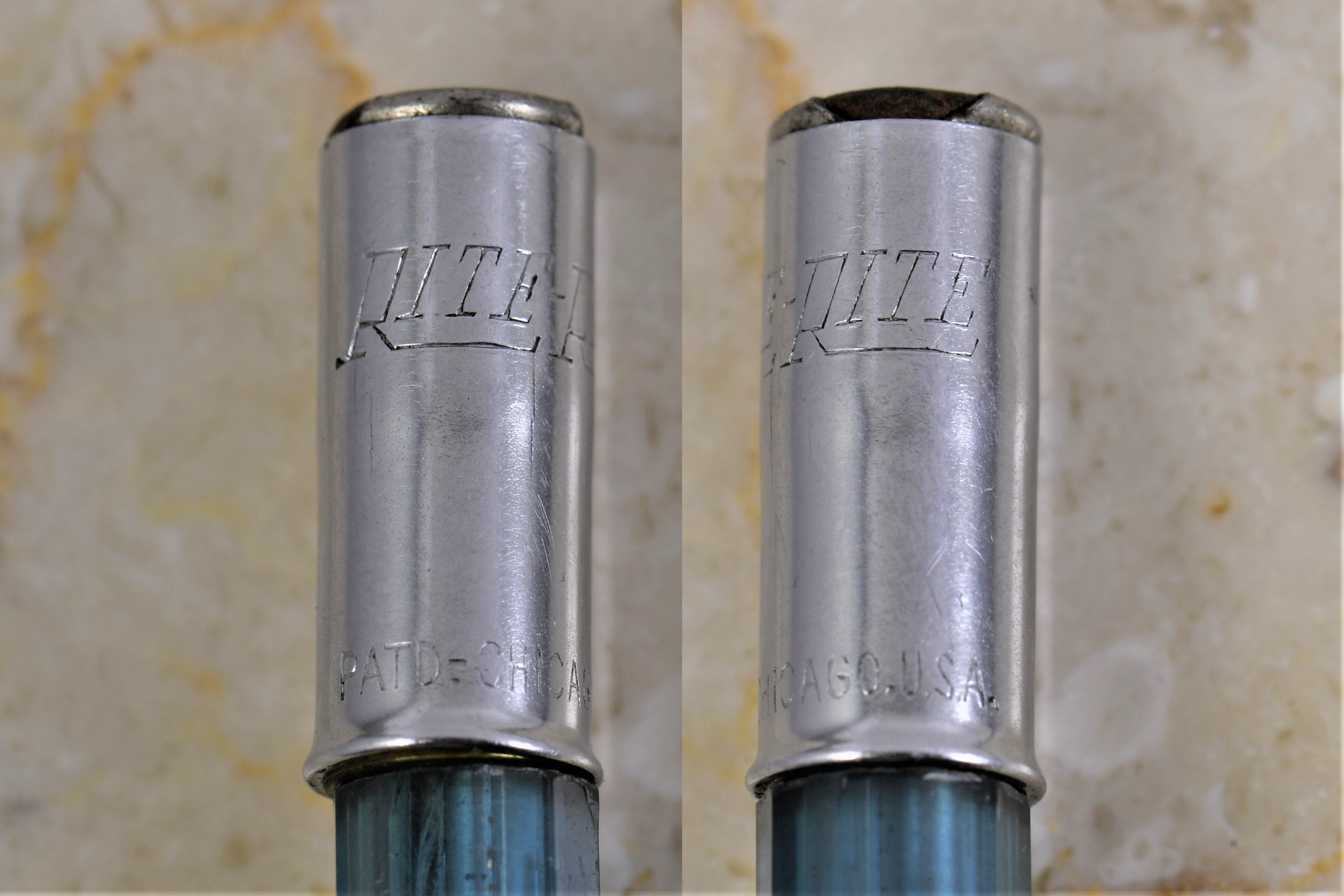
All but one of these have the Rite-Rite name on the upper ferrule:


The sole exception is the clear example, with the shorter tip.  The Rite-Rite name is missing – the “Patd. Chicago USA” is still present, so I’m confident this is part of the same series:


I should have been more “transparent” in that last article about something I said: I identified these as Rite-Rite “X-Ray” pencils.  That wasn’t right . . . with such a cool name as that, I owed it to you to show you where I saw that.

I wanted to, really I did . . . but I lost it.  

Believe it or not, that’s highly unusual around here.  You can call the largest collection of American mechanical pencils a lot of things:  “overwhelming,” one observer called it when he saw it the first time.  “You’d better outlive me so I don’t have to deal with this,” Janet says. 

But you can’t call it disorganized.  Ask me where something is at the museum, and I’ll take you right to it every time.  It’s my only superpower: I can find my way around my own damned collection.  When I can’t find something down there, I have a visceral moment of panic . . . if I can’t find one thing, how many other things are missing in action?  

In this case, the answer was that it wasn’t in the museum.  When that last article posted in 2014, I had made the commitment to “going paperless” at my law firm – if you look at my desk at any given moment it would appear laughable if I tell you what an overwhelming success that transition has been, but it  has been life-changing.  For the better, I mean.

Around that time, I thought to myself: if I can convert tens of thousands of pages of information into digital form, maybe I can also convert other things too, like this 1938 Rite-Rite catalog:


The results, given the technology I was using, were not quite what I had in mind.  The scanner that was burning through file cabinets full of old files wasn’t a flatbed, so if I was going to run these old pages through it I’d need to remove the staples and hope everything went through smoothly, without pages getting scrunched or wadded up - and I wasn’t going to do that.  I tried making a photocopy and then scanning that, but I was losing too much detail.  After fiddling around with it for awhile, duty called and I set the catalog aside to get back to work.

Six years later, as I was doing a bit of pandemic spring cleaning at the office, I opened up a box of random things hastily packed up from my old office during the move to my current location in 2015.  Inside I found both the long lost Rite-Rite catalog as well as that Eagle catalog I wrote about here a few weeks ago (yeah, that one didn’t go so well, either).

I’ve since picked up a CZUR book scanner that does a good job archiving things like this without disassembling them.  I am pleased to report, long after the fact, my source for calling these the Rite-Rite “X-Ray” pencils; Model 33, in fact:


Listed in six colors of transparent “Tenite”: Amber, Orange Red, Light Blue, Light Green, Rose and Crystal.  Light green I haven’t seen; “orange red” and “rose” may look an awful lot alike after more than 80 years.  Maybe I have one of each – maybe one with a more orangeish or roseish will surface.

Thursday, June 4, 2020

The Big Black Hole

This article has been edited and included in The Leadhead's Pencil Blog Volume 6, now on sale at The Legendary Lead Company.  I have just a few hard copies left of the first printing, available here, and an ebook version in pdf format is available for download here.

If you don't want the book but you enjoy this article, please consider supporting the Blog project here.

A Century of Autopoint isn’t just about Autopoint; it’s about the people who were involved with the Autopoint story and Charles Keeran in particular.  I discussed Keeran’s early life in a previous article here (see “There But For the Grace of God”), which was covered in the first chapter of A Century of Autopoint.  After Keeran got the boot from Autopoint the second time in 1924, he didn’t depart completely from the story.  As that previously mentioned article covered, he landed at Dur-O-Lite for a time and maintained a decades-long epic of a feud with his former colleagues at Wahl.

In Chapter 7 of the book, “Exit Stage Left,” I’ve strung together all of the clues which provide insight into Keeran’s activities after 1924.  One of his landing places, albeit very briefly, was at another Chicago pencil company, the Rite-Rite Manufacturing Company.  On page 82, you’ll find this picture of some early Rite-Rite pencils:


Something that has puzzled me, since long before I sat down to write the Autopoint book, was the “Patd.” imprint on these clips:


I’ve never seen a patent for that clip, exactly . . . although the one I found that is the closest is one that was issued to Charles Keeran for a similar clip, and found on early Realite pencils and then continued on Autopoints after the two companies merged.  Here are early Realite pencils from 1922-1924 sporting the clip:


Keeran didn’t apply for a patent for this clip until May 24, 1924 – right around the time he got the boot from Autopoint the second time, which was probably the inspiration for his application.  It wasn’t issued until April 26, 1927 as number 1,625,809:


Note that Keeran’s patented clip, like the ones found on these Rite Rites, is contoured around the barrel, so only one bolt is needed to secure it and keep it from spinning.  Is it possible that Keeran got mad at Autopoint, packed up all his toys including the single-bolt clip and took everything over to Rite-Rite, hence the “Patd.”?

I don’t think so.  And what I do think shines a flashlight into the inky blackness of the United States Patent Office.

First, Keeran’s patent was assigned to Autopoint, probably as part of his severance from the company.  If Keeran walked into Rite-Rite’s door, he wasn’t bringing with him the rights to use that clip.  Maybe there was a license agreement, but there’s a better explanation.

As I was pawing through that 1931 Van Valkenburg catalog the other day looking for Listo clips, I found another page relevant to today’s story:


Notice clips number 6 and 14?


There’s no way Van Valkenburg would have secured a utility patent for these clips by 1931, since Keeran’s nearly identical clip had just been patented in 1927.  No, I believe there was a design patent issued to Valkenburg to protect the distinctive look of these clips – and that’s somewhere in the black hole.

My methodology in researching and writing American Writing Instrument Patents, both volumes, was fairly straightforward.  I started by going through every patent in category 401, the category in which most writing instrument patents reside, and I compiled a database of the pen and pencil ones.  Next, I went through other random categories scattered across the USPTO in which known pen or pencil patents would have been filed.  That’s how all the design patents wound up in the book – I had a few known design patents, figured out in what categories they were filed and then researched all of them.

The system wasn’t perfect, but then again – neither is the Patent Office.  Human beings were picking what categories to put things into, and as long as there are humans there are human errors.  With artificial intelligence, doubly so.

After I’d exhausted every line of inquiry, I organized the books in spreadsheet form, sorted in different ways – by date, by description, by inventor, by assignee and finally, by location.  If you have a patent date or number, the first section will do just fine.  But say you want to look at all the “clip design” patents?  That’s where a tool like my books really shines.

As long as the data is good.  There’s a hole somewhere.

Here’s the page in the book on which I was confident I would find a design patent issued for a clip sometime in the 1920s (next to Colonel Mustard in the library, of course):


Notice anything odd?  On average, four or five design patents for clips were issued per year, but there’s a gap – some time in 1916, and for the next 15 years, no design patents for clips appear in the book (I did find a few figural design patents, such as Schnell’s airplane clip, but no generic shapes).

I went back and retraced my steps, painstakingly checking over my research.  All the categories I checked were to my knowledge the right ones, and yes, I did correctly report all the relevant patents filed in those categories.

My guess is that someone found an insane place in which to file design patents for clips sometime in 1916, and that person consistently did so until 1930.  And I haven’t found that place.  Eventually a clip will turn up with a patent number on it from the 1920s, and with any luck, that will be the key that unlocks that one particular file drawer in that improbably immense filing cabinet we call the patent office.

And when that happens, I’ll have plenty more to report to you.

Monday, October 17, 2016

The Rest of the Story

This article has been edited and included in The Leadhead's Pencil Blog Volume 4; copies are available print on demand through Amazon here, and I offer an ebook version in pdf format at the Legendary Lead Company here.

If you don't want the book but you enjoy this article, please consider supporting the Blog project here.

The accepted bedtime story about the Wahl Adding Machine Company, which later became the Wahl Company, is that the company was incorporated in 1905 to make John Wahl’s nifty attachment for typewriters which turned any old typewriter into a steampunk mechanical calculator.  Ten years later, though, John Wahl met inventor Charles Keeran, who was interested in purchasing some machinery to make his new pencils (since his existing supplier, the George W. Heath Company, wasn’t making them fast enough to keep up with the demand).

Wahl started making Keeran’s pencils in October, 1915, quickly learned  how much money the company could make in the writing instruments business, bought Keeran’s company,bought the Boston Fountain Pen Company to add fountain pens to their line, shortened the name to Wahl Company, dropped adding machines like a hot rock and lived happily ever after.

Well, sort of happily.  Until that whole ballpoint thing brought the company to its knees and forced the sale of its writing instruments division to Parker in 1957.

The story leaves out one important detail: John Wahl didn’t invent the adding machine that started it all.  Who did?  Well, as Paul Harvey used to say, I’m now going to tell you the rest of the story.

When I first sat down to write this article, my research led me straight to a fellow blogger’s work over at oz Typewriter, where Robert Messenger posted a terrific article in 2014   (http://oztypewriter.blogspot.com/2014/04/john-conrades-wahl-and-remington-wahl.html), and he attributes John C. Wahl’s rise to fame as an inventor to his patent for a calculating machine, applied for on October 28, 1904 and issued on July 21, 1908 as number 893,717:


A second application, filed by Wahl on April 17, 1905 was also issued on July 21, 1908 as number 893,718.  Both applications, read closely, are for “improvements to” calculating machines, both were assigned to the Wahl Adding Machine Company and in both, Wahl indicates, “I have shown my device attached to a well known Remington typewriting machine.”   In his second patent application, however, he adds at the end of that statement, “although it may be attached with equal facility to other machines.”  Remington apparently made sure that never happened, formally “adopting” the adding attachment in 1908 with a lease of the patent rights for seventeen years, to end in 1925.

There’s a loose end here:  if John Wahl’s first patent was for an “improvement” to calculating machines, what was he improving?

This:


Several months before John Wahl applied for his first patent, Hyman Eli Goldberg filed an application for his patent for an improvement in calculating machines, on March 7, 1904, but unlike Wahl’s, Goldberg’s patent was issued fairly quickly, on Valentine’s Day, 1905 as number 782,554.  Goldberg’s first patent was not assigned to anyone, but later patents he filed were assigned to the Goldberg Calculating Machine Company, which was established in 1902, three years before the Wahl Adding Machine Company:


Wahl and Goldberg each patented dozens of improvements on a calculating attachment for typewriters; Wahl assigned his to the Wahl Adding Machine Company, while Goldberg’s were assigned to the Goldberg Calculating Machine Company.  The two did collaborate in the filing of an application to patent this improvement on March 16, 1908, which was issued on August 25, 1908 as number 896,871 – and assigned half to the Wahl Adding Machine Company and half to the Goldberg Calculating Machine Company:


The Wahl/Goldberg patent became wildly successful through the next decade, and at the Panama-Pacific Exposition in San Francisco (the 1915 World’s Fair), history records that John C. Wahl won a medal for the Wahl Adding Machine.  History has it wrong: it was actually the co-inventors of the Wahl Adding Machine, John C. Wahl and Hyman Eli Goldberg, who received the honors, as reported in the September, 1915 issue of Typewriter Topics.


Note:  The Panama-Pacific Exposition is where Charles Keeran first went national with his new Ever Sharp pencil.  Did John Wahl and Hyman Goldberg meet Keeran at the Exposition?  History does not record such a meeting, and it was an enormous event – but surely their common experience there gave them something to talk about when the two met, and Keeran hired the Wahl Adding Machine Company to manufacture pencils for him, beginning in October, 1915. 

One question which has always bothered me is why the Wahl Adding Machine Company had any interest in making pencils for Charles Keeran.  The company had been around for ten years, dedicated solely to the refinement of a wildly successful invention, sold in partnership with one of the largest typewriter manufacturers in America.  Did John Wahl’s agreement to make pencils for a small-time inventor such as Keeran suggest that there were tensions brewing between Wahl and Remington?  I believe that it does, and the company was looking to diversify its manufacturing base at around that time.

The best evidence of a pending storm between the Wahl Adding Machine Company and the Remington Typewriter Company comes from what happened after the company acquired a controlling interest in Keeran’s Eversharp Pencil Company, after the company purchased the Boston Fountain Pen Company and after the company name was shortened to simply “Wahl Company.”


The Remington Typewriter Company got wind that the Wahl Company’s shareholders were planning to sell the assets and business to the Goldberg Calculating Machine Company, and filed for a restraining order to block the sale on July 16, 1919; note that this news report states that Remington had a 25 year lease, rather than a lease until 1925 (I’m not sure which is correct).  The parties litigated over the rights to Wahl’s adding machine business for a year: on July 14, 1920, news accounts reported that Wahl had sold all the rights to its adding machine business to Remington for $1,700,000.00.


Included in the sale were all of John C. Wahl’s adding machine patent rights – and also all of Hyman Eli Goldberg’s.

Remington’s acquisition of the Goldberg adding machine patents, something as a pencil history researcher I never would have thought to examine, is what leads me to the rest of the story.

After the sale, the Remington Typewriter Company set about the task of refiling all of the adding machine patents it had acquired, to reflect their assignment to Remington, and there is a curious notation on each of them:


Each of the Goldberg patents is reported as being issued to “Hyman E. Goldberg (now by judicial change of name Hyman Golber).”

Wow. Hyman Goldberg I’d never heard of before, but Hyman Golber – well, you know who he is.  Just a year after the Remington Typewriter Company purchase went through in July, 1920, Hyman Golber applied for a patent for a mechanical pencil on September 15, 1921:


And then, he set up a company to manufacture his new pencil, filing a trademark on the name:


That’s right, folks: John C. Wahl’s coinventor of the Wahl Adding Machine changed his name to Hyman Golber, invented a pencil, began doing business as H.E. Golber & Co. and founded Rite-Rite.

Rite-Rite became successful in its own . . . rite . . . with Golber at the helm until the company was acquired by the Joseph Dixon Crucible Company to become Dixon Rite-Rite in the 1940s, after the tragic end to the Golber story:


At the age of 70, on November 11, 1942, Hyman Golber became despondent that he was losing his eyesight, without which, as a lifelong tinkerer and inventor, he believed he would no longer be able to pursue his life’s passion.  Hyman went to a Chicago restaurant and, in a second floor bathroom, he ingested poison and took his own life.
Thursday, December 24, 2015

Ritest of the Rite

This article has been edited and included in The Leadhead's Pencil Blog Volume 4; copies are available print on demand through Amazon here, and I offer an ebook version in pdf format at the Legendary Lead Company here.

If you don't want the book but you enjoy this article, please consider supporting the Blog project here.

That same seller that had the 40-pencil lot including that Ripley Vacumatic posted a similar lot a few months ago, which included this one:


I wasn’t entirely sure what this one would be, with those fuzzy pictures.  When it arrived, I found it was a Rite-Rite:


That distinctive plastic really stood out.  The only other ones I’ve seen along these lines have been in an equally distinctive, teal-colored  plastic:


There’s some nice detail work on the lower barrel:


And on the top, a surprise that didn’t show up in the pictures:


That’s not a sticker: that “3 1/4" emblem is built into the plastic, and I haven’t seen that feature on the teal ones.   I thought maybe it might be a more-permanent-than-usual price sticker, so I checked the library at the Pen Collectors of America (www.pencollectorsofamerica.com) to find out at what price point they were offered.  The library has a 1938 Rite-Rite catalog, and this one is listed – at a price of $74.60 per gross:


The “3 1/4" was the model designation, derived from its lead capacity of 3 1/4 inches.   This is only the second color I’ve encountered, but they came in “black and assorted pearl metallic colors,” served . . .


. . . in a “jewelry type display box.”   How cool is that!

Wednesday, March 25, 2015

Ringing a Couple More Bells

This article has been edited and included in The Leadhead's Pencil Blog Volume 3; copies are available print on demand through Amazon here, and I offer an ebook version in pdf format at the Legendary Lead Company here.

If you don't want the book but you enjoy this article, please consider supporting the Blog project here.

A while back I posted an article titled “This One Rings a Bell Now,” (
http://leadheadpencils.blogspot.com/2015/01/this-one-rings-bell-now.html)in which I attributed a pencil marked only with “Bell System” to Rite-Rite based on the unusual hexagonal plungers found on both:


John Coleman was quick to respond with this pair of Bell System pencils, one of which is unmarked with a phone dialer, and the other of which sports a Rite-Rite ferrule:


That, I thought, was a significant step towards nailing that down . . . if only it weren’t all too easy to stick any ferrule of the correct diameter on the end of a pencil.  But the clincher has arrived, by way of an online auction:


There’s no doubt about it when the clip is bolted to the side of the barrel . . .


. . . the pencil has a Bell System imprint . . .


. . . and inside is exactly what you would expect to see!


Saturday, March 7, 2015

A Rite-Rite Footnote

This article has been edited and included in The Leadhead's Pencil Blog Volume 3; copies are available print on demand through Amazon here, and I offer an ebook version in pdf format at the Legendary Lead Company here.

If you don't want the book but you enjoy this article, please consider supporting the Blog project here.

A few weeks ago I posted an article (http://leadheadpencils.blogspot.com/2015/01/straight-from-land-of-shaw-barton.html) about a strange line of Shaw Barton pencils that turned out to be made by Rite-Rite:


Rambling around the local antique show last weekend didn’t turn up much, but I was pleased to find this one:


This one sports a Rite-Rite accommodation clip, but the pencil is otherwise identical to the ones shown in my earlier article:


And I can proudly report to you that the Rite-Rite No. 50 sold for the princely sum of 53 cents:

Saturday, January 10, 2015

Straight From the Land of Shaw-Barton

As much as I’d like to say that Shaw-Barton’s pencils were all original, they weren’t. Nearly all of the Shaw-Barton pencils I’ve found were made by Ritepoint, probably supplied to Shaw-Barton with the company’s name on the clips, which Shaw-Barton then screen printed with the customer’s advertising.

Nearly all, that is, except for these:


These translucent pencils don’t fit the mold.

To learn more, this full article is included in The Leadhead's Pencil Blog Volume 3, available at Amazon, Barnes & Noble and everywhere else you buy books, or you can order a copy signed by yours truly through the Legendary Lead Company HERE.


Thursday, January 8, 2015

This One Rings a Bell Now

(Note: this is the second part of a two-part series. The first part posted yesterday at http://leadheadpencils.blogspot.com/2015/01/silent-witness.html).

I’ve had this pencil laying around for years, because I didn’t know quite what to make of it:


The only markings on this are "Bell System":


To learn more, this full article is included in The Leadhead's Pencil Blog Volume 3, available at Amazon, Barnes & Noble and everywhere else you buy books, or you can order a copy signed by yours truly through the Legendary Lead Company HERE.