Showing posts with label GF (General Fireproofing). Show all posts

Wednesday, June 17, 2020

Flashpoint

This article has been edited and included in The Leadhead's Pencil Blog Volume 6, now on sale at The Legendary Lead Company.  I have just a few hard copies left of the first printing, available here, and an ebook version in pdf format is available for download here.

If you don't want the book but you enjoy this article, please consider supporting the Blog project here.

In "Wahl, Sheaffer and the Race for Boston" I laid out the case that Sheaffer’s earliest Sharp Point pencils were invented by David J. LaFrance, even though the patent was issued in Walter Sheaffer’s name.  Some nagging questions linger:   as I mentioned the last time I wrote about the Sharp Point in April, “I never found the evidence to prove whether it was the Boston Fountain Pen Company before Wahl purchased it, or David J. LaFrance on his own, or LaFrance working a fledgling pencil program for Sheaffer.”  See "When the Point Was Sure".

And then there’s Charles Keeran, the man who invented the Eversharp and who helped orchestrate Wahl’s purchase of the Boston Fountain Pen Company.  He was abruptly and mysteriously ousted from Wahl shortly after the purchase was consummated in early 1917, and almost immediately after Sheaffer’s Sharp Point was introduced in mid-1917.  

Was Keeran forced out for incompetence, because he failed to scoop up LaFrance’s pencil design along with the rest of the Boston Fountain Pen Company, or was he suspected of actively collaborating with LaFrance and/or Sheaffer with establishing a pencil program in 1917?

One thing is certain: between 1917 (when the Sharp Point was introduced) and 1919 (when Sheaffer set up its own pencil manufacturing works in New York), the same hands were making Sheaffer Sharp Points and Redypoints for Samuel Ward.    

My last article in April concluded with very similar pencils marked GF (for General Fireproofing of Youngstown, Ohio) and how they fit into this mix.  I didn’t bring them up in “Wahl, Sheaffer and the Race for Boston” because their connection wasn’t quite as direct – “a tremendous amount of smoke, but no fire yet.”
  
And, with the April article done and in the can, I did what I always do . . . scoped around a bit to see if there were any other examples of General Fireproofing pencils out there that I might want to scoop up.  

There were two.

And both add significantly more smoke:


The silver filled one was in a bunch of parts pencils in an online auction, and I didn’t notice until the package arrived that it was from Richard Lott, accompanied by a nice note that he hopes we see each other at another pen show soon.  This one was in the bunch because the cap is a bit scrunched on one side:
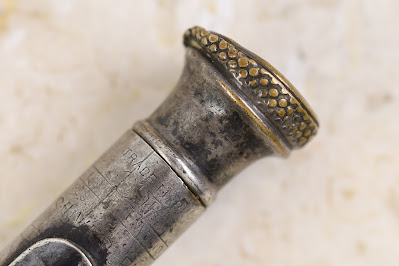

But, I suppose it can share custody with the cap from one of my early Sheaffer Sharp Points.  The parts are interchangeable:


To be honest, I thought from the auction photos it might be an unmarked Sharp Point, since the GF imprint is so faint:
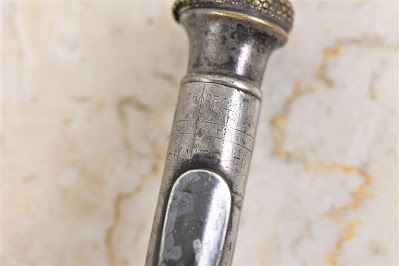

But there it is – and here it is, posed between the Redypoint and Sharp Point pencils from “Wahl, Sheaffer and the Race for Boston,” proving the connection between the two:


I was disappointed that the Redypoint was clipless, since that would have provided one more nexus for comparing the two.  This one does, but you might argue it proves nothing, since it terminates in a flatter, more spoon-shape tang rather than the Sharp Point’s more graceful, pointed terminus:


But . . . that’s just one style of Sheaffer clip.  Another style (the one I call the “bowler clip,” since it looks like a bowler hat at the top) has an identical tang:


Advertisements at the time suggest that the bowler clip, at least on Sharp Point pencils, came after the earlier, more pointed clips.  General Fireproofing pencils, however, might never have had the same clips . . . or at least, not enough of them have surfaced to know.  But at last I’ve got a General Fireproofing pencil that was indisputably made by the same hands that crafted the Redypoint and Sharp Point:


From the top, these are the Redypoint, the General Fireproofing, the Sharp Point and the later Sharp Point – and note also that those double bands at either end of the barrel were dropped by Sheaffer.
And what of that gold filled example of the GF?


It has a very distinctive pattern on it, and when I compared it to all my other Sharp Points – all my other Sheaffers, t00 – it isn’t even close to anything else I’ve found.  Yet it looked so familiar . . . I was sure I’d seen it somewhere . . . 

Wait a tick . . . you don’t suppose . . . 


A checkerboard pattern on most of the barrel – very close.  The GF has squares comprised of four lines, while the match I found has blocks of five lines.  And on the front, a cartouche pinched in the middle like a peanut:


That’s the GF at the top.  Note that like the checkerboard pattern, it isn’t identical, but it clearly evokes the same lines.  Line up fifty, or a hundred, or what the heck .... all my other metal pencils with cartouches like this, and you’ll see: there is no question that the pattern on this GF pencil deliberately, but admittedly feebly, copied the pattern on this other pencil.

And that other pencil is . . . 


A Heath-clip Eversharp, made by the George W. Heath Company for Charles Keeran’s fledgling Eversharp Pencil Company before Keeran contracted with Wahl to make them for him in October, 1915.  This pattern was never made by Wahl.

And then here’s the kicker: the pattern is also found on Sheaffer Sharp Point pencils.  Jerome Lobner had this one recently – unfortunately, I was so preoccupied with writing that I didn’t see it, but he let me use his picture:


Time to step back and string the clues together.  Between 1917 and 1919, one manufacturer was making Sheaffer Sharp Point Pencils, Redypoint pencils for Samuel Ward & Co. and pencils for General Fireproofing.  The Redypoint ties in with David J. LaFrance, the pencil’s inventor.  LaFrance was working for Boston when Keeran helped arrange the sale of Boston to Wahl.    Keeran admittedly neglected his duties at Wahl after the sale to attend to patent disputes “etc. etc.” in New York.  The GF pencil that just turned up and Jerome's Sheaffer Sharp Point copy a pattern Charles Keeran used on his Eversharps before he became involved with Wahl, which his current employer was not using.  Keeran is relieved of his duties after the introduction of Sheaffer’s Sharp Point is made public.

What we need is documentation to establish when General Fireproofing was offering pencils for sale.

Wednesday, April 29, 2020

When the Point Was Sure

This article has been edited and included in The Leadhead's Pencil Blog Volume 6, now on sale at The Legendary Lead Company.  I have just a few hard copies left of the first printing, available here, and an ebook version in pdf format is available for download here.

If you don't want the book but you enjoy this article, please consider supporting the Blog project here.

When this one appeared in an online auction, I was sure there was a mistake in the listing.


“Sure-Point,” the title of the auction read.  Sometimes it seems like the guys that thought up names for these things had a pair of dice with words on them - “Ever” . . . “Perfect” . . . “Point” . . . “Sharp” . . . about every combination of pencil-like words possible was used, but this was one I hadn’t heard of.  Bidding on faith, I brought this home to find that it is, in fact, a “Sure-Point” . . .


And that had me scratching my head a bit.  Notice the lettering, in that squared-off, football scoreboard style?  Looks exactly like something else I’ve seen:


When Sheaffer first introduced the company’s new mechanical pencils in 1917, they were marketed as the “Sharp-Point” pencil (the entire saga of how Sheaffer got into the pencil business is told in “Wahl, Sheaffer and the Race for Boston,” which begins at https://leadheadpencils.blogspot.com/2016/12/wahl-sheaffer-and-race-for-boston-part.html).  Sheaffer’s earliest known Sharp-Points shared the same spikey, Winchester-inspired lettering seen on Eversharp pencils at the time, but Sheaffer soon changed the imprint to this squared-off font.  Note that with the exception of that first word, the entire imprint is identical, with “Pat Apl’d. For” on the second line.

But the two pencils look so . . . different . . .


I can’t get the cap off of the Sure-Point to see what’s going on inside, and I don’t want to force the only example I’ve found – but the caps don’t want to budge on my early Sharp-Point ringtop pencils, either.  So I spent some time combing through hundreds of metal pencils at the museum, looking for any other pencils that had a top like this:


It kind of looks like a Henber . . . kind of looks like those weird Acme pencils that don’t have the Perfect Point tops . . . but then again, it kind of looks like what Sheaffer did later, adopting a bell-shaped cap that would endure until the Balance era.


But there’s one other design element on that Sure-Point that provides a clue.   Did you see that both ends of the machining on the barrel terminate in a double band?


I went through my entire collection looking for anything else that was machined this way, and there were only three which have that feature.  Here are two of them:


Yep, you guessed it - these are the “Redypoint” pencil and that early Sheaffer Sharp-Point from “Wahl, Sheaffer and the Race for Boston” – the two pencils which confirmed, with all the other evidence presented in that article, that David J. LaFrance (of DeWitt-LaFrance and Superite fame) was the inventor of the Sheaffer Sharp-Point:


And those grooves were deliberately added independently of the rest of the design – note that on the Sharp-Point, the chasing actually overlaps those bands at the nose end:


I feel that same headache coming on that started during the months I was researching and writing "Wahl, Sheaffer and the Race for Boston."  In the article, I got as far as proving that whoever made that early Redypoint for the Samuel Ward Manufacturing Company also made the first Sheaffer Sharp Points, but I never found the evidence to prove whether it was the Boston Fountain Pen Company before Wahl purchased it, or David J. LaFrance on his own, or LaFrance working a fledgling pencil program for Sheaffer.

A couple Tylenol didn’t help.  I mentioned that the Redypoint and Sharp-Point were two of the three pencils I found in my collection which shared the Sure-Point’s double ribs.  Here’s the third:


Sure looks like a Sharp-Point, doesn’t it?  And it doesn’t just look like one, it works like one, too:


And there are those same double bands at either end:


The manufacturer’s imprint – or “producer’s imprint,” maybe, tells a different story entirely:


“GF / Youngstown, Ohio.”   These pencils were produced by the General Fireproofing Company, and I mulled about the similarities these pencils have to early Sheaffer Sharp-Point pencils here at the blog back in 2013 (The Leadhead’s Pencil Blog Volume 2, page 153).  Here’s the summary I provided of the company’s history:

“According to The History of Youngstown and The Mahoning Valley by Joseph Green Butler (1921), the company was established in Youngstown in January, 1902 to manufacture building products, particularly fireproof insulation and steel reinforcement for concrete. The financial panic of 1907 (an event on the scale of our recent “great recession”) slowed the building industry and threatened the survival of the fledgling company, so GF’s management diversified into office furniture and products.”

In the December, 1921 edition of Office Appliances, the magazine published a directory of manufacturers, listing General Fireproofing under Stationery Cabinets and Tables . . . but not under pens and pencils.


In fact, I have never found any documentation for GF’s production of pencils, and knowing how these fit chronologically into the Sheaffer story might explain a lot.  The company was active in stationery circles in January 1917, running an advertisement for sales representatives in Typewriter Topics that month:


There’s no mention of GF’s Youngstown manufacturing facilities – only the London and New York offices, the latter of which was at 399 Broadway.  Maybe it is just a coincidence, but GF’s New York office was only a block away from one of the other characters in our story:


Sheaffer’s New York office was at 270 Broadway until the company moved a bit farther up in April, 1921 . . . to 203 Broadway.

And maybe it’s another coincidence that in November, 1916, General Fireproofing invited the public to a demonstration of Modern Bookkeeping at their Boston office, located at 125 Federal Street:


That fact isn’t so random in the context of "Wahl, Sheaffer and the Race for Boston."  The Redypoint, as the article indicates, was made for prominent Boston stationer Samuel Ward Manufacturing Company . . . and Samuel Ward was located practically around the corner from 125 Federal Street, at 8 State Street.

At this point, I’m seeing a tremendous amount of smoke, but no fire yet.  Must be the fireproofing.

Monday, June 17, 2013

Maybe It Stands for "Great Freakin' Pencil?"

Joe Nemecek knows that, while I may not be a rabid Buckeye fan, I am through and through a proud Ohioan. That’s why he brought this one with him to the Raleigh Pen Show and insisted on giving it to me:

To learn more, this full article is included in The Leadhead's Pencil Blog Volume 2, available at Amazon, Barnes & Noble and everywhere else you buy books, or you can order a copy signed by yours truly through the Legendary Lead Company HERE.