Showing posts with label Swanberg. Show all posts

Monday, August 11, 2025

The Four-Trick Pony

 I dropped a teaser the other day when I included a picture of that tray from Jon Martenson (ex Susan Wirth) that included two examples of The Keeran Pencil:


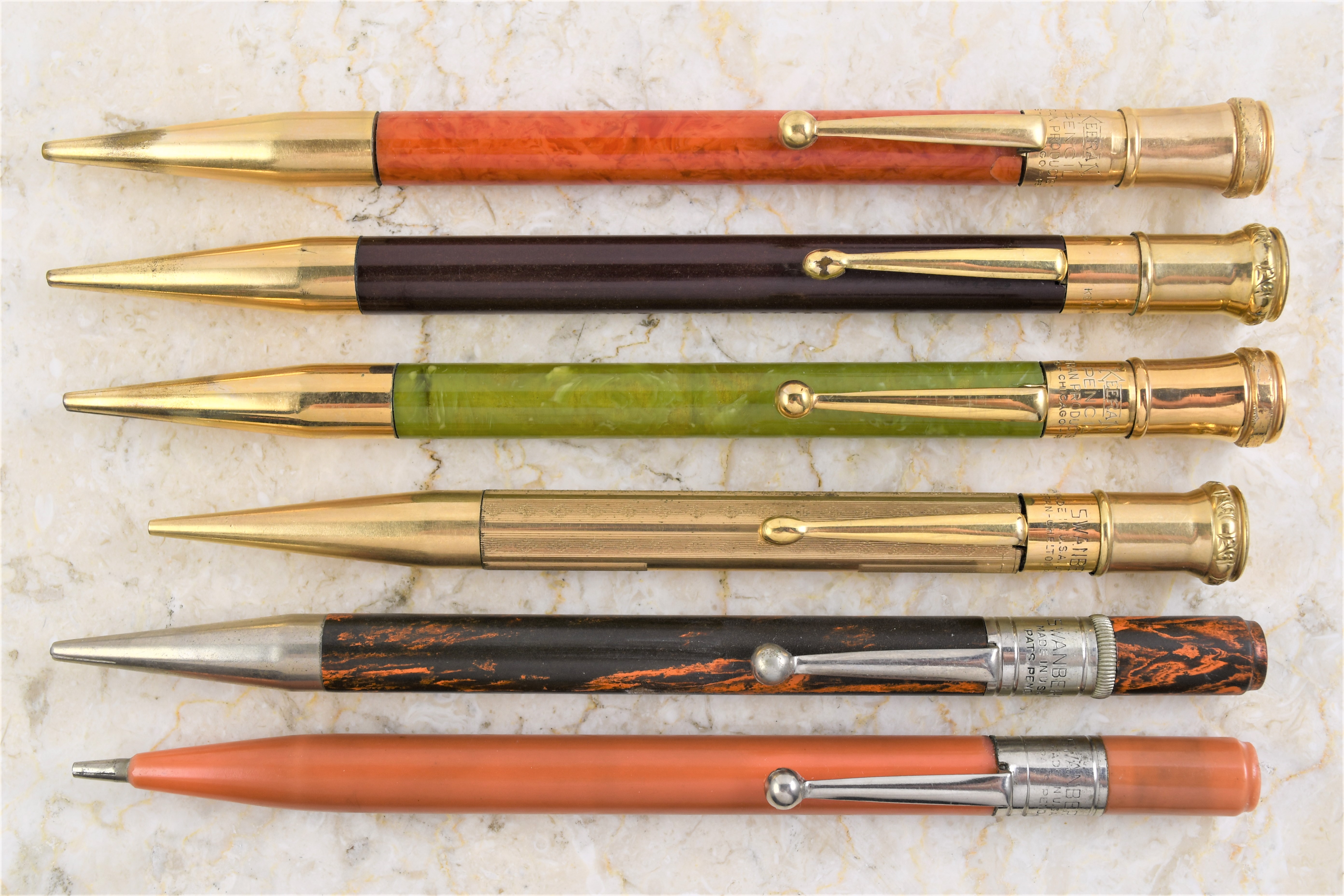
The Keerans are on the right; second from left is a Autopoint 1925 Model with the early “spoon clip” (by 1927, the clips on these terminated in a round ball). That one is no slouch, but it wasn’t the reason I took this picture.

The other pencils in this tray come from the Swanberg Manufacturing Company, in their hard rubber, Keeran Pencil-derived incarnation. A rough outline of Swanberg (named for Julius Swanberg, inventor of the Shur-Rite pencil) was laid out in “Cult Collection” (April 4, 2018: Volume 5, page 214). When I started collecting, I thought Swanberg was a one-trick pony, since the most common examples from the brand are those thin aluminum pencils, branded either with the Swanberg or “Tubit” name.


More on these later. These next pencils, I later learned, were the second trick from this particular pony . . .


. . . or so I thought. Most examples along these lines are made of hard rubber. Some earlier examples, including those featured in A Century of Autopoint on page 78, were made of celluloids carried over from the Keeran Pencil, but apparently Swanberg wasn’t as effective in procuring these materials as Charles Keeran had been –  most of these straight-top models are made from hard rubber. Here’s the image of some of them, which was also included in Volume 7:


Most, that is . . .


That center example is made from an interesting celluloid, not derived from one of LeBoeuf’s exclusive materials but something quite different. 


Note also that the bottom example is branded as a “Swanberg Special,” a crown top example of which was featured here in that last article, as well.

Even the relatively mundane example in black adds an extra backflip to Swanberg’s usual routine: gold filled trim on these utility models is out of the ordinary, and this one sports a shop imprint near the top: “150" might denote a model number, but it also might have referred to a suggested retail price of $1.50:


All three of these are minor variations on Swanberg’s second trick. But there is something interesting about this tray: those random bits and pieces are not so random when examined closely. All are Keeran or Swanberg parts, and if Swanbergs and Keerans are scarce as hen’s teeth, spare parts for them are unicorn feathers.


Over the years I’ve coined the phrase “junk box provenance” to describe those cases in which the circumstances in which something is found suggest there is something more than initially meets the eye going on. In this case we have a tray full of items which have a clear but obscure connection: Charles Keeran, Autopoint, and Swanberg. They were found all in one place, and while they were in the possession of Susan Wirth – a towering figure in the pen community – I believe they were kept together as they came into her possession.

Susan Wirth was many things, but organized was not one of them. She appreciated pencils, but her primary interest was pens; assembling a grouping like this would have required years of dedicated and focused hunting. Besides, Susan had acquired large portions of Autopoint’s factory archive, which would reasonably be expected to have acquired whatever remained of Swanberg and The Keeran Pencil. I have no doubt she would have recognized the value of keeping these things together, but I believe she acquired them in one go, close to the source.

And what a go it must have been! There was another tray I haven’t shown you yet that was in Jon’s possession:


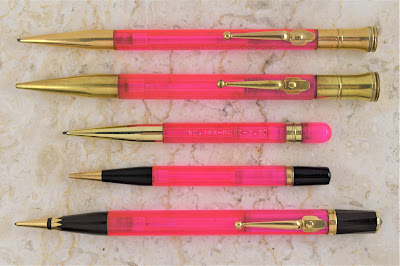
As John Cleese would say, “and now for something completely different.” These aren’t some pitcher who only throws fastballs eeking out an additional couple miles per hour . . . this is Bugs Bunny suddenly “perplexing ‘em with a slowball” and striking out the Gashouse Gorillas, all at once with one pitch.

For starters, consider the aluminum examples which look at first like someone might have just stuck colored caps on them:


Wait a tick . . . those caps are the right shape for Swanberg’s plastic models, but those colors? I’d never seen them before. But wait again . . . there’s more . . . each is loaded with a lead matching the color of the cap, and what leads they are!


These are .075" “Checking” (as they were called by Eversharp) or “thick” (as Autopoint referred to them) leads, something I haven’t seen on any Swanberg before. This would not be a simple modification to existing tooling: with screw drive pencils, the entire mechanism would have to be retooled from scratch.

There are other interesting things about these aluminum checking pencils. Note the clips:


These were sourced from Van Valkenberg, which sold generic unmarked accommodation clips and referred to these as the “Holyoke B” model in Van Valkenberg’s 1931 catalog, preserved in the Pen Collectors of America’s online referenced library. 


Among the three otherwise pedestrian aluminum pencils, there’s another variation worth noting, the top example in this next image:


That top example also features a Holyoke B clip which granted, could have been added at any time. Not so easily explained are the steel tip, which has been substituted in place of the usual brass, and two additional knurled bands:


Now for a closer look at those last three in this tray:


The top example isn’t too far off the beaten path, although I haven’t seen this model in mottled hard rubber before:


The bottom one, however, is another matter entirely . . . a fat pencil in a striking, subtle olive-swirled plastic. It is the only example I know of in this size and in this material, and the bottom two sport specially marked accommodation clips I haven’t seen on any Swanberg before:


These were also sourced from Van Valkenberg - these were the company’s flagship “Security” clips as shown in the 1931 catalog:


Given the unusual twists and turns in this tray, it appears these were Swanberg’s last gasps . . . although the word “prototype” is overused, the absence of surviving examples of any of these “in the wild” suggests either very limited production or experimental pieces, perhaps acquired by Autopoint and later passed on to Susan Wirth before finally being passed on to me . . . with no notes to explain why or when they were made. 

Therefore, the search for additional documentation continues . . .  and so does the hunt for this particular pony’s fifth trick!

Friday, August 8, 2025

A Beautiful Mystery

 At the Chicago show a couple years ago – I think it was the post-pandemic “catch up” Chicago Show in 2021, when there was a second Chicago show in September – Jon Martenson had piles of things from the late Susan Wirth’s collection on hand. Most of it was likely stuff that Susan herself didn’t know she had.

Deals were made by the box, not by the item, and I bought several. One such box included this gem:


The similarities to Charles Keeran’s Eversharp are overwhelming, particularly with that floral crown top. However, it has no identifying markings - not even a stamp to denote that the fittings and overlay are sterling silver, which they appear to be. It bears a strong resemblance to other pencils of the 1920s, all of which have one thing in common: a connection to Keeran:


From the top, there’s our mystery pencil, a Heath-made Ever Sharp (two words at the time) made between 1914 and 1916. Next are two examples of “The Keeran Pencil,” produced by Keeran after his departure from Eversharp in 1917 and likely after Keeran was ousted from Autopoint for the second time in 1924. The clipless example is a shame, but I include it to show that Keeran also used that same or very similar red celluloid.

At bottom are two Swanberg pencils. After Keeran struck out on his own, he briefly associated with Julius Swanberg, inventor of the “Shur-Rite” pencil. Earlier celluloid Swanbergs were rebadged Keeran pencils, but later examples like the example at bottom were more streamlined.

What is going on inside of our mystery pencil, however, doesn’t resemble any of these:


Starting at left, note that the later Swanberg and our mystery pencil share a similar ribbed metal washer: that’s a distinctive design feature one doesn’t see often outside of Swanberg pencils. However, the cap on our example unscrews to reveal spare leads - it is a nose drive pencil. That nose drive sets our pencil apart from the Eversharp to the right of our pencil. While both The Keeran Pencil and Swanbergs are both nose-drive pencils like this, both have caps which are friction fit over a straight top.

The quality of our mystery pencil is top notch; it is a shame more were not made and that this one is not marked. My best guess is that this is something Keeran had made during the time he was set adrift from Autopoint in 1921, although nothing says he might not have been tinkering with new designs before he left Autopoint. The timeline is tight, since he associated with the owners of the startup Realite Pencil Company almost immediately in 1921, but perhaps his agreement was not exclusive.

The use of celluloid in the barrel rules out the possibility that it was made earlier than 1924, and likely rules out the possibility that some other unknown maker turned this one out with design features that copy Keeran’s work . . . I’ll talk about that tomorrow.

So, for now, this one rests comfortably among my examples of The Keeran Pencil.

Saturday, July 17, 2021

Maybe a Threebit

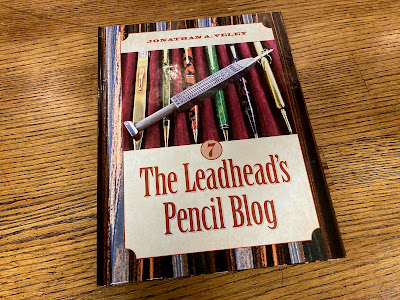
This article has been included in The Leadhead's Pencil Blog Volume 7, now available here.


If you don't want the book but you enjoy the article, please consider supporting the Blog project here.

This one has been a long time coming:


The imprint at the top reads “Tubit,” with a pencil in that same shape:


One of the first articles here at the blog established that the Tubit was a brand name used by the Swanberg Manufacturing Company (Volume 1, page 37).  At the time, all I had found was the trademark image and number, but now that the mark has been included in American Writing Instrument Trademarks 1870-1953, the full certificate is available:


Julius Swanberg was operating at 1516 Foster Avenue, Chicago - right in the same neighborhood as Autopoint - when the trademark application was signed on July 1, 1921.  He had started using the mark just two days earlier, on June 29, 1921, fresh off his gig as inventor of the Shur-Rite pencil for the Fabart Instruments Company.  Note that the pencil illustrated in the Tubit mark has a straight top: these pencils come in ringtops and full length models, with straight tops and bell-shaped crowns:


Even though I knew about the bell top models ten years ago, it’s taken me that long to scrounge up a Tubit that matches the trademark drawings!  The bell tops, I believe, were introduced later.  Swanberg applied for a design patent for that version on June 11, 1923, which was granted May 27, 1924 as Design Patent 64,772:


Based on the trademark filing, I believe the Tubit was the brand name first introduced, while Swanberg-marked pencils came out later and were sold alongside Tubits at the same time.  Swanbergs also come in straight top and bell top models.


The straight top models come both with exposed erasers as well as with plain tops.  Note that the one shown with the exposed eraser has knurling matching Swanberg’s design patent, while the one with a plain top is different:


The imprints are different, too:


With the bell top models, I need to circle back around to something I said earlier, when I was comparing my bell-top Tubit to the Swanberg (Volume 1, page 37):


I noted how similar the pencils were, but took this picture to illustrate the difference between the slanted-line knurling around the crown of the Tubit and the crosshatched knurling on the Swanberg.   With the benefit of hindsight, now that I’ve acquired a few others and several more have passed through my hands, I know the crosshatched top on the Swanberg from that early article was a real oddity; all the others I have seen have tops identical to the Tubit:


My new Tubit with the straight top differs from its Swanberg counterpart in two respects: it is slightly smaller, and it lacks any knurling on the barrel at all:


Swanberg hard rubber pencils appeared to evolve the same as their aluminum pencil lines; I’m suspecting the earlier models had straight tops with accommodation clips stamped “Swanberg,” while the later ones adopted the same crown top with the imprint on the cap and a plain clip, the Van Valkenberg “Holyoke B” (see Volume 6, page 37):


A few weeks ago another Swanberg surfaced in an online auction that I’ve been hunting ever since I saw the one my father had - it was pictured in A Century of Autopoint on page 78, at the bottom in this image:


This new one is in flat green plastic, a color I haven’t seen on a Swanberg before:


Ordinarily, I’d assume that the long metal nose is earlier; most other manufacturers started with that since they were easier to make with a straight tube of rubber or plastic, and the tapered nose required more complicated machining.  


However, the mechanism extends from the nose in exactly like the earlier metal Tubits and Swanbergs.  Similarly, at the top end the long nose Swanbergs have an added ring above the band bearing the Swanberg imprint:


Was this a carryover from the earlier knurled crowns which was dropped later, or an extra bit of spice added later on?   There isn’t much information available concerning the company’s product lines, and as I mentioned in an earlier article, the closest thing we have to a Swanberg catalog is a 1927 advertisement which describes the company’s available models at the time, but doesn’t include any pictures (see Volume 5, page 215).  For now, all I can do is document the different variations as they surface, and hope that some day documents will surface to explain how these lines evolved.


Thursday, June 18, 2020

Elite Company

This article has been edited and included in The Leadhead's Pencil Blog Volume 6, now on sale at The Legendary Lead Company.  I have just a few hard copies left of the first printing, available here, and an ebook version in pdf format is available for download here.

If you don't want the book but you enjoy this article, please consider supporting the Blog project here.

Writing A Century of Autopoint was a great experience.  It brought me into some really great company, including John Keeran (Charles Keeran’s grandson), author Jeffrey Meikle, who wrote American Plastic: A Cultural History, and several closet collectors of Autopoints, some of whom I knew well but never knew they collected the brand.  It was also a wonderful collaboration with the two leading collectors of Autopoints – Jim Stauffer and of course, my dad.

Dad and I live about thirty miles apart, and we both have a large number of Autopoints - to make things easier, I’d shoot images of what I had and send them over to him - he’d pick out things in his collection that weren’t represented, bring those over and we’d reshoot family photos.  Jim and the other contributors lobbed in pictures of other examples from afar.

I’ve continued to pick up variations of things covered in the book - some, like these three, were variations I would have included had I been able to lay my hands on them.  All three were in one auction lot:


The yellow ringtop is a subtle variation masquerading as something you think you’ve seen.  These were denominated Model 17XR (X for short, R for ringtop) and first appeared alongside other variations of the “Model 1925" Autopoint when introduced in 1924.  Here’s Figure 5-13 from page 59 of A Century of Autopoint:


“Ambertype,” Autopoint called the Bakelite barrels, and yellow (“Amber”) is the most commonly encountered color.  However, look closely: Autopoint’s Amber had white swirls in the yellow plastic, while this new addition is a clear yellow.  On that same page, I noted that clear yellow was not catalogued, although Dad has an example of the full length model that was included in Figure 5-12, also on page 59:


As for the other two, they were Autopoint “Streamline De Luxe” models, and in this configuration they were denominated Model 19BXG (B for slim model, X for short or vest pocket model, G to denote gold filled trim, although no “non-G” examples along these lines are known).  A previously unpublished catalog showing these appears on page 117 of A Century of Autopoint, and other examples are shown on page 119 (Figure 8-65):


Boy, I really would have enjoyed having both of these examples on hand when this picture was shot - I’d recreate it, but that will have to wait until Dad can bring his examples over for a family reunion shot sometime . . . when this stupid virus thing is over . . . 

In the meantime, “Rose” Autopoints are well represented in my collection -- all but the ringtop model 17XR pictured in the book were from my collection, so I was able to add the 19BXR to the spread for a group shot:


This was another online find which augmented the book a little bit:


This is marked Realite on the clip; the Realite Pencil Company, formed in 1921, gobbled up the failing Autopoint Pencil Company in 1924, assuming the name Autopoint Products Company in the merger.  During the late 1930s, Autopoint reintroduced the name on a budget line of pencils, including these - they came in two sizes, with this being the larger of the two.  Other examples are shown on page 129 of the book, Figure 8-95:


These usually have the Autopoint name stamped inconspicuously on the back side, near the top, but this one has a bit more:


“Property of Autopoint Company,” and on the other side, a model designation I didn’t have – No. 84PB.  We even know that this green was color 3384.  I wonder what the color number was for that green and brown barbershop pole color!

The Swanberg Manufacturing Company figured into the Autopoint story as one of Charles Keeran’s landing places after he was kicked out of Autopoint – for the second and last time, in 1924.  Keeran’s activities after Autopoint were detailed in Chapter 7 of A Century of Autopoint, “Exit Stage Left,” and Swanbergs are shown on pages 78 and 79.  The “Keeran Pencil” later became Swanberg’s more upscale line of pencils, complementing the more humble aluminum Swanberg and “Tubit” pencils the company was offering.  Here’s the shot of some of Dad’s Keeran and Swanberg pencils, Figure 7-3 on page 78:


Due to space constraints, I had to cut the image of similar pencils with nickel plated trim and crown tops.  I showed a couple of them here in 2018 (see"Cult Collection"):


In that last article, I’d turned up the closest thing we’ve found to a Swanberg catalog, a 1925 advertisement listing four models: the Tubit, the number 7 (also in aluminum), the number 5 (a checking pencil) and the number 11, “the most beautiful and perfect pencil ever offered.”  Of course, there were no pictures to accompany any of these descriptions.

This one, however, was something else:


The “Swanberg Special” – maybe not as special as a Number 11, but certainly special enough to add to the collection.

These last two recent finds are things you’ve seen in the book, but both were rites of passage for me.  Jim Stauffer pointed this one out to me in an online auction, because I had commented to him several times how much I admired the ones in his collection:


It’s a Realite “blimpie,” as Jim likes to call them, and Jim’s boxed example is shown in Figure 3-13 on page 37:


Realite used a blimp in its early advertising to emphasize how lightweight its new bakelite pencils were.  I don’t think it was the company’s first logo on its pencils – Keeran’s contract with the company is written on letterhead using a baseball-jersey style script logo, which was probably the first.  The “blimpie” imprints on Realite ferrules, however, are in my experience more rare:


And last, I finally received formal admission into the Super-Duper-Serious Autopoint Collecting Society (SDSACS, or “sad sacks” as we are better known – no, that doesn’t really exist . . . I just made that up) when I got my pin:


I learned in the course of writing A Century of Autopoint that this advertising mascot was called “Autokid” by the company - see page 184 of the book and the company’s 1939 catalog.  “Creepy little dude,” I like to call him.  As the book notes, Dad and Jim Stauffer both have one of these.  Next time we’re all together, rest assured we’ll all be wearing them as the sad sacks are called to order!