Showing posts with label Ritepoint. Show all posts

Saturday, May 16, 2020

One for the Graduates

This article has been edited and included in The Leadhead's Pencil Blog Volume 6, now on sale at The Legendary Lead Company.  I have just a few hard copies left of the first printing, available here, and an ebook version in pdf format is available for download here.

If you don't want the book but you enjoy this article, please consider supporting the Blog project here.

It is a real shame that commencement exercises across the country had to be canceled during this most unusual time.   That doesn’t mean, though, that I can’t offer something by way of best wishes to all of those transitioning to the next stage of their lives:


This Ritepoint came my way along with a bunch of other pencils, and I really didn’t notice it in the fuzzy auction pictures.  Too bad that part of the top is broken, but as thin and vulnerable as it is, I suppose that isn’t surprising.  This is the Ritepoint “Mortarboard Cap Pencil for Graduates,” sample number 939:


Although the mortarboard tops were available in black only, the rest of the pencil was available in all of Ritepoint’s available plastics – “use the school colors for best results,” the imprint suggests:


Ritepoint had a knack for great stuff like this, and I’ve posted about them here before - unfortunately, the articles aren’t live anymore (they were printed in The Leadhead’s Pencil Blog Volume 1, pages 167 and 339).  For a little throwback, here’s the pencil in the earlier of those two articles:


“I can’t remember the name, but the fez is familiar,” I said, riffing Austin Powers. 


Hug your graduates, and always, always, ALWAYS keep a sense of humor about these things.

Monday, October 15, 2018

Rekindled and Settled Once and for All

This article has been edited and included in The Leadhead's Pencil Blog Volume 5; copies are available print on demand through Amazon here, and I offer an ebook version in pdf format at the Legendary Lead Company here.

If you don't want the book but you enjoy this article, please consider supporting the Blog project here.

Some five years ago, there was significant controversy and debate (by tempest in a teapot standards) concerning whether triangular pencils such as these are Triads:


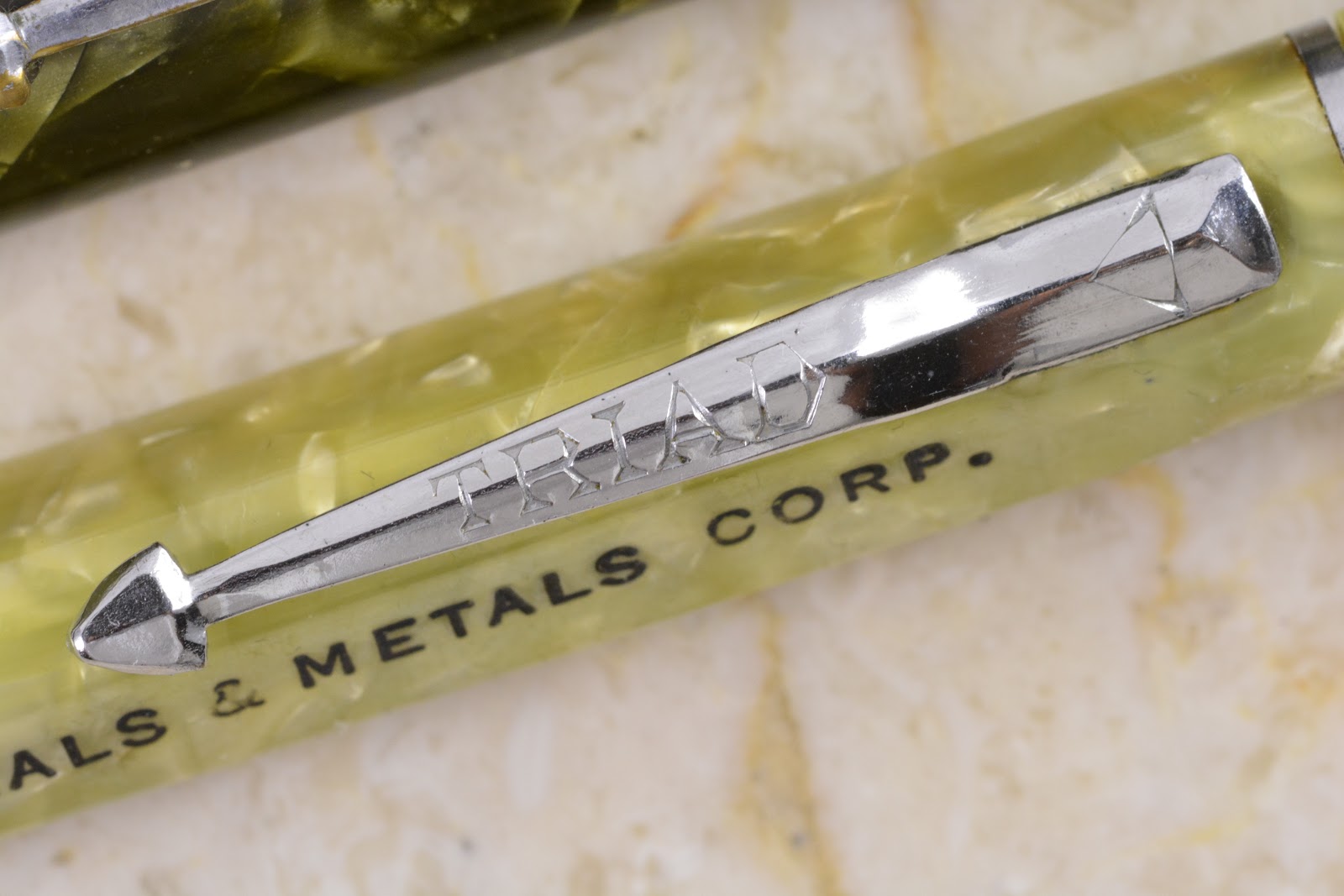
The stakes are high.  Triads – the originals made by the Tri-Pen Manufacturing Company – are grail finds for pencil collectors.  Here’s the ones I’ve been able to find, augmented by the four that were part of a collection I purchased from Alan Hirsch in Raleigh:


These Triads are made in spectacular celluloids, with a nice imprint and a great clip marked “Triad.”


The later ones, however, don’t have a Tri-Pen imprint – usually they have advertising imprints instead, and usually for Providence, Rhode Island area businesses.  While the clips are shaped the same, only rarely are these marked Triad:


In 2013, I suggested that these later pencils couldn’t possibly be legitimate Triads, since Tri-Pen was gone by 1933, replaced by an outfit called the “Improved Pencil Company,” (see Volume 2, page 70) and that later red, white and blue models like these, apparently made during World War II, were probably made by a “Triangle Pen Company” formed in March, 1940 (Volume 2, page 75):


In the years since, there has been an uneasy truce about this issue; Joe Nemecek and I have a ritual where he refers to these later pencils as Triads, I say “you mean those made by the Triangle Pen Company,” and we have generally settled on the term “Lesser Triads.”

I’m not settling anymore.  There was one more pencil in that collection Alan Hirsch sold me:


Clearly World War II vintage – not just from the patriotic colors, but also from the (admittedly crappy) plastic tip and the monoplanes on one of the three sides:


And on the other side, all the evidence one needs that the argument is over . . . “Lesser Triad,” my butt:


There is one last piece of the puzzle in this story.  I have suggested that those later red, white and blue pencils might actually have been made by Ritepoint Company of St. Louis, and one other example I’ve found seems to have settled that argument, too:


Same clip . . . same cap . . . the V for Victory . . . and on the back:


It’s a salesman’s sample for the Newton Manufacturing Company, an advertising specialty company.  In an earlier article, I had suggested that one example of Newton’s pencils might have been made by Quickpoint – unless Ritepoint also made Quickpoint (page 120).  But thanks to this case that turned up a while ago, we know that at least one of Newton’s suppliers – if not the only one – was Ritepoint.


Wednesday, February 28, 2018

A Different Sort of Golf Pencil

This article has been edited and included in The Leadhead's Pencil Blog Volume 5; copies are available print on demand through Amazon here, and I offer an ebook version in pdf format at the Legendary Lead Company here.

If you don't want the book but you enjoy this article, please consider supporting the Blog project here.

I know the title is wishful thinking here in Ohio, where snowblowers have been busier than they have been in the last three years . . . but as the traditionally dismal second month of the year winds down, it helps to pass the time to think about activities that don’t involve coats, thick socks and a stuffy nose.

Like golf.  Even though I don’t play the game.

A couple things come to mind when someone uses the term “golf pencil.”  It refers generally to any short, stubby pencil that might fit conveniently in a pair of shorts while strolling around the green – short enough to be a lady’s pencil, but fat enough to pass for a masculine accessory (at least masculine enough to keep a golfer from being harassed without mercy by the others in the foursome).  It also refers to those short wooden pencils golf courses give away with your scorecards as you set out for the day. 

Here’s a third sort:


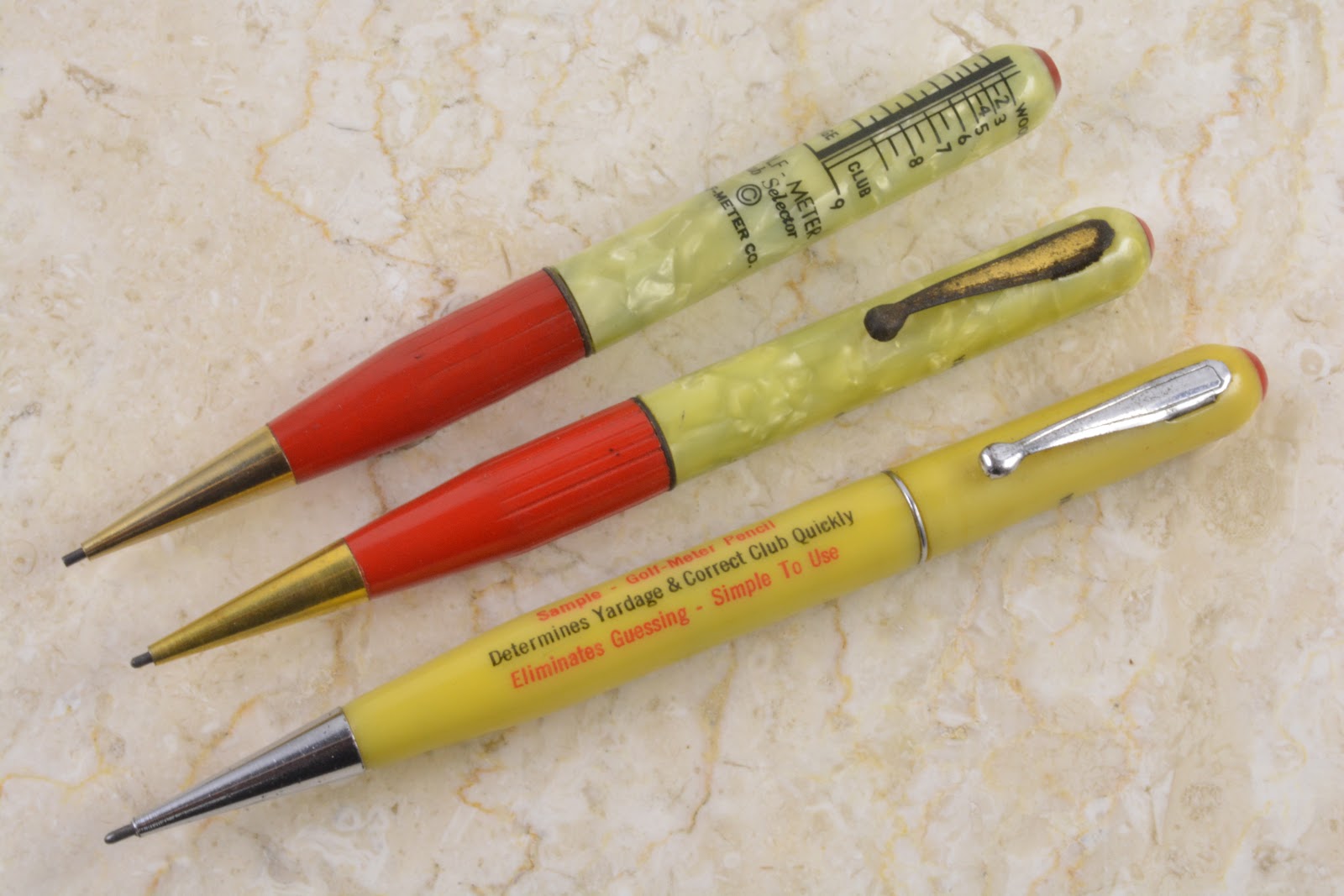
The two shorter examples came my way in a larger lot of pencils - I can’t remember which one.  They are marked “Golf-Meter / Club Selector / Golf Meter Co.”


At the top, opposite the clip, is a chart that suggests a club depending on how far from the hole a duffer should find himself:


The C within a circle suggests a copyright, and the name “Golf Meter Co.” looked like a promising lead, which panned out.  The Golf-Meter Co. of Kalamazoo, Michigan, began copyrighting their brochures and advertising materials in 1944.  Here’s an entry from the 1946 copyright register:


And, a cross-reference: to William T. Rietzke, dba Golf-Meter Company:


The Golf-Meter pencil must have enjoyed some measure of commercial success.  The earliest advertising I found for it was in the July, 1946 edition of Popular Mechanics:


Newspaper advertisements in late 1946 show our pencil exactly.  One which appeard in the November 26, 1946 Battle Creek (Michigan) Enquirer, directed customers to send orders to the P.&D. Supply Company, on East Michigan Avenue at Monument in Battle Creek:


Meanwhile, an advertisement in the December 8, 1946 St. Louis Post-Dispatch referred customers to the Famous-Barr Co. of St. Louis:


The pencils were still being advertised in 1954; here’s an ad from the Chicago Tribune on June 6, 1954:


Rietzke filed one last round of advertising materials for copyright protection, in 1955.  I haven’t found an end date for when the Golf-Meter pencil was discontinued, but production may have been continued by the manufacturer after Rietzke called it quits.  Did you notice the salesman’s sample language on the larger example in that first picture?


Under the golf meter on the back side is an imprint which confirms what the appearance of all three pencils suggests:


They were made by Ritepoint.

Saturday, December 6, 2014

Gerlach-Barklow

Like a lot of these advertising pencil companies, Gerlach-Barklow specialized in making calendars. According to Joliet’s Gerlach-Barklow Calendar Company by Tim and Michelle Smith, the company was founded in 1907 in Joliet, Illinois by Theodore R. Gerlach, Edward J. Barklow and K.H. Gerlach.

By July, 1919, the Gerlach-Barklow plant was "the largest in the world devoted exclusively to the making of art calendars and direct-by-mail advertising media," as reported in Monotype: A Journal of Composing Room Efficiency Published by the Langston Monotype Machine Company:

To learn more, this full article is included in The Leadhead's Pencil Blog Volume 3, available at Amazon, Barnes & Noble and everywhere else you buy books, or you can order a copy signed by yours truly through the Legendary Lead Company HERE.


Sunday, November 23, 2014

Ready Ritepoint? Or Riterpoint?

One of the more unusual pencils found in the salesman’s sample wallet of Vernon pencils I received from Michael Little is the one on the far left in this picture:


Here’s the top up close:


To learn more, this full article is included in The Leadhead's Pencil Blog Volume 3, available at Amazon, Barnes & Noble and everywhere else you buy books, or you can order a copy signed by yours truly through the Legendary Lead Company HERE.


Saturday, November 22, 2014

Beyond a Doubt, Indeed

You can’t please everyone. I still remember the irate email I received shortly after The Catalogue was first published, in which one of the buyers of the book complained bitterly that I didn’t include enough advertising pencils. The guy might not have been alone:  the most-read article here at Leadhead's since I started the blog is "Shaw Barton Gets Its Due."

So when I decided last week that I was going to start posting about advertising-specific pencil companies on weekends, it didn’t surprise me much that a few emails arrived to chime in about their favorite brands. One of them came from Harry Shubin, who sent me pictures of this "Vernon," which he described as "beyond a doubt Ritepoint."


To learn more, this full article is included in The Leadhead's Pencil Blog Volume 3, available at Amazon, Barnes & Noble and everywhere else you buy books, or you can order a copy signed by yours truly through the Legendary Lead Company HERE.


Sunday, November 16, 2014

Shedding Another Mystery

After World War II, the mechanical industry underwent a transition. Before the war, there wasn’t much of a distinction between companies making pencils as writing instruments and those which manufactured pencils intended as promotional giveaways. In general, companies just turned out pencils, some better than others, and if a customer wanted pencils made with an advertising slogan on them, the companies would gladly oblige.

Postwar, there was a much brighter line. Companies tended to specialize more, with some turning out mechanical pencils intended to be sold as quality writing instruments, while others were devoted almost entirely to making advertising pencils. Usually, the mechanisms inside these pencils were cheap nose-drive screw mechanisms, and since they were cheaply made, they haven’t yet attracted broad collector interest. Values of advertising pencils are usually driven by what is advertised on them rather than what who made the pencil itself.

Although there was a proliferation of advertising specialty companies proliferated beginning in the late 1940s, very few of the dozens of new trade names under which advertisers were sold actually made the pencils themselves. An established company, such as Brown & Bigelow or Ritepoint, would supply generic pencils to an advertising specialty company, which would then screen print the customer’s advertising on to customers.

Not much has been written about these connections to date. Since interest in these is starting to take off and I’ve got piles of these pencils evidencing these connections, I’m going to start throwing out there what I’ve been able to figure out about these so far.  For starters, take these:


"Shedd-Brown" pencils turn up every so often, and on most of them, there’s no outward indication that there was no Shedd-Brown Company that actually made pencils . . .

To learn more, this full article is included in The Leadhead's Pencil Blog Volume 3, available at Amazon, Barnes & Noble and everywhere else you buy books, or you can order a copy signed by yours truly through the Legendary Lead Company HERE.


Thursday, September 13, 2012

A Grand Day Out

I’ve talked a bit before about the Springfield Antique Show in western Ohio, just off Interstate 70. Janet and I don’t get over there quite as regularly as we do the Don Scott Show in Columbus, since it’s almost an hour further distant, but we did make the August show this year.

There are times in Ohio, in the dead of winter, when all is grey and wet, that it helps to think about the times in my fair state when the weather is nice and you can actually do things outdoors. Pictures of those nicer days are always a tremendous help during those short, dark days that make up nearly half of our year. And this picture, taken at the Springfield show, is one of those that I’ll use to remind me in February why I still live here . . .

NOTE:  This article is now included in the print version of The Leadhead's Pencil Blog, available anywhere you buy books, or also from The Legendary Lead Company.

To order, here's the link:  Volume 1 at Legendary Lead Company


Saturday, April 7, 2012

I Can't Remember the Name . . .

This example was in with that bunch of pencils I recently bought from my friend Michael McNeil at Northwest Pen Works.  It is a Ritepoint, a St. Louis company that made some really neat and really fun pencils.

NOTE:  This article is now included in the print version of The Leadhead's Pencil Blog, available anywhere you buy books, or also from The Legendary Lead Company.

To order, here's the link:  Volume 1 at Legendary Lead Company