Wednesday, March 25, 2020

A Bird Under the Other Rock

This article has been edited and included in The Leadhead's Pencil Blog Volume 6, now on sale at The Legendary Lead Company.  I have just a few hard copies left of the first printing, available here, and an ebook version in pdf format is available for download here.

If you don't want the book but you enjoy this article, please consider supporting the Blog project here.

George Kovalenko was one of my early mentors when I was developing the early version of the Online Mechanical Pencil Museum and during the time I wrote The Catalogue.  Soon after I started writing this blog, I had speculated a bit about the origins of one brand of pencil – I don’t remember which – but I didn’t have to.  The answer which had been eluding me as a pencil guy was fairly obvious to anyone into fountain pens.

I felt pretty foolish when the answer was pointed out to me, and I admitted I must have been living under a rock to hang around with all these pen guys without knowing this answer.  George came to my defense:  pen folk live under one rock and pencil people live under another one, he said . . . and sometimes we both need to get out and explore what’s under each other’s rocks.

Or something like that.  It was years ago.

As I was getting ready to write this article, I did my usual poking around and learned that something that is fairly common knowledge under my particular rock might not be so well known under rocks on the “other side.”   Now that I’m in a position to return the favor, I’ll lift this little rock I call home and show you around.

It started with this one:


The pictures from the online auction were terrible, and about all I could tell for certain was that this one had a really nice color, with those red veins on black, and that distinctive faceted top.  I couldn’t read the clip, but that top tipped me off (“topped me off?”) that this was probably a Mabie Todd Swallow, which proved correct:


Rough, yes.  Meh - I didn’t pay much, I’ll probably find a better cap at some point and that color is just to die for.

As I put it away, it went towards the end of the Mabie Todd wing at the museum, where I keep my other example of the Swallow alongside another later Mabie Todd subbrand: the “Starling.”


This is a pretty small straw poll here, but if these Swallows and Starlings are consistent with other examples of these Mabie Todd subbrands, I can tell you that Starlings had faceted barrels, inlaid middle sections of different colors and nickel-plated trim.  Swallows had gold filled trim and plain, although colorful, round barrels.


I was surprised to see some confusion on the fountain pen side of the world concerning Mabie Todd’s connection with the Starling brand.  After all, both of my Starlings have been in the Mabie Todd section of the museum for more than a decade, since the caps are clearly marked with the Mabie Todd name (note: the larger one is also so marked – the imprint is just turned away from the camera and I was too lazy to reshoot).

Starling fountain pens, apparently, are not marked with the Mabie Todd name and are more difficult to attribute.  Speculation concerning the origins of the Starling pen began on the Fountain Pen Network in 2013 (that’s the real FPN, not the hijacked Facebook version ruled by rulehappy, self-important dictators – ask me what I really think when I’ve had a few some time); a couple contributors deduced a Mabie Todd connection during that conversation, primarily because of the bird name thing, but no one was able to provide a conclusive diagnosis.

I thought maybe people generally haven’t read David Moak’s excellent book, Mabie in America, which is still the definitive word on all things Mabie Todd.  Hell, I can sympathize with someone writing a great book nobody seems to read!

I checked Mabie in America, and I’ll chalk what I know about the Starling up to good luck in finding a couple examples with clear imprints.  Moak’s index doesn’t refer to the Starling, but on page 153 he states the Starling was introduced by Mabie Todd in the 1930s, including a picture of a pencil similar to the ones I have found.  “The author has seen one other example of a Starling pencil, but no pens,” he says.  Unfortunately, the poor lighting in Moak’s photography leaves me questioning whether the example shown has gold filled or nickel plated trim; otherwise, however, what he pictures is the same as what I have observed.

So while anyone who thoroughly read Moak’s book would know Starling pens were made by Mabie Todd, under pen rocks it’s remained an obscure bit of information; less so under pencil rocks.

You’re welcome, pen guys.  Come visit under my rock any time!

Tuesday, March 24, 2020

Lightning Strikes a Second Time

This article has been edited and included in The Leadhead's Pencil Blog Volume 6, now on sale at The Legendary Lead Company.  I have just a few hard copies left of the first printing, available here, and an ebook version in pdf format is available for download here.

If you don't want the book but you enjoy this article, please consider supporting the Blog project here.

You’ll find it funny, coming from a guy who’s a bit of a stickler for provenance, that I can’t remember precisely where today’s pencil came from.   From what I recall, it was the product of what I call “junk box provenance,” found in a lot of inconsequential things that strongly suggest no one had bothered to tamper with it for decades.  There wasn’t anything that came with it to suggest it’s special, so it's only the thing itself that speaks volumes:


If you have X-ray vision, or if you are otherwise in the know, this is an Eversharp repeating pencil demonstrator.  Until this one came along, I would have called it a Skyline demonstrator, even though the same mechanism is found on Skylines, Fifth Avenues, and Symphonies (it was also seen on the Doric line, but I ruled that out as the barrel is round, rather than faceted).  By the time the Fifth Avenue and Symphony lines were introduced, Eversharp was fighting for its survival, not for market share, so in my mind a demonstrator was more in keeping with Eversharp’s halcyon days during the earlier Skyline era.

Until I found this one, I had only seen one other like it.  Pat Mohan sold it to me years ago:


There is a difference in the mechanisms, but since the inner workings on all Eversharp models were largely interchangeable and I haven’t seen documentation concerning when different lengths of the various components were in production, all I can say is that the two are different but neither is unusual.

Note that Pat’s example was all clear, including the lucite nose cone.  This new one has a regular nose with a demonstrator window neatly cut out to expose what’s going on . . . not as cool, maybe, but too clean to have been fabricated anywhere else but at the company:


I wrote about the example Pat let me pry away from him back in 2013 (the article’s images were wiped out by the Google snafu, but for those who have The Leadhead’s Pencil Blog in print or ebook format, the article is in Volume 2, at page 8).  “Even though the barrel is completely unmarked, I’m confident it’s an Eversharp,” I wrote, “and from the shape of it I also know it’s a Skyline.”

[Editor’s note: duh, Jon.  The mechanism you can see right through the barrel is what makes it an Eversharp.  The author reserved all rights to call himself a doofus at a later time.]

But the next sentence was better: “I lump it in with the Skyline Press Clips because the press clip families had this one piece barrel.  An earlier, buttressed clip example would have a separate clip and derby assembly.”

[Editor’s note: the author further reserved the right to be heralded by himself as a genius.  Atta boy, Jon.]

Press clip era, you’ll note I said.  The example Pat passed on to me had no evidence that it ever had a clip.  This new one sure did, though.  If I had to guess, I’d say that the attempt to staple the clip in place is what caused those stress fractures.  If it had been broken out after it was inserted, you’d likely see a gaping hole, not neatly symmetrical cracks like this:


I thought, in the interests of looking a little less like damaged goods, that it might be nice to salvage a clip from a common press-clip Skyline and insert it into those staple slots . . . but there was a problem:


That was no Skyline pressed clip that was fitted onto this pencil.  Those clips were a lot narrower than the slots in this barrel.

Although the Fifth Avenue shared the same mechanism, I didn’t think that this demonstrator was ever fitted with a Fifth Avenue clip.  All Fifth Avenue models had metal upper barrels, and since there isn’t anything really interesting going on towards the top of these, I’d think even a Fifth Avenue demonstrator would have a metal, even if opaque, top end.

But what of the Symphony line, introduced in 1948?  Yes, most of those also had metal tops like you’d see on a Fifth Avenue, but the Symphony line also had some variations with all-plastic barrels . . . and side by side, I think that’s our likely suspect:


Perfectly spaced, and note that the barrel shape and location of the stapling is identical.   If this is correct, that means as Eversharp was taking its last gasps in the wake of the infamous ballpoint fiasco, the company still continued to market the novelty of its repeating pencils with demonstrators . . . even though that mechanism had been in production for more than 10 years, on three previous lines of Eversharp pencils!

Monday, March 23, 2020

A Well-Done Neldun

This article has been edited and included in The Leadhead's Pencil Blog Volume 6, now on sale at The Legendary Lead Company.  I have just a few hard copies left of the first printing, available here, and an ebook version in pdf format is available for download here.

If you don't want the book but you enjoy this article, please consider supporting the Blog project here.

I’ve always got a soft spot for a good “trick” pencil – pencils that do something more than write, and the Neldun falls into that category:


The Neldun is a lighter pencil.  It appears on page 105 of The Catalogue, although I didn’t know much of anything about it at the time:


The bottom example in that first picture shows a faceted, flattop version of essentially the same pencil, marked “Allbright” instead of Neldun.  I wrote about that one back in September, 2016 (see https://leadheadpencils.blogspot.com/2016/09/subbrands-of-subbrands.html).


I had thought, until the Allbright turned up, that these must have been foreign made, since the “Reg’d” imprint you see on the clips suggests either English or Japanese production.  But then again, you’ll notice the Allbright distinctly says “Made in U.S.A.” instead of “Pat. Pend’g.” at the top of the clip.

The Allbright remains the only one I’ve seen, but Nelduns turn up from time to time and I’m a sucker for an example in a different color.  That’s why when this one turned up online, it wasn’t a question of whether I would buy it  -- it was how fast I could punch the buttons to make it happen:


That lapis color on the lower barrel, though, was only part of what had my motor running for this one:


The “Century of Progress” sticker commemorates the Chicago Worlds’ Fair of 1933-1934 – another passion of mine.  Other Chicago makers, including Eversharp and Autopoint also made commemorative souvenirs for the fair.  The Eversharps you’ve seen here; as for Autopoint, I featured the one I pried away from Irvine Nichols on page 113 in A Century of Autopoint:


If the Allbright suggests these Nelduns were American-made, finding one produced for the Century of Progress all but screams these are homegrown – and it sharply narrowed my research focus to firms with a Chicago connection operating in the early 1930s.  I took another shot at trying to learn the source of these Allbright and Neldun pencils . . . and I think I’ve found a really good lead.  There was a company located in Chicago, founded in 1901, which manufactured machinery and equipment for the meat packing industry:

The Allbright-Nell Company.

I ran across the company in several court cases, mostly involving patent disputes with other meat packing companies.  The name . . . the location . . . the manufacturing capability.  It’s like Colonel Mustard is waving around a lighter pencil in the library instead of a candlestick.  That name just can’t be a coincidence. 

Is it a stretch to think that a company specializing in making meat processing equipment would, during the depths of the Depression, take a stab at entering the novelty pencil market?  I don’t think so.  Allbright-Nell published a flashy trade catalog in 1932, just one year before the Century of Progress exposition opened, and while I haven’t been able to get my hands on a copy, one online seller had an image of the introductory pages, in which I found this:


The introduction describes the company’s facilities, including “a Sample Room where we have on display a variety of small articles, supplies, etc., which we handle and manufacture.”

All my other leads have been dead ends.  Whatever patent was pending as referenced on Neldun clips, the patent didn’t surface when I wrote American Writing Instrument Patents 1911-1945 - all the patent applications pending when Nelduns were sold at the Century of Progress were issued to Aronson’s Art Metal Works for their Ronson Penciliters.  If “Reg’d.” implies a trademark filing for either the Allbright or Neldun names, it didn’t turn up while I was writing American Writing Instrument Trademarks 1870-1953.

Maybe Allbright-Nell is just a guess, but I think it’s a good one.

Sunday, March 22, 2020

A Milepost at Two Important Crossroads

This article has been edited and included in The Leadhead's Pencil Blog Volume 6, now on sale at The Legendary Lead Company.  I have just a few hard copies left of the first printing, available here, and an ebook version in pdf format is available for download here.

If you don't want the book but you enjoy this article, please consider supporting the Blog project here.

When Janet got the order to work from home for the foreseeable future, we scrambled to set up all her equipment in our home office – a room which, for the last ten years, has been where my online purchases have been opened, sort of a pencil halfway house for new arrivals that haven’t made it down to the museum just yet:


Distractions such as these were not conducive to working from home, so it was time this weekend to put these things away.  But as I started doing so, it occurred to me . . . we’ve all been through a lot these last two weeks, and maybe I can do something to give you a taste of normal.  Something you can read that isn’t about some stupid virus or some stupid politician talking about some stupid virus.  I always knew something extraordinary would probably lure me back into writing here, but I thought it would be an extraordinary find – not an extraordinary time. 

So relax, take a deep breath, and forget about all that for a while.  I’ll share some of the neat stuff I’ve been finding to give you something positive things to read.  I’ll start with this one:


When this one popped up, I wasn’t too excited at first.  I still try to limit myself to American pencils, and I always fear once I start branching out into foreign products, such as those from the German house of A.W. Faber, I fear having too many open cans of worms.  This worm, however, proved too enticing to resist, because it has something distinctly American about it:


That’s an American patent date of August 13, 1861, which refers to patent number 33,034 issued to Johann Lothar Faber “of the firm of A.W. Faber”:


This is a really interesting time in Faber’s history.  In 1849, Lothar Faber and his brother Johann Faber dispatched their brother, Eberhard Faber, as their emissary to establish operations in America.  Eberhard set up shop in New York selling a variety of “fancy goods,” but he does not appear in directories as “sole agent” in America for A.W. Faber until 1854.

(Note: I’ve posted a more detailed history concerning the relationship between A.W. Faber and Eberhard Faber here, starting with “So Many Fabers” at https://leadheadpencils.blogspot.com/2016/01/so-many-fabers.html).

Young Eberhard soon began to establish himself as a successful American manufacturer in his own right, a reputation which was enhanced after April 1861, when the American Civil War made importing Faber pencils from abroad more difficult.  His offices and “manufacturer’s depot” were located at 133 William Street, but he later moved his offices to 718 Broadway in 1877.  Eberhard died in 1879.

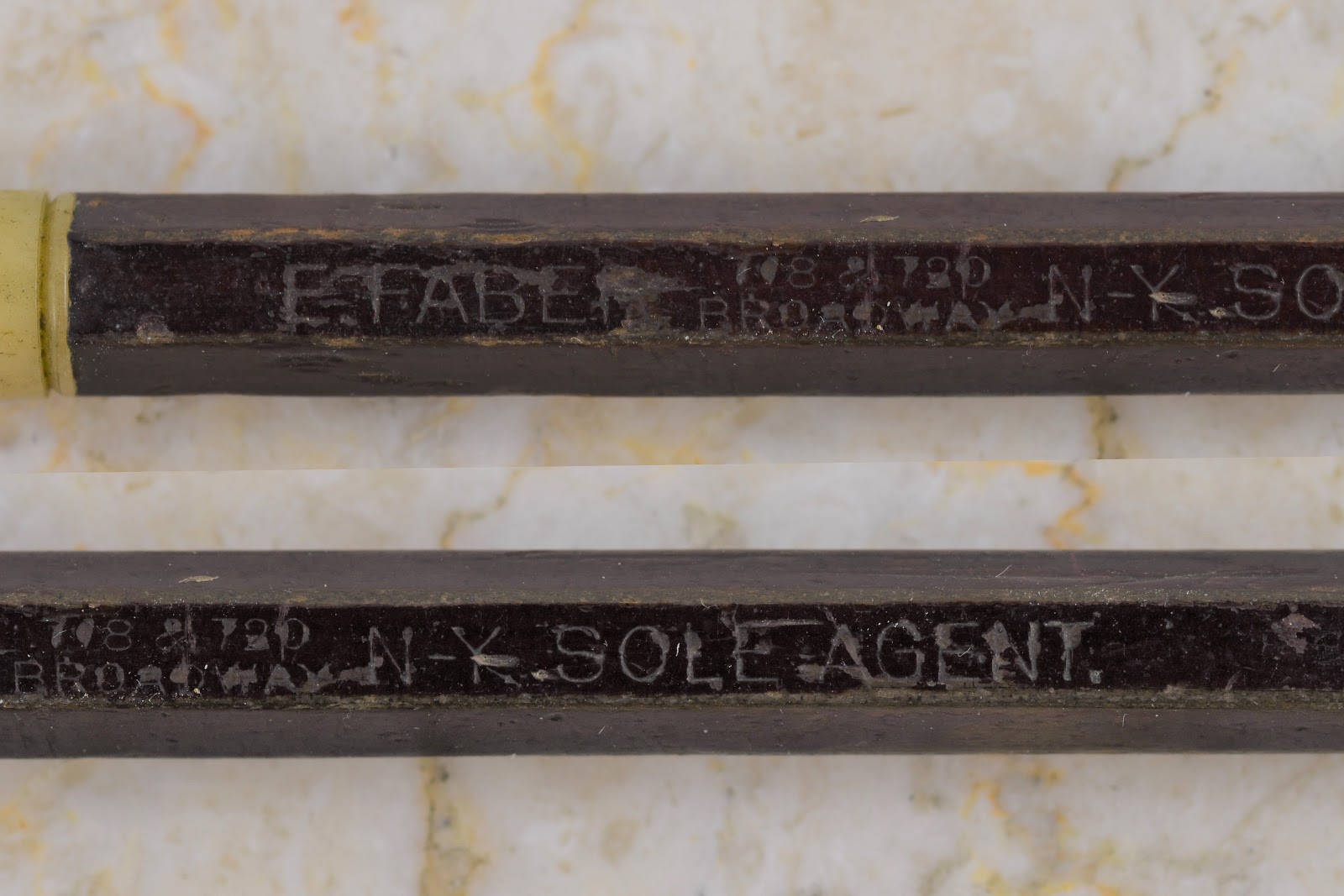
Which brings me to another fascinating detail found on the back side of this pencil – much more faintly imprinted than the gold foil stamp on the other side:


“E. Faber 718 & 720 Broadway NY Sole Agent.”  Our pencil dates to a very narrow window in time, between 1877 when Eberhard moved to that address and his death in 1879.

And it is that window which brings us to our second interesting crossroads, because this Faber shares some intriguing similarities with another pencil I’ve shown here before.  Note that our Faber is “left handed” – while most pencils have lettering running from the tip end towards the top, this one has lettering running the other direction (so the letters are upright when the pencil is held in your left hand).  Also note the hexagonal wood barrel and that bone finial at the top:


That’s our Faber alongside three examples of the “Sun Pocket Pencil,” which are also left-handed, wood hexagonal pencils with bone finials, and a nearly identical nose.  Even the lettering is identical:


Some Sun Pocket Pencils are marked, as the bottom example in this picture, with “Ink & Copying Pat. June 26, 1877.”  That patent reference is to number 192,555 granted to Charles Walpuski and assigned to Joseph Reckendorfer – it’s for the composition of the lead, not for the pencil itself.  “Copying” or indelible lead was impregnated with ink, so that something written with it could be copied by pressing a damp piece of paper against it and then transferring the image to another piece of paper.

And who made the Sun Pocket Pencil?  Reckendorfer’s name on the assignment provides a solid clue if you are up on your pencil history, but a conclusive identification comes from a rather nice book on trademarks titled American Writing Instrument Trademarks 1870-1953:


The Eagle Pencil Company registered the Sun trademark twice.  The earlier one, number 9,208, was filed on February 20, 1882 and was registered on March 21, 1882.  The second one, filed due to changes in trademark registration laws, was registered in 1905.

I’ve always had my Sun Pocket Pencils in the Eagle section at the museum, based on the Walpuski patent date for the lead and the trademarks that were assigned to Eagle.  Conclusive, right?

Maybe.  I’m having second thoughts.

The pencils share a mechanism patented by Johann Faber.  Yes, some Sun Pocket Pencils have the Walpuski patent date, but that’s just for the lead inside.  As for those convincing trademarks registered by Eagle, the earliest was filed in 1882 . . . five years after the Walpuski patent was issued and long after the 1861 patent on my Faber pencil had expired. 

The timing doesn’t make sense: Eagle was extremely aggressive in protecting its intellectual property, filing dozens of patents and trademarks over the years.  If Eagle was marketing a Sun Pocket Pencil in 1877, I’m confident Eagle would not have delayed five years to protect the name.   But if Eagle later purchased the rights to use the name, say in around 1882 . . .

I used to know exactly who made the Sun Pocket Pencil.  I’m still kind of sure, but the only thing I am 100% confident in saying is that whoever made the Sun also made this A.W. Faber pencil during the last two years of Eberhard Faber’s life.

Sunday, March 1, 2020

Maybe I Won't Buy Duplicates Now...

 Cadet Utility (bead band)

Sovereign Utility/Admiral Utility/Craftsman Utility (bead band, gold filled trim)

Statesman Utility (wide band)

Valiant (1946)
Valiant (1947)
Statesman (1947)
Statesman (1946)

Cadet (chrome trim)
Diana (gold filled trim, shown) and Minerva (chrome trim)
Sentinel

Tuckaway (first year)

Triumph Tuckaway
Autograph (14k trim, no ribs on band)
Valiant Tuckaway (1946)
Valiant Tuckaway (1947)
Lady Sheaffer (1947)


Tuckaway II (1946) or Tuckaway (1947)
Lady (Milady) Tuckaway
Sentinel Tuckaway and Crest Tuckaway


INJECTION MOLDING BEGINS 1948


Saratoga (if the tag is right)