Monday, February 19, 2018

Two Finds, One Box, A Century Apart

This article has been edited and included in The Leadhead's Pencil Blog Volume 5; copies are available print on demand through Amazon here, and I offer an ebook version in pdf format at the Legendary Lead Company here.

If you don't want the book but you enjoy this article, please consider supporting the Blog project here.

Here’s an interesting one I’ve never heard of before, as it came to me from an online auction:


“American Lens Pencil.”  The box lid and what you see on the card in the floor of the box are all that came with this one . . . what you see is all I know:


The pencil itself is completely unmarked, and the accommodation clip is a stock “Holyoke B” clip that appears in the 1931 Van Valkenberg catalog, a copy of which is posted at the Pen Collectors of America’s online library:


If I had one guess as to who made this one, I’d go with the American Lead Pencil Company of New York.  American specialized in lower end, gimmicky stuff, and another New York Company, the Pen-N-Pencil Co., introduced the "The New Marvel Two-In-One Combination Magnifier and Mechanical Pencil," also in the 1930s (I posted about the New Marvel here early on at the blog – unfortunately, it was one that google wiped out the pictures, but the article for what it’s worth is at https://leadheadpencils.blogspot.com/2012/01/just-one-point-on-these-but-its-good.html).

There is that wooden tube of leads in the box – however, that’s a bonus, not anything that originally had to do with this pencil.


The label says “2 / Everpoint Leads / H. Cohen & Co. Phila.”


These leads are earlier – almost a century earlier.  “Everpoint” is a term of art that goes back to the dawn of the mechanical pencil industry, a name coined by S. Mordan & Co. in the 1820s to refer to a pencil you didn’t have to whittle down to use  (as in, it ever has a point), but which quickly became a generic term for any mechanical pencil.

Henry Cohen & Co. was a stationer, listed in Sheldon & Company’s 1845 edition of the Business or Advertising Directory, at 3 South Fourth Street, Philadelphia:
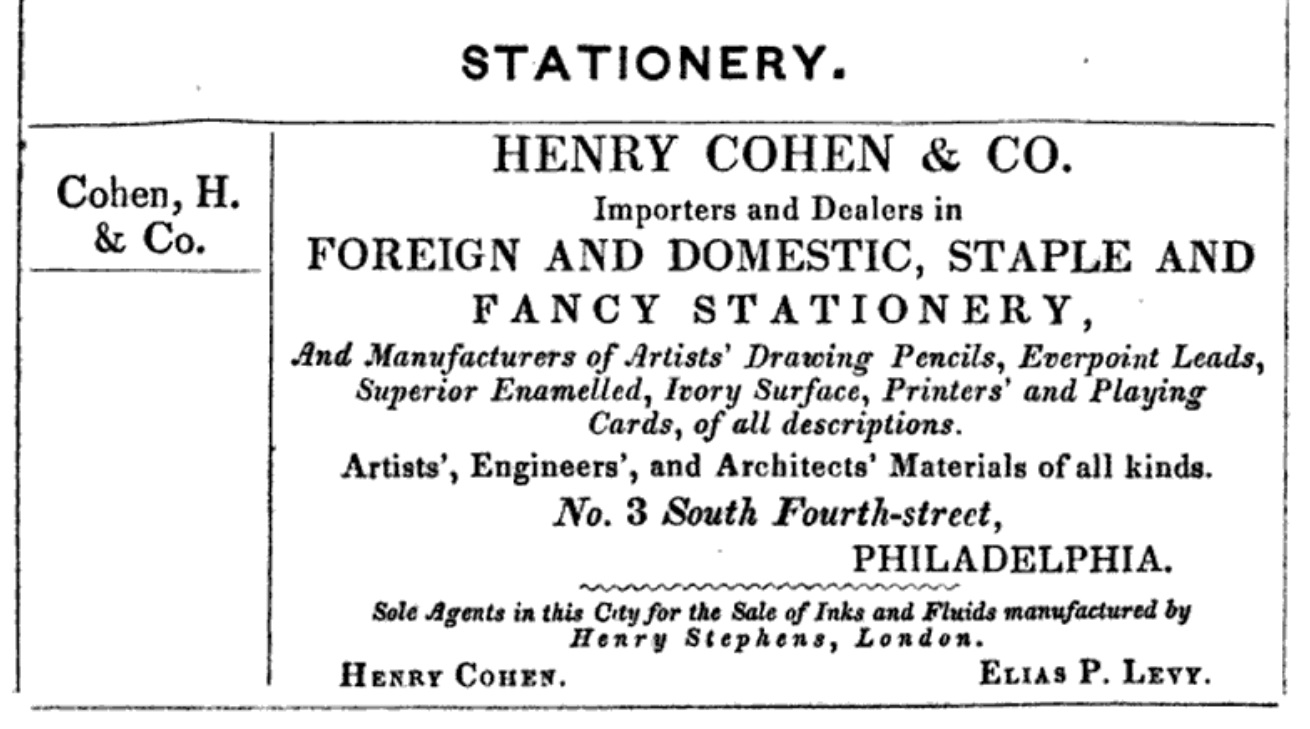

In an advertisement in The American Stationer on May 31, 1883, Henry’s successor, Charles Cohen, claimed that Henry Cohen & Company was founded in 1838:


Sunday, February 18, 2018

The "World's Largest Manufacturer of Shoes"

This article has been edited and included in The Leadhead's Pencil Blog Volume 5; copies are available print on demand through Amazon here, and I offer an ebook version in pdf format at the Legendary Lead Company here.

If you don't want the book but you enjoy this article, please consider supporting the Blog project here.

An Tran had this one to offer at the DC Show:


I had to buy it, not just because the color is really nice, but because it has a name on the clip I hadn’t seen before:


“Sundial Shoes,” a company which in the 1950s marketed itself as “The World’s Largest Manufacturer of Shoes.”  Although it’s usual to see custom made clips rather than an imprint on a barrel on an advertising piece, I was fairly confident this was not made by a shoe company and I wondered who might have made it for them.

I think I have my answer.  Here it is shown next to a Trupoint, the Sears brand manufactured by Eclipse (see https://leadheadpencils.blogspot.com/2014/12/stepping-it-up.html):


Note the same top and the same tip, although the clip is quite different and the Trupoint is a bit shorter.  So let’s put it next to another Trupoint:


There you go.  Same length, same clip, same everything but the cap (but by the way, you can interchange them and they fit each other).  No doubt in my mind this is an Eclipse-made pencil.

Saturday, February 17, 2018

A Great Color Name Identified At Last

This article has been edited and included in The Leadhead's Pencil Blog Volume 5; copies are available print on demand through Amazon here, and I offer an ebook version in pdf format at the Legendary Lead Company here.

If you don't want the book but you enjoy this article, please consider supporting the Blog project here.

From what I recall, this Dur-O-Lite popped up in an online auction:


I bought it because it fits in nicely with a few other Dur-O-Lites in my collection in that same color:


The top example in this picture appears on page 45 of The Catalogue, and I’ve had it for years.  The bottom two are Dur-O-Matic repeating pencils; the one in gold-filled trim came from Mike Kirk’s “World Famous Hotel Bathroom Studio” a few years back – it’s appeared here a couple of times (see https://leadheadpencils.blogspot.com/2013/03/a-pair-of-dur-o-lite-ejectors.html and https://leadheadpencils.blogspot.com/2015/02/an-interesting-transition.html). 

The nickel-plated trim example is a little goofed up and I haven’t been able to fix it yet, which is why I needed an opportunity like this to show it off, warts and all.

What I like best about this new example is that it is a salesman’s sample, which finally puts a name on that knockout color:


Tortoise.

Friday, February 16, 2018

They Didn't Make Just One

This article has been edited and included in The Leadhead's Pencil Blog Volume 5; copies are available print on demand through Amazon here, and I offer an ebook version in pdf format at the Legendary Lead Company here.

If you don't want the book but you enjoy this article, please consider supporting the Blog project here.

Just a few days ago, I wrote about the strangest Sheaffer I’d ever seen – a Skyboy with a barrel that screwed directly onto a specially modified mechanism, eliminating the need for a separate metal tip (see 
https://leadheadpencils.blogspot.com/2018/01/a-week-or-so-ago-my-friend-jerome.html posted on January 27).

Since that pencil lacks Sheaffer’s shop markings or any other provenance to suggest it was a prototype pencil, I thought – and still think – it actually went into production, albeit for an extremely short period of time.  And if it was a production piece, that means they didn’t make just one:


Shortly after that last article ran, my friend Matt McColm emailed me with a link to another of Jerome Lobner’s auctions, with a Sheaffer Crest pencil that had that same weird end treatment.  The auction had ended with nobody bidding on it –- this was shortly before I gave up my campaign for Congress and had enough time to cruise through online auctions again.

“Maybe he still has it,” Matt suggested, so I emailed Jerome, who did have it and was only too happy to sell it to me, shipping it along with the next batch of things I purchased through his online auctions.  I asked if he knew anything more about them or had any more, but Jerome says he’s only seen these two examples and has no other information about them.  That leaves me to my own devices to see what there is to learn about them.

And when it comes to the Sheaffer Crest, there’s a lot to learn.

For starters, these two pencils are essentially identical on the lower half and mechanism.  The caps interchange, as they do between most Sheaffer models of the period.  That raises the question whether the cap might have been switched at some point over the last 75 years: on the plus side, I know Jerome wouldn’t have done that and his source, likely Edd Dawson (see https://leadheadpencils.blogspot.com/2017/08/craig-sheaffers-gift-to-edd-dawson.html) acquired a lot of weird stuff from Sheaffer as a prominent stationer.  On the down side, though, nobody can say for sure.

Back on the plus side, Sheaffer Crest pencils are inherently goofy animals.  Here’s the new one alongside my three other legitimate Sheaffer Crests:


Unlike Sheaffer pens of the period, which had manufacturer’s imprints on the barrels, Sheaffer pencils had imprints on the caps.  Since Crest caps are not marked “Sheaffer” anywhere, that meant on the Crest pencils, Sheaffer relocated the imprint to the lower barrel:


So when I tell you these are my three other “legitimate” Sheaffer Crests, I’ve left out the green one because on closer examination, there’s no Sheaffer imprint on the lower barrel.  I’ve resigned myself to the fact that it is an ordinary Sheaffer Balance pencil onto which someone has stuck a Crest cap.  Probably.  Maybe.  Ok, there’s nothing I can show you about that’s different other than it’s green and the cap is a little banged up.

On this new example, there’s no Sheaffer imprint on the lower barrel, either:


Because of the source, and the fact that the lower barrel on this thing is so utterly weird for a Sheaffer, I’m inclined to give this one a pass for now as a legitimate production piece, until such time as further documentation either confirms or refutes whether these tipless Sheaffer pencils were made for both Skyboy and Crest lines.  Since the caps on both are otherwise stock, if it ever turns out that one or both of these has a wrong cap, switching it out for something correct according to Hoyle will be easy enough.

There’s another reason I’m giving this one a temporary pass: while I’ll call my other three Crests legitimate, a look under the hood reveals that there’s no such thing as “normal” in this series, since no two of the ones I’ve found are alike:


The top example I’ve never been able to explain.  It’s the only one I’ve seen with a plastic mechanism with grooves for spare lead storage on the outside of the mechanism, rather than inside:


And while the other two share gold-plated mechanisms consistent with the Crest’s status as a higher-end model for Sheaffer, note that one of these has a bushing on the mechanism and a thin cap, while the other has the usual mechanism (except for color) and a thicker cap wall::


So yes, a tipless Sheaffer Crest pencil with no Sheaffer markings is unusual . . . but not outside the realm of possibility.

Thursday, February 15, 2018

In the Company of Fine Snails

This article has been edited and included in The Leadhead's Pencil Blog Volume 5; copies are available print on demand through Amazon here, and I offer an ebook version in pdf format at the Legendary Lead Company here.

If you don't want the book but you enjoy this article, please consider supporting the Blog project here.

As Joe Nemecek and I went through the large collection of Victorian pencils Ed Fingerman brought to show us at the DC show, it quickly became apparent that I was going to have to prioritize.  Even limiting myself to American pieces only didn’t pare down what he was offering sufficiently for me to be able to afford them all; after I had assembled my little pile, I found myself playing a mini-game of “pencil survivor,” making difficult choices about which ones to vote off the island.

When it came to these three, they are all along the same lines . . . but in the end, I simply couldn’t bear to put any of them back:


I’ve heard these referred to as “desk pencils,” not because they fit into a socket or stand but because they are full length and they don’t telescope – best for sitting on a desk rather than protruding from one’s pocket.  All three are sterling, and all three have an exquisitely wrought “snail” pattern.

And if you know what subtle dfferences to look for, you know who made two out of three of them without even having to reach for a loupe to find the hallmarks.

The top example has that great middle section you’ve seen here before, most recently on a gold-filled “Hutch Clutch” pencil (see “The Mabie Todd-Hutcheon Connection” at https://leadheadpencils.blogspot.com/2017/07/the-mabie-todd-hutcheon-connection.html), which I compared to a very similar desk pencil marked Mabie Todd.  In fact, this new addition is a nice complement to the desk pencil from that last article:


And both examples have a hallmark used by Mabie Todd, an M within a square (see “M Is for Mabie” at https://leadheadpencils.blogspot.com/2016/12/m-is-for-mabie.html).


Now let’s have a look at the bottom example from that first picture.  Notice that ring of beads at the top end and near the nose?


After you’ve studied these things for awhile, you’d immediately suspect Hicks . . . and lo and behold . . .


There’s the Hicks acorn hallmark, at the right end.  I’ve got a theory – an unsubstantiated theory – that Hicks marked pencils made for its own account with the name “Hicks” or “W.S. Hicks,” but when the firm made pencils for sale by others, they were marked with an X and the acorn.  Maybe the theory isn’t entirely unsubstantiated . . . have a look at a very similar pencil marked with the name of the jewelry firm Black, Starr & Frost and the Hicks acorn in “Welcome to the Family” (https://leadheadpencils.blogspot.com/2015/02/welcome-to-family.html).

And then there’s that middle example from that first shot.  Well, maybe I exaggerated a bit at the beginning of this article – two out of three of these pencils I could see what they were from a blue mile away, but on this third one the center cartouche is the only thing that’s distinctive (other than the incredibly artistry):


So yes . . . I had to break down and pull out my loupe to see what was going on.  The answer was indeed there on the nosecone:


A shield with an F and a J . . . for Fairchild Johnson.  The errant F next to the shield appears to be a double stamp (note that you can also see traces of the diagonal line within the shield).

Wednesday, February 14, 2018

Eversharpish

This article has been edited and included in The Leadhead's Pencil Blog Volume 5; copies are available print on demand through Amazon here, and I offer an ebook version in pdf format at the Legendary Lead Company here.

If you don't want the book but you enjoy this article, please consider supporting the Blog project here.

I don’t remember who brought this one to me in DC:


This isn’t something I’d normally go for - clearly not American, and unmarked.  But look at what’s inside:


It’s so close to a first-generation Eversharp inside that were it made in the United States, it would most certainly have been the subject of litigation:


Yeah, I’m showing off a little bit . . . that’s a solid gold hand engraved Eversharp. 

What’s really cool about this piece is the way its design overcomes the first-generation Eversharp’s design quirk.  With the Eversharp, the lead is pushed forward as that plunger rod is screwed down into the barrel, which means when you’ve reached the end of your lead and need to reload, you have to manually unscrew it all the way back out.   In America, when the Eversharp was redesigned in 1924, the new mechanism only had teeth on one side, with a projection at the front end of the mechanism which kicked the rod in when the mechanism hit bottom and allowed you to simply pull it out.

This English example solves that inconvenience in an elegant way: the drive tube itself is swaged in a bit towards the front end, and the push rod has a split plunger:


So when the plunger reaches that point, it is pulled inward to disengage the teeth so the mechanism can be pulled out.  In fact, this mechanism can be pulled out at any point, rather than just at the bottom:


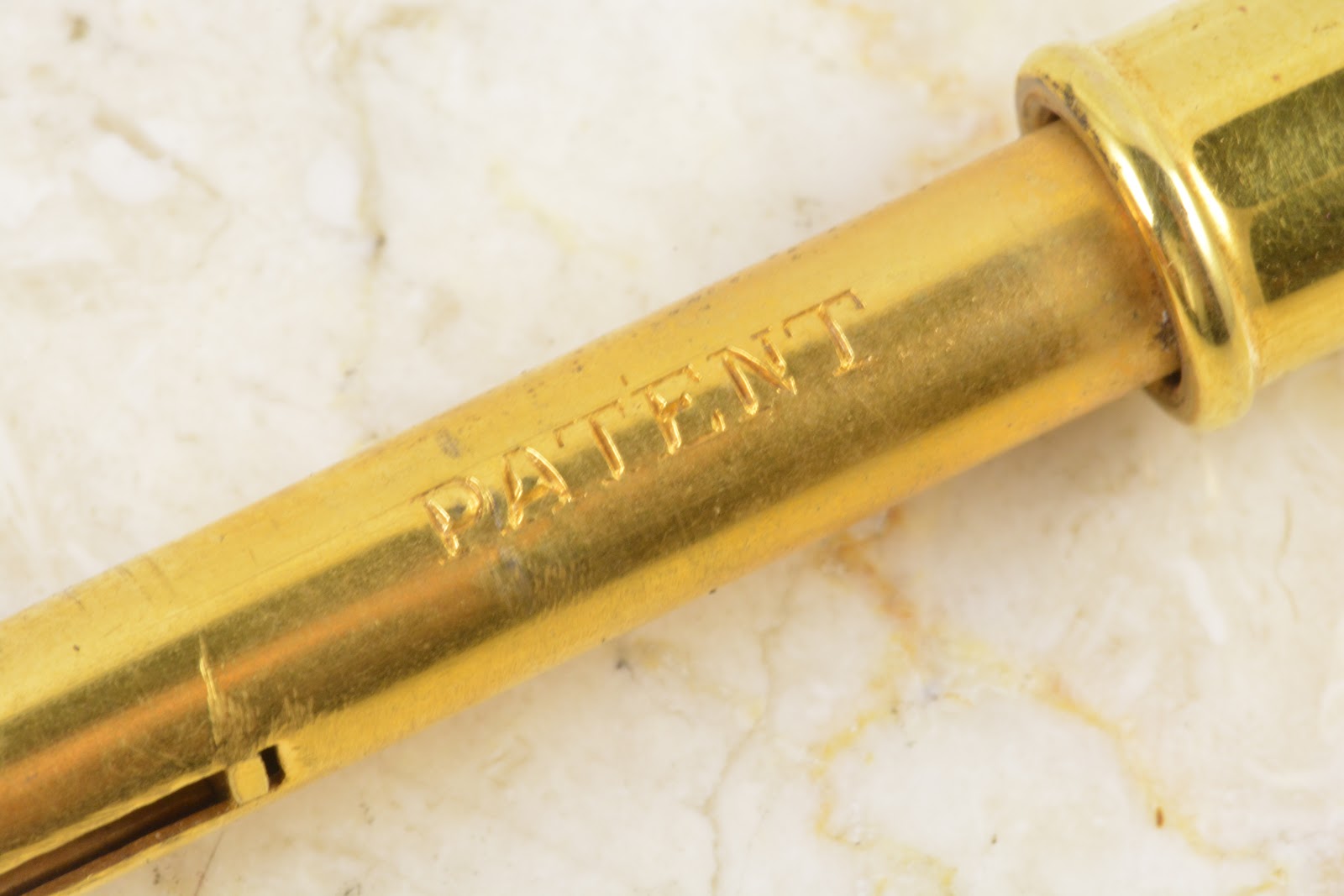
I’m sure there’s more to this story, and a tantalizing lead is stamped on the upper part of the mechanism:


“Patent.”  That likely indicates English manufacture.  I’d love to find out more about English writing instrument patents (since I’ve written two books on American patents and I understand the value of the information they provide), but they are not organized anything like our well-organized American system.  In fact, the Brits from what I understand have a pay-per-view system for looking at their historical patents.

Someone should write a book.  And no, I’m not volunteering.

Tuesday, February 13, 2018

Hoffman and Boman Ride Again

This article has been edited and included in The Leadhead's Pencil Blog Volume 5; copies are available print on demand through Amazon here, and I offer an ebook version in pdf format at the Legendary Lead Company here.

If you don't want the book but you enjoy this article, please consider supporting the Blog project here.

The Eagle Pencil Company is one of my favorite manufacturers to collect, since the dizzying array of innovations the company introduced – some great, some just plain goofy – provides endless variety.

One of the best ideas the company had was that of the “Automatic” or “Stop Gauge” pencil, first patented by Joseph Hoffman in 1879 and later refined in 1885 by Claes Boman.  These thick lead pencils, which merely held lead in a chuck that would be released by the press of a button on the aft end, are the great granddaddy of all techincal leadholders and all modern “clutch” style pencils,

There were also later incarnations of the Stop Gauge, such as these:


These things are like an elephant hiding in the corner.  Although they are much larger than most pencils, for some reason they just don’t jump out at you as much as you would expect, and it wasn’t until just a couple years ago that I know they existed.  At the tip end you’ll find the characteristc thick lead and gripping jaws:


On the cap, they are identified as the “Clutch” No. 692 – and with a more recent patent number of 2,134,570:


The patent number refers to Joseph Meilner’s pencil, for which he applied for a patent on May 17, 1935 and which was granted on October 25, 1938:


I’ve read and reread the text of the patent, and I honestly can’t tell what was new and exciting about Meilner’s incarnation of the pencil.  Even the sharpener built into the cap he states is just an optional bit, and nothing is claimed as patentable for that feature (besides, it was opted out in all three of my examples). 

There was another less robust version of the Stop Gauge , too: the model number 10, which more closely resembled its ancestor.  There’s one shown amongst the early Eagles pictured on page 45 of The Catalogue, It’s the gold colored one near the middle:


I don’t think this one belongs in the company of Victorian Eagles, though.  While the design is older (notwithstanding the “Pat. Pend.” imprint), the No.10 probably dates to the 1930s – this example turned up on a store card with an Eagle logo dating to the Depression, and referring to it on the card only as the Eagle “Prestop”:


Note also the indication that the Prestop took a four-inch lead, which also places this example squarely in the “Square 4" era. 

Lastly, along the lines of the Clutch and the No. 10 is this odd duck:


This one shares the same overall appearance of the No. 10 and uses a thicker lead like the “Clutch,” but this has a nose drive twist mechanism:


Chris Egolf turned this one up for me.  It’s an Eagle “75-60,” and it apparently cost twenty cents, twice the price of the number 10:


The numbering is significant . . . or maybe it isn’t.  In its earliest incarnation, the Stop Gauge was sometimes referred to as the “Automatic.”   In the the thirties, Eagle applied the name to a spiral drive plastic pencils - with a 75- model number, and the “Giant Automatics,” the large souvenir pencils with a conventional nose drive stuck in the front end, which all share a 75- prefix as well.