Wednesday, March 14, 2018

Poking the Wounded Bear

This article has been edited and included in The Leadhead's Pencil Blog Volume 5; copies are available print on demand through Amazon here, and I offer an ebook version in pdf format at the Legendary Lead Company here.

If you don't want the book but you enjoy this article, please consider supporting the Blog project here.

I don’t know if it’s another weird Ohio saying or just generally good advice: never poke a wounded bear. A few weeks ago, I raised the ire of many a Parker fan by suggesting that the Parker Pen Company might have had something to do with crappy later offerings from the Conklin Pen Company, after the company had been relocated to Chicago in 1938 and likely after the shadowy syndicate that purchased Conklin had in turn resold it to Joseph Starr’s Starr Pen Company.

Unless it pains you too much to relive the experience, the article was posted at https://leadheadpencils.blogspot.com/2018/02/finally-enough-evidence-and-new.html.

It took some time for blood pressures to return to normal and for the angry mobs to return their pitchforks and torches to their normal household purposes.  It’s probably best at the peak of the frenzy that I didn’t follow up immediately with a second article, opening with “and another thing . . . “


These, like the “mother of toilet seat” pencil I discussed in my last article, are examples of the Conklin Minuteman – the same name was used on both of these very different looking pens and pencils.  As a proud Ohioan, I didn’t mind gathering together all of the colors they came in . . . even though Conklin had long since left Toledo and it does drive the OCD part of my brain a little nuts that the gray one is a little bit bigger than the others.

These are simply awful syringe-filling pens with similarly awful business ends, but during wartime shortages of new consumer goods, they were probably about as good as you could find at the time.

I was a beginning collector at the time, and I know in those early days I questioned whether these were made by Parker.  If I said it aloud, I’m sure I was loudly dismissed as unworthy to walk the aisles at pen shows or otherwise be seen in polite society.  Hopefully I figured out on my own that notwithstanding a similar washer clip and screw-on top to secure it, anyone could have made something similar in construction to a Duofold flattop after Parker’s ubiquitous 1916 patent on the washer clip expired.

Bear with me now.  Or bears with me, I should say . . .


Consider the Parkette Zephyr, another of the lower tier lines of Parker’s offerings.  According to Tony Fischier’s excellent site, Parkerpens.net, the Parkette Zephyr was being phased out in 1941 (see https://parkerpens.net/parco.html).


The very year Joseph Starr acquired The Conklin Pen Company.


You know where I’m going with this, don’t you?


If I didn’t tell you those were Parkette pencils, and if you didn’t know Parkette Zephyr pens were streamlined in shape rather than flattops, you’d swear these were matching sets of pens and pencils.  Don’t deny it.

One commentator on my last article suggested that the Starr Pen Company bought all of Parker’s remaining materials and parts, put them together and resold them- a timeline that fits nicely into Tony’s assertion that the Zephyr was discontinued at the same time Starr got into the business.

But by all accounts, Starr didn’t actually make anything.  The company simply resold jobbed pens and pencils, mixing and matching stuff any way they could so they could keep serving large helpings of pen crap onto a wartime market starved for anything that claimed to be a fountain pen.

Starr bought its pens from someone else who made the pens Starr sold.

No one has ever questioned whether Parker made the Parkette Zephyr.

And to those who say Parker would never make such crap, I say yes they did.

In fact, Parker made identical crap.

Tuesday, March 13, 2018

The Pencil-Peddling Russian Count

This article has been edited and included in The Leadhead's Pencil Blog Volume 5; copies are available print on demand through Amazon here, and I offer an ebook version in pdf format at the Legendary Lead Company here.

If you don't want the book but you enjoy this article, please consider supporting the Blog project here.

Joe Nemecek bequeathed this one to me at the DC show for two reasons.  First, he thought the simple bone handle and cheaper nose drive mechanism were just a little sad  . . .


And second, he and I knew it had an Ohio connection:


C. – or maybe G –  Sackersdorff is imprinted into the bone handle.  We knew about the Ohio connection from my recently released book, American Writing Instrument Trademarks 1870-1953 (the book is available at https://www.legendaryleadcompany.com/store/p86/American_Writing_Instrument_Trademarks_1870-1953_.html):


Gustav Sackersdorff, “a subject of the Czar of Russia, residing and doing business at Cleveland, Ohio,” applied to register trademark number 28,675 on May 28, 1896, for “the facsimile of my autograph signature ‘Sackersdorff.’”   In his application, he claimed to have used the mark since September 30, 1880.

The trademark was filed during that awkward time at the Patent and Trademark Office, during which drawings weren’t included in the registration cerficates – and for whatever reason, they weren’t preserved.   Fortunately, the images can still be found from the Official Gazette, so I painstakingly went back through and tracked them all down, reproducing them all in the first section of the book.  Here’s the image


The signature version of Sackersdorff’s trademark wasn’t carved into the humble bone pencil, for obvious reasons.  The filing of the trademark, however, adds a dimension of understanding to this pencil – and its Ohio connections – which would otherwise have been forgotten.

In 1876, Gustav appeared in Carlisle, Pennsylvania, selling Russian lead pencils - almost assuredly wood-cased pencils, in the lingo of the day - and the local paper was proud to “pronounce them good.”


In 1882, the Wilkes-Barre Sunday News extolled the virtues of Sackersdorff’s Russian pencils, indicating that they were about a third the price as others on the market at the time.  There’s a bit of inconsistency in the story though - the article claims the pencils are “pure plumbago,” which would be extremely soft, but states that the pencils could be stuck into wood without the point breaking.  Note that the address provided for Sackersdorff was 63 4th Avenue, New York:


In Tunkhannock, Pennsylvania, they apparently didn’t see too many “real live” Russians, and Gustav’s appearance there, as reported in the July 21, 1882 Wyoming Democrat, seemed dubious as to whether he was the genuine article.  “If his word is as good as his pencils we know he told the truth,” the article conceded.


By 1895, Wanamakers was advertising the “Perfect Lead Pencil” for 35 cents per dozen:


In fact, twelve years later, John Wanamaker still “said so.”


Gustav was married to an opera singer who, according to this account, sang with the Metropolitan Opera House.  She died suddenly on January 5, 1908 at the Hotel Victoria in New York, and her death – reported on the front page of the Sun -- was ruled the result of apoplexy:


As noted in the article, Mrs. Sackersdorff’s faithful dog refused to leave her side and had to be forcibly removed.  Days later, the terrier was reported to be refusing food and drink, dying of grief at the loss of its owner:


By the time Gustav was widowed, his fortunes had apparently changed, and he claimed he “had no friends in this country.”  On August 24, 1908, the sixty-year-old Gustav – who was perhaps taking a cue from the house of Faber and going by the title “Count Augustus Sackersdorff” – checked into the Hotel Diana on West 35th Street.  Half an hour later, he called the clerk to say he wasn’t feeling well and asked for a physician.  Dr. Foote from the New York Hospital was summoned, but when he arrived shortly after, the Count was found dead.

Gustav’s death was also front page news, in the August 25, 1908 New York Tribune.  While Dr. Foote believed the cause of death to be heart disease, the police suspected “unnatural causes,” citing reports from a friend of the Count that he did not expect to live much longer:


“Unnatural” does not appear to have meant “suspicious,” though.  Another account of Gustav Sackersdorff’s passing, which appeared in the Benton Harbor (Michigan) News-Palladium the following day, shows Sackersdorff in an entirely different light: as a once-wealthy Russian Count, who once peddled pencils and was married to a famous opera singer, and who died penniless in a cheap New York hotel.

Monday, March 12, 2018

C. Pat?

This article has been edited and included in The Leadhead's Pencil Blog Volume 5; copies are available print on demand through Amazon here, and I offer an ebook version in pdf format at the Legendary Lead Company here.

If you don't want the book but you enjoy this article, please consider supporting the Blog project here.

This might seem like an unlikely one to have made the cut as I was deciding which out off Ed Fingerman’s Victorian collecdtion I could afford to buy:


I’ve got scads of pencils like this - nearly all are marked Mabie Todd, together with John Mabies October 3, 1854 patent date, a reference to patent number 11,762 (regardless of whether it is also equpped with the sliding dip pen nib:


This one, though, bears no reference to Mabie’s ubiquitous patent.  Instead, it says something else:


“C. Pat. 51" This one has me scratching my head.  True, a few of these are marked with Nelson Goodyear’s hard rubber patent of May 6, 1851 – but that would be “G. Pat.,” wouldn’t it?  And try has I might to get a G out of that imprint, it just isn’t there – it’s clearly a C.  There were just four patents issued in category 401 that year, according to American Writing Instrument Patents 1799-1910, none of them taken out by or assigned to anyone by the name of C.

Could it stand for “Canadian?”  Well, I’m pretty sure the 51 is a date, and the Dominion of Canada wasn’t formed until 1867 (and I checked - Canadian patent number 1 was issued in 1868). 

I have a theory.  I’m pretty sure the “Pat. 51" refers to a patent issued in 1851 – that brings me back to Nelson Goodyear’s patent for hard rubber.   Except it wasn’t called “hard rubber” in 1851


Goodyear referred to it as “India-Rubber” in the title, but in the first paragraph he calls it “Caoutchouc or India-Rubber”:


In fact, when Goodyear’s nephew Austin G. Day took out a patent for a slightly different formulation in 1858 (see “That Third Interesting Holland” at https://leadheadpencils.blogspot.com/2016/09/that-third-interesting-holland.html), that’s exactly what Day called it:


I think this imprint is shorthand for Nelson Goodyear’s 1851 patent for Caoutchouc.

Sunday, March 11, 2018

Larry Derails Me (A Little Bit)

This article has been edited and included in The Leadhead's Pencil Blog Volume 5; copies are available print on demand through Amazon here, and I offer an ebook version in pdf format at the Legendary Lead Company here.

If you don't want the book but you enjoy this article, please consider supporting the Blog project here.

My friend Larry Liebman bequeathed this one to me:


It’s a Quickpoint, with really cool graphics advertising the Rock Island railway:


The gift was an invitation - to start a niche collection.  No, Larry doesn’t collect Quickpoints . . . at least not specifically.  What he does collect are pencils with trains on them:


The thought is intriguing.   My collection has always been organized by manufacturer, and whatever personalization they have, whether it be a name or an advertising imprint, is incidental. Otherwise, it would be nearly impossible to navigate my way around the museum and find something . . . or anything.  I have made just a few exceptions, and each time the results have been disastrous.  There's this grouping of all of my ebonized pearl Sheaffer Balances around the super hard to find golf pencil:


Since I had separated these from my other Sheaffers to group them by material rather than by construction, when I pulled together all of my Sheaffer special-banded Balances for a family photo I posted on facebook, I forgot to pull the ebonized pearl double band out of its special corral to join in the shot:


So there’s a shot I’ve got to redo.

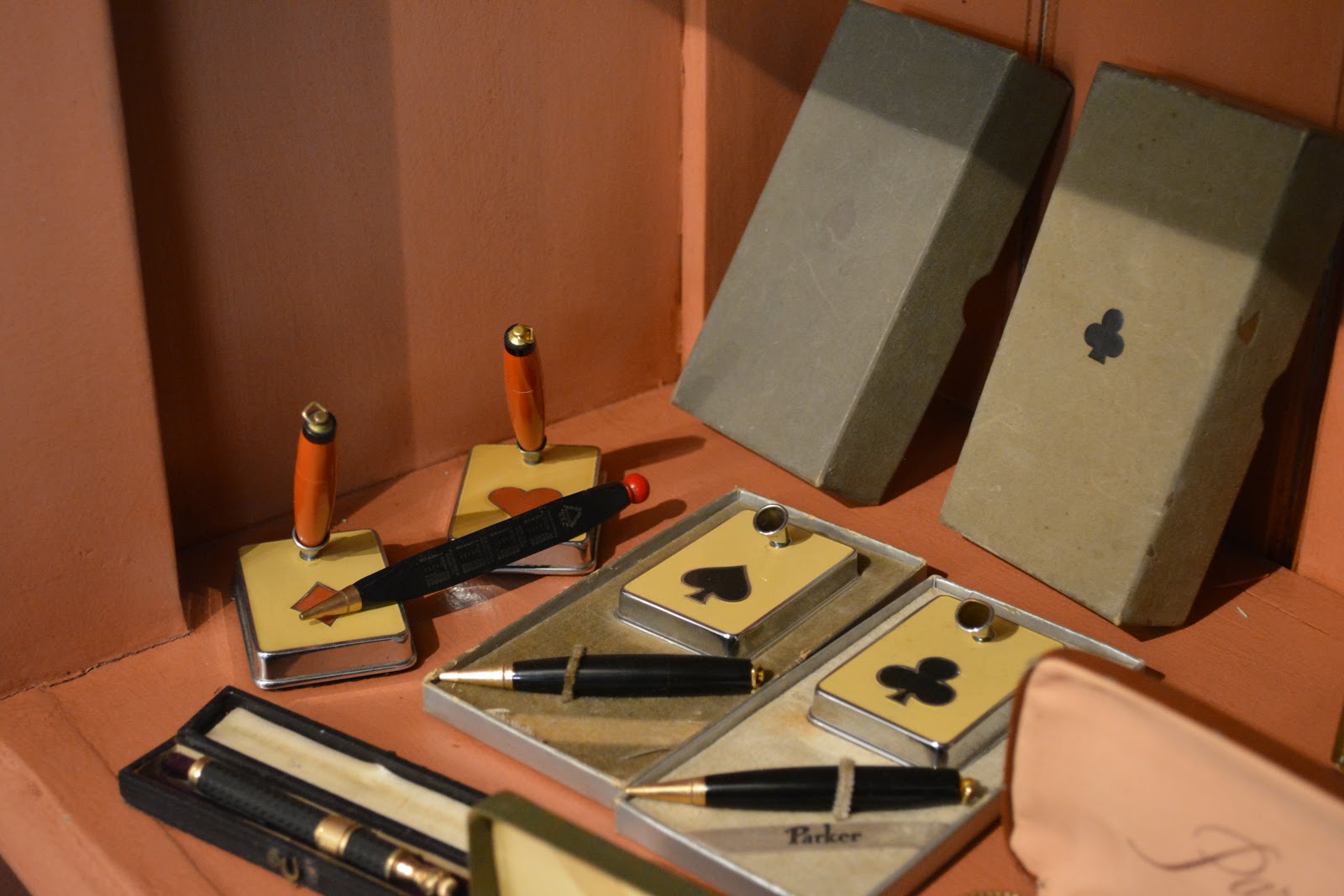
Then there was the “Parker bridge pencil panic of 2017" – the case of a lost, very rare and very expensive pencil that I was more than a little frantic trying to find when I reorganized the museum last year.  After a couple hours of searching, I finally remembered that at some point I decided it would look nice with my other card-themed pencils (in particular, with my Parker bridge set).  There it was, much to my relief, lounging across the red suit bases:


Aggravation notwithstanding, the sight of Larry’s spread of train-themed pencils did stir a question in my mind . . . I’ve got literally hundreds of advertising pencils like this, many of which haven’t been organized yet and are piled up in drawers and cigar boxes.  Like my early days of collecting Sheaffer pencils, if I see something neat I pull it aside to think about more someday, and someday hasn’t come yet. 

I’m sure a cool picture of a train has generally spiked my neat-o-meter enough to throw the switch and redirect it to the roundhouse – but the roundhouse for the manufacturer of the pencil, not a newly-constructed one just for train pencils. 

How many do I have with railway advertising, I wonder? 

After that earworm got into my head, this Scripto Wordmaster passed into my hands, clustered together in a lot of pencils I bought for something else.  I pulled it aside, but it didn’t make it to the drawer containing my other Scripto Wordmasters.  It’s still sitting in a pretty random place, on the showcase that holds my Ruxton Multi-Vider prototypes, for two reasons . . .


First, it has a train on it. 

Second, I can't find the Quickpoint now to put them together.  After I photographed it, I didn’t put it with my other Quickpoints . . . now THAT’S a first . . . and because I didn’t, hell if I know where it is!  Apparently I took Larry's invitation to heart and put it somewhere by itself, alone in some out-of-the-way new roundhouse and waiting for other new arrivals.  I’m probably going to spend a lot more time than I care to admit going through every drawer looking for a $2 Quickpoint with a picture of a train on it.

Until I do, that Scripto is going to stay right where it is – in a random but front-and-center spot where I’ll be able to find it again when the other one surfaces. 

Then, as Janet and I always say, two’s a coincidence and three is a collection.  I’m sure I have a collection at this point.  I just haven’t collected them together yet.

Thanks a lot, Larry - looks like I”ve got one foot aboard a new train.

Saturday, March 10, 2018

The Completist

This article has been edited and included in The Leadhead's Pencil Blog Volume 5; copies are available print on demand through Amazon here, and I offer an ebook version in pdf format at the Legendary Lead Company here.

If you don't want the book but you enjoy this article, please consider supporting the Blog project here.

My friend Richard Fernandez was a bit puzzled at the DC show.  He had a big baggie of pencils for me to look at, and while he knew there wasn’t much in there to see, he gave ma a chance to paw through it.  Out of everything in that bag, there was only one thing I had to have, and it was covered in more rust than a railroad spike. 

But I didn’t have one and I’d been looking for one for a long time.  Even if I couldn’t get it cleaned up, I was glad to have a placeholder on the wall o’ pencils.

Fortunately, attacking it with a buffing wheel yielded some pretty good results:


The pencil is marked “Guild” on the clip, and closer up you can see there’s still some substantial pitting left behind after the corrosion was removed:


Still, I’m pretty happy with it.

The Guild Products Corporation was a scheme in the early 1920s by the Mid-Atlantic Retail Stationers’s Division of the National Association of Stationers and Manufacturers to squeeze pen manufacturers into more “reaonable” pricing – the idea was that members would band together and sell only Guild Products, so that any pen or pencil manufacturer that wanted to sell products in member stores needed to supply “Guild” branded products.  The whole story can be found in “Back to the Drawing Board” posted back in 2013 (see https://leadheadpencils.blogspot.com/2013/08/back-to-drawing-board.html).

To my knowledge, only two manufacturers signed up to make Guild-branded pencils — Conklin and Mabie Todd.   Each made pencils which looked exactly like their regular lines, but with a flared cap squared off at the top to set I apart a bit.

When I wrote the last article, David Moak, the author of Mabie in America, allowed me to use an image from his book of a boxed example of the Guild, complete with the paperwork to establish conclusively that Mabie Todd was its source:


It was driving me a little bit crazy not being able to find a metal Mabie Todd Guild all this time. 

Now I just need to find a ringtop.

Friday, March 9, 2018

Redemption

This article has been edited and included in The Leadhead's Pencil Blog Volume 5; copies are available print on demand through Amazon here, and I offer an ebook version in pdf format at the Legendary Lead Company here.

If you don't want the book but you enjoy this article, please consider supporting the Blog project here.

There was a time, many years ago, during which I would look at a pencil critically, decide whether it “fit” into my collection, and if it didn’t I would send it on to a new owner.

Later, as I became more interested in the subject and the collection expanded, I resigned myself to being more of an archivist than a collector – every pencil “fit” somewhere, it was just a matter of figuring out where.  In most cases, it wasn’t all that hard to reacquire the pencils I’d let slip through my grasp, since after all they didn’t just make one of each.

One, however, eluded me for more than a decade:


About five years ago, my friend John Coleman sent me a picture of his example, and I wrote about my wayward Redipoint that July (see https://leadheadpencils.blogspot.com/2013/07/i-wish-i-could-remember-what-i-did-with.html).  I’ll admit to having something of a selfish motive in writing that last article, since often one of my readers will come up with something I’m looking for after I let it be known I’m trying to find it. 

In this case, though, the article didn’t do any good, and it would be another four years before I’d cross paths with another example.  Funny, you’d think I would remember where and from whom I got it, after as long as a searched.

This is a Redipoint, and we know from the imprint that it was made after 1926, when old man Bigelow from Brown and Bigelow finished serving his prison sentence for tax evasion and had reclaimed the Redipoint brand from William Ingersoll, to whom he had sold it in 1922 (see “The Real Story of Redipoint” at https://leadheadpencils.blogspot.com/2017/01/the-real-story-of-redipoint.html).

Note the absence of the Ingersoll name from the imprint:


The trademark for this script is included in American Writing Instrument Trademarks 1870-1953 (my blog, so my shameless plug – the book is available at https://www.legendaryleadcompany.com/store/p86/American_Writing_Instrument_Trademarks_1870-1953_.html):


The Redipoint name in this script was filed before the incorporation of Ingersoll Redipoint, in 1921 – and in it, the date of first use claimed was in 1917:


In “The Real Story of Redipoint,” I characterized the incorporation of Ingersoll Redipoint as something of an outright sale, a handoff of the Redipoint pencil business from Brown & Bigelow to William Ingersoll in early 1922.  That my have been an oversimplification. 

The registration for the Redipoint Ingersoll mark is also included in the book, and it wasn’t filed until January 11, 1923, eight months after the new company was formed and by all accounts the transition was over.  The application for registration was signed by Herbert H. Bigelow, as Treasurer of the Ingersoll Redipoint Company, Inc.:


There’s one more detail about this pencil which helps to date it to even later than 1926.  That extra long top conceals a built-in lighter:


That lighter can be pulled out, and there’s something stamped on it:


“Redilite,” in the same script as the Redipoint trademark.  Of course, the Redilite trademark isn’t found in my book, since it doesn’t have anything to do with writing instruments, but fortunately it was pretty easy to find:


Many trademark registrations were filed long after the dates the mark was first claimed to be used, so it’s anybody’s guess how accurate that date might be.  In the case of the Redilite mark, however, the application for registration was filed on May 9, 1929, and the date it was first claimed to be used was April 1, 1929.

I think that date is rock solid.

Thursday, March 8, 2018

From Bagley through Todd - Part Three

This article has been edited and included in The Leadhead's Pencil Blog Volume 5; copies are available print on demand through Amazon here, and I offer an ebook version in pdf format at the Legendary Lead Company here.

If you don't want the book but you enjoy this article, please consider supporting the Blog project here.

Note: this is the fourth installment in a series of articles.  Part one is posted at https://leadheadpencils.blogspot.com/2018/03/with-couple-twists.html.

Since the 1840s, the pen and pencil factory founded by Albert G. Bagley had seen many principals come and go, and the dissolution and formation of numberous partnerships in rapid succession.  By 1868, the works were operating under the name of Kurtz & Monaghan, owned by Keller Kurtz and Joseph Monaghan.  In that year, Edward Todd retired from nearby Mabie, Todd & Co. on January 13, 1868:


In David Moak’s book Mabie in America, Moak questions whether Edward Todd was actively involved in the business or whether he was more of the financier and marketing wizard for the firm (although he does note that Edward Todd had two patents to his credit).  There may be some truth to Moak’s claims: sources indicated that after his retirement, Todd took a year off traveling before settling into a decidedly non-pen related post-retirement.  On November 28, 1868, the Brooklyn Daily Eagle identified him simply as a “merchant” at 180 Broadway:


An Edward Todd also appears on the board of directors for the Brooklyn Life Insurance Company on March 12, 1870.  However, Todd wouldn’t stay out of the pen and pencil business for long.

Keller Kurtz retired from Kurtz & Monaghan, effective March 18, 1870, leaving Joseph Monaghan to continue the business alone:


On September 1, 1870, Edward Todd and Joseph Monaghan published notice that they had formed a partnership at 1 Maiden Lane, called Edward Todd & Co.


After this blizzard of successive partnerships, the name would remain the same for decades, although there were some changes in the principals and organization of the firm.  In February, 1884, Edward Todd Jr. and Henry C. Potts were added to the firm as partners:


Joseph Monaghan died on February 1, 1886, triggering a dissolution of the partnership.  The new partners were Edward Todd, Edward Todd, Jr. and Charles S. Freer, and an announcement of the new copartnership was printed in The American Stationer on February 25, 1886, rather than in the local newspaper:


In early November, 1897, Edward Todd, Jr. filed a petition for the appointment of a receiver to dissolve the partnership, owing to the advanced ages of his father and Mr. Freer.  “It is whispered that the firm may be reorganized,” The American Stationer reported on November 4:


The whisperings were accurate.  As soon as the partnership was wound up, The New York Times reported the incorporation of Edward Todd & Co. on February 5, 1898.  The directors of the new corporation were G.E. Avery of Detroit, and Henry E. Avery and Edward Todd Jr. of New York.


Under Edward Todd Jr.’s leadership, the firm continued through 1932 – at least, that’s the best information available.  Although that date is often repeated on various pen sites, the only source I have been able to find for that date is Edward Todd Jr.’s obituary, which states tersely that “his business was discontinued in 1932.”  Edward Todd Jr. passed away on Christmas Eve, 1937:


After winding through this entire history, we now have a nearly complete history of the ancestry of the New York firm of Edward Todd & Co., from its origins with the colorful Albert G. Bagley to Edward Todd & Co.’s demise:

Albert G. Bagley, 1839 (claimed) - May, 1846
Albert G. Bagley (informal partnership - Albert G. Bagley, Gerrit Smith and Edgar M. Smith - May, 1846-November 30, 1846
Albert G. Bagley & Co. - Albert G. Bagley, Gerrit Smith and Edgar M. Smith - December 1, 1846-August 10, 1848
Albert G. Bagley - August 11, 1848-late 1849 (between May and October)
A.G. Bagley & Co. - Albert G. Bagley and Henry Harrison Houghton - late 1849 (between May and October)-December 31, 1855
Bagley, Houghton & Co. - Albert G. Bagley, Henry Harrison Houghton and Charles F. Newton - January 1, 1856-April 19, 1856
H.H. Houghton & Co. - Henry Harrison Houghton and Charles F. Newton - April 19, 1856-
October 27, 1857
C.F. Newton -  Charles F. Newton - October 27, 1857-December 31, 1860
C.F. Newton & Co. - Charles F. Newton, James P. Byrne and Joseph Monaghan - January 1, 1861-December 30, 1863
C.F. Newton & Co. - Charles F. Newton, James P. Byrne, Joseph Monaghan and Keller Kurtz - December 31, 1863-December 31, 1864
Newton, Kurtz & Co. - Charles F. Newton, Keller Kurtz and Joseph Monaghan - January 1, 1865-
May 1, 1867
Kurtz & Monaghan - Keller Kurtz and Joseph Monaghan - May 1, 1867-March 18, 1870
Joseph Monaghan, March 18, 1870-September 1, 1870
Edward Todd & Co. - Edward Todd and Joseph Monaghan - September 1, 1870-February, 1884
Edward Todd & Co. - Edward Todd, Joseph Monaghan, Edward Todd, Jr. and Henry C. Potts - February, 1884-February 1, 1886
Edward Todd & Co. - Edward Todd, Edward Todd, Jr. and Charles S. Freer - February 1, 1886-November, 1897
Edward Todd & Co. (Incorporated) - February, 1898-1932