Sunday, August 13, 2017

The Observation of the Century

This article has been edited and included in The Leadhead's Pencil Blog Volume 5; copies are available print on demand through Amazon here, and I offer an ebook version in pdf format at the Legendary Lead Company here.

If you don't want the book but you enjoy this article, please consider supporting the Blog project here.

Not long ago, a full-sized Century pencil owned by Joe Nemecek limped into the museum for repairs.  After I got it working again, I took a shot of it alongside my ringtop example for grins:


I also shot it alongside a couple identical pencils marked “EVRDA” on the clip.  EVRDA (short for Everyday) was the name A.A. Waterman last traded under, during his last enterprise with the Chicago Safety Pen Company (see http://leadheadpencils.blogspot.com/2012/11/evrda.html).


I don’t have much else to offer about these, except for the observation that there were two variations of the EVRDA clip:


It's difficult to tell, but it looks like both the ball clip and flat clip variations appear in the catalog excerpt I included with that last article:


Saturday, August 12, 2017

What a Box!

This article has been edited and included in The Leadhead's Pencil Blog Volume 5; copies are available print on demand through Amazon here, and I offer an ebook version in pdf format at the Legendary Lead Company here.

If you don't want the book but you enjoy this article, please consider supporting the Blog project here.

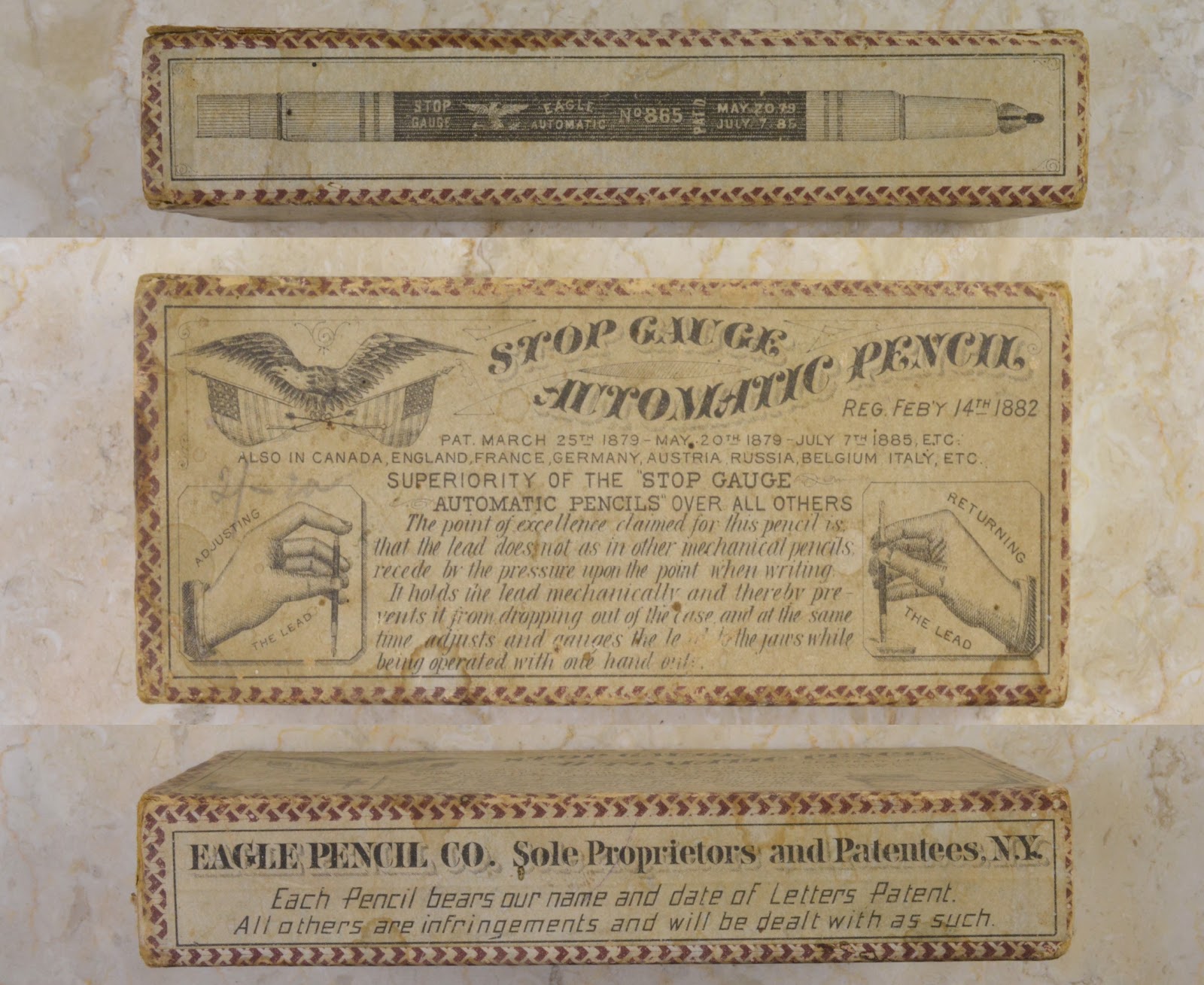
Since I spent so much time yesterday talking about Eagle Automatics, it seemed a good time to show off one that came my way recently:


The top of the box was a little rough, but it was unusual in having two drawers, one for the pencil and one containing a box of copying leads:


Both the pencil and the leads I have, and neither is particularly noteworthy.  What is special is the other three sides of the box, which are very well preserved and which contain some amazing graphics and some interesting language:


In particular, note what’s written on that bottom panel:


“Each pencil bears our name and date of Letters Patent.  All others are infringements and will be dealt with as such.”

What’s interesting to me is the ominous nature of the warning.  Yes, Eagle emblazoned nearly everything they made with patent dates and when it came to both patents and trademarks the company was both prolific and territorial.  However, a warning like this suggests that there was at least one product which actually infringed upon Eagle’s patents – or was close enough to justify such strong language.

Now to find the “all others!”

Friday, August 11, 2017

A Different Take on a Familiar Name

This article has been edited and included in The Leadhead's Pencil Blog Volume 5; copies are available print on demand through Amazon here, and I offer an ebook version in pdf format at the Legendary Lead Company here.

If you don't want the book but you enjoy this article, please consider supporting the Blog project here.

In a recent auction of larger, flattop pencils online, this was not the one that interested me the most:


The pencil appeared to be a Magnum Pointer (see page 47 of The Catalogue), but in red . . . a color that I didn’t have.  Besides, I don’t think I’ve added one to my collection since I wrote the book:


But with that silver-colored trim, it doesn’t quite fit into the series.   I wondered if it might instead be part of this series:


At the Chicago Show three years ago I bought an advertisement from Terry Mawhorter referring to these as the “Silver Canary.”  The advertisement was for a third-party contest, though, with these pens and pencils being offered as a prize – so I wasn’t firmly convinced that was the name Eagle gave to it.  Unfortunately, that piece of ephemera was such an odd shape that was sure to put it someplace where it wouldn’t get damaged.  That explains why I can’t lay my hands on it to snap a picture for it now; it is amazing how few things get lost around the museum, but when things go missing they really go missing.

No worries.  It will turn up.

In the meantime, though, I don’t think this new Eagle belongs alongside the Silver Canary, since the latter sports clips which are bolted on, as well as a bell-shaped cap:


This example, just like those gold-filled Magnum Pointers, has a distinctive clip stamped “Pat. Pend.”:


I’m not sure whether the imprint relates to just the clip or to the entre pencil.  The patent for the pencil is easy: it was applied for by Otto Huber on June 6, 1929 and was issued on April 14, 1931 as number 1,800,201:


The clip, though, is a little trickier to find.  Since to my knowledge it appears only on Eagle Magnum Pointers, I checked the “Patents by Assignee” section of American Writing Instrument Patents Volume 2: 1911-1945, and none of the clip patents listed under Eagle fit the bill.  Some rainy day I’ll wade through all the clip patents to see if this patent was issued to an individual and was never assigned to Eagle – or even more fascinating, if the patent was assigned to a company other than Eagle.

Of course, it’s possible the patent was never issued at all.

There are two types of Magnum Pointers in the Eagle lineup, and this one appears to have a bit of both: the trim of the “Platinite Finish” line, and the clip of the gold-filled ones.  Note that on the platinite finish ones, the barrels are faceted and the clip matches the earlier “Ritaway” series:


Magnum Pointers are prominently marked on the cap on both series:


Which leads me to one other interesting feature on this new addition.  It isn’t marked “Magnum Pointer”


It’s marked “Automatic.”

The Automatic name has a long and varied history with the Eagle Pencil Company.  It was originally used to describe the company’s early “Stop Gauge” clutch pencils and was registered as a trademark by Eagle (yes, it’s included in American Writing Instrument Trademarks 1870-1953) as number 9,102 on February 14, 1882:


The name was also applied to later Eagle pencils, both the thin model Automatics frequently found with “Property of U.S. Government” imprints as well as the wooden Giant Automatics, including those painted with Chicago Worlds’ Fair, Popeye and other souvenir scenes.

Does this mean my example comes before, after or during the Platinite Finish and gold filled Magnum Pointers?  I’ve always been inclined to think Platinite Finish Magnum Pointers came first, since they carried over features from earlier lines, while the gold filled ones were a later, more refined step.  Since the skinny plastic Automatic wasn’t patented until a bit later, after flattop pencils such as these had become passe, I’m inclined to think that after upscaling the Magnum Pointer line with gold filled trim, Eagle reverted back to Platinite trim to cut costs and revived an old and venerable name in an effort to boost sales – shortly before abandoning everything but the Automatic name.

Thursday, August 10, 2017

The Reason I Wrote the Trademark Book

This article has been edited and included in The Leadhead's Pencil Blog Volume 5; copies are available print on demand through Amazon here, and I offer an ebook version in pdf format at the Legendary Lead Company here.

If you don't want the book but you enjoy this article, please consider supporting the Blog project here.

“That must have been a lot of work,” is the first thing most people say when they see 
American Writing Instrument Trademarks 1870-1953.

Yes, I tell them.  Yes, it most certainly was.


The logical follow-up question, one which most people don’t ask, is what on earth possessed me to take on such a project, let alone to spend nearly every spare moment for three months researching and writing it.

The short answer is that I needed this book and it didn’t exist, so I wrote it.

For years the lack of a viable resource documenting trademarks for pens and pencils has mildly annoyed me as I’ve researched articles here.  I wanted more information about the Rite-Rite trademark, but I couldn’t find anything more than what I posted.  Google’s snippet views for post-1922 trademarks are infuriating in two respects: it tells me that this information has been preserved in digital form, but that the good folks at Google haven’t figured out that government publications are not protected by copyright and could be made available.

As you might suspect, there was a flashpoint – the straw that broke this camel’s back.  There was that one bit of information I desperately wanted to find, which caused me to finally say enough is enough and sent me on a three-month detour out of life to stop everything, start from scratch and put something together that would end my frustrations with trademark research once and for all.

This was that flashpoint:


I’ve seen these a few times over the years, but in recent months I finally had the opportunity to acquire two of them, in nearly back-to-back online auctions.  The clips are marked “Ye Wm Penn”:


Both of these are Rex Manufacturing Company products, and they are early ones.  The red one is marked only with McNary’s February 19, 1924 patent:


While the black hard rubber example has the August 5, 1925 patent date:


As a Rex Manufacturing Company fan, I started researching to see what I could find out about the “Ye Wm. Penn,” and what I found had me begging for more:


Nearly everything Rex made in the way of writing instruments were made under others’ names, most notably under the Gold Bond label for Montgomery Ward and the Gold Medal brand for Sears.  Yet here was evidence, from the January 12, 1926 edition of The Official Gazette, that Rex applied for a trademark for “Ye Wm Penn” as a mark for its own products, with a claim to have first used that mark since January 1, 1925.

I wanted more: I knew the trademark registration certificate would contain more information, but I couldn’t find it.  The Trademark Office has a search portal called “TESS,” but since old abandoned marks have been largely purged from the system, that search turned up nothing.

That was the morning of February 6, 2017.  When I got home from work that night, I started poking around – not for the Rex trademark specifically, but for where these records have been documented and preserved.  Three months and more than 2,200 trademarks later, I had my answer:


The trademark for Ye Wm Penn was ultimately granted registration, as number 211,489 on April 13, 1926.  Harry M. Burt signed the application as Treasurer of the Rex Manufacturing Company, and the address of the company was 14 Blount Street, Providence, Rhode Island.  Unfortunately, in this case, both of these things I already knew.

But what the heck . . . I got a great book out of the deal!

Wednesday, August 9, 2017

Craig Sheaffer's Gift to Edd Dawson

This article has been edited and included in The Leadhead's Pencil Blog Volume 5; copies are available print on demand through Amazon here, and I offer an ebook version in pdf format at the Legendary Lead Company here.

If you don't want the book but you enjoy this article, please consider supporting the Blog project here.

For years I’ve called my collection the “museum,” tongue firmly planted in cheek.  However, there are times when objects force me to realize that I don’t really own any of this stuff.  I’m only their caretakers charged with preserving them for future generations.

Nothing better typifies this sentiment than a piece I acquired from Dan Reppert at the DC Show this past weekend:


“Edd Dawson –

“I’m genuinely glad to add our latest Sheaffer pencil to your interesting collection – especially since the very first pencils in the collection were Sheaffer.”

Signed by none other than Craig Sheaffer himself:


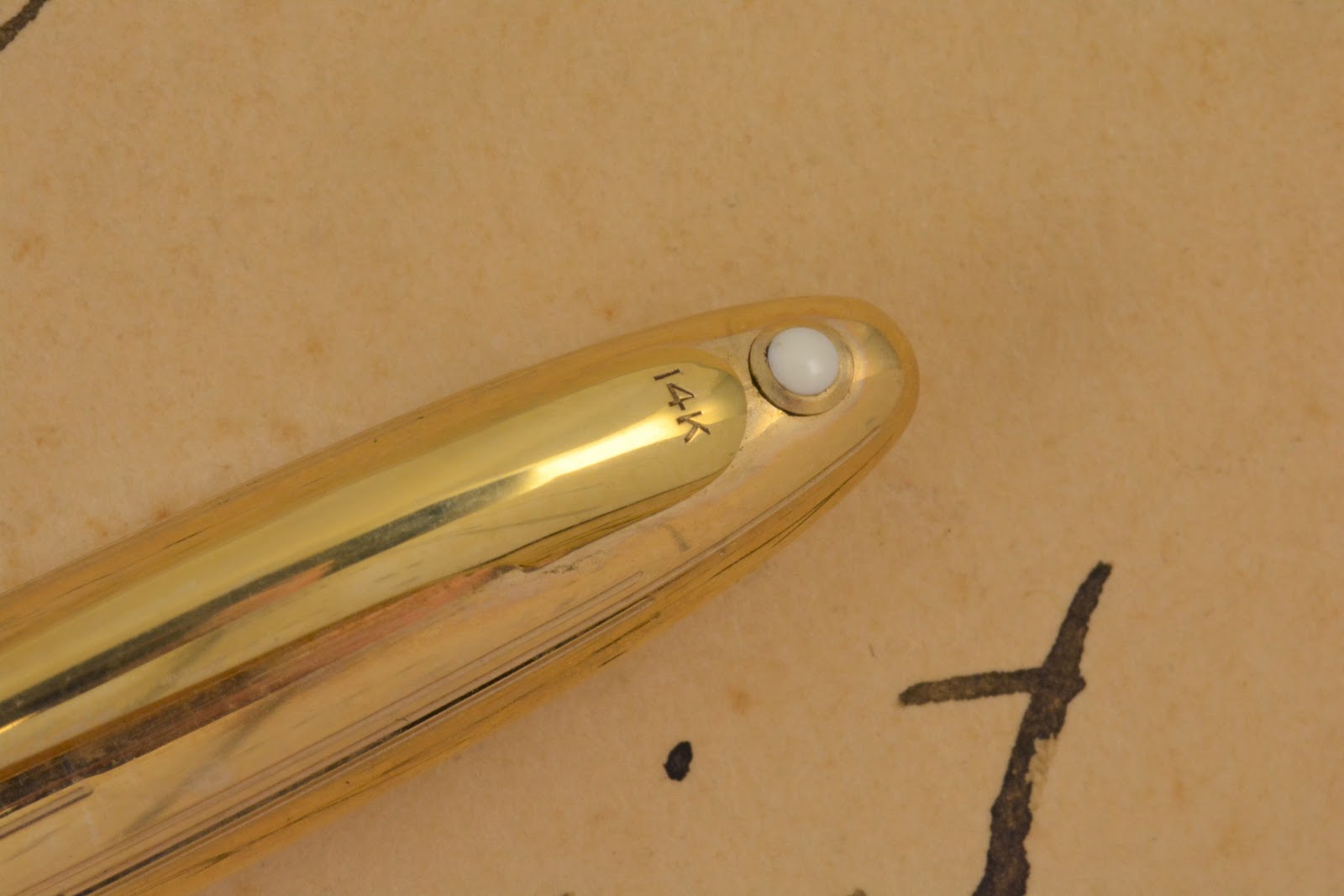
The pencil is a Sheaffer “Masterpiece.”  At the top end, above the 14k clip, the white dot is sent into a rivet, which is in turn set into the barrel, a feature which dates the pencil fairly specifically to the first quarter of 1948:


The barrel and tip are likewise marked 14k:


And on the lower barrel, a facsimile of Craig Sheaffer’s signature is engraved in the barrel:


My one and only concern when I was offered this piece was whether this was something special – a one-off gift for a true friend – or whether Craig Sheaffer signed a bunch of these for several hundred of his closest friends as promotional items.  Since several of the Sheaffer experts were in the room at the DC show, I asked around but no one had heard of such a promotion.

The conclusive answer, I decided, must be with the named recipient of the gift: Edd Dawson.  I had high hopes that the extra D in “Edd” might make it possible to find out something about a guy with a pencil collection in 1948 who might have had enough pull to entice Craig Sheaffer to part with his personal pencil.

It did.

And the first clue was right here at the blog:


This Eversharp pencil, imprinted with Edd Dawson’s name, was featured here at the blog back in November, 2014 (the full article is at http://leadheadpencils.blogspot.com/2014/11/get-your-minds-out-of-gutter.html).  Most of the time I don’t even mention the names imprinted on pencils when I find them, so it was a real stroke of luck that I noted Edd Dawson’s name in the article.

So I’ve got two Edd Dawson pieces in my collection.  Who was this guy?

With a bit more digging, I found him.  Edd B. Dawson was the sales manager for Koch Brothers, an office supply company and stationer in Des Moines, Iowa.  Here he is, in the center of this picture from the Des Moines Register on December 29, 1935, celebrating $23,000.00 in new orders for January, 1936:


But as distinctive as “Edd” with two d’s might be, did this Mr. Dawson collect mechanical pencils? Why yes . . . he started collecting them in 1940, and by 1947, his collection made headlines:


On June 20, 1947, the Des Moines Register reported that “Part of Edd B. Dawson’s pencil collection, which includes more than 13,000 pencils from around the world, is now on display in the window of Koch Brothers stationery store, 321 Grand Avenue.”

Dawson assembled his collection seventy years ago, without eBay, without pen shows, and without writing a book or a blog to give him the gravitational pull to draw pencils into his orbit.  Without question, Craig Sheaffer’s gift pencil was truly a thoughtful and respectful gift to someone Sheaffer knew would truly appreciate and preserve it.

Even before I knew all this, I was thinking that I needed to find the perfect place to keep this one, and I found it:


I’ve had this case for a while . . . the upper tray was the perfect place to bring together all of my ebonized pearl pencils (see http://leadheadpencils.blogspot.com/2014/12/my-quandry-is-resolved.html).  I never could figure out what I wanted to put on that lower shelf, until now –


It’s the perfect place to preserve Craig Sheaffer’s gift for another generation.

Tuesday, August 8, 2017

Pre(ish) Rex

This article has been edited and included in The Leadhead's Pencil Blog Volume 5; copies are available print on demand through Amazon here, and I offer an ebook version in pdf format at the Legendary Lead Company here.

If you don't want the book but you enjoy this article, please consider supporting the Blog project here.

Now that I’m on the subject of Rex, and in particular the early history of the company’s involvement in writing instruments, this one proved to be an important find:


The pen has a Webster logo which matches later Webster products made during the middle to late 1920s; the pencil, however, has a more understated imprint:


What had me excited about this set when I first saw it online was the Certificate of Guarantee carefully tucked behind the sash in the lid.  Certificates like these have helped me fill in important pieces of the Rex story: on two occasions, they have been counterstamped with the Rex name, such as this one:


See http://leadheadpencils.blogspot.com/2014/11/help-with-cheese.html and http://leadheadpencils.blogspot.com/2015/03/set-number-4555.html.  But these certificates were from hard rubber and celluloid sets.  I was excited at the prospect of finding an earlier metal set with a Certificate of Guarantee - would it have the Rex name on it, too?

No. It had something even better:


This certificate indicates this is set number 611 – significantly earlier than the earliest certificate I had seen before this – and printed at the bottom: “B. & G. Mfg. Co.,”

The name baffled me.  Obviously there was some connection with Rex here, but who B and G might be eluded me.  On facebook I posted a picture of the set and had a lengthy conversation with myself, musing over who made up B & G, when David Nishimura finally came to my rescue with a bit of what he described as “google-fu,” turning up a reference to the company from the February 26, 1919 issue of The Jewelers’ Circular:


Wow.  Harry M. Burt and Harry Garabedian, operating at 14 Blount Street - that’s the address of the Rex Manufacturing Company.  Of course, I thought.  Harry M. Burt was one of the original incorporators of Rex in 1911:


Burt surfaced later as Vice President of Tri-Pen Manufacturing Company, makers of the Triad (see http://leadheadpencils.blogspot.com/2013/03/rex-manufacturing-company-father-of.html), which was the first bit of evidence I found to confirm that Tri-Pen was the successor to the Rex Manufacturing Company.

But the real prize in finding the B & G Manufacturing Company is establishing Burt’s association with Harry Garabedian in 1919, because Garabedian later plays the most important role of all in Tri-Pen:


He was the inventor of the Triad fountain pen.

And there’s more.  According to the announcement in the The Jewelers’ Circular, the B & G Manufacturing Company was established in 1919, which coincides with the earliest reference I found to the “Never-Dull” pencil, in this August, 1919 issue of Advertising & Selling:


And one final interesting point.  The last time I explored the connection between Rex and Webster, I shared this interesting excerpt from the 1922 edition of Trade-marks of the Jewelry and Kindred Trades:


In this excerpt, the entry for Rex has been inserted, out of alphabetical order, just before Webster.  Note that beneath the Webster name is the legend “no recent record.”   In the course of researching American Writing Instrument Trademarks 1870-1953, I located earlier editions of the book, including the one published in 1915 (the 1896, 1904, 1915 and 1922 editions are all reproduced in the Appendix at the end of the book).  Here’s what the listing for Webster looked like in 1904 and 1915:


The Webster Pen Company was located at 37-39 Maiden Lane in New York, and there’s no mention of the Rex Manufacturing Company, which had been incorporated in 1911.

These new discoveries have opened up quite a few details in the history of the Rex Manufacturing Company.  Based on what I know now, here is what I think:

1.  The Webster Pen Company was an independent pen concern as late as 1915.

2.  Harry M. Burt and others form the B. & G. Manufacturing Company as a writing instruments subsidiary to the Rex Manufacturing Company.

3.  At some point between 1919 and 1922, B. & G. may have begun manufacturing pens and pencils, either for the Webster Pen Company.  The company also manufactures and markets “Never-Dull” pencils under the Rex (and Rex-Hold), Eclipse and Albert Howard names.

4.  My best guess is that B. & G. or Rex either acquired the Webster Pen Company or started using the Webster name after the Webster Pen Company closed.  This might well have happened in 1921, when an economic downturn forced many companies out of business or into the hands of others.

5.  At some point between 1919 and 1922, by the time the updated edition of Trade-Marks of the Jewelry and Kindred Trades is published, B. & G. has been absorbed by Rex.