Wednesday, April 14, 2021

Perfect on the Third Try

This article has been included in The Leadhead's Pencil Blog Volume 7, now available here.
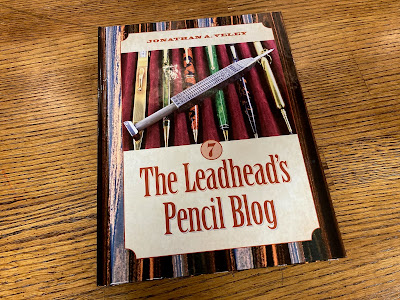

If you don't want the book but you enjoy the article, please consider supporting the Blog project here.

One of the items that I received from Don Jacoby’s collection was this little gem - I knew what it was without reading the imprint:


I’ve only seen those floral bands at the top and bottom of the barrel, with another floral band running diagonally between them, in two other places . . . 


. . . that is, on the two other examples I have of this same pencil:


These are all marked “Perfect Point”:
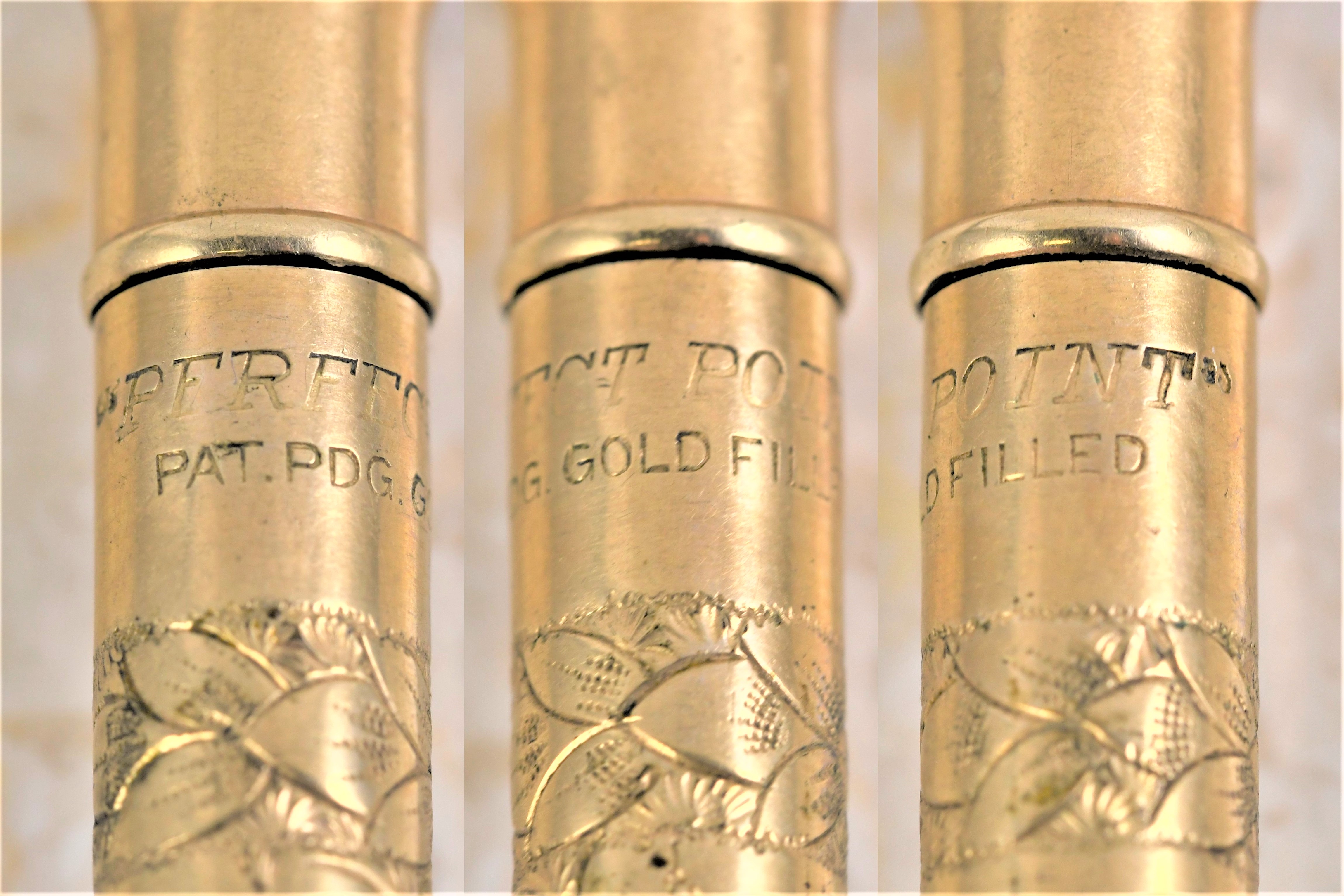

The top example is the one that caused me to explore the history behind this brand during the first year of the blog (Volume 1, page 334).  The Perfect Point was the flagship product of the Stull-Boylson Company of Fremont, Ohio (he said, swelling as I did in Volume 1, with Buckeye pride).   

Jacob Henry Stull, of Fremont, Ohio, applied for a patent for the Perfect Point on June 19, 1919, and it was granted December 7, 1920 as number 1,361,115:


The drawing shows why my other two examples aren’t working.  The example from Volume 1 is missing the propelling rod, and the second one that limped into the museum is missing . . . well, pretty much everything inside:


I was thrilled to find that Don’s example is in working condition. What made the Perfect Point special was a truly elegant design: the pushrod and screw drive is just a single piece of wire, wrapped around the inner tube to engage threads inside the barrel:


The Perfect Point was offered in a wide range of varieties during its short but spectacular run.  The short models are typically ringtops, with a distinctive bail over the top crown.  Very rarely, short models with clips turn up:
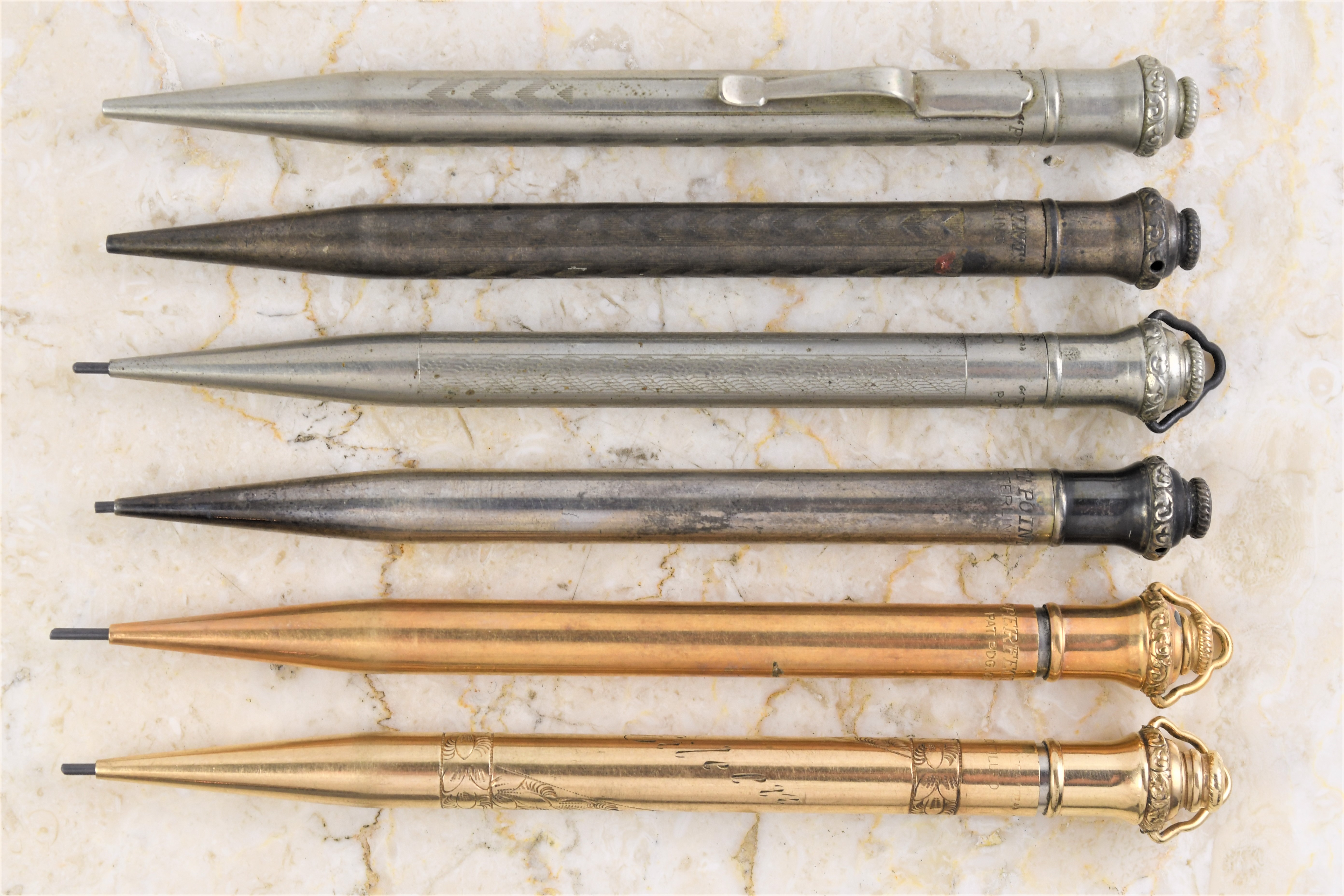

Then there are the longer models, which cut a commanding presence equal to anything the best pencil manufacturers were offering at the time:


“The Pencil That’s Always Sharp,” the box lid at bottom states.


The green gold example with price tag indicates that the Perfect Point was a luxury item, with a $6.00 price tag that exceeded the cost of a Parker “big red” Duofold at the time:


The fact that these were so well made, and so many have survived, led me to retrace my steps and see what happened to the Stull-Boylson Company to cut short the brand’s life.  Formation of Stull-Boylson was announced in the Fremont News Messenger on June 23, 1919:


Several local men were the incorporators, but the three officers were Jacob Henry Stull, President; E.J. Boylson, “formerly of Cincinnati,” Vice President, who is described as having years of experience and who also “is interested in several other patents recently granted to J. H. Stull.”  The new company’s secretary and treasurer was local attorney M.G. Thraves.  The Perfect Point was Stull’s only writing instrument patent; his other patents related mostly to improvements in railroad cars and equipment.

Perfect Point pencils were available by mid-1920.  The first mention I found was when they were made available locally by Druggist H.W. Birkmier, who advertised them in the News-Messenger on June 1, 1920:


By 1921, Stull-Boylson had engaged in a national advertising campaign to promote the new pencils.  This advertisement is from the Oxford (Kansas) Register on September 8, 1921:


Stull-Boylson, as the initial account of its formation indicates, was only “marketing” the Perfect Point pencils.  They were actually being made in Attleboro, Massachusetts - the heart of jewelry production in the United States.  E.J. Boylson was Stull-Boylson’s Attleboro connection: that “formerly of Cincinnati” bit from the initial announcements of the company’s formation was added just for a little all-Ohio flair.

What isn’t clear is whether Boylson was affiliated with some other manufacturer which made Perfect Point pencils for Stull-Boylson, or whether Stull-Boylson had set up its own machinery and equipment in Attleboro to make the pencils itself.  I haven’t found any evidence to confirm the latter, so I’m suspecting the former.

By late 1922, as demand for the Perfect Point pencils was taking off on a national scale, there was a shift in whatever this Attleboro-Fremont arrangement was, and Jacob Stull and E.J. Boylson began making plans to bring its manufacturing operations in-house and integrate them with the company’s executive offices.  They chose Lima, Ohio, some 80 miles southwest of Fremont, as a suitable location.  

On September 6, 1922, the Lima (Ohio) Gazette and Republican published an announcement that Stull-Boylson was considering locating there, “If Lima citizens subscribe $50,000 of the $200,000 capital stock.”  In the article, A.E. Stull is named as the company’s president, replacing the inventor of the pencil, Jacob Henry Stull:


In order to further fan the flames of interest, Stull-Boylson begin advertising in the paper on September 15, 1922:


The stock offering – according to Stull-Boylson representatives – was an immediate, runaway success.  Just a month later, on October 15, 1922, the Gazette and Republican announced that $50,000 in local investment had been secured, a site for a new factory had been purchased on Water Street, and the company was relocating to Lima.  Plans must have been in motion well in advance of the September stock offering, since the article provides specific details concerning the planned factory, which would measure 50 by 200 feet with three sides made of glass.   “[T]he first story of the building will be completed and the plant [will be] in operation by mid-December,” the report indicates . . . 


. . . MAYBE.  There’s a few curious details in this news story that suggest something more was afoot.  First, the report states that the “Perfect Point Pencil company” (that’s “company” with a lowercase “c”) was relocating to Lima – maybe that was shorthand, since people in Lima might not have associated Stull-Boylson with the pencil’s brandname, but it might also indicate that a new company separate and distinct from Stull-Boylson was being set up for a fresh, new venture . . . rankling local investors who had so recently been enticed to invest in Stull-Boylson.

Second is the activities of E.J. Boylson detailed in the report.  He was in town to consult with the architects about the new factory when the account was published, but at the end of the article, the story states that “Boylson will leave Lima this morning for the east where he will purchase machinery which will give the local plant five times the capacity of the Attleboro plant, it is said.”

What followed was an almost immediate implosion of the company.  On December 12, 1922, notice was published in the Gazette and Republican that Stull-Boylson had applied to amend its Ohio securities license so that it could deal in its own securities, rather than going through A.A. Meggett, the company’s agent of record:


Then, just six months later, McAllister’s Book Store in Fremont, Ohio published a large advertisement in the News-Messenger announcing that it had purchased “the stock of the Stull-Boylson Mfg. Co., who are retiring from the manufacturing business.”


The collapse of Stull-Boylson now takes on the characteristics of a century-old murder mystery.  Who killed the company, just as its coffers were full of fresh capital and the fortunes of its flagship product were on a meteoric rise?   All of the scenarios are fascinating.

1.  Perhaps the company made a huge gamble and overextended itself - if the $50,000 capital drive didn’t really succeed, contrary to Stull-Boylson’s statements, that might explain why Stull-Boylson wanted to fire its stock agent.

2.  If Stull-Boylson was having an unknown Attleboro firm make its pencils, that manufacturer might have refused to sell the company the equipment it needed to put itself out of business – or even used its connections to prevent those from whom it acquired those machines from selling to him.

3.  Jacob Stull’s replacement as president suggests there may have been internal struggles that brought down the company.

4.  Maybe the stock offering to local investors invited a Trojan Horse takeover.  A century ago, Lima, Ohio was primarily an agricultural center.  Where would $2 million (in today’s dollars) in local investment have come from?  While the report indicated stock was offered only to local investors, it would be easy for someone else – someone with a motive to kill off the company – to quietly finance the acquisition of a controlling interest in Stull-Boylson and use that position to quietly and legally put an end to it.

I have two likely suspects.  The less likely of the two would be whatever shadowy Attleboro firm was making the Perfect Point before the company decided to do its own thing rather than have someone else do it for them.  

The reason I believe that is less likely is that there would be no financial incentive: sure, they might have quoted a buttload of money for the machinery, and they might have obstructed the company’s efforts to leave.  However, after the decision was finally made to terminate whatever relationship ended, the only motive remaining would have been revenge, sort of a “if we can’t have you, nobody can have you.”  No businessman – particularly any businessman answering to their own investors – would commit that sum of money just to quelch an outgoing customer like a spurned lover.

A more likely culprit, if this is what happened, would be Wahl Eversharp.  I previously noted how that Perfect Point box lid, with its “Always Sharp” tagline, might have been playing things close to the line in going head-to-head with the pencil giant.  However, the company was actually well over the line, just by adopting the name “Perfect Point,” even if it was in quotes on the pencil’s imprints.   Shortly after Wahl entered into the pen and pencil business, stationer advertisements across the country touted the Eversharp in company-supplied language: as “The Perfect Point Eversharp”:


Wahl would have had a legitimate business reason to squelch an up-and-coming new pencil company, which was capitalizing on a name Wahl used extensively in advertising, but never registered as a trademark.  How much would Wahl invest to gain control and then quietly kill a rival? 

We know Wahl spent the equivalent of $1 million in today’s money to purchase the Boston Fountain Pen Company.  Throwing another million or so to gain control of something that might be a real threat to their investment?  That might not have been seen as throwing good money after bad.

As I investigated all these possibilities, though, a much more likely scenario took shape – the possibility that Stull-Boylson and the Perfect Point were simply collateral damage in a much bigger game.  The first step in establishing the perfect storm that ended the Perfect Point is to have a closer look at the Perfect Point’s nearest relative: the Acme.

Tuesday, April 13, 2021

My First Love

This article has been included in The Leadhead's Pencil Blog Volume 7, now available here.


If you don't want the book but you enjoy the article, please consider supporting the Blog project here.

In the spring of 1999 – gulp, 22 years ago – I was browsing around at the Don Scott Antique Show at the Fairgrounds in Columbus, Ohio.  It was a warm Saturday morning with clear skies, so there were vendors set up outside, in between the three or four buildings that housed the show at the time.
I remember browsing through the offerings of one of those outdoor vendors, displayed in cardboard boxes in varying stages of decay, filled to their brims with what appeared to be the contents of someone’s garage.  It was heaven pawing through all of that stuff.  As I did, a pencil caught my eye . . . my father had me keeping a sharp eye out for pencils that were marked “Autopoint” on the clip, so I pulled it out for a closer look.

“Majestic,” the clip read.  I’d thrown back lots of pencils like this when the clip didn’t say “Autopoint,” since Dad wouldn’t want them.   This time, something gave me pause . . . maybe it was the deep glow of those brown strips of celluloid, or those great geometric, deco shapes on the center band.  It just had a bit of class to it.  Maybe, I thought to myself, if it isn’t too expensive I’ll just buy this one for myself.

It was a buck.

There’s two types of people on this planet.   The normal ones would have spent a buck to take this one pencil home and be happy with a nice find they will use and enjoy for the rest of their life.  

Then there’s collectors, who wonder how many more of these things are out there.

With that Majestic in my pocket, I continued to wander around and I had a fateful meeting with Terry Mawhorter, of Ohio Pen Show fame, who used to set up at the Scott Antique Show when he lived up north in Zanesville.  I remember being enthralled to find someone whose entire display was dedicated to exactly what I was kinda sorta looking for.

I was excited to share my crappy, $1 Majestic pencil with Terry.  In his calm, measured voice, he said to me, “that’s nice . . . but let me show you something a little bit more special.”  And Terry showed me a full-sized Eversharp Doric pencil in Kashmir (green marble).

That was it . . . my first “real” pencil purchase.  I was hooked, and for my first couple of years attending pen shows (at first, just two . . . Columbus and Chicago), I was laser-focused on finding other Doric pencils.  It was, as the title of this article suggests, my first love.

I haven’t written about it much here at the blog, but that’s only because by the time I wrote The Catalogue in 2011, I already had already assembled nearly all of them in my collection and included them in the book.  I haven’t had much to add.

However, one whopper of an addition came my way in recent months, by way of my friend Michael Krut:


Black and pearl is an ubiquitous celluloid during the Golden Age – but in the Doric series, it is a unicorn which commands special attention.  When the Doric was introduced in 1931, it was documented in five colors: Jet (black), Morocco (red marble), Kashmir (green marble), Burma (grey marble), and Cathay (an electric, almost glow-in-the-dark green).  Black and pearl, common in earlier Wahl flattop and Equipoised pens as well as an industry-wide favorite, was never a catalogued color on the Doric.

Yet they turn up, very rarely.  Just often enough to whet collectors’ appetites, so they command substantial premiums.  And this set is just flawless . . . 


There’s collector’s lore about the black and pearl Dorics, but nothing documented . . . just stories that they were made for Wahl employees as gifts.  This is the only trim configuration in which they are found; in The Catalogue, I refer to it as “Doric I,” and it was the flagship trim level when the model was first introduced in 1931.  I’ve found them in four out of the six possible variations, and I don’t know if any exist in the fifth:


Which brings me to a long overdue taxonomy of the type I Doric, since it has the most interesting little variations within its ranks.  We’ll start with the obvious: there are in fact four variations represented here:  when the Doric was first introduced, artwork in advertisements confirms that the trim bands on the pencils were initially split between the upper and lower barrels.


Eversharp’s catalog from 1932 provides additional detail.  A very poor copy is included in the Pen Collectors of America’s library, and a black-and-white reprint is also still available.  At the 2019 DC Show, Rob Bader sold me a slew of old pen catalogs, and this was one of them.  Although it’s a bit worse for wear, it’s original and in full color:


The narrative at the right side of this page states there were four Doric models: full-size with side clip (DC), soldier clip models (DSC), clasp pencils (DK) and ringtops (DW).  Although the artwork appears to show an oversized pencil, larger than the DC, the model numbers provided are the same, so that suggests artistic license rather than a fifth, distinct model.

Note that both the full-sized DC pencils are clearly illustrated with split bands. I have found them in that configuration in the uncatalogued black and pearl, Cathay and Jet.  Note the oversized seals in the Cathay examples:


At some point, the entire trim ring was moved to the lower barrel to streamline production.  If the 1932 attribution is strictly accurate (and the artwork was completely updated), this happened sometime during 1932 or later; however, split bands added unnecessary complexity to the manufacturing process, so Wahl may have made the switch even before the 1932 catalog was published.


Note that while both of the Burma (gray) examples has a silver-colored center band, one has a gold-filled clip and matching gold filled seal, while the lower one has matching silver-colored trim on the cap, referred to in the catalog as “white Platinic gold.”  The cap might be a mismatch, but I’ve never seen a Burma with a gold-filled band and the catalog indicates it was offered only in the white Platinic gold.

Also note the cap on the Cathay example at the bottom, which lacks a gold seal and is fitted with a “second-generation” clip which is stapled into the barrel, unlike the earlier roller clips which were inserted into a slit in the barrel and secured inside by a screw.  This one appears to be a mismatch, although I don’t rule out the possibility that it was created from leftover parts in the same way the “X-Seal” pencils were. 

The Doric “soldier clip” model (DSC) was pictured on the preceding page of Wahl’s 1932 catalog:


Note that this illustration also shows a split band, so the DSC went through the same evolution as the DC model.  That is consistent with the examples I have found, some of which have split bands, while later examples have one-piece bands on the lower barrels:


One of the Cathay examples shown has a gold seal while the other does not, and neither of the Burma (gray) DSC pencils is what I would call normal.  The lower of the two was a split band model, but the cap lacks the upper part of the band (or any groove to accommodate it), and the gold clip is paired with a longer and later gold tip.  Since the tip is so much longer than what you’d normally see on a Type I Doric, I’d say this was likely part of the cobbling-together that happened at Wahl in the late 1930s to clear out leftover parts.  

The other Burma pencil, advertising “Sharp & Smith St. Louis,” doesn’t appear entirely cricket either, with that truncated, non-gold seal cap and plastic jewel mounted in the top.  The weirdness is also reflected in the price sticker on the back side:


According to the catalog, a soldier clip Burma Doric should be model number 40102DCS.  This one is denominated model 4005C.  

The “clasp” model Dorics are shown in the 1932 catalog with one-piece bands, and that is consistent with what I have found:


For the OCD types out there, that is a very satisfying picture, of each color (including black and pearl) in exactly the same configuration, matching the 1932 catalog.  But then the clasp family gets a little weird, too:


The top three lack gold seals . . . we’ll come back to that in a minute.  The bottom four also lack gold seals and are fitted with the longer roller clip seen on the full-sized DC models.  As for the one missing a nose?  It’s a one piece barrel, apparently put together with the intent of wedging a simple nose drive mechanism into the front end.  And those bottom two have that same “jewel” seen on the Burma DSC soldier clip pencil described earlier.  

Now to circle back to the Cathay example at the top in that last picture . . . the proportions are different than all the others, with a shorter cap.  The price sticker has the color coded correctly per the 1932 catalog: 40103 . . . and I can make out the D . . . but I can’t tell what comes next: 


I don’t think Eversharp knew what came next, either, because this oddball is in fact a gold seal pencil – the seal is just on the back side, over a cartouche for engraving:


Weird, yes, but I know exactly why it looks like that.  This brings us to the last and rarest model in the Doric series – the ringtop model DW:


The cap to my model 40103D...whatever started as a ringtop cap, with a slot cut in the opposite side so that a clip could be added.  

Twenty two years after meeting Terry, I’m still chasing down those last few variants.  Examples of the ringtop DW in Jet (black, perhaps obtainable) and black and pearl (which may or may not exist) would put me over the moon.  Finding a true oversized pencil pictured in the catalog and noticably larger than the DCs I have would add significantly to my knowledge on the subject.  The oldest wing in my collection - the Eversharp Doric wing - still isn’t finished.

And I probably need to tell you more about the Doric II, III and IV at some point!

Monday, April 12, 2021

One of Us Needed to Do It

This article has been included in The Leadhead's Pencil Blog Volume 7, now available here.


If you don't want the book but you enjoy the article, please consider supporting the Blog project here.

A few years ago my good friend and Loyal Knight David Nishimura penned a nice article for his blog about the Pal line of pencils made by the Hoge Manufacturing Company (the article is posted at https://vintagepensblog.blogspot.com/2016/01/pal-pencils.html).  

To sum up, the Pal line was introduced in early 1921, and while David indicates a snippet view indicates there’s a reference to Pal pencils as late as 1928, suffice to say that metal pencils were out of style by the end of the 1920s, replaced by brightly colored celluloids.

American Writing Instrument Trademarks 1870-1953 confirmed what David wrote: the “Pal” mark was registered, and the certificate reveals that the Hoge Manufacturing Company first claimed to use the mark on January 12, 1921:

The “Modern,” also manufactured by Hoge, was introduced only the previous year  as mentioned in yesterday’s article (see also “Enough with the Musing” in Volume 3, page 169) . . . at least, that’s the No. 500 propelling Modern.  As my previous article on the brand mentioned, before the Hoge Manufacturing Company delved into propelling pencils, the company offered clutch leadholders under the “Modern” name.  From that earlier article, here’s an advertisement for Hoge’s clutch “Modern,” from The American Stationer on January 2, 1915:


I mentioned recently that it only takes two idiots to set the market in an auction.  Between my interest in the humble budget line of Pal pencils and David’s well-presented article, that makes two potential idiots who might well have set a distorted market for this when this showed up online:


An original catalog of the Hoge Manufacturing Company’s offerings turned up unexpectedly, and David and I both appreciated how unusual it was for one to surface.  We both needed to see what additional details it could add to the story we knew, but we kept our wits about us: either of us would have been happy with a clean, high-quality scan of the catalog, and both of us have the equipment to make such a scan.  Only one of us needed to bid - I was tapped for the job.

I bid the stupid money on the chance that there might be a third idiot out there.  There wasn’t, and I was relieved as the opening bid carried the day.  The catalog is brief – after all, Hoge was largely a one-trick pony, with the Pal as its prized steed:


The catalog is undated.  The “Modern” isn’t listed, and neither are the Pal pencils I suspect were referred to in 1928 (I’ll get to that at some point).  The artwork matches that initial flurry of national advertising Hoge generated when the pencil was introduced, so I’m inclined to believe (1) the “Modern,” introduced in 1920, was discontinued quickly for whatever reason and (2) the catalog dates to the early 1920s.

And that is what makes it so fascinating.

As with most trade catalogs of the period, there’s an introductory page which provides a bit of company backgrounds, similar to an “About Us” tab on a modern webpage (modern, that is, in the general sense). The Hoge introduction includes just enough information to piece together something I’ve suspected – but never been able to prove – for years:


According to the company’s own contemporaneous account of its history, it was founded in 1912 (that bucks a bit of information floating around in several places on the internet, which states that Hampden Hoge founded the company in 1909 – we’ll get to that in a minute).   The catalog identifies Hoge’s location at 157 Fulton Street, New York, which is consistent with what we already knew about the company.  But then there’s a curious detail:  “Established factories in Connecticut were subsequently acquired,” it states.

Curiouser and curiouser, the account becomes.  “For example, it is not generally known that forerunners of the highly developed ‘Pal’ line of all-metal propelling pencils were first made in this factory fifteen years ago,” it states.

The timeline does not appear to line up at first.  If Hoge was founded in 1912 and this catalog is from the early 1920s, that means these “forerunners” were manufactured in Connecticut by someone other than Hoge.  Fortunately, these “proto-Hoges” were still in production when the catalog was published:


Unmarked clutch pencils such as these are ubiquitous, and I would have trumpeted my suspicions that they were Hoge products a long time ago – if I had not already attributed them conclusively to someone else here at the blog many years ago.  Someone in Connecticut.  In fact, someone in the “Naugatuck Valley,” where Hoge’s snazzy, “most up-to-date” manufacturing facilities were located:


This image is from an article I wrote here at the blog very early on, in Volume 2 at page 255.  The bulk of the article delved into the meaning of the odd face on the accommodation clip, over which the word “UWANTA” is embossed.  After a bit of digging I concluded this was an American Indian’s face, and the clip advertised “UWANTA” cigars:


However, before I became sidetracked with the neat story behind the clip, I’d noted something else about these UWANTA pencils – a patent date of June 22, 1915:


Which, I explained, was a reference to patent number 1,114,082, issued to Harry Clarence Welton and assigned to the Mattatuck Manufacturing Company of – you guessed it – Waterbury, Connecticut:


Welton’s patent date doesn’t appear on very many of these, likely because the patent was later invalidated.  After all, there isn’t really anything new about the pencil he devised - Heath was making nearly identical leadholders much earlier, and the Faber “Pony Clip” is exactly the same thing, but with innards made of wood rather than metal.

There’s more.

Hoge’s “Pal” line must have been the tail that wagged the Mattatuck dog for a number of years, given how common they still are today, but metal pencils outside luxury models made by Hicks and the like had largely gone the way of the dodo by 1930.  Hoge reinvented itself, as a manufacturer of stamped metal toys and model trains.  

The histories of collectible toys and trains have been much more heavily documented on the internet than writing instruments, and while I haven’t tracked down the original source documents to substantiate the story, all sources agree that the Hoge Manufacturing Company’s toys were manufactured by the Mattatuck Manufacturing Company.

I also found a biographical account of Stuart Edwards Judd, which states that Hoge became a wholly owned subsidiary of Mattatuck in 1940.  Judd, according to this account, served as secretary and treasurer of both companies from 1940 on, becoming the sole owner of Mattatuck when he bought out all of the other shareholders in 1946.  Hoge’s toy lines were discontinued in the late 1940s, after which Hoge served only as a distributor of Mattatuck products until Hoge was finally dissolved in 1958.

Finally, with the missing pieces of the puzzle presented in this Hoge catalog, the entire story is clear.  The Hoge “Manufacturing” Company was a spin-off, set up in 1912 to pursue the exciting new opportunities in the field of writing instruments made in Mattatuck’s factories.  After a few years of spectacular success, Hoge reinvented itself as a toy manufacturer, enjoying additional successes for a couple more decades before folding back into the company from which it originated.  

Pencils to toys, dust to dust.

Sunday, April 11, 2021

Hogey Goodness

This article has been included in The Leadhead's Pencil Blog Volume 7, now available here.


If you don't want the book but you enjoy the article, please consider supporting the Blog project here.

One school of thought, when you encounter wadded-up paperwork that’s more than 100 years old, is that it should be left alone.  “Do no harm” is a common sentiment when it comes to messing with things that might be lost forever if disturbed.

I interpret “do no harm” from a different perspective.  If a piece of paper is disintegrating from age anyway, I feel the only benefit to leaving it alone is to enjoy a fading glimpse of how a box’s contents looked a century ago.  Fading, and inevitably nearing its end.

That, in my opinion, is its own sort of harm.  Given a choice, I think there is more value in preserving the information a piece of paper can pass on than in the paper itself.  Document, document, document is my mantra – if a piece of paper is falling apart anyway, I think it is best that it disintegrate while giving its last full measure to pass on whatever message it contains.

With the contents of this Hoge box, this was going to be a challenge.  As I mentioned yesterday, no amount of care during previewing could prevent more bits of the paperwork from breaking off like snow.  It had at best one last unfolding to see what it said. Here is the paperwork as it appeared in the catalog:


I keep letter-sized, PVC-free document holders on hand for just this purpose, but wrangling old pages into them to flatten them out is always difficult, particularly when they are deteriorated this badly.  I hold the open end of the plastic frame open, then starting from the bottom of the paper, I slide it in as far as possible, working little folds out as I go.  This paper was nearly torn in half and much of the top was already gone, but after ten or so tense minutes (taking nary a breath), I was finally able to exhale, as it flattened out enough to reveal its contents:


The paperwork, like the box, had nothing to do with the Pearce pencil around which it was wrapped . . . but fortunately, it had everything to do with the box.  “Modern” in this context had nothing whatsoever to do with A.A. Waterman, which at one point adopted the name “Modern Pen Company” (the full story on that clarification appeared here in Volume 3, page 169).

As illustrated in that previous article, Hoge’s “No. 500 Modern” propelling pencils were introduced by the company in Geyer’s Stationer on July 15, 1920:


The announcement indicated that as of that writing, Hoge was already “making deliveries” of the No. 500 in silver finish, but that “Their full line of pencils, consisting of different finishes and styles, will be ready not later than September 1st.”

I’ve never seen a Hoge No. 500 Modern in anything other than a plain, nickel plated barrel, nor in different sizes or configurations from what is shown.

As for the paperwork - now that it is in its protective case, it’s possible to remove it but I am doubtful I could do it in one piece.  It has now served its purpose - communicating a little information, now to be preserved electronically as well as in books.  It now has legs and will still convey its message long after I’m gone, for much longer than it would had I left in that box to decay into oblivion.

With respect to the box, I have now installed a No. 500 Modern inside it . . . 


And it now rests comfortably in the “M” section on the wall o’ pencils, a carryover from the days when I wasn’t sure where to put the “Modern” other than alphabetized by the name on it:


Maybe I should move it to the “H” section for Hoge, or at least down to the “P” section alongside its better known Hoge product, the “Pal” line of pencils.

Hmmm... that reminds me that there’s something else I need to show you ...

Saturday, April 10, 2021

My Hogeless Pal

This article has been included in The Leadhead's Pencil Blog Volume 7, now available here.


If you don't want the book but you enjoy the article, please consider supporting the Blog project here.

This one, also from the Krinke auction, made me chuckle when I read the online descriptions, and I had to preview it just to be sure it was what I thought it was.


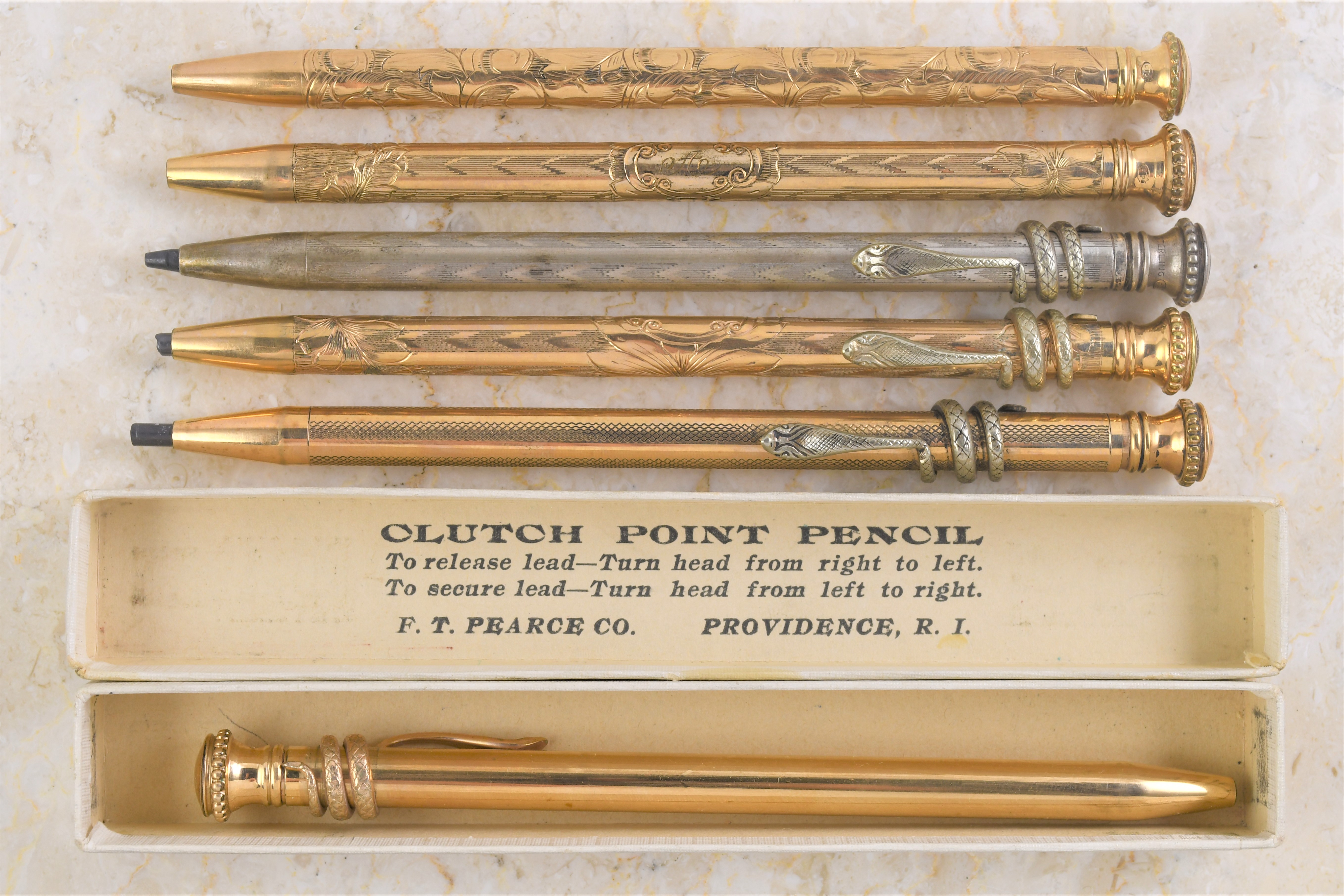
Whoever was writing up the descriptions aptly read what was on the box lid and described Lot 2338 as a “Hoge Mfg. Co. Stock Broker Gold Filled Pencil.”  The notion of the Hoge Manufacturing Company making that pencil was absurd to me – from all appearances, that was a leadholder made by the Frank T. Pearce Company, like these:


I had shot this latest family portrait of Pearce leadholders only a couple weeks before the Krinke auction, in anticipation of writing an article about that top example, which has a couple interesting new wrinkles worth mentioning:


The first wrinkle was my motivation for buying it.  It’s the first time I’ve found an example with a fraternal emblem on top. 


Although it’s damaged a bit, the John Hall connection warmed my heart.  As a Mason, John was also a member of the Shriners – what he called the “drinking Masons.”  We’ll just call this a “Shriner’s Pour” of cache added to my collection.  However, when this one arrived and I examined it up close, there was a second detail I found curious:


Instead of the familiar “FTP” in an oval for Frank T. Pearce Co. (the oval is actually the letter C, with a tiny “o” nestled on the right side for “Co.), this one was marked simply “Sterling” with no trace of the typical Pearce hallmark.

Frank Pearce died tragically in 1914; more tragic was that his only male heir who would carry on the firm, Aldridge Pearce, died very shortly thereafter.  The firm was apparently absorbed by Pearce’s former employer, the A.T. Cross Company, which continued to use this snake clip and later streamlined it for use on pencils into the 1930s.

(Note: for the full story on Pearce, George T. Byers and the patent litigation over the clip, see Volume 3, page 260.  For Pearce’s snake clip on a humongous Cross stockbroker pencil, see Volume 6, page 113).  

Both the fraternal emblem and the lack of a Pearce hallmark – two features I’ve not encountered on these – suggests that this was actually turned out by Cross, very shortly after absorbing what was left of the company.  

There was something else that struck me about this recent addition.  With only one exception, all the larger models I’ve turned up have been in gold fill, with only one example coming my way in sterling:

On the other hand, without exception all the smaller ones I had found are made of sterling.


I stopped short of writing the article which would have ended right there.  An intervening Hoge connection between the Pearce years and Cross, while extremely unlikely, would be fascinating.  Since I was planning to attend the Krinke auction anyway, I couldn’t wait to examine this “Hoge Stockbroker” in person, to see what interesting twist it might add to the story.

The preview was disappointing.  The box barely squeezed into the square plastic container in which the auction house packaged individual items - so tightly that some of the lettering on the box lid might have been wearing off a bit every time it was removed.  I removed the pencil for examination as gently as I could, but a couple pieces of the fragile paper inside came apart, so I couldn’t read whatever it contained.  There would only be one more opportunity to carefully flatten it out to see what it said, although I could make out “The Hoge Mfg. Co.” at the bottom end.

And then there was the pencil, badly dented with pliers at the nose end by some nimrod who apparently thought you turned the nose to make it work (I’m sure it wasn’t Fred Krinke - just someone with whom this pencil had an unfortunate encounter in its 100-year lifespan).  At the crown, all was revealed: whoever wrote the description apparently looked no further than the box to see whether the pencil had anything to do with it:


Yep.  It’s a Pearce.  Not a shred of evidence supported any connection with Hoge – unless that fragile paperwork established some previously undocumented connection between the two companies.

Damage aside, I still thought it might be worth a roll of the dice.  I notified the auction house of what I found during the preview, but no announcement was made during the auction of the discrepancy between what the pencil was versus how it was described in the catalog.  I had to pay more than I wanted to, but my new, worse-for-wear Pearce did add a wrinkle to the story I had planned to write:


This is the first time I’ve found a smaller sized example in gold fill, so I’m able to amend my third observation from the article I was going to write earlier: most of the smaller Pearce leadholders I have found were sterling, not all of them.

Now, for a closer examination of that paperwork . . .