Monday, May 25, 2020

Stars of the Show

This article has been edited and included in The Leadhead's Pencil Blog Volume 6, now on sale at The Legendary Lead Company.  I have just a few hard copies left of the first printing, available here, and an ebook version in pdf format is available for download here.

If you don't want the book but you enjoy this article, please consider supporting the Blog project here.

A while back I posted pictures of a large lot of pencils I had plucked from the garden of online shopping:


Offhand, I had mentioned that two items in this mess of mostly junk would pay for the whole party, at least as far as I was concerned.  After all, you might have spotted in this mess two unusual looking pencils:


Those gawky looking tops and long metal noses are dead giveaways that these are Riedells, among the most interesting and goofy pencils ever made:


The Riedell is listed in The Catalogue, and the picture on page 126 says it all about how weird these pencils were:


And then, as if on cue and arriving just in the nick of time to include in this article . . . these two examples also turned up:


A while back I posted a couple articles detailing the full history of the Riedell Corporation and its quirky accountant-turned-pencil-tycoon, Charles M. Riedell (The Leadhead’s Pencil Blog Volume 3, page 41-46).  Thanks to the Riedell family, I had a fairly good idea of the extent of the known universe of Riedell pencils after Lynn Riedell forwarded me pictures of the sales sample cases he had inherited:


Over the years I’ve managed to find examples of most of what is shown in these cases, including the full sized models in six colors and two trim levels (the teal and bronze marble was the first example I found, but there wasn’t one in the Riedell family archive).


The Riedell family has several examples with price bands - with these latest two additions, I've got three, designating that the base model with nickel plated trim was $2.50, gold filled trim was $3.50 and gold filled trim in fancy colors sold for a whopping $5.00:


Ringtops have proven more difficult to come by. I’ve only found three varieties:


As detailed in my previous articles, the Riedell was named for and marketed by Charles Riedell beginning in late 1928, but it was invented by Hugo Hasselquist, best known among pencil guys as the inventor of Wahl’s “military clip” used on metal pencils.

In A Century of Autopoint, I documented Hasselquist’s departure from Wahl to join Charles Keeran with his new business venture, and Hasselquist became the first vice president of the newly formed Autopoint Pencil Company in 1920 (page 16).   The first incarnation of Autopoint quickly ran into financial difficulty, and Hasselquist disappears from the slate of officers at Autopoint when the new leadership team was elected in April, 1921.  I haven’t been able to trace his movements after then; by June 5, 1922, when he filed the patent application for what would become the Riedell, it appears he was on his own living in Chicago - the patent was not assigned to anyone:


It would be more than seven years for Hasselquist’s patent to be granted, on July 9, 1929.  If I ever found a Riedell with that patent date on it, I’d believe they were produced for more than just a few months.  But I’ve never seen one with the date - all of the examples I found indicate that the patent was still pending:


There was one patent for the Riedell which had been issued by the time the first pencils were marketed in late 1928:  Hasselquist also secured a design patent for that distinctive faceted cap, which applied for around the same time he applied for the utility patent for the Riedell.  However, his design patent (number 66,797) was issued much more quickly – on St. Patrick’s Day, 1925.


Legitimately, Riedell pencils could have been stamped with this patent date when they were introduced in late 1928; why they weren’t is a mystery to me, since both the utility and design patents were held by Hasselquist.  That’s the thing about these research projects – I knew I wasn’t quite finished writing about these pencils in 2014, and although I’ve added a few more details in 2020, I know this story isn’t complete - yet.

I just keeping tugging on the loose strings thinking maybe one of these days the rest of the sweater will be unknitted.

Sunday, May 24, 2020

Not Quite Right

This article has been edited and included in The Leadhead's Pencil Blog Volume 6, now on sale at The Legendary Lead Company.  I have just a few hard copies left of the first printing, available here, and an ebook version in pdf format is available for download here.

If you don't want the book but you enjoy this article, please consider supporting the Blog project here.

Here’s a throwback from two cameras ago: I found this Waterman pencil at a show several years ago, and never got around to writing about it:


The clip gives this one away as a Waterman:


I’ve got a number of these in different colors, but at the time I didn’t recall having an example in plain ol’ black and pearl (or nacre, in Watermanese).  The 1933 catalog refers to these as the “Short Ninety Two,” but the pencils were Model 91v (the “v,” in Watermanese, was for vest pocket model, even though these had clips).


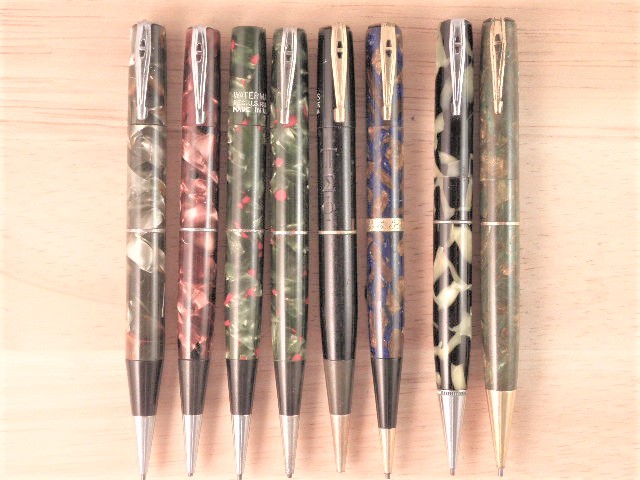
But there’s something that didn’t look quite right about this pencil, and the point is best illustrated by showing it alongside other 91v pencils:


The ones on the left have a two-part nose section with a hard rubber portion, reminiscent of other Waterman models such as the Patrician, introduced in 1929.  Since the 1933 catalog shows the 91v with a plain nose drive mechanism, I’m betting that the mechanism was simplified in the interests of cost-cutting as the Depression wore on.   Note that there’s three different styles: a thin long rubber section, a thin short one, and a stubby short one. 


And notice one other thing:


The 1933 catalog doesn’t show a nose with those ribs around the ferrule.

Saturday, May 23, 2020

A Taste of Normal

This article has been edited and included in The Leadhead's Pencil Blog Volume 6, now on sale at The Legendary Lead Company.  I have just a few hard copies left of the first printing, available here, and an ebook version in pdf format is available for download here.

If you don't want the book but you enjoy this article, please consider supporting the Blog project here.

In that recent article I published about the Waterman Patrician (https://leadheadpencils.blogspot.com/2020/04/putting-that-first-year-designation-to.html), there was something in that first picture that bugged me.  If you are OCD like me, you already know what I’m talking about:


Yeah.  My banded turquoise has the same clip from the Waterman Number 7, rather than the traditional Patrician clip . . . and (cue fingernails on a chalkboard) it doesn’t match the clip on all the other banded Patrician pencils in that picture.

The reason has been my fascination with “closeout” Patricians made in the late 1930s, using leftover parts from the Patrician line blended with parts from later models.  I’ve written about those several times here – most recently at https://leadheadpencils.blogspot.com/2016/12/three-patricians-from-ohio-pen-show.html (if you’ve got the Leadhead’s books, the seminal article explaining these - “With Apologies to Mr. Nishimura,” is in Volume 2, starting at page 37).

Patrician pencils, especially in the more desirable colors like turquoise, are expensive.  Given a choice between a “normal” one and a closeout edition, I’ve found the latter more interesting; satisfied with what’s in my collection, I haven’t been going out of my way looking to drop a fair amount of change on something that feels . . . frankly, a little anticlimactic.

But with that picture sticking between my ears like a pebble in your shoe, I happened to stumble across normal, and at a reasonable price:


So there’s a nice range of Patrician pencils in turquoise, from bandless “first year” (not really), banded normal, banded but with a No. 7 clip as Patrician clips ran out, and at bottom, one made after Waterman’s supply of Patrician clips, bands and longer nose sections had all run dry:


Staging all those pencils from the first picture was a bit of a pain in the rear, and I’ve not gotten around to reshooting it.  Guess for now, I’ve just pulled that pebble out of one shoe and put it in my other one!

Friday, May 22, 2020

The Widest Range in the Narrowest Market

This article has been edited and included in The Leadhead's Pencil Blog Volume 6, now on sale at The Legendary Lead Company.  I have just a few hard copies left of the first printing, available here, and an ebook version in pdf format is available for download here.

If you don't want the book but you enjoy this article, please consider supporting the Blog project here.

In April, 2018, I identified the producer of  “Supremacy” pens and pencils along these lines:


The article is still live and identifies the Supremacy Ink Company, successor to the W.L. Henderson Ink Company of Medford, Massachusetts as the company which used that very same Supremacy logo in old English-Robin Hood looking script (see https://leadheadpencils.blogspot.com/2018/04/weve-all-had-it-wrong.html).

And the Henderson Ink Company had pens and pencils made for and supplied to it by . . . drum roll . . . The Rex Manufacturing Company of Providence, Rhode Island.

Most Supremacy pencils are like those in that first picture; oversized, often bearing the “four horsemen” patents I’ve discussed here quite a bit (check out The Leadhead’s Pencil Blog Volume 1, at page 103 . . . and the sad part is I knew the volume and page without looking it up at this point!).  However, Supremacy was one of Rex’s earliest and best customers:


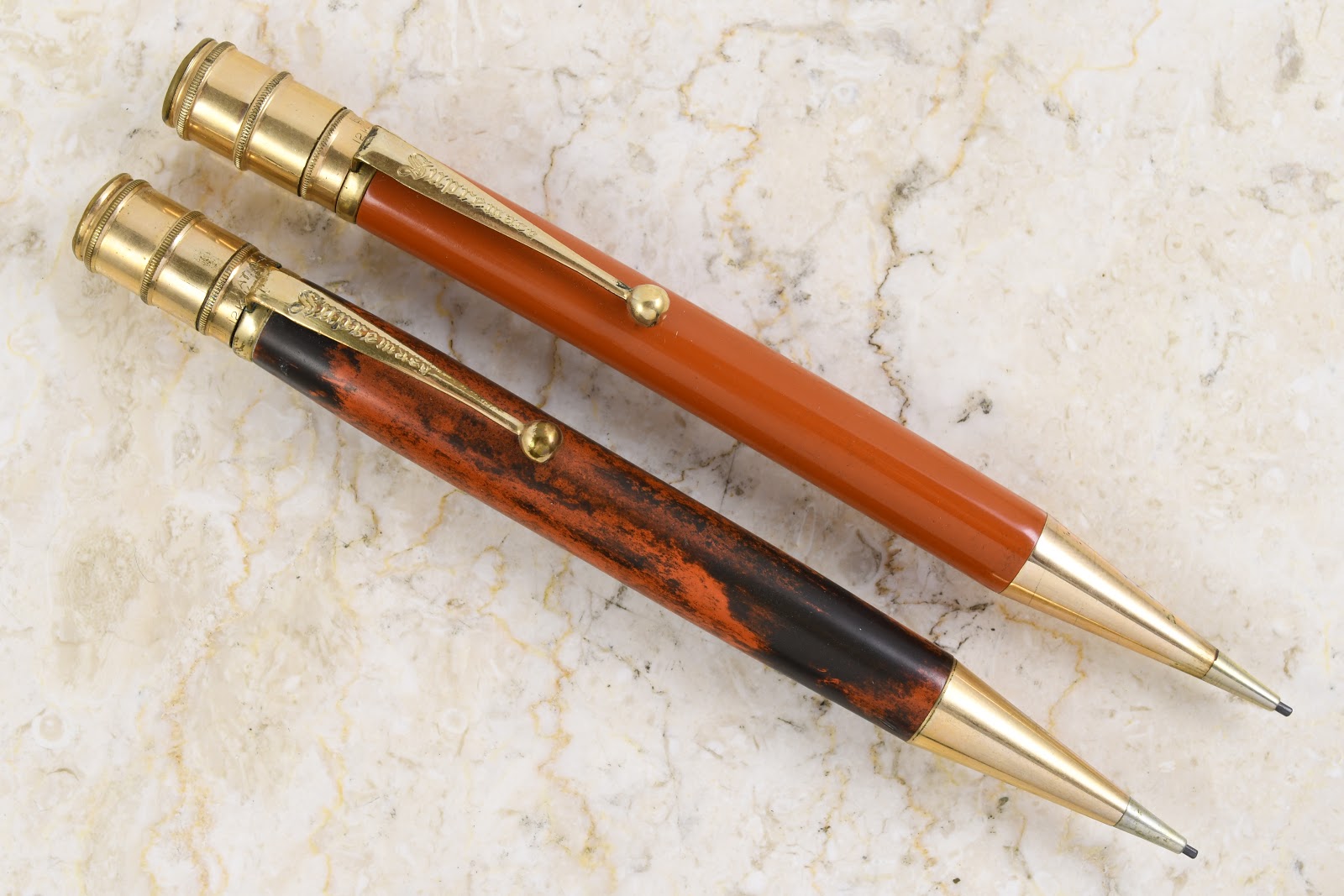
The lower pencil, a ringtop, has McNary’s early patent of February 19, 1924, which ranks Supremacy among the earliest Rex customers . . . I’m sure there’s an even earlier metal pencil out there somewhere, but I just haven’t turned one up yet.  The top example is what’s really interesting: it’s a thin model, but in the later incarnation using the “four horsemen” patented innovations.

After that last picture was taken, I managed to score a full length Supremacy in 1924 patent configuration - here it is, alongside that ringtop and the red full-sized slim model from above:


Note that the distinctive rib on the nose present on the black pencils, with the earlier 1924 date on them, is missing on the later red one. Note also that the red thin-model Supremacy sports that clip and cap that eventually got Rex sued by Parker in 1929, since there’s a washer clip hidden in that bulky mounting.


We’ll get back to that in a minute, but the other thing I want you to pay attention to is the caps – the 1924 patent pencils have short caps, while the later ones had more substantial top sections.  In fact, the Supremacy models appear to have been made before the 1924 patent was issued, since neither has that date stamped at the top:


Keep that checklist of characteristics in your head while I show you what I found at the Springfield Extravaganza last fall:


The dealer who had this set keeps a scale at his table on which he measures every bit of gold-plated junk he has and quotes you a generous fraction of his version of  “gold value,” so when he told me 25 dollars for the set I couldn’t pull the money out fast enough before he changed his mind.   This set is something special – I’ve never seen that color on ANY Rex product, ranking Supremacy right up there with John Holland as the only two companies who have merited special colors.

The pen, were it not be accompanied by the pencil, might be hard to peg.  The nib is nondescript:


But the lever does have that distinctive old English S:


There’s also some nice detail on the bands on the cap, and the faceting on the barrel and cap end with some really nice patterns, too:


Most of the time, it’s the pen that has the more detailed imprints, but in this case, it’s the pencil that clinches this one:


And it’s a McNary patent, but notice that it has the later, more substantial top and while the rib on the nose has been eliminated, there’s a ring of dimples.  Looks like this is a transitional set, somewhere between 1924 and 1925, exhibiting evolutionary steps in between the earlier models and the “four horsemen” era – and in a color I haven’t seen anywhere else.

And speaking of things I haven’t seen anywhere else, check this one out:


Without an imprint, it took a minute for this one to register with me what it was.  Until it came along, I was only aware of one other example like it:


It’s another slim model, “four horseman”-era Rex pencil.  Since the only other one I’ve found was marked Supremacy, that would be my first guess . . . except this one isn’t marked on the clip, as all other clip-model Supremacy pencils I have are.  As shown, the Supremacy cap is a perfect fit, in case you harbored doubts whether this was the same pencil.  Note also that the mystery pencil has the two-stage tip.

Many Rex models were marked on the cap only, including John Holland and Pick.  Finding another slim model cap will be a challenge, and if I do it will likely be attached to something I wouldn’t want to part out.

Thursday, May 21, 2020

Mother of All Ringtops

This article has been edited and included in The Leadhead's Pencil Blog Volume 6, now on sale at The Legendary Lead Company.  I have just a few hard copies left of the first printing, available here, and an ebook version in pdf format is available for download here.

If you don't want the book but you enjoy this article, please consider supporting the Blog project here.

Chuck Cohen had this inconspicuous hunk of metal on his table at the Philadelphia Show in January:


We both knew what it was, so it was an easy sell – there’s a lot more going on here than meets the eye:


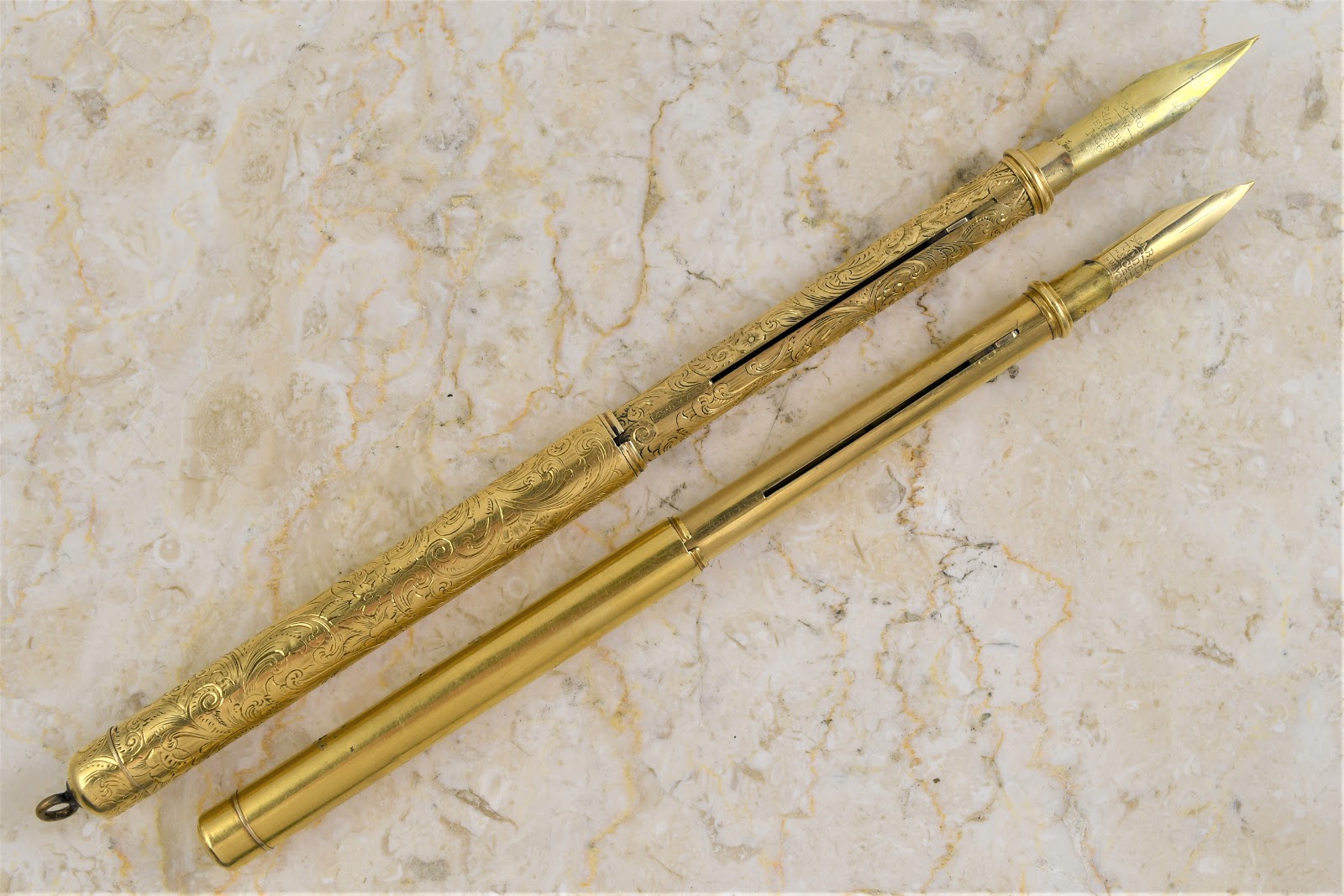
The front end pulls out to reveal sliders on either side of the extension tube, one for a dip pen nib and the other for a pencil.  The nib in this one may or may not be right . . .


Mabie, Todd & Co. was headed by John Mabie, who had previously worked with, and eventually became partners with, John Rauch – one of America’s earliest pen and pencil makers.  Mabie sort of “retired” for health reasons from Rauch’s firm in 1851, but Mabie was back in New York by late 1852 to form a new partnership with Alexander Johnston, then John Knapp (see ). 

Why is the John Mabie connection relevant?  Because of what is very faintly imprinted on either side of the barrel:


“Rauch’s Patent / Jany. 6 1852.”  The reference is to patent number 8,640 issued to John H. Rauch on that date:


There’s an important nuance in this imprint: it’s “Rauch’s Patent,” so it doesn’t necessarily mean it was made by or sold by John H. Rauch.  Maybe it was, maybe it was licensed for production by someone else.  Or should I say, “Mabie” it was licensed for production by someone else, because the two remained at least friendly in later years . . . there’s a lot of crossover between Mabie Todd products and Rauch products.  Suffice to say that if this didn’t have a Rauch nib, I would still consider it perfectly correct with one bearing a Mabie Todd imprint.

This was the second example of an 1852 Rauch patent I had found and truth be told, I had to get it because I want to see how it measured up to the other one in my collection . . . literally.  As you’ve probably gathered from the title of this article, my other 1852 Rauch is a ringtop, but if you were expecting a dainty little ladies’ version of this combo, I’m sorry to disappoint . . .


She’s bigger, she’s heavier and while she sports neither a Rauch nor a Mabie Todd nib, the one that’s in it is a substantial bit of hardware:


That Fairchild Number 6 nib will get some attention when you whip that thing out!   Every square millimeter of this is hand engraved as exquisitely as a presentation pistol:


Every bit, of course, except exactly enough space for the imprints, and not one bit more: