Showing posts with label Innes (George) Co.. Show all posts

Saturday, June 12, 2021

The Inconvenient Question

This article has been included in The Leadhead's Pencil Blog Volume 7, now available here.

If you don't want the book but you enjoy the article, please consider supporting the Blog project here.

One of the things from Don Jacoby’s collection that I liked the best was this Carter’s pencil, complete with its rounded celluloid case.  It didn’t bother me that the pen was missing:


The Carter imprint is easy to miss on these:


Later Carter pencils are unmarked, like this next one, and it took me some time to attribute these to Carter (see Volume 5, page 164):


I didn’t remember seeing a Carter that matched its carrying case so closely . . . until I arrived back at the museum and went to file it away.  I’ve posted so many articles here that I had forgotten that I wrote about a similar set (Volume 5, page 263):


The pencil from Don’s collection is, I think, a little bit earlier – a thought I come by honestly, after Rob Bader sold me a copy of Carter’s “Catalog 11" at the DC show a couple years ago:


This catalog is from 1931 or so, near the end of Carter’s run as a pen and pencil manufacturer.  I gave a copy to Ross McKinney, who used it as the backbone for his article on later Carters for The Pennant recently since it redifines what we thought we knew about Carter’s later years in its short four pages.  On page 2, we see the pencils with short noses and that later clip like the blue one from Volume 5, and the longer-tip pencils are discontinued:


Note also the pencils on the left; the venerable DeWitt-LaFrance clip has been abandoned in favor of a more streamlined version on the “Pearltex” line.  They are also shown on the following page of “Coralite” pens and pencils:  


I’ve got a few of these later Carter pencils in the collection:


I suppose the black with brown swirls might pass for “Mahogany” as described in the catalog.  There’s no gray listed, and that funky blue striated plastic?  I can’t believe they would just call that plain ol’ “Blue.”  

Then there’s those bottom two pencils: back in the days before Rob parted with that Carter catalog, I called that pattern “snakeskin.”  However, the last page of Catalog No. 11 refers to them as the “Mosaic Line”:


Although Catalog Number 11 shows Coralite, Pearltex and Mosaic pens and pencils all in the same trim configuration, note that the two Mosaic examples I have are a little different:


They are smaller, the nose is longer, and the top trim band is omitted in favor of a plain, black top on my Mosaic pencils.  


They aren’t like any other Carter, but they do resemble something else:
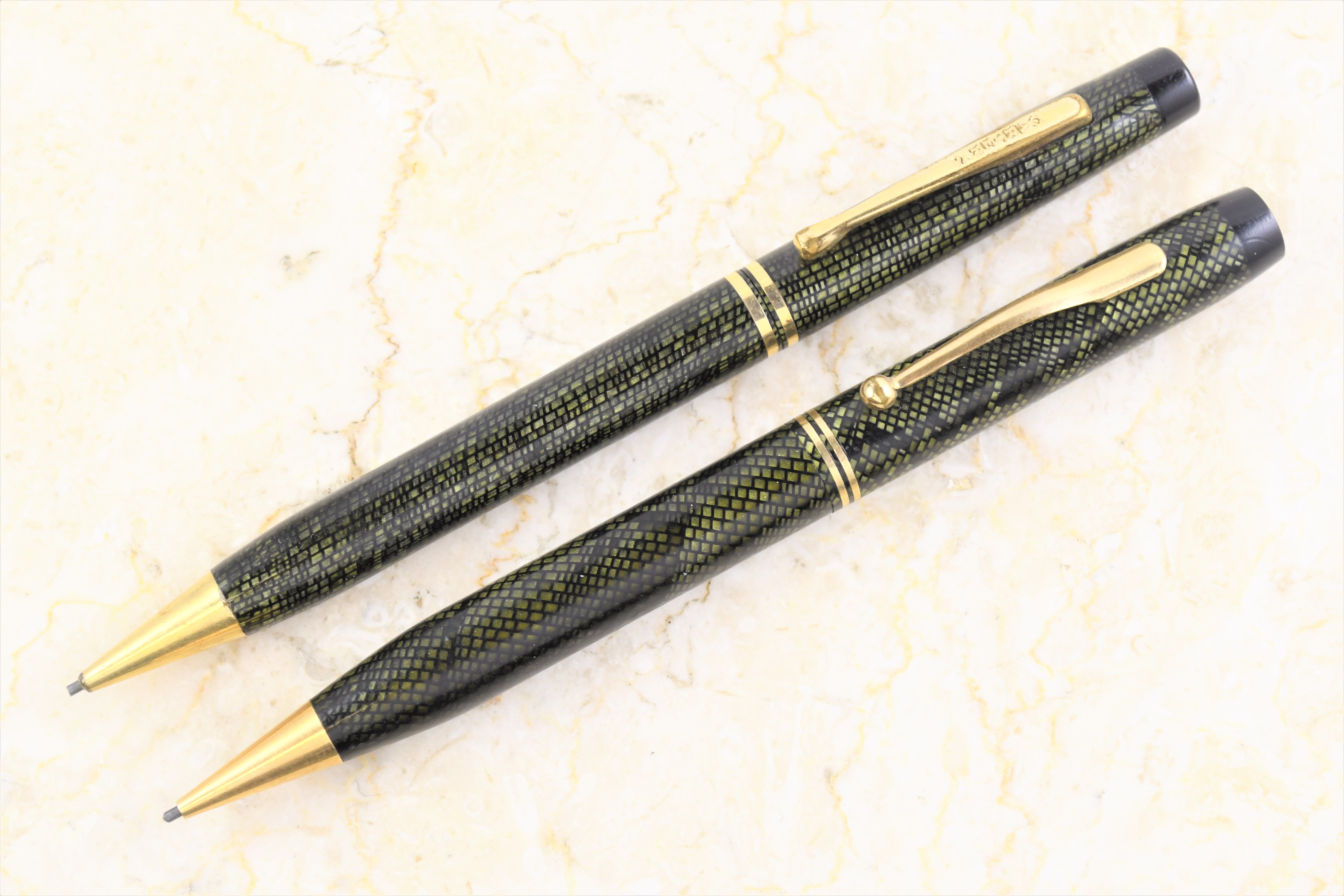

That other pencil is marked “The Geo. Innes Co.” and it was made by the Seth Crocker Pen Company (see Volume 5, page 159), which made pencils for the Innes store, as it also did for Macy’s (Volume 5, page 161).  

Let’s throw something else in the mix: the Seth Crocker pencils were protected by a design patent.  Seth Chilton Crocker applied for the patent on July 8, 1934, and the patent was granted as number Des. 94,118 on December 25, 1934:


I titled this article “The Inconvenient Question” because every time that I ask it, everybody just looks at me like I have lobsters coming out of my ears and goes back to talking among themselves.  The question is this: if the Seth Crocker pencils were protected by a design patent, and these Carter Mosaic pencils are exactly like a Seth Crocker but with the grid running straight instead of on the diagonal . . . is there any connection between the Carter and the Seth Crocker?


I’ve attributed the Carter Catalog Number 11 to 1931, but there’s no dates inside it . . . and it might be later: after all, the only newspaper advertisement I found which shows anything like what’s in Catalog Number 11 appeared in the Asbury Park (New Jersey) Press on December 22, 1933:


Perhaps these were closeouts, distributed after Carter discontinued its operations . . . after all, like so many other companies that perished during the Depression, Carter’s departure from the industry wasn’t announced.  Perhaps Carter then sold off equipment to Seth Chilton Crocker, who then took out a design patent.  

But perhaps, during Carter’s waning days as a writing instruments manufacturer, Carter made writing instruments for Seth Crocker.  

The only thing that I’m certain about is that Carter’s Mosaic line and Seth Crocker’s patented design could not coexist without some agreement.


Thursday, February 22, 2018

In the Heart of Wichita

This article has been edited and included in The Leadhead's Pencil Blog Volume 5; copies are available print on demand through Amazon here, and I offer an ebook version in pdf format at the Legendary Lead Company here.

If you don't want the book but you enjoy this article, please consider supporting the Blog project here.

Note: this is the second installment in a series about the Seth Crocker Pen Company and its connection with the George Innes Company.  To start at the beginning, the first installment can be found at https://leadheadpencils.blogspot.com/2018/02/with-surgical-precision.html.

What a difference seven years makes.

Seven years ago, after piddling around online for enough time that I wish I had it back, I scoured the internet trying to figure out whether the imprint on this pencil, “The Geo. Innes Co.,” was a manufacturer’s imprint or an advertising imprint:


In yesterday’s installment, David Nishimura helped me to establish conclusively that this pencil was made by the Seth Crocker Pen Company.  The question remains, though, what significance the George Innes Company bears on all this.

Seven years later, I sat back in front of a newer computer, with vastly enhanced research materials available on the internet, and I’ve found an answer that fits perfectly into a missing gap in the Seth Crocker story.

The answer at first seems highly unlikely . . . The George Innes Dry Goods Warehouse was first established in Wichita, Kansas, in 1897:


“In the Heart of Wichita,” was the company’s catchphrase:


The store included not only dry goods, but other departments as well.  Here’s a shot inside, from the 1890s, courtesy of the Wichita-Sedgwick County Historical Museum:


In 1937, the Innes Department Store opened in downtown Wichita:


That’s at almost exactly the right time the Seth Crocker pens like David’s and my pencil marked “The Geo. Innes Co.” were made.

So is this an advertiser or a rebadged store brand?  Well, when Parker made pens for Sears, marked with the department store’s Diamond Medal name, it’s considered a rebadge - particularly in light of the fact that more than one company (or manufacturer) made them for the store (which was, in my lexicon, the producer).  The same can be said for Eversharp, Waterman and Sheaffer, each of which made Gold Bond pens for Montgomery Ward.

I haven’t seen any advertisements for Innes pens, but somewhere in Wichita I would bet they are out there.   I do not believe this was an advertising pencil or a “property of” pencil, but one which was manufactured on order for the Innes Department Store for resale as a house brand.

There’s more.

By the 1950s, Innes Department Store advertisements included a subtitle: “a Macy store”:


Eventually, the signage on the venerable downtown location was changed over to reflect new ownership:


What is odd is that I cannot find one shred of information to indicate when Macy’s purchased Innes.  Since Macy’s operated the store under the Innes name, the buyer clearly understood the good will value of the Innes name, so how long the store was operated under Macy’s secret ownership is, as of the writing of this article, unknown. For all we know, the Innes Department Store might have been a Macy's subsidiary when it decided to move into a very Macy's-like building in 1937.

And now, as Paul Harvey used to say, I’m going to tell you the rest of the story.

One of the only things I knew about the Seth Crocker Pen Company when I last wrote about it in 2014 was this detail:

“From some discussion online, it looks like Seth Crocker may have made storebrand pens for companies including R. H. Macy.”

Wednesday, February 21, 2018

With Surgical Precision

This article has been edited and included in The Leadhead's Pencil Blog Volume 5; copies are available print on demand through Amazon here, and I offer an ebook version in pdf format at the Legendary Lead Company here.

If you don't want the book but you enjoy this article, please consider supporting the Blog project here.

Last November my good friend David Nishimura had the opportunity to have a look around the museum on the eve of the Ohio Pen Show.  I was proud to tour someone around, since I had just completed a long overdue (and months-long) project of reorganizing the entire collection:


What amazed me was how quickly David zeroed in on just one specific pencil on this big wall – one I haven’t thought about in years – and one that, given the alphabetical organization of the items on display, was nowhere near where he should have expected to see it:


This pencil is unmarked except for an imprint on the back side of the barrel: “The Geo. Innes Co.”:


The Innes, as I only knew to call it in 2011, appeared on page 91 of The Catalogue indexed under Innes – with the caveat that I wasn’t sure whether the imprint was a manufacturer’s imprint or simply an “unmarked advertising piece for a company unrelated to pencils.”

As it turns out, it isn’t quite either one.  And David knew exactly who made it, because he happened to have the matching pen in tow:


The pen is a Seth Crocker, about which I last wrote in 2014 (see “The Patent Book Passes a Harsh Test” at https://leadheadpencils.blogspot.com/2014/11/the-patent-book-passes-harsh-test.html).  From what I’ve been able to gather, The Seth Crocker Pen Company was organized by Seth Chilton Crocker, the son of Seth Sears Crocker, founder of the Crocker Pen Company.  After Seth Chilton Crocker orchestrated the buyout of Crocker Pen’s assets after his father’s death, he gave the company a new name – Chilton – which operated in Boston but then moved to Long Island before Seth’s investors ousted him from the company that bore his middle name.  Seth went on to form the Seth Crocker Pen Company sometime around 1932, and there is a passing reference that it was still around in 1938.

The last time I wrote about the Seth Crocker, it was about an example featuring a truly bizarre repeating pencil design.  In my defense, there wouldn’t have been any reason to associate these two pencils with the same company, since they share nothing:


The tip, the clip, the mechanism (the Innes has a conventional nose drive) . . . nothing here suggests that these two might be related.  But there was one clue in that previous article that might have tipped me off – I ran down all the patents associated with Seth Crocker, and one of them, design patent number 94,118, might have triggered me to make the connection:


However, I’ve got pencils made by other companies in that sort of pattern, most notably Carter, which threw me off the trail.  Now that I see it, though, I can’t unsee it.  Without question, my pencil marked “The Geo. Innes Co.” is made by the Seth Crocker Pen Company.

But another question remains: if there were a second edition of The Catalogue, would the entry for Innes be deleted and this pencil moved to an entry for Seth Crocker? 

No.  Well ok, I’ll probably put it in both places.  The George Innes Co. deserves its own mention, because it fits perfectly into, and fills in a small gap, that has been missing from the Seth Crocker story.

More on that tomorrow . . .