This article has been included in The Leadhead's Pencil Blog Volume 7, now available here.
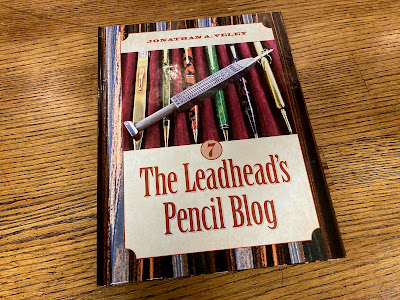
If you don't want the book but you enjoy the article, please consider supporting the Blog project here.
Now to circle back to one of “Specialty King” James Kelley’s advertisements, in which he advertised the “gothic” “Keystone Banker” in 1932.

There was a trademark filed for the Keystone name, but it was registered by Alfred Berolzheimer on behalf of the Blaisdell Pencil Company. Berolzheimer claimed that Blaisdell had been using the mark since January 1, 1911, and he applied for registration on October 27, 1921:

I’ve always thought that the trademark was problematic, since the Keystone pencils I have don’t bear any strong resemblance to Eagle products (Blaisdell was a subsidiary of Eagle by this point); if anything, they look more like they were supplied by David Kahn, Inc.

Then there’s the logo above the word: a K within a Keystone shape most of the time (one has the K within a diamond):

I’ve wondered whether that K stood for Keystone . . . but that seems a bit redundant. Kahn? These look more like David Kahn products, but they aren’t exactly the same . . . and besides, known David Kahn brands have DK in a circle, not just the letter K.
Since Kelley had also “lifted” the Banker and Master names after the previous incarnation of the Bankers’ Pen Company had given it up, and he referred to his “gothic” Bankers as “Keystone Bankers,” I suspect the K on Keystone pens and pencils stood for James Kelley. Once again, Kelley appeared to be appropriating an abandoned name – there was a “Keystone Fountain Pen Company” advertising pens during the teens and early 1920s, using many of the same shenanigans Kelley would later employ. One was advertised in The Bourbon News (Paris, Kentucky) on April 20, 1917:

Keystone is no longer listed in the 1922-1923 New York directory, and advertising halts for this incarnation of the Keystone in 1925; four years later, the Keystone name was revived – apparently by James Kelley – and he would drag yet another third tier brand into the mix.
Classified advertisements for “cheap new” Keystone pen and pencil sets appear in Pomona, California beginning in April, 1929 - at 225 N. Rebecca, a single-family residence. These notices began on April 26, 1929 in The Pomona Progress Bulletin:

Beginning in November 1929, advertisements very similar to those hawking Banker and Waterson pens and pencils begin appearing in drugstore advertisements in Los Angeles, a $11.50 set selling for just $1.50. This one appeared in the Modesto (California) News-Herald on December 11, 1929 . . .

. . . and it was identified as a product of the “Packard Pen Company.” Packard is a name that makes collectors shudder – later examples are some of the ugliest pens and pencils in pen(cil)dom:


Who do you suppose was behind the Packard Pen Company? An advertisement for Packard pens in the Battle Creek (Michigan) Enquirer on June 21, 1928 answered that question:

The tipoff is buried in the fine print: “Packard & Waterson pens also made in smaller size”:

On December 23, 1930, the Rosslyn Drug Company advertised a three-piece set including a pocketknife strongly resembling Salz’ “Three Musketeers” set in the Los Angeles Evening Post:

The following year, “Bullet shaped” Keystone Pens were offered on behalf of its unnamed manufacturer in The Los Angeles Times on September 13, 1931. The similarities between this and Kelley’s Banker advertisements are too much to ignore:

An advertisement in The Idaho Statesman illustrated “Banker-Keystone” pens and pencils on December 16, 1931. These were more rounded than the bullet-shaped models; however, if Sheaffer forced the modification, it didn’t scare Kelley much. These were offered with “Lifetime Chromium” nibs and if you look close, the illustrations showing the letter S in a circle at the top of otherwise unmarked clips:

An address for the company was finally revealed on March 4, 1932, when an advertisement in the Brooklyn Times Union identified the Keystone Pen and Pencil Company at 467 Willoughby Avenue, Brooklyn, New York.

The company is listed at that address in the 1933 Brooklyn City Directory, and Sam Krasnor is identified as the proprietor:

Just as was the case in California, 467 Willoughby Avenue is a residence, in this case a three-story brownstone in an exclusively residential area - the 1933 directory lists Sam Krasnor and his wife Ruth as the occupants. From what I can tell, “Sam Krasnor” had no other connections to the pen and pencil industry – I conclude that he and the Keystone Pen and Pencil Company were just another front for James Kelley’s operations.
Keystone advertisements along the lines of what have already been presented limp along through 1937, after which sets are offered on clearance for less than a dollar – no gimmicks, no side deals. I never found any indication that the Federal Trade Commission caught up with Sam Krasnor or the Keystone Pen and Pencil Company, so perhaps Kelley’s nine-headed Hydra sacrificed a noggin for the cause.
However, the FTC did catch up with the Packard Pen Company, identifying it as an alias for one Harold Tanner – another name with no other apparent connections to the writing instrument industry. On August 23, 1937, the FTC enjoined Tanner from the same litany of offenses as Kelley’s other enterprises, including specifically his use of the term “Lifetime Guaranty” . . .

. . . and his use of “Master Banker’s” as a measure of size. If the FTC had any inkling what was going on, they would rightly had assumed that the use of “Master” and “Banker” only meant James Kelley was behind it all.


