Showing posts with label Aikin Lambert. Show all posts

Sunday, October 5, 2025

Rehabilitating a Lovely Rulebreaker

I simply had to have this one when it showed up in an online auction recently, even though it broke one of my rules:


This sterling silver pencil has everything going for it . . . everything, that is, but that one thing I always look for: some marking to indicate who made it.


I held out hope, however, that the information stamped on the clip might help me attribute it to a specific maker and bring this wayward pencil into the fold. “Pat. Apr. 19, 1910" it reads:


Finding the patent wasn’t difficult, but it wasn’t very helpful, either. Joseph W. Kessel of New York City applied for patent 955,517 on November 19, 1909.


Kessel’s patent was not assigned to anybody, and it is his one and only appearance in American Writing Instrument Patents 1799-1910. He appears three times in American Writing Instrument Patents Volume 2: 1911-1945, and from those later patents we know his full name was Joseph Warren Kessel. All three of those later patents were for clips, none of them were assigned to a specific maker, and none of them are anything I would associate with any particular manufacturer, either. Kessel is a dead end.

Note that Kessel’s drawings show studs on the back side of the clip rather than protruding through the face as seen on my example. Still, no other clip patents were issued on that date, so I conclude this must be the right patent; perhaps in practice it was easier to have the studs protrude through the face of the clip rather than soldering them to the back side.

Wait a tick . . . that sounds familiar . . . 


My mystery pencil is what I call a leadholder. There’s no means of propelling or retracting a lead; turning the nose one way loosens a clutch to release the lead, and turning the other way tightens the clutch to secure it. Aiken Lambert made similar leadholders, and the Aiken Lambert tree trunk figural shown here is one of the prizes in my collection. Aiken Lambert supplied nibs to L.E. Waterman in the Nineteenth Century, and Aiken Lambert gradually became a captive supplier for Waterman, formally becoming a Waterman subsidiary in 1907.

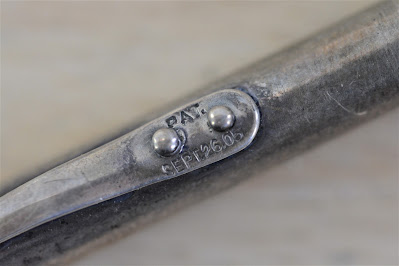
And . . . Waterman was well known for using that riveted clip on fountain pens and pencils. The clip on my tree trunk has the design carried forward onto the clip, but usually these clips are stamped with a patent date of September 26, 1905 as seen here:


That date refers to William I. Ferris’ patent number 800,141:


But wait a minute . . . Aiken Lambert can’t be right. First, our lovely pencil operates by twisting the nose to release the lead, while Aiken Lambert leadholders are operated by twisting the top. Also, it doesn’t make sense for Aiken Lambert and Waterman to develop the elegant Ferris clip, in use from 1905 through the late 1920s, then put a less elegant – even awkward – Kessel clip into service around 1910.

Whoever made today’s pencil was not Aiken Lambert or Waterman – it must have been some other manufacturer trying to get around the Ferris patent.

There was a well-known manufacturer which was prolific in the art of nose-operated leadholders: Mabie, Todd & Co., which offered “Mabie Magazine” pencils in the early teens. The clips for which Mabie Todd pencils are so well known, however, are not the Kessel clip - they typically sported a clip patented on January 19, 1915. Here are three Mabie Todd “Fyne Poynt” screw drive pencils sporting different variations of the 1915 clip:


As with our sterling silver pencil under examination, the metal work on these is also exquisite:


I had photographed these together to illustrate the different clip variations, but it makes sense to include them in this article since Mabie Magazine pencils also typically used these same clips.


The patent date refers to Charles Mabie’s patent number 1,125,144, applied for on May 20, 1914.


I’ve accumulated dozens of metal Mabie Todd pencils, both Fyne Poynt and Magazines, because they are just too pretty to turn down. They had become so crowded together on the wall o’ pencils that when I picked up another printer’s cabinet last year, one of my first orders of business was to spread out my Mabie Todds so I could better see what was there (and cull a few duplicates from the herd).


As I filed away these three new Fyne Poynts in the newly organized Mabie Todd wing of the museum, I found something . . . 


There it is: apparently before Charles Mabie patented Mabie Todd’s ubiquitous clip, at least some Mabie Magazine pencils sported Joseph Kessel’s weird Ferris-ish clip.


At this point, you might think we now have our mystery pencil pegged: it is a Mabie Magazine pencil, but lacking the typical Mabie Magazine imprint at the nose. That is part of the answer, and I have filed this example with my other Mabie Todd pencils, since I do believe that is who likely manufactured it . . . not to mention that’s the best way for me to remember where I put it.

The more complex question, however, is whether this is an unmarked Mabie Magazine pencil, made by Mabie Todd for its own account, or whether Mabie Todd might have manufactured it for someone else.

I’ll address that as soon as I send Gabriel Goldsmith some money and wait patiently by the mailbox for part of that answer to arrive . . . 

Monday, September 1, 2025

A Star Is Borne

One of my “rules” of collecting, and I put “rules” in quotes because I break them so often, is that I don’t buy a pencil unless it is marked with a manufacturer’s name . . . or at least, I can with confidence attribute it to a specific manufacturer.

That went out the window when I saw this one in an online auction:


This is a leadholder: turning the cap one way releases the lead, and turning it in the opposite direction clamps down on the lead to hold it in place. The pattern is very high relief and is worthy of picking up regardless of who was responsible for creating it.


Although there is no name on it, I do believe I have a shot at identifying this one. Both the clip and barrel are marked Sterling with a star afterward:


Here is the new addition shown alongside an Aikin Lambert leadholder – one of the superstars in my entire collection. The mechanisms are the same in operation, the clip is the same shape, and while the patterns are different, both are made in that great naturalistic art nouveau style.


There are many known Aikin Lambert pencils that are marked “Sterling A.,” and the company used many other trademarks as reported in Trade-Marks of the Jewelry and Kindred Trades over the course of several editions. A star by itself? I haven’t found the evidence yet to support that.

Until that evidence materializes, I am reluctant to file this one away with my other Aikin Lambert pencils. But where . . . someplace where I won’t misplace it . . . 


At the Detroit show a couple years ago, Myk Daigle gave me a small rubber duck which was subtly extending a middle finger - that duck has ever since been a fixture on my display at pen shows, an Easter egg that brings a chuckle to nearly everyone who sees it. I noticed a woman staring intently at my table during one show, and when I asked her if I could help her find something, she asked me – as if she herself was unsure – “is your duck . . . giving me the bird??”
At the Philadelphia show last January, Myk doubled down on the duck, presenting me with a more formal version, cast in acrylic and gesturing double-barreled. One duck is enough on my table, so this one sits proudly on display atop one of my printers’ cabinets in the museum. Until the day comes when I can formally trace the pedigree of my starry leadholder, it’s the perfect place for it to reside.

Thursday, July 1, 2021

Aikin Lambert Update

This article has been included in The Leadhead's Pencil Blog Volume 7, now available here.


If you don't want the book but you enjoy the article, please consider supporting the Blog project here.

I wrote about the early history of Aikin, Lambert & Co. in Volume 4, page 50, and Loyal Knight David Nishimura has ably documented J.C. Aikin’s asssociations with D.F. Foley (see http://vintagepensblog.blogspot.com/2012/06/dissolution-of-d-f-foley-co.html) and Aikin Lambert’s later transition from independent company to Waterman subsidiary (see http://vintagepensblog.blogspot.com/2012/12/waterman-and-aikin-lambert.html).

Aikin Lambert is one of those companies whose story intertwines with so many others.  The firm has wormed its way into several articles here, including those about the Chicago Gold Pen Company (Volume 6, page 114), L.C. Hardtmuth (Volume 6, page 218) and even Samuel Kanner and his flip-top Nupoints (Volume 5, page 111) – in each case,  Aikin Lambert made a quick cameo appearance, then darted back into the shadows.  

In recent months, a few more Aikin Lamberts have arrived which add a few more insights into the firm’s complex story.  This first one has a distinctly European look, perhaps somehow connected to the firm’s Hardtmuth connections:


There’s a nice monogram on the barrel that ends with “A,” but I’m not going to suggest any Aikin family connection.  Not that I didn’t go through my notes to see if any Aikins associated with the firm’s history went by the initials “E.K.”:


The trim on this hard rubber pencil is a little different, with more of a copper color than gold.  The firm’s name is imprinted around the nose:


This next one forced me to bid on a box lot of absolute junk, solely in order to get a closer look.  It was shown in partially closed position, but for what I paid I figured it was worth a shot trying to get it going again:


When it arrived, I was pleased in two respects.  The lighter fluid trick worked like a charm and I was able to get it working smoothly again, although there’s not much that can be done about the wear and dents.  I was also pleasantly surprised to see the ALCO hallmark on the barrel.  


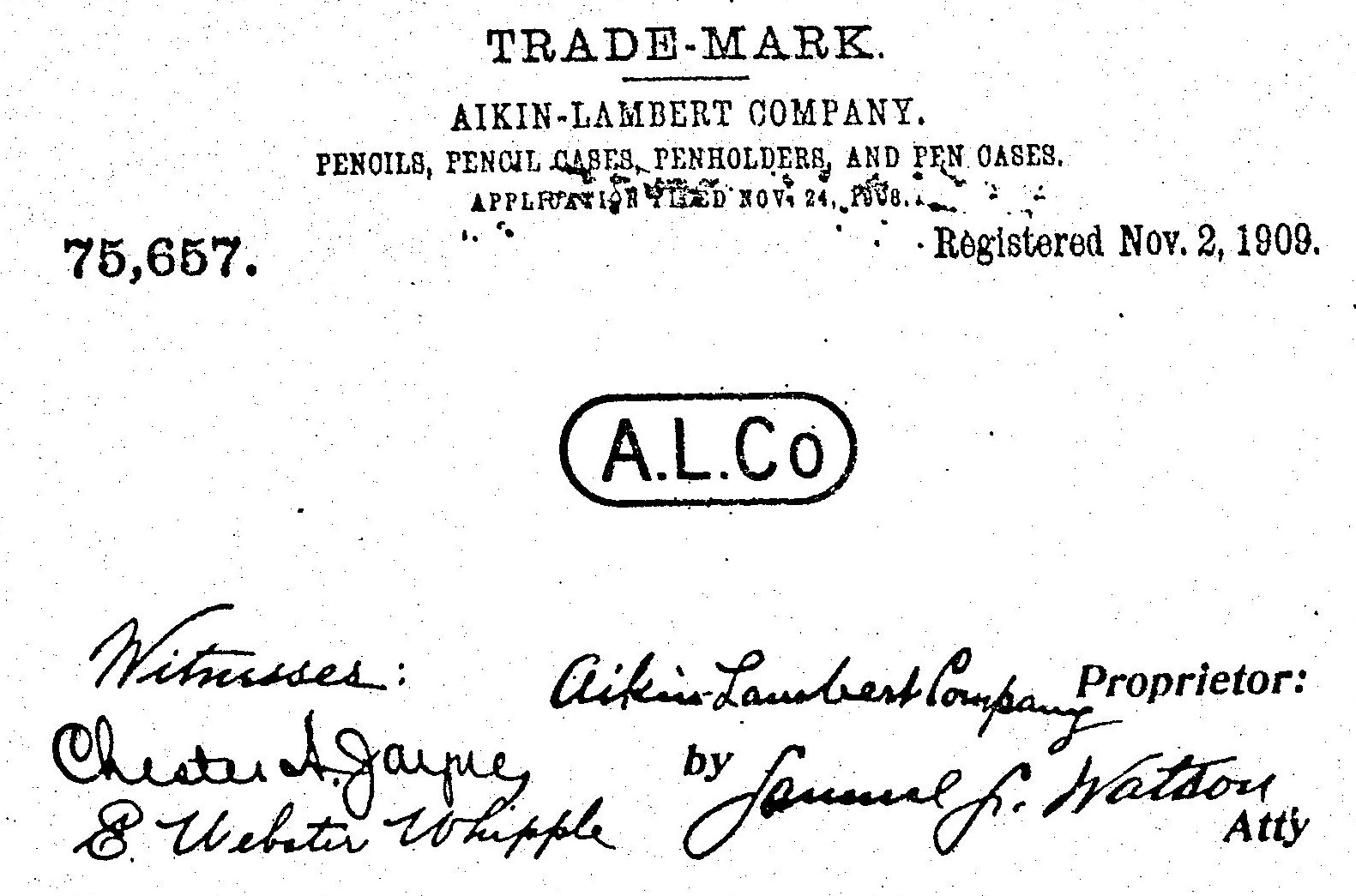
This mark appears in American Writing Instrument Trademarks 1870-1953, registered for pens and pencils by the company on November 2, 1909.  The application was filed on November 24, 1908, but unfortunately at the time it was filed, the date the firm first claimed to use it was not typically reported:


I suspect this was made later, perhaps in the late teens, after the firm was absorbed by Waterman.  Since Waterman was so resistant to the notion of offering mechanical pencils, its earliest “sets” consisted of Waterman pens paired with Aikin Lambert pencils – it would be nice to find documentation of a Waterman set including a magic pencil like this one, but I haven’t seen anything like that.  

Here’s another “junker” that came my way.  The seller properly disclosed that the upper barrel was split:


The seller did not mention how heavy it is, and from the weight I surmise this piece is almost certainly at least 9k gold.  I have several of these extending combination pens and pencils; all were based on Albert Bagley’s patent of January 1, 1850, but I’ve found examples marked with the names of several New York firms.  I was hoping when it arrived I would find another maker’s name on it, but if nothing else it would be good for parts:


And perhaps a nib:


J.C. Aikin.  The holder itself is unmarked, and nibs are readily swapped out, but I’m inclined to think the nib is consistent with the holder: as documented in Volume 4, page 50, J.C. Aikin & Co. was founded in 1864 – on the late end for these fluted combination pen/pencil outfits, but still plausibly within the window during which these were made.

The machining on the barrel is a little different than what is normally found on these, and this is typical of the sort of patterns Aikin Lambert used.  Maybe another one will surface in this pattern, but marked on the instrument itself with Aikin’s name.  For now, at least, this one is staying just as it is, and exactly where it is: in the Aikin Lambert section, where the firm connects with yet another family of pencils.

Saturday, June 27, 2020

An Interesting Connection

This article has been edited and included in The Leadhead's Pencil Blog Volume 6, now on sale at The Legendary Lead Company.  I have just a few hard copies left of the first printing, available here, and an ebook version in pdf format is available for download here.

If you don't want the book but you enjoy this article, please consider supporting the Blog project here.

(Originally scheduled to post May 13, 2018) 

There were two reasons I didn’t publish these photographs after I took them four years ago or so:


The first was that I had already used pictures of the top one in an article I wrote establishing that the “Sterling.A.” mark was in fact an Aikin Lambert mark, since it bears both marks:


The other reason was that I couldn’t explain the imprints on the other one.  It looks like a German pencil, with that black nose, but the top imprint is also Aikin Lambert:


The other imprint, however, puzzled me:


“L. & C. Hardtmuth’s / Kohinoor.”   There are eight versions of the Koh-I-Noor trademark listed in American Writing Instrument Trademarks 1870-1953; the German firm first claimed to use the mark with respect to pencils, in 1890.


It seems an unlikely collaboration, but we know from the ALCo hallmark that the pencil was made after 1908, after Aikin Lambert had been absorbed by L.E. Waterman in 1907 (see David Nishimura’s article on the subject posted at "Waterman and Aikin Lambert").  And who was the distributor for Waterman’s pens outside of North and South America?  


L. & C. Hardtmuth.  The relationship ended by necessity with the outbreak of World War I in 1914, and apparently it went both ways: Hardtmuth distributed Waterman pens overseas, while Aikin Lambert – Waterman’s subsidiary – distributed Hardtmuth’s Koh-I-Noor products, including pencils . . . 


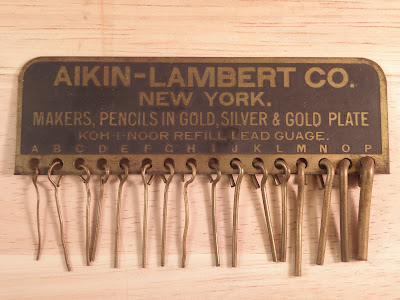
. . . and lead refills, as indicated by this wire lead gauge owned by Joe Nemecek.

Friday, June 26, 2020

Victorian . . . ish

This article has been edited and included in The Leadhead's Pencil Blog Volume 6, now on sale at The Legendary Lead Company.  I have just a few hard copies left of the first printing, available here, and an ebook version in pdf format is available for download here.

If you don't want the book but you enjoy this article, please consider supporting the Blog project here.

(Originally scheduled to post May 12, 2018) 

Here’s a grouping of earlier Aikin Lamberts:


The top one and the fourth are the earliest, fully marked “Aikin Lambert & Co.”


The fifth one is marked on the nose with Aikin Lambert’s “Sterling.A.” mark:


The sterling work is really impressive:


But what’s even more impressive is its size.  It measures a hair over five and a half inches:


As for the remaining three, we’d tend to lump magic pencils such as these into the category of “Victorians,” except for what we know now about the trademarks:


From yesterday’s article, we know the trademark application for this mark wasn’t filed until November 24, 1908 – years after Queen Victoria passed away in 1901.  Edwardian might be a better word to use for these.

Thursday, June 25, 2020

A Few More Aikin Lambert Leadholders

This article has been edited and included in The Leadhead's Pencil Blog Volume 6, now on sale at The Legendary Lead Company.  I have just a few hard copies left of the first printing, available here, and an ebook version in pdf format is available for download here.

If you don't want the book but you enjoy this article, please consider supporting the Blog project here.

(Originally scheduled to post May 11, 2018)

Here’s some commanding “stockbroker” Aikin Lambert leadholders, considerably fatter and with correspondingly fatter business ends:


I picked them up at the Philadelphia Pen Show auction a few years ago, when the Philly show was still at the Downtown Sheraton.  I suppose I never wrote about them because I used that gold filled one in an article I posted about a miniature version of the pencil, for comparison (see "The Sleeper"):


I also discussed that riveted clip in that article.  It was patented by William Ferris and assigned to Waterman:


The gold plated example has an Aikin Lambert hallmark, and the silver one does too – “Sterling.A.”:


(See "That Last Nagging Doubt" about that hallmark).

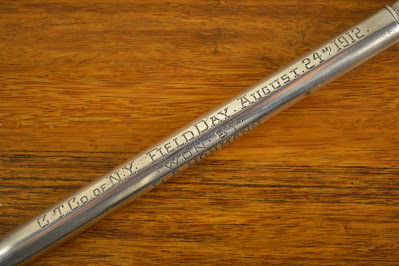
What’s really enthralling to me about the silver one, though, is that great commemorative engraving:


“C.T. Co. of NY Field Day August 24, 1912 / Won By / D.A. Hohmann.”  It took a bit of digging, but “C.T. Co. of N.Y.” is the Commonwealth Trust Company of New York, and Daniel A. Hohmann worked in the company’s collection department, presiding over the acquisition and liquidation of troubled assets.


I’ve picked up a few other Ferris-clipped Aikin Lamberts, too.  Here’s another gold filled example in an unusual hexagonal shape:


This one also has the ALCo hallmark:


The mark, by the way, appears in American Writing Instrument Trademarks 1870-1953.  It was registered in 1909, and although dates of first use were not reported during that time, the application was filed on November 24, 1908:


I’m a sucker for these.  I used to collect antique bottles, and in those collecting circles, we used to have a saying: “The more it looks like a third grader made them, the more we like them.”