Showing posts with label Louis Tamis (LT) & Son. Show all posts

Saturday, October 11, 2025

Motor City Highlights

The stories behind how these bits and trinkets find their way to me are sometimes as much fun as exploring the history of the objects themselves. Unfortunately, during the time I was off fooling around writing the Sheaffer and Eversharp books, many of these back stories have faded from my memory.

Janet and I were at the Detroit Pen Show last weekend, and I found a few interesting things to show you. Rather than lining them up at the end of the long queue of stuff I need to photograph, I thought I’d tell you about them now, while my memory is fresh.

Detroit was better attended and busier this year than it has been in recent years. Janet and I had two tables, and on Friday show organizer Dale Penkala stopped by to ask me how business was. Great, I replied – I’m losing all kinds of money. 

Dale looked concerned until I told him it’s a great show when I lose money on Friday: that’s what happens when I am so busy flitting around the room, talking to people, and buying things for my collection that I’m not minding my shop. Saturday, I told him, is when I stay at my table and make all of that money back. Funny . . . I sell so much more when I’m sitting there.

I added all five of these to my collection that Friday.


Michael Krut was responsible for corrupting my pencil collection with those two half-pencil, half-pen combos at the top, but I was a willing co-conspirator. Both have those distinctive, turned-up ball clips that place them squarely in the Edward Todd / William S. Hicks family:


The gold filled example is marked for Edward Todd, both imprinted on the barrel and with a nice number 3 Edward Todd nib:


Although the sterling silver one has no imprint on the barrel, it does have a nib marked “W.S. Hicks Sons,” and I don’t have any reason to attribute it to any other maker:


The example at center came from Jerry Rosenthal, and it might have started life out as another combination pen and pencil before someone had a better idea for it.


Instead of a pencil, this has a really weird metal piece on the end, the parts of which don’t budge. With that  end removed, there’s nothing but an empty space inside:


I’m recalling the “Presso” toilet powder dispenser from “Marveling at Last in Person” (September 10, 2025), but there’s no movement with that end piece to suggest that it dispenses anything. Neither would there be any reason to store leads in a fountain pen. Perhaps it was a pill container or something.

There is a Hicks hallmark on the end of the cap, and the curled end of the clip instead of a ball is unusual but not unprecedented for a Hicks:


The nib, however, is a generic 14k nib. 


What had me puzzled was that there is no lever on the barrel, leaving me to wonder what this thing might be. Unscrewing the section provided that answer: it is a cheap bulb filler.


That pen and pencil set shown at bottom in that first image were also from Michael Krut. I had to give chase, because I’ve only seen one other pencil like this one.


I had a devil of a time finding that gold one - I knew I had taken pictures of it, but since these are so unlike anything else Hicks produced, I ended up shooting it alongside a few other random things I had purchased at the Baltimore Show a few years ago.


From top in this picture are a solid gold Mabie Todd:


A solid gold Hicks:


A vermiel (gold fill over sterling) pencil made by Louis Tamis & Son:


And this one, which was owned by Bob Johnson. It too is vermiel:


I’ll admit I didn’t shoot Bob’s pencil on its own because at the time, I thought it was kind of ugly but I felt compelled to buy it . . . the same sense of obligation I feel whenever I wind up buying a beautifully ugly Parker-Eversharp. I’ve softened on that a bit now, since it looks so nice alongside Michael Krut’s sterling silver set.


Both the pen and pencil bear Hicks hallmarks . . . 


The nib is a correct W.S. Hicks sons nib:


And just like the example I got from Jerry Rosenthal, there’s no lever on this pen, either. It has that same bulb-filler mechanism inside.


Wednesday, September 24, 2025

As My Last Bastion Falls

Back in 2022, Larry Liebman was in Columbus for the Ohio Show, and he spent a night or two at our place so he could fully take in the museum. He did not come empty handed: Larry brought with him some of the pieces he has collected made by Louis Tamis & Son, the New York jeweler’s firm that made high quality writing instruments both on its own account as well as for luxury retailers such as Tiffany, Cartier and the like.

Larry collects these because he has a distant family connection to LT & Son - he’s tried to explain it to me, and I keep getting confused about who is twice or thrice removed. Most recently, I talked about that in  “Narrowing the Gap” (May 31, 2021: Volume 7, page 156). Larry snapped a few photos with his iPad in preparation of his visit to see what he should bring for better shots; this one was the one I couldn’t wait to lay my hands upon, even if only for a brief photo session:


Yes, it is solid gold - and a two-tone yellow and rose gold to boot.


I recreated this pattern for my Legendary Pencil Company Model 124, which I dubbed the “Trinity.” I wasn’t deifying Tamis’ work - the Trinity reference is rooted in the fact that this same sort of design was used by three distinct makers.


Here, Larry’s LT & Sons pencil is flanked by two examples in my collection. The top one is a magic pencil bearing a W.S. Hicks hallmark. It isn’t stamped very well, but you can make it out near where the pencil emerges:


The one at bottom is a later gold filled pencil made by Mabie Todd & Co. in the late 1930s. These frequently slip under the radar because the imprint is in the center of the pencil:


Now I have to correct something a little bit. On the Legendary Pencil Company’s website listing for the Model 124, I identified the trinity of father, son, and pencil ghost as Louis Tamis & Son, William S. Hicks, and Edward Todd & Co. – not Mabie Todd & Co.


At the time I came up with the Trinity name, I had forgotten about these later Mabie Todds . . . forgivable, I hope, since this was the only models Mabie Todd did in this pattern, while the other three used it with abandon on lots of different things. If it isn’t forgivable, I’d hedge and say we’ll call it three and a half, given the abnormally close relationship between Edward Todd and Hicks.

Mea culpa. Trinity sounds much better than “Foursome” or “Trinity-ish,” so we’ll just chalk up my mistake to brilliant marketing and move on to the other thing Larry wanted to be sure we photographed. 


This solid gold fountain pen has the typical turned-up ball clip used by Edward Todd, Hicks and Louis Tamis – but not by Mabie Todd (see, I knew there was a reason I left Mabie out of the equation). While I can probably rule out Edward Todd, which used a slightly smaller clip, it is a tossup as between the other two, since it isn’t marked for either. This one is marked only for Tiffany & Co.


While we were having fun playing with these things and I had all of my similar stuff out for manhandling, I took a better picture of my LT & Son watch pencil. I had noticed that in the last time I talked about it, I had used only the auction house picture – I think I was so excited to write about it that the article published before the pencil was in my hands. See “Tying In Tamis” (June 18, 2021: Volume 7, page 206):


Over the years, I’ve expressed my disdain for buying solid gold, since I value history more than metal and for the price I can buy more history if the gold is not pure. I’ve also had a bit of a chip on my shoulder about high-faluting names - yeah, I apologize for my recent comparison of Tiffany products to Buckeyes memorabilia and dog turds. For God’s sake, don’t get me started on “precious resins,” either – precious, my butt. At least all I got wrong in my marketing was a model name.

I do cry Uncle on Larry’s solid gold stuff. They are absolutely beautiful and in my opinion, worth more than the metal in them solely based on their artistic merit. I have surrendered myself to the fact that the reason the Tiffany name commands a premium is because the company has earned it.

I have, however, maintained my last bastion of resistance to those bamboo pencils, which are nearly always marked only for the luxury retailer that offered them. LT & Son was the last of the “trinity” to survive, and I believe LT & Son made most if not all of these. They come in pencils as well as ballpoints, and I last visited them in “Dr. Seested, I Presume . . .” (January 18, 2016: Volume 4, page 97). 

Vic Seested and I finally met in person at the DC Show that year, after months of email correspondence. He had brought a spread of Hicks, LT and the like for me to photograph, including his solid gold bamboo pencil, marked both LT & Son and Tiffany:


“Dang, again,” I wrote, “as in dang, that’s ugly, but I do appreciate the attraction to something so distinctive . . . every time I see one, I think to myself to hold one is to look like you have waaaaay too much money. Maybe that is what they were going for.”

I don’t think I was wrong.

Dan Schenkein has recently taken a liking to these metal bamboo figurals, too. Here are his two ballpoints and an LT-marked pencil.


I am gradually developing greater appreciation and fewer objections on principle to these. When my friend Chiaming Chen in Taiwan posted a picture of this Cartier-marked example – in real bamboo, not metal – I quickly jumped on the opportunity to obtain permission to use the images:


It has British 18k hallmarks on the nose, above the Cartier name:


My growing appreciation and waning objections to bamboo pencils finally hit critical mass when I quietly managed to find one of these up for myself. At last I had spotted my prey laying in the weeds, improperly described, and buried in with a bunch of unrelated junk, so I was able to scoop it up at a price I could swallow: 


It actually wasn’t laying too deep in the weeds: since it measures over six inches long, it was more like a giraffe hiding behind a telephone pole in the middle of an open field. Still, nobody else seemed to pick up on what it was. On one nose, it is stamped “Made in Italy” and “laminato oro,” meaning gold filled or plated:


The other end reveals which high-end retailer thought a six-inch, double ended piece of wood sticking out of one’s shirt pocket might be considered a status symbol in certain circles:


Gucci. 

Friday, June 18, 2021

Tying in Tamis

This article has been included in The Leadhead's Pencil Blog Volume 7, now available here.


If you don't want the book but you enjoy the article, please consider supporting the Blog project here.

We know more about Edward Todd and William S. Hicks during their decline than I ever thought we would know just a few years ago.   You would think after the article I posted on June 4 (https://leadheadpencils.blogspot.com/2021/06/the-end-of-ws-hicks-revealed-at-last.html), it would be easy to explain how Louis Tamis wound up with all of Edward Todd’s equipment.  Maybe Hicks was making Edward Todd’s stuff, Larter & Sons bought Hicks, then Larter and Sons sold to Louis Tamis & Son, perhaps when Larter discontinued the Hicks name between 1943 and 1947.

Nope.  There’s a problem.  Two, actually.  We don’t know exactly what Larter & Sons bought, and we don’t know exactly what Louis Tamis & Son bought, either.

Let’s back up and start with what we know.  

1. Larter & Sons acquired William Hicks’ Sons between 1925, when the Hicks boys were still running the show, and 1929-1931, when Halsey Monroe Larter’s patents were being used inside Hicks-marked pencils (and other of Larter’s patents were assigned to Hicks).  If that seems to thin to accept as definitive, we know it must have happened by the time the Larters were named as Hicks’ partners in the 1933-1934 New York directory.

2.  The business of Edward Todd & Co. “Was discontinued in 1932,” according to Edward Todd, Jr.’s obituary five years later.  That’s equally thin evidence for a definitive date, but reliable for the fact that Edward Todd, Jr. was out of the business for a time before he died.   The firm is still listed in the 1933-1934 city directory, with Edward Todd, Jr. at the helm; maybe the information was collected during 1932 and Edward Todd Jr. closed up or sold out at the end of 1932 – but maybe not.

3.  In the 1933-1934 directory, Louis Tamis is still affiliated as a partner in Schanfein & Tamis, in which he had been involved since 1910 or so – as a jeweler, with no known involvement in the writing instruments industry.  

4.  Larter & Sons changed Hicks’ address to 10 Austin Street, Newark, New Jersey in 1937. That’s the house next door to Larter & Sons’ four-story factory, which Larter had occupied to manufacture its products since 1909. 

4.  Edward Todd, Jr. died in December, 1937.

5.  Sometime between publication of the 1933-34 and 1940 directories, Louis Tamis leaves Schanfein & Tamis and forms Louis Tamis & Son.

6.  The last mention of Hicks is in the 1943 Newark directory; when the next published edition came out in 1947, Hick is gone. 

Something else we know, but we don’t know when it happened, is that someone made identical pencils marked with Hicks and Edward Todd hallmarks, pursuant to William M. Hicks’ 1918 patent.  See Volume 6, page 40 for a pair of identical perpetual calendar pencils (the article is still online at  https://leadheadpencils.blogspot.com/2020/04/that-thing-i-hate-to-do.html).

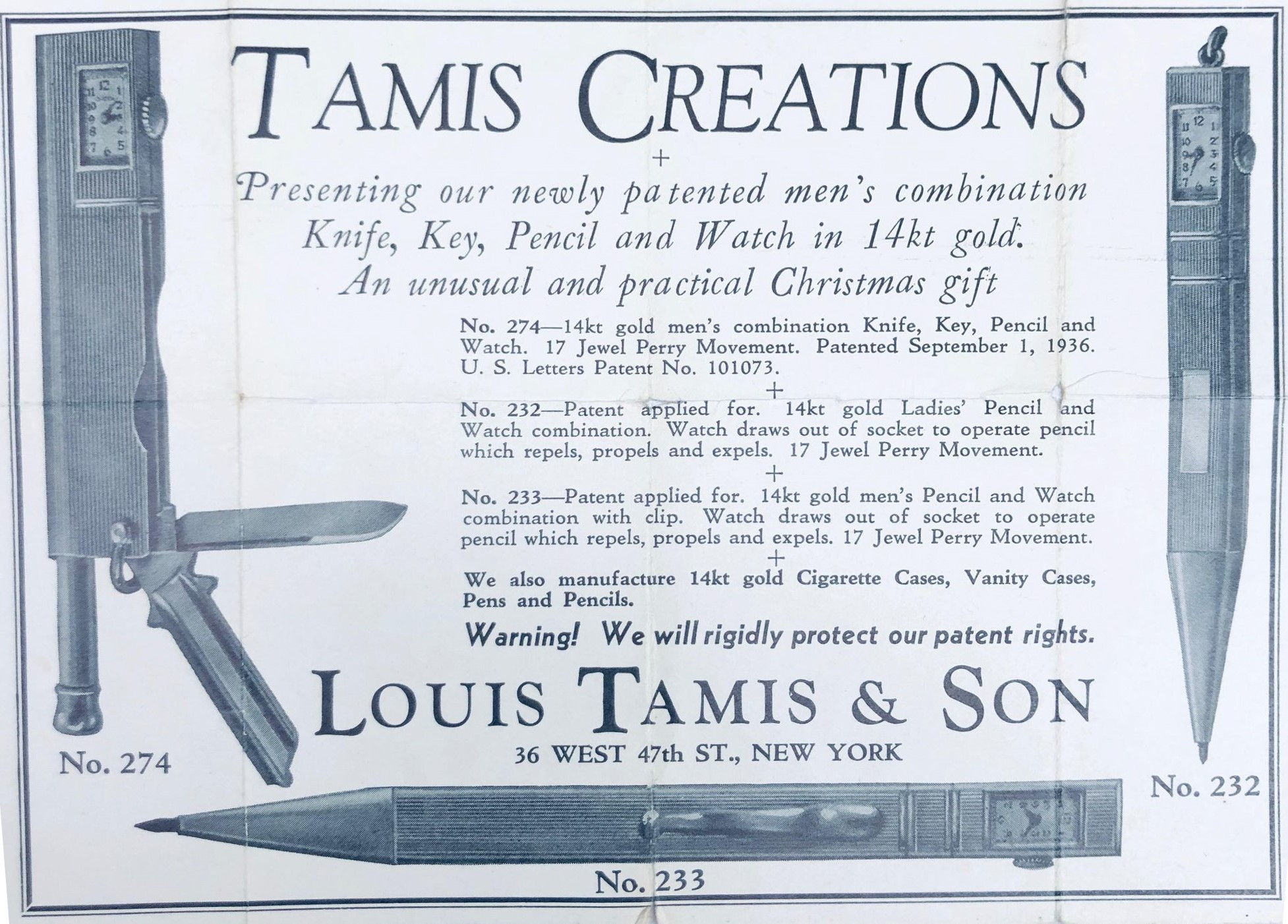
Now, let’s supplement this story with what Larry Liebman and David Nishimura learned when they visited the Louis Tamis & Son factory a couple years ago.  The Tamis archives include pencils and documents which do not fit neatly into our timeline, the earliest of which is this advertisement, which Larry indicates was pencil-dated 1937 (the same year Hicks’ offices were relocated to Newark):


The clips on the side clip model shown are Hicks-style, and the advertisement states these pencils were “manufactured” by Tamis – although the watch movement was not, and the pencil mechanism likewise might not have been.  The “newly patented” language is consistent with the patent references:  Jack Tamis’ design patent number 101,073 for the pencil/knife/watch combination was applied for on June 30, 1936 and was issued September 1, 1936: 


Note that the model 232 ringtop and 233 side clip watch pencils are both “patent applied for.”  Jack Tamis was working on more than just the outward appearance of writing instruments – the patent covering these pencils was a utility patent for the mechanism.  Tamis applied for patent number 2,107,879 on December 12, 1936, and it was issued on February 8, 1938.  It was designed so that the top pulled out of its rectangular housing a bit, then twisted like an ordinary screw drive pencil:


Right as my recent article on the end of William S. Hicks was publishing, Eric Magnuson pointed out an example of one of Tamis’ watch pencils in an online auction.  It sold for exactly the exorbitant price I predicted, and although I hate paying gold value, I couldn’t resist:


The advertisement for this pencil proves two things: first, by 1936 Louis Tamis & Son was in the writing instruments business.  Second, the firm was developing mechanical expertise (suggesting also some manufacturing capability) to make much more than just the outer shells. 

Tamis’ archives also includes a notebook containing details of the firm’s product offerings, and David Nishimura snapped a few pictures with his phone and agreed to share them here.  One page is titled “L. Tamis & Son Report July 31, 1938" and another page states “L. Tamis & Son Report April 30, 1939.”  


The products shown appear to be Edward Todd pencils.  Note the alternating vertical/horizontal ribbed pattern typical of Edward Todd, and models 391-55 and 391-17 appear identical to those Edward Todd pencils I recently showed on May 31 (see https://leadheadpencils.blogspot.com/2021/05/narrowing-gap.html):


There is also an illustration of one of Edward Todd’s square, extending ruler pencils, sporting the more conical nose I’ve observed on pencils marked Cartier and Pen-N-Pencil, and consistent with Edward Todd Jr’s 1925 design patent (see Volume 6, page 10):


The notebook also includes handwritten price sheets for fountain pens and combination pen/pencils (referred to as “Duplexes”), which itemize four product lines: “plain,” “E.T.,” “B.C.-17" and “S-55.”


“B.C” and “S” are a mystery, but “Plain” suggests without any branding, and “E.T.” must mean that Tamis was offering writing instruments branded Edward Todd in 1938 and 1939.  This is consistent with Larry Liebman’s oral history, which states that Louis Tamis & Son acquired whatever remained of Edward Todd, whenever Edward Todd, Jr. gave up making writing instruments.

Larry and David observed that Louis Tamis & Son also has pen and pencil-making equipment, which was acquired (according to the company) from Edward Todd – however, all of the remaining equipment on hand pertains to manufacturing the barrels, not the mechanisms inside.

If we knew who was making the insides of the pencils Edward Todd and Hicks were selling, before Todd sold to Tamis and Hicks sold to Larter & Sons, the complete story behind all of these firms would be much easier to put together.  

I have always thought Hicks had taken over the manufacturing for Edward Todd, based on identical Todd and Hicks pencils made under Hicks’ patent. I thought Edward Todd’s listing in the 1933-1934 directory, showing that the firm occupied rooms on the eighth floor of a 6th Avenue address, further supported that – not so fast, says David Nishimura, who points to the fact that many jewelry firms (including Tamis) have actual manufacturing going on upstairs, rather than at street level.

Jack Tamis’ utility patent for the watch pencil also suggest that along with the name, Tamis & Son also acquired wherewithal – at least to invent mechanisms, but perhaps also to make them.

On the other hand, Larter’s decision to move Hicks to the house next door to Larter & Sons’ manufacturing facility suggest Hicks was was making mechanisms as well as the shells that surrounded them, because there wouldn’t be any reason to park Hicks’ offices next door to Larter’s factory if Hicks existed in name only. As long as Larter’s offices were at 15 Maiden Lane and separated from Larter’s manufacturing, it would make more sense to keep Todd’s offices at the same location. 

We just don’t have any evidence yet to tell us whether either Todd or Hicks was making pencils for the other, whether each was making its own using shared equipment and technology, or whether both firms were sourcing the insides of their writing instruments from some unknown third-party supplier.

It’s still a dead end, but it isn’t as dead as it used to be.  The truth has a habit of floating to the surface as additional pieces of the story come together, and we know more than we did just a few weeks ago.