Showing posts with label Parker Vacumatic. Show all posts

Friday, August 6, 2021

The Cobra Strikes Again

This article has been included in The Leadhead's Pencil Blog Volume 7, now available here.


If you don't want the book but you enjoy the article, please consider supporting the Blog project here.

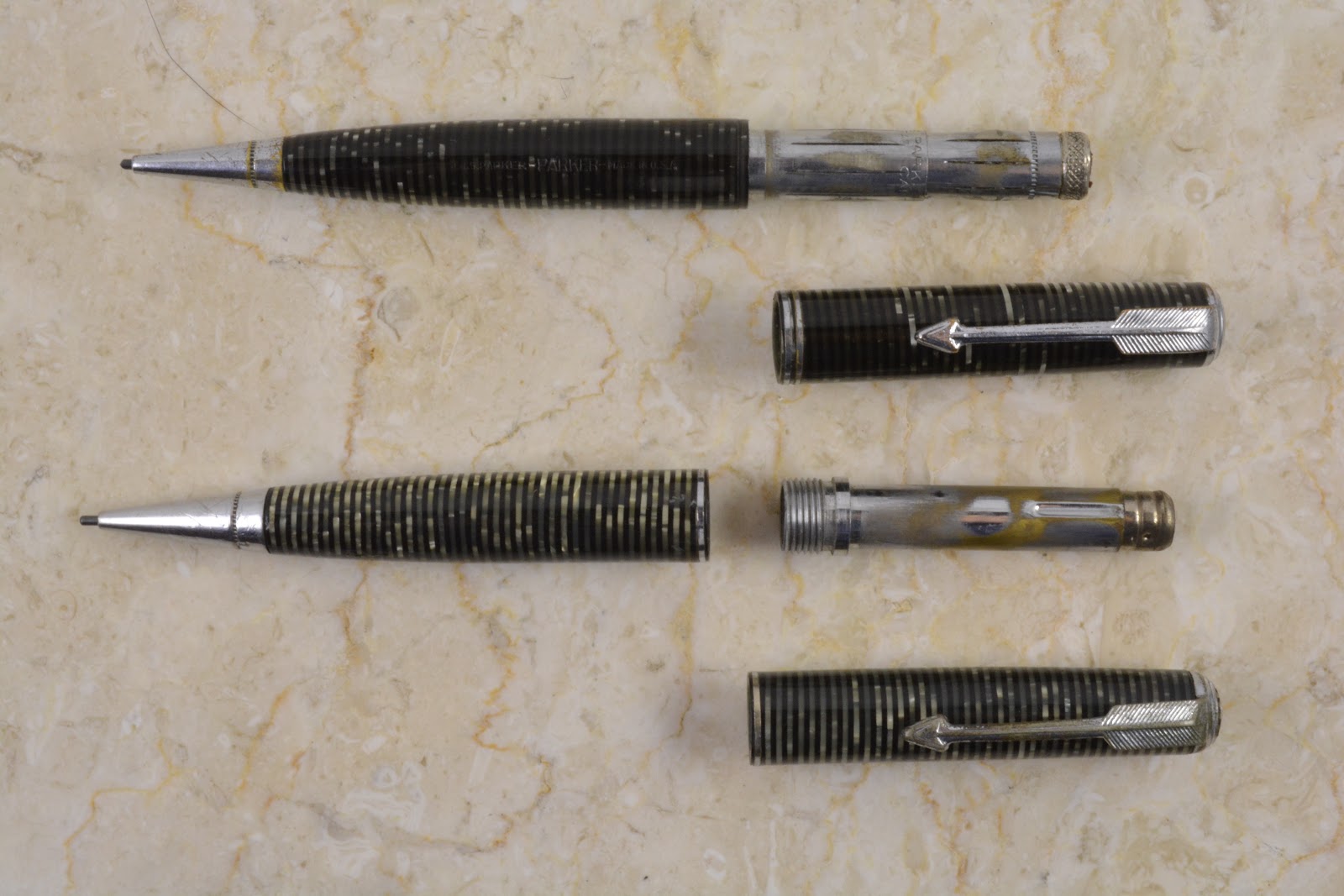
I had a bit of fun posting this picture online, with the caption "When the Ripleys are the 'common' ones in this picture, it's a good day":


From left, these are a Parker "Golden Arrow," predating the adoption of the Vacumatic model name, two "Ripley" Vacumatics, one from the early run and the other from the "Class of '39" Parker parts blowout (see Volume 5, page 281); a Parker Vacumatic in "Cobra" or "Egg Shell"; and a pair of Parker prototypes with highly unusual mechanisms (see Volume 3, page 8).  

The Cobra was the reason I took the picture.  Ten years ago, during the release of The Catalogue of American Pencils at the Ohio Show, someone approached me to offer me a Parker "Cobra" at a price that made me gulp.  Someone else didn't gulp as hard, but at least I had the presence of mind to shoot a picture of it before it slipped away.  It made its appearance here in Volume 1, page 149:


While some collectors refer to this pattern as "egg shell," I think such a formidable pencil deserves the alternative, more familiar title of "Cobra."  Perhaps "Cobra eggshell" would do, in the spirit of compromise.  Over at Parkercollector.net, Tony Fischier illustrates Cobra pens in what he calls "pale yellow" -- very similar to the pencil shown above, and red.  "The Egg Shells are probably pre-production trials and are rare," Tony notes. "Especially the red one."

That comment was rattling around in the back of my mind when the red(ish) pencil appeared in an online auction:


The closing price was twelve bucks less than the unimaginable price I was quoted ten years ago -- maybe the market has changed, but more likely it was my perspective that did, because I was determined not to let another one get away.  

The pencil was described as "repaired," but from the pictures it looked like there was a bit of surface crazing rather than any repair that had been done.  Unfortunately, the issues were uncomfortably close to the remaining traces of its Parker Made in USA imprint; fortunately, with a light touch most of it came out:


I would agree that these sit on the early end of the Vacumatic spectrum, but I question his assessment as pre-production -- the nose is too short, more consistent with later Vacumatics than Golden Arrow, Ripley and early production Vacumatics.  Just enough of these have surfaced to suggest a test market effort rather than exclusively in-house experimentation.

The red pen Tony illustrates is more fire engine red than my pencil, which is more of a terra cotta orange.  I asked Tony if his image reflected the true color, but alas -- he attributed the photo to the Parker archives, and he's never laid eyes on it personally.  Likewise, his "pale yellow" may be the parchment-tinted white of the pencil I photographed so many years ago . . . or maybe there are four colors accounted for here -- red, orange, yellow and white -- rather than just two.

But there's more: at least as far as the pens go, a collector who prefers to remain anonymous (we debated whether to call him Bruce Wayne or Batman) has examples of Parker Cobra pens in brown and green, too. 


Maybe I'll lay off the cigars and whisky and get some exercise.  At the rate of one Cobra every ten years, it might forty more before I've seen the full range of colors in Parker's cobra pencils!

Tuesday, April 28, 2020

The Chilton Vacumatic

This article has been edited and included in The Leadhead's Pencil Blog Volume 6, now on sale at The Legendary Lead Company.  I have just a few hard copies left of the first printing, available here, and an ebook version in pdf format is available for download here.

If you don't want the book but you enjoy this article, please consider supporting the Blog project here.

There I was, minding my own business, researching yesterday’s article and just trying to learn when the different caps on Chilton pencils were made for my sleepy little pencil blog.  As I pawed through countless advertisements, a news piece popped up.

And my eyes popped out.


Arthur O. Dahlberg isn’t well known in pencil circles, but among pen historians, he is canonized as the inventor of the Parker Vacumatic, one of the most popular fountain pens in the hobby.

I wasn’t researching anything related to the Parker Vacumatic, or at least I didn't think I was; this article floated to the surface because of the following paragraphs:

“Fountain Pen Inventor

“In 1929, [Dahlberg] went east for the first time to take a post with the Chilton Pen company of New York City.  While working for this company, in an engineering capacity, he ‘intermittently invented pens, and improvements for them,’ he recounts.

“Among his inventions is the vacuum-filler pen which is now so popular throughout the country.  The patent was first sold to the Chilton company, but when that firm went broke in the crash of 1929, Dr. Dahlberg succeeded in getting his patent back, and only recently sold it to the Parker Pen Company.”

Huh, I thought.  I never knew that the Vacumatic was very nearly the Chilton Vacumatic.  But as I’ve mentioned a few times here over the years, pen guys and pencil guys tend to live under different rocks, and it’s always worth peeking under the other guy’s rock just to make sure what is news to you isn’t well known over there.  Call it seeing how the other half knows.

I posted the above article in a couple groups online and heard promptly from all the people I would expect to say pshaw . . . be gone, ye mere pencil folk.  Instead, the unanimous response was . . .

Huh.

What was known was that Dahlberg shopped his vacuum-filling pen idea around to various pen companies before Parker finally bit - but nobody suspected any connection with Chilton, and certainly nobody had any idea Dahlberg was actually in Chilton’s full-time employ at the time.

Yet here is Dahlberg’s own account, written just five years after he claims he was hired by Chilton – sending all of us back to the drawing board to see if this account could be verified.  Trevis Young pulled out his copy of the revered book on the subject, Parker Vacumatic by Geoffrey Parker, David Shepherd and Dan Zazove, and he reports there is no mention of a Chilton connection, even though several pages in the book are dedicated to Dahlberg.

Then Brian McQueen found something he hadn’t noticed before in Dahlberg’s agreement with Parker, which appears to confirm the 1934 news piece.  He sent me this screenshot:


In section 6, Dahlberg is warranting his title to his patent application for what would become the Vacumatic “. . . said Dahlberg representing that his only previous transaction affecting rights under or titles to any of said present inventions consists of a certain ‘license agreement’ dated August 22, 1929, between him and The Chilton Pen Company, and the ‘cancellation and general release’ dated September 20, 1930 cancelling the same . . ..”

So the 1934 account is essentially correct:  Dahlberg didn’t technically “sell” his patents, he sold Chilton the rights to use them.  Dahlberg “got them back” by convincing Chilton to release those rights so that he could sell them to someone else - and it was Parker which ultimately turned his invention, with several improvements, into the Vacumatic.

This account fits perfectly into what we know about Chilton’s history, as well.  From yesterday’s article, we know there was a noticeable lull in official company advertising after June, 1929; Chilton’s license was signed on August 22, 1929, just before – or while – the company moved to Long Island City.  The license was canceled on September 20, 1930, and Chilton ads for new colors and bulbous tops began in October, 1930.  Chilton either decided to go in a different direction or couldn't afford to refine Dahlberg's design and produce it.

Dahlberg would continue to take out other pen patents, with his last issued in 1947.  However, in retrospect he is better remembered for his accomplishments outside the field of writing instruments.  He was born in Escanaba, Michigan in 1898, and his education after high school was interrupted by was interrupted by World War I: after the United States entered the conflict, military personnel were dispatched to the school to provide military training to the student body, organizing a Students’ Army Training Corps (S.A.T.C.) of more than three thousand students - Dahlberg was assigned to naval training.  Here he is, pictured in the 1919 “Michiganensian: A War Record” in uniform:


He graduated with a degree in mechanical engineering in 1920, then got his graduate degree in sociology from the University of Wisconsin in 1924.  That’s when he started tinkering with pens as a hobby, which resulted in his employment by Chilton and his later connection with Parker.

Dahlberg attracted national attention as an economist after the publication of one of his nine books, Jobs Machines and Capitalism (1932).  He became a policy advisor to the Hoover administration, then later worked for the NRA – that’s the other NRA, the Roosevelt administration’s “National Recovery Administration” dedicated to pulling the country out of the Great Depression.

It was during his work for Roosevelt that Dahlberg gained his greatest notoriety for a radical proposal to stimulate spending.  Dahlberg wanted to stop people from hoarding cash with essentially a ‘use it or lose it’ policy: he proposed printing currency in different colors each month, devaluing (taxing) the previous month’s paper money by one percent every month so that a dollar printed in one color would be worth less every month you held onto it.

The proposal drew ire and ridicule in the press in 1933-1934 and was never adopted:


But no publicity is bad publicity, and Dahlberg’s legacy was certainly assured.  He remained a noted economist for the remainder of his life, picking up additional degrees in economics from Harvard and The London School of Economics, founding the U.S. Economics Corporation in 1944, and creating the Visual Economics Library at Columbia University in 1951.  When the Cuban Missile Crisis nearly brought the United States to the brink of nuclear war, Dahlberg was back in the national headlines again with his vocal position that a war with Cuba would not stimulate the economy:


Arthur Dahlberg passed away on September 30, 1989.  Obituaries were published across the country; most published an abbreviated version of the one that ran in The New York Times, identifying Dahlberg as “economist and inventor of the Parker fountain pen”:


But note that this contains another claim: “he created the internal mechanism for the Parker fountain pen and the design of its arrow clip.”

Unlike the 1934 article, which was a contemporaneous account perfectly filling in a gap in what we knew about Dahlberg, the arrow clip claim was printed fifty years after the fact and appears at first to be inconsistent with what we know.  The Parker arrow clip was protected by a design patent filed on October 13, 1932 by Joseph B. Platt and Ivan D. Tefft, granted on December 27, 1932 as Design Patent 88,821:


Still, it seems like such an odd, random claim to make - especially in someone’s obituary, a place reserved for the most important accomplishments in a person’s life.  Dahlberg’s epitaph was (1) economist, (2) inventor of the Vacumatic, and (3) inventor of Parker’s arrow clip, so you would think all three of those things would be right.

Let’s look a bit more closely into that claim.  No, Dahlberg wasn’t the one who filed a design patent for the Parker arrow clip; however, if you look at Dahlberg’s patent history (I run them all down in American Writing Instrument Patents Vol. 2: 1911-1945), all of the patents he took out were utility patents.  If Dahlberg ever took out design patents, I’d be the first to agree that one of his three claims to fame might need to be scratched from his tombstone; however, since he was a mechanical engineer, it is plausible that he was only interested in protecting what went inside a pen – if he had an idea for the arrow clip, he might not have patented it and Parker picked up that ball after he darkened their door.

Next, have a closer look at that design patent and who signed it: Ivan Tefft’s name is signed twice, once as coinventor and once as attorney for Parker.


Why is that?  Was Tefft truly the coinventor, or was his name substituted on the patent application in someone else's place?  If Parker liked a clip Dahlberg had come up with at Chilton but Dahlberg hadn’t secured a patent for it yet, it is plausible Parker would substitute Tefft’s name in Dahlberg’s place on the patent application, to be discreet:  otherwise, Chilton might argue the clip was a work for hire to which Chilton might lay claim.

And then there’s one other detail, which may be just a coincidence . . . if you believe in coincidences, and after doing this research for all these years, I don’t believe in that sort of thing.  Recall that before Parker settled on the name “Vacumatic,” Parker called Dahlberg’s pen by another name: the “Golden Arrow.”

The Chilton Pen Company’s last gasp, just before the Thirties drew to a close, was the introduction of one last model . . . the “Golden Quill.”  I don’t have one of the pencils, but David Nishimura has a picture of one of the pens on his website, vintagepens.com - and here’s the clip:


Huh.  If you’re thinking this looks like the feathers on a Parker arrow clip turned upside down, and in particular like the “split arrow” Parker clips (introduced in 1938, just a year before the Golden Quill was introduced), but you don’t think there’s any connection between the names of the pens and design elements on their clips, then you’re dismissing these similarities as coincidences . . . because you believe in that sort of thing.

Answers to all these questions may be very close to within our reach.  Dahlberg’s papers, including his correspondence during the 1920s and 1930s, is inventoried at the Herbert Hoover Presidential Library and Museum.  I’ve already emailed a request for information, and as soon as this virus thing eases a bit, they promise to scan documents from their files for me.

UPDATE: After this article ran, Hirsch Davis, an avid Chilton collector, asked: “Jon, were you joking when you mentioned a “Chilton Vacumatic”? It appears that at least one actually exists.”


The patent Dahlberg had licensed to Chilton, which he later assigned to Parker and which would later be refined to become the Vacumatic, was number 1,904,358:


Note that the blind cap on the end of Dahlberg’s pen was permanently attached to the end of the filling unit?


Reports Hirsch: “ I had originally thought that it might be an experimental prototype of the Seth Crocker pump filler. However, the filler is spring loaded. While I haven’t attempted to take the filler out, it appears much closer to a vacumatic mechanism.”

In the article, I had suggested it was possible that Chilton, in its weakened state after the stock market crash, might have released its rights to Dahlberg’s patent because it couldn’t afford to refine and produce his design. Now we know Chilton apparently did – even if only once.
Wednesday, April 22, 2020

Why I Think What I Do

This article has been edited and included in The Leadhead's Pencil Blog Volume 6, now on sale at The Legendary Lead Company.  I have just a few hard copies left of the first printing, available here, and an ebook version in pdf format is available for download here.

If you don't want the book but you enjoy this article, please consider supporting the Blog project here.

A couple weeks ago I divided the evolution of Parker’s pencil manufacturing into three epochs, “Ignore them,” “Oh crap” and “Screw it.”  If there’s die-hard Parker fans still reading this blog, God love you for having a good sense of humor about that!

Parker’s decision to outsource production of pencil mechanisms to Cross in the mid-1930s, I opined, signified the beginning of the “Screw it” period, after which Parker didn’t really show much interest in what went inside their pencils, as long as the outsides of them looked like their pens (the Liquid Lead pencils, I said didn’t count since they were just ballpoint pens using graphite paste rather than ink).

Over on Facebook, Mike Crawford asked a good question: so what about the Parker Vacumatic cap-actuated repeating pencils, like these?


All of these sport Made in U.S.A. imprints, all of which have date codes of 8 (the top three) or 9 (the bottom four), for 1938 and 1939:


Most cap-actuated repeating Vacumatics, if I remember correctly, were made in Canada.  My collection isn’t the best straw poll for that statement, since I steer away from Canadian models – not that I have anything against them, but since I don’t actively collect Vacumatics, it’s easier for me to keep fast to my “I only collect American pencil” excuse when someone tries to sell me one.  Not that I haven’t fallen off the wagon . . . at least once . . .


So what of my comment, that this is “what the insides of Parker Vacumatics look like after the “Screw it” era began”?


OK, you got me.  That’s what the twist-action Vacs look like.  But while the cap-actuated repeaters were totally different deal inside, they were exactly the same deal when it came to Parker’s attitude towards pencils.  I think Parker was still outsourcing mechanisms in 1938 when the Vacumatic was dressed up in cap-actuated trim . . . I just think it was coming from a different source:


Here’s that 1938 burgundy Vacumatic alongside a contemporaneous Esterbrook pencil.  Both cap actuated, and under the hood they are far too similar to be coincidental:


In both, the mechanism is secured to the barrel by a threaded bushing, which travels up and down between two protruding ribs on the mechanism’s outer tube.  The only difference between the Parker and Esterbrook is the location of the spring – on the Parker, the spring rests against that washer inside the front of the barrel, while the Esterbrook has the spring mounted behind a self-contained plug.

Now, I’ll be the first to admit that I don’t know all that much about Parker, and since Parker continued cap-actuated pencils well into the Parker 51 era, it’s possible that Parker actually did make these mechanisms themselves – maybe from the outset, or maybe after outsourcing them from someone else for a while.

Suffice to say that if it wasn't Esterbrook making these Vac mechanisms, whoever did was copying Esterbrook.

Friday, April 3, 2020

Brian Beat Me to the Punch

This article has been edited and included in The Leadhead's Pencil Blog Volume 6, now on sale at The Legendary Lead Company.  I have just a few hard copies left of the first printing, available here, and an ebook version in pdf format is available for download here.

If you don't want the book but you enjoy this article, please consider supporting the Blog project here.

Several of the pictures I’m about to show you are a few years old.  A few others are from 2016, right after the Ohio Show and a fiasco over trying to find parts to fix a Parker Vacumatic pencil for Greg Proctor.  In the end, I never did anything with them.  Why?  My good friend and Vacumatic maven Brian McQueen posted a more thorough examination of the innards of Vac pencils, and it seemed redundant.

Now, some four years later, I figure I might as well throw my two cents’ in.

Parker Vacumatics are interesting because they straddle two of the three great epochs of Parker pencil development.  Those three are:

First Epoch: “Ignore them, they’ll go away.”  Parker, along with Waterman, disdained pencils – although Parker was a little less aggressive towards them. (One Waterman publication said that writing with a pencil only ruins one’s handwriting!)  Even with the introduction of the Eversharp in 1913 followed by Sheaffer’s introduction of the Sharp-Point in 1917, and the skyrocketing fortunes of both firms due in large part to offering companion pencils to match their pens, Parker went to its happy place and blissfully made nothing but what it was used to making.

Second Epoch: “Oh crap, we’d better get serious about this.”  In late 1921, Parker announced plans to introduce an original pencil of its own, but only after it was beginning to lose market share to pen companies that were offering pencils.  The “Non-Clog” pencil (later renamed the “Lucky Lock,” for the way the cap locked onto the barrel) came out in 1922, and Parker was playing catchup in pencil engineering trying to come up with something that was as reliable as what experienced pencil companies were making.  Most of the company’s ideas during this era were bad ones, but they are interesting to collectors today.

Third Epoch: “Screw it, as long as it looks like the pens on the outside, who cares?”  Beginning in the 1930s, Parker began outsourcing production of pencil mechanisms to Cross.  It’s no coincidence that the reliability of Parker pencils improved significantly around that time, but as far as variety goes . . . well, it’s darn near the same thing inside most Parkers from the mid-1930s on, dressed up on the outside with different-looking bits of plastic and metal.

Note:  no, Liquid Lead pencils don’t count as a deviation from the third epoch . . . those were just ballpoint pens that were supposed to use graphite paste instead of ink.

Here’s what the insides of Parker Vacumatics look like after the “Screw it” era began:


You’ll only see the spiral inside that chrome tube if something has gone wrong inside, as was the case with this one  – normally, these are pretty robust mechanisms, so you won’t get that chrome outer shell off to peek inside.

Before Parker went with these, the beginning of the Vacumatic era, from 1933 until about 1935, was the zenith of Parker’s attempts to come up with something that worked better than what other companies had been doing for a decade or two.  The high water mark, I believe, was those weird Autopoint-like prototypes I wrote about here back in 2014 (now in print, at The Leadhead’s Pencil Blog Volume 3, page 8):


Outside of esoteric shop pieces like these, though, there’s plenty of variety in Vac mechanisms before the company gave up and let someone else make them.  From what I recall, it was 2016 at the Ohio Show when  my challenge was to find a replacement mechanism for a pencil like this for Greg Proctor:


With the cap removed, you’ll see something typical on earlier Vacumatic pencils - a two stage top, where the topmost portion is the part that rotates to advance the lead, and the lower part acts to provide additional friction to hold the cap in place:


From what I recall, I saw Greg on Thursday, and he was hoping I’d be able to repair this early Vacumatic – I can tell it’s early because the nose is longer.  Since I commute back and forth Thursday and sometimes Fridays to the Ohio Show, I agreed to take it home because I knew I had one laying around that might be a suitable donor. 

Note: Vacs are generally plentiful enough that it’s usually easier to swap a mechanism out of a donor than it is to repair them.

Today was not Greg’s day though . . . the pencil I was thinking of turned out to be something quite different on the inside, although it looked almost identical on the outside:


By the way, Greg's did have three bands - there's a groove on the lower barrel for the third band which has gone missing.  Greg’s pencil is a rear-drive pencil, meaning that turning the cap at the rear of the pencil advances the lead.  The one I was thinking of using as a donor looks exactly the same on the outside, but it has a simple nose drive mechanism.  The screw-in top section’s only function is to hold the top half of the barrel on.


Huh.

So I started going through my other earlier Vacumatics, hoping I could find something that works, and from this small sampling I was noticing a trend:


The top halves all work the same, but you’ll notice that most of the time, the nose is much shorter like you’ll see in bottom example.  That reflects the fact that the insides are not interchangeable – the barrel opening was too narrow inside.


And there’s something else: most of the time there’s three bands, all on the top section, but every so often you’ll find one of the three bands on the lower section (these pictures are really old):


I didn’t have the right mechanism to spare for Greg, but he did get something else out of the deal.  I’d mentioned here that I had inadvertently outbid a friend for a Vacumatic Senior pencil I’d won in an online auction (https://leadheadpencils.blogspot.com/2016/11/one-out-of-three.html) – I didn’t mention who it was for some reason, but Greg was happy to add it to the series he was working on.  I also mentioned that he had let me photograph his other two examples as part of the deal, but since that image was still in my unpublished pictures folder, I don’t think I ever got around to showing it here:


Those slightly wider middle bands are what identifies these as Vacumatic Seniors.  Then, of course, there’s Eric Magnuson, who spared no expense acquiring this one:


From the days before Parker fully figured out how to get those lines straight, this senior-banded Vacumatic has an old Duofold-style top and washer clip, and the earlier Duofold-style imprint:


It took me forever to find these last few pictures.  When I was editing The Pennant, my friend Tsachi Mitsenmacher brought a few things to the 2016 Chicago Show for me to photograph, and I remembered taking some shots of his Ripley Vacumatics.  Alas, my days at The Pennant were shorter than my photo archive, and none of the pictures ever made it into print.

I looked everywhere on my laptop and my backup drive . . . nothing.  And then I remembered – I replaced my laptop a couple years ago.  Down into the catacombs I went, to turn the crank on the side of old faithful to see what might still be on her, and there it was: “Pennant - Pipeline,” a folder containing nearly 7 gigabytes of material I shot but never had the opportunity to use.  There they were:


Ripley Vacumatics have been the topic of a few articles here over the years, most recently in “The Class of 1939,” exploring among other things those 1939-dated Ripleys that surface from time to time (see https://leadheadpencils.blogspot.com/2018/10/the-class-of-1939.html?m=0).  Rare they are in red; numbered on maybe one hand are the known examples in grey pearl:


The pen is a nice compliment to this pencil, but it's not a Ripley.  Those narrower stripes, according to Brian McQueen, indicate it's a silvery blue Vacuum Filler pen:


Monday, October 22, 2018

The Class of 1939

This article has been edited and included in The Leadhead's Pencil Blog Volume 5; copies are available print on demand through Amazon here, and I offer an ebook version in pdf format at the Legendary Lead Company here.

If you don't want the book but you enjoy this article, please consider supporting the Blog project here.

Companies are far more interesting when they are desperate.  I think that’s why Parker doesn’t interest me as much as so many other brands – rarely did they flail around in desperation, and with nearly everything they did, regardless of how goofy it was, they made it look like they meant to do it as surely as a cat calmly walks away after falling off the kitchen counter.

But 1939 was different for everyone, Parker included.  America was still in the Depression, and the late Thirties in general represented a time when pen manufacturers great and small alike were pulling out all the stops to introduce gimmicks to attract the largest share possible of a much smaller pool of customers. 

In Parker’s case, the answer was the Parker 51, which had just come out of research and was about to take the pen world by storm.  But there was a problem . . . the company’s flagship Vacumatic line was still in production, and apparently Parker had quite a bit of leftover stock of what would soon become an obsolete commodity.  Perhaps in anticipation of the 51s success, and with an uncharacteristic “waste not, want not” approach, Parker took some unusual steps to use up what was on hand rather than put it in a dumpster.

One example of this was the “Ripley” Vacumatic, about which I’ve written here a few times (see Volume 2, page 212 and Volume 4, page 48).  Nicknamed after the mock “Ripley’s Believe it or Not” cartoons used to promote the new Vacumatic when it was introduced in 1933, they are relatively easy to spot with their early trim configurations and wider-than-usual alternating stripes, but the acid test for whether an early Vac is a Ripley is to hold it up to the light and see if the dark strips glow blue.

At the Chicago Show, I had the opportunity to buy another Ripley and, partly because these came up so rarely, I didn’t mind a significant investment to add another to the fold:


I say “partly” because the bulk of my motivation was that the new example, the lower one in this picture, needs no light to confirm its Ripleyness.  It simply glows blue as if there were already a light inside it!

There was another reason for the purchase, though . . . this one has something you won’t find on a “normal” Ripley:


That 9 with two dots at the end of the imprint is a date code signifying production in 1939, long after the Ripley advertising campaign had ended.  Several Vacumatic aficionados, most notably Brian McQueen, have noted this anomaly, and several examples bearing a 1939 date code have turned up with advertising imprints, another thing you don’t see on the earlier incarnation of the Ripley.  Given the 1933-period correct trim and mechanism, abandoned after Parker outsourced production of its pencil mechanisms to Cross, the only plausible explanation for these is that Parker had stores of complete, assembled Ripley pencils somewhere in its warehouse that the company decided to sell rather than scrap.

Parker also used up leftover rod stock.  This one also came from Chicago, although I can’t remember who from:


This example is odd not only because of the lack of center trim bands (no, there’s no grooves where they have gone missing), but in the placement of the middle joint: the lower barrel is significantly longer than usual, with the break between the cap and lower barrel just a quarter inch or so below the end of the clip.  Also, even though this is a slender pencil that would usually have a black jewel on top, this one has a diminuative striped jewel, one of the smallest I’ve seen:


I consulted with a few Parker guys who confirmed this is a legitimate weird variant, which makes sense given the imprint, which confirms this one is also a graduate of the class of ‘39:


This last one I’ve been wanting to show you for awhile – it belongs to Joe Nemecek, and I photographed it at the Baltimore show when my skills with a camera were far more feeble:


This one lacks a date code, because it was a lower-priced line at the time: the Parker Televisor:


The Televisor was a Parker model made exclusively in and for the Canadian market.  According to Tony Fischer’s website, it was introduced in 1935 and came in two incarnations: the first, which he calls “MKI,” looks a lot like a Parker Challenger, but in 1938, he says the line was redesigned to include a clip with “Parker” on it, like this one.  The line was discontinued in 1940.

Tony doesn’t show any picture with this 1938-and-later clip, but I suspect Joe’s example is a prime example:


Instead of a straight clip, Joe’s example has a “waterfall” shape to it, and note that where the clip is sandwiched between the cap and that top button, the clip bulges out a bit from the plastic.  Was this a repurposed clip, bent out to fit a pencil with a wider girth?  I don’t think so.  By that time, Tony indicates you could have any color so long as it was black, and looks more like a last-ditch effort to add a bit of pizzazz to a dying line.