Showing posts with label Dow. Show all posts

Saturday, May 22, 2021

Closet Enthusiasts

This article has been included in The Leadhead's Pencil Blog Volume 7, now available here.
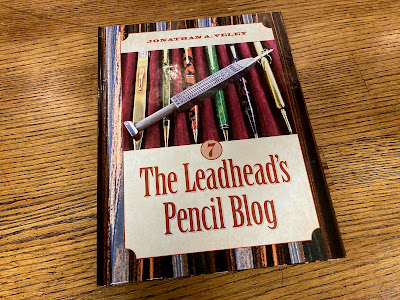

If you don't want the book but you enjoy the article, please consider supporting the Blog project here.

“No really . . . some of my best friends are pencil collectors.”   Seems like I hear that every time a pen guy says pencils really aren’t his thing at a show, after he’s been standing in front of my table long enough that I’ll ask him if he wants to have a look at something.

I’ll smile inside.  Most of the time, we’ll chat . . . they actually do want to look at something . . . and they’ll end up taking one with them.  And some lead, while they’re here.   As Janet says, two is a coincidence and three is a collection, and I’m sure these guys are looking at coincidences in the rear view mirror.  

I was chatting with a friend the other day who had just taken in a collection from a guy that died – he was actually surprised that there wasn’t a single pencil in the entire pen collection.  It’s become the norm to have a few pencils about, even though most of us call ourselves “pen collectors.”  I do the same thing too sometimes, telling people I don’t know that I collect pens - for whatever reason, it’s just easier to explain.  Maybe I’m just saving a syllable.

Pen collectors have been both drawn to and a little ashamed of their affinity for pencils as long as I’ve been collecting, although the stigma of being a “pencil guy” has disappeared.  When I started collecting twenty years ago, fountain pens were a serious, high-stakes business.  People attended pen shows with thousands of dollars in their pockets, investing in a bull market one thousand-dollar pen at a time.  Pencils?  They just weren’t worth anyone’s time.

Times have changed.  These days, people appreciate that pencils have their own, distinct appeal.  Their colors are perfectly preserved, they have their own “build a better mousetrap” gadgetry, and they always work . . . or usually, anyway . . . at least you can leave a piece of lead in one for years and it will write when you pick it up without missing a beat.

And “low-stakes” no longer means lowbrow – yes, pencils still are generally less expensive than their inky cousins, but people have come to realize and appreciate that smaller investments in the things we enjoy leaves more of an opportunity to relax and have fun.

Even people you wouldn’t expect, like prolific author and pen restorer Richard Binder, who engaged me in conversation recently about a subject you would assume wouldn’t be worth the time of day in polite pen society:


Richard wanted to add information to his Pen “Glossopedia” about these lowly baseball bat pencils, and he was wondering if I had information to confirm or deny that they were made by Scripto in Atlanta.  Anyone can spin a miniature bat and stuff a rudimentary pencil mechanism in one end, I said, and while I didn’t have any proof that Scripto made them, I did have proof of one company that did:


The top pencil in that picture is one of the most common varieties along these lines – commemorating the 100th Anniversary (ish, of course) of the game of baseball.  The next one has an imprint for the United States Military Academy – take from that whatever you will . . . 


. . . as well as something that provides more than just a guess as to whom might have made at least some of these:


The Louis F. Dow Company of St. Paul, Minnesota, like its crosstown competitor Brown and Bigelow (makers of the Redipoint line), specialized mostly in campy stuff like these made for advertising purposes, including cigar-shaped wood pencils complete with mock paper bands:


As well as that puzzling but hysterical example at the bottom: “Dow’s Original Sausage Pencil.”


Richard and I went through the evidence together, and all I could do was draw my usual line between who manufactures a pencil (actually makes it), versus who produces it (has it made for them to sell to the public).  

Then, however, I met with Margaret Jacoby to pick up the rest of Don’s collection.  As she showed me drawer after drawer of pencils (Don, like me, never had any shame about liking the things), there was a drawer of kitchey stuff, including a few bat pencils as well as something I had to message to Richard, right there from the table:


There it is . . . the “M” word . . . clarifying that Dow actually made at least some of these things.  When I got home, I flattened it out a bit better:


“Easy to write with . . . fun to own.”  That’s what I’ve been saying about these things all along!  

Still, the notion that Scripto might also have had something to do with these left some nagging questions, which were answered in what I would consider an unlikely place.  A website dedicated to the 100th Anniversary of Baseball in 1939 (1939baseball.com) celebrates everything in connection with that glorious year in our American pastime.  For a generalized website, this one has a surprisingly detailed dissertation on the art of the baseball bat pencil on a dedicated subpage.  

The author attributes bat pencils in darker finishes and smooth nose cones with Dow, and lighter finishes with grooves around the nose with Scripto.


Although these words are spoken with authority there’s still plenty of room for discussion, starting with the fact that pencil mechanisms may have been sourced by either company separately from the bats themselves.  Maybe I’m putting too fine a point on this issue, but I’d like to see paperwork accompanying a light-colored bat pencil with a grooved nose that has the same “manufactured by” language on the paperwork before I’d accept the conclusion as ironclad.

The humble baseball bat has wormed its way into Richard’s heart, and therefore into his online “Glossopedia” at Richardpens.com – in the entry for Scripto, although if the 1939baseball.com article is correct, the pencil he shows is a Dow.   Dow hasn’t yet warranted an entry of its own, over at Richard’s website . . . oh, but I’m sure Richard hears the company banging more persistently on his door these days!

It's like a tube of Pringles.  You can’t stick your head in that rabbit hole just once . . . 


Unmarked bowling pin pencils, like baseball bats, are a fairly common sight, and ordinarily even I wouldn’t bother to specifically chase one – especially when, like this one, someone apparently poked holes on either side of the neck to accommodate a keychain or something.  But this one had just a little bit more to it:


The auction listing described it as a “Herrin” pencil, but on close examination I can see “HEDPIN,” as in the head pin in a bowling alley.  It’s too small to be an advertisement . . .   and . . . it looks like whatever was written in the bottom of that shield was deliberately but crudely painted over.

The clues were enough to lead me to an old auction listing for another example of the “HEDPIN,” without the obliteration of the rest of the message:


The pictures weren’t helpful, but the title of the auction was: “F.E. Farrant, Marion, Ohio."  If you squint really hard when you look at that picture while thinking that’s what it’s supposed to say, that looks about right.  I was able to confirm a person by that name in that city:


A series of notices in The Marion Star in September, 1949 advertised that the contents of a storage unit owned by F.E. Farrant, “in the first building North of The Highway Rollerina,” was scheduled to be auctioned.  There’s no way to know what Farrant had in storage, but if the lucky winner happened across a treasure trove of unsold “Hedpin” pencils, it would make sense that some would turn up with Farrant’s name painted over – but not the catchy name.

I haven’t found anything else concerning the Hedpin, and outside of these two examples I haven’t seen others marked.  In the absence of the “M” word anywhere, all we can do is guess a bit based on what we might know about the baseball bat pencils.  All the ones I have seen are lighter colored, and those with metal tips have grooves — so if the 1939baseball site is correct, Scripto might have had something to do with these.  However, sometimes these are found with red plastic tips instead (suggesting wartime production); as shown on the “Sausage Pencil” above, we know Dow used those tips – and I haven’t seen one on a Scripto.

Campy, funny and addictive.  I might as well grab that can of Pringles - can’t have just one, after all.


Tuesday, April 20, 2021

Henber Wrinkles, Part One

This article has been included in The Leadhead's Pencil Blog Volume 7, now available here.


If you don't want the book but you enjoy the article, please consider supporting the Blog project here.

One of the distinctive features that makes Henber pencils stand out from the crowd is the way the chasing extends down the barrel past the point at which it begins to narrow down to the tip:


After writing that article, I suppose that feature was rattling around in the back of my mind as I cruised the online auctions – so this one stood out:


The picture suckered me right in, with that great chasing and a much brighter finish than you’ll see on most Henber pencils (being somewhat of a traditionalist, I never polish silver with nice patina).  However, when this one arrived I saw it was no Henber . . . and I should have remembered what it was:


“Dow / Pat. 3-6-23.”  The Dow was one of my early favorites here at the blog, featured in an article titled “The Real Housewives of Minneapolis” (Volume 1, page 282).   At that time, I was focused on the patent history.  The title of the article was derived from the inventors, Elizabeth O’Brien and Mary C. Vierling of Minneapolis, Minnesota, who applied for patent number 1,447,397 on April 6, 1921:


The Dow, produced by the Louis F. Dow Company of Minneapolis, has an inner sleeve which slides inside an outer shell, held in place solely by friction.  The lead simply sticks into the end:


Telescoping tubes held in place by friction were nothing new; in fact, another Minneapolis company, Brown and Bigelow (best known as makers of the Redipoint), had patented a similar design in 1921 - the patent was issued to Brown and Bigelow’s dream team of inventors, Howard L. Fischer and Frank J. Kristofek, on April 19, 1921, just two weeks after O’Brien and Vierling filed an application to patent the Dow:


Brown and Bigelow responded by filing an application to reissue Fischer and Kristofek’s 1921 patent on April 12, 1923 – a month after the patent for the Dow issued – adding claims for the same features that O’Brien and Kristofek had patented.  The Brown and Bigelow reissue was granted on January 12, 1926, and Brown and Bigelow immediately sued the Louis F. Dow Company for patent infringement.

It would be four years before the case was finally decided.  On August 9, 1930, the Federal Appeals Court for the Eighth District issued its opinion affirming the decision of the Minnesota District Court exonerating Dow (Brown Bigelow v. Louis F. Dow Co. (C.C.A. 8) 42 F.2d 785).  The Court noted that the prior art of using frictionally engaging tubes was “a crowded one,” including among many others Sheaffer’s venerable patent for the Sharp Point, issued November 5, 1918 – remember how that spare lead magazine doubles as a drive tube?


Nice try, Judge Booth said to Brown and Bigelow.  With so many telescoping tube elements in the prior art, in order to uphold a patent, the specific manner in which those tubes engage is the only thing that can be patented.  Since Fischer and Kristofek did not claim the specific way O’Brien and Vierling’s pencil was held together, Fischer and Kristofek couldn’t add that claim to an earlier patent as a “reissue.”  

The Court, however, made it clear that it was not ruling that the O’Brien/Vierling patent was valid – Judge Booth only found that it did not infringe on the Fischer/Kristofek “reissued” patent. 

The threat of infringement litigation likely started in 1923, when the Dow patent was issued and the Brown and Bigelow reissue application was filed.  That would explain why the advertisements for the Dow I could find were published in the early 1920s, beginning in October, 1922.  This particularly nice ad, for the checking pencil version, ran in Office Appliances in November, 1922:


All the advertisements I found were for more humble versions of the pencil such as these, with plain, painted barrels rather than the finely engraved sterling example at the beginning of this article.   Finely engraved . . . exactly like the very uncommon engraving on another Minneapolis brand – the Henber.  

Was there a connection between Louis F. Dow and The Henber Company?  Perhaps, but one other detail has me thinking it was as a successor rather than a supplier.  As I filed away my Dow ringtop, I had forgotten that I had a full sized version in the box (you would think I would have remembered that, since it was featured here in Volume 2, at page 42):


Note the logo on the box: in the years since I last wrote about that pencil, I’ve put together a nifty little reference book titled American Writing Instrument Trademarks 1870-1953, and the trademark registration for that mark is among the more than 2,200 trademarks included in the book:


According to the registration certificate, the Louis F. Dow Company first used this mark in August, 1923 – the Henber, according to my research, vanished without a trace in February, 1923.  

Were sterling Dow pencils also made earlier, while Henbers were also being made?  Perhaps, although one would expect the flagship, luxury models to be featured prominently in Dow’s 1922 and 1923 advertisements if it was.  The timeline, like Clark Kent entering a phonebooth and emerging as Superman, suggests that Henber’s operations were absorbed by Louis F. Dow.

Maybe.  But that doesn’t explain the other two wrinkles I have to show you.  

Saturday, March 21, 2015

Tempting Enough

This article has been edited and included in The Leadhead's Pencil Blog Volume 3; copies are available print on demand through Amazon here, and I offer an ebook version in pdf format at the Legendary Lead Company here.

If you don't want the book but you enjoy this article, please consider supporting the Blog project here.

Normally I don’t chase after wood lead containers, but this time I just couldn’t resist:


The Louis F. Dow Co. of St. Paul, which made “The Universal Pencil,” is something I’ve had a soft spot for since posting “The Real Housewives of Minneapolis” here almost three years ago (http://leadheadpencils.blogspot.com/2012/07/real-housewives-of-minneapolis.html).  Just after I posted the initial article, a swarm of them seemed to turn up in rapid succession, then as quickly as the deluge began, it stopped.   This is the first bit o’ Dow I’ve seen turn up since 2012.

And it goes sooooo nice with this:


Tuesday, February 19, 2013

A Wooden Eversharp??

When Joe called me to tell me he’d found a wooden Eversharp, I was really excited.

When he told me that he found two of them and I could have the other, I danced shamelessly about the room!

But then, as we was describing it to me, it didn’t sound much like an Eversharp. Sure, the name was proudly written on the side of the barrel, but the mechanism just didn’t sound like anything Charles Keeran cooked up. It did, however, sound like something else that I happened to find at right around the same time, and I’ve found a couple other examples since. That’ the way it seems to go with these things – I’ve never heard of one, then five of them turn up all at once, then nuthin’.

Joe brought both of his examples with him when he came to the Ohio Show, and during our photo shoot after the show, we got his and mine together for a group shot:


To learn more, this full article is included in The Leadhead's Pencil Blog Volume 2, available at Amazon, Barnes & Noble and everywhere else you buy books, or you can order a copy signed by yours truly through the Legendary Lead Company HERE.


Tuesday, February 12, 2013

I'm Better En-Dowed Now

I’d never heard of the Dow before last year, when an example bearing a patent date turned up and led me to write "The Real Housewives of Minneapolis" back on July 26, 2012 (see https://leadheadpencils.blogspot.com/2012/07/real-housewives-of-minneapolis.html). I was so excited that Michael Little had an example during our swap-a-thon that I included it in the picture of killer finds in my Ohio Show Report. Here’s a closer shot of it:


To learn more, this full article is included in The Leadhead's Pencil Blog Volume 2, available at Amazon, Barnes & Noble and everywhere else you buy books, or you can order a copy signed by yours truly through the Legendary Lead Company HERE.


Thursday, July 26, 2012

Real Housewives of Minneapolis

At an online auction recently, I noticed a group of pencils – mostly not very good ones – in a single lot. One attracted my attention, because the seller indicated it was stamped "Dow Patent 3-6-23." As I am always the sucker for names and patent dates I’ve not seen before, I had to bite just to see what it was all about. Here’s the pencil,  and just as the seller described, there was the imprint on the bell top . . .

NOTE:  This article is now included in the print version of The Leadhead's Pencil Blog, available anywhere you buy books, or also from The Legendary Lead Company.

To order, here's the link:  Volume 1 at Legendary Lead Company