Showing posts with label Artpoint. Show all posts

Sunday, September 14, 2025

Still Starving

I haven’t searched the online auctions as carefully as I have in the past lately: between my new fascination with dip pen wells and a massive influx of new pencils piled up in the musuem, waiting to be photographed and documented, I haven’t had as much of an appetite to bring a bunch more home.

I said I didn’t have as much of an appetite. I didn’t say I was dead.

It had been a couple weeks since I had logged into eBay, but when I did the infinite well sprang anew. One of the first things I saw was this lot:


The pencils are all unmarked, and other than their distinctive 1920s look there was no way to know who made them . . . unless, of course, you read this blog. 

I knew exactly what they were, because I’ve written about them. These were made by the Western Pencil Company, which was set up to succeed the Dollarpoint Pencil Company, which had failed in early 1925. Western Pencil Company was alive, at least in name only, until its remaining assets were sold at auction in 1938. I last visited the brand in “Diamonds Amongst the Rough” (April 30, 1921: Volume 7, page 73), an article in which I noted how starved I am for more information about these:


The primary reason for that last article was the two-tone example that had recently turned up, in jade with those red marbled end pieces. Some, like the top three shown here, have a deeply ribbed tip with a longer metal section, mimicking the appearance of the earlier metal Dollarpoint and Artpoint lines. Later examples have a much shorter metal tip and a smooth, celluloid nose. The bottom two have no markings, other than an advertiser’s imprint on the red one.

One of the things I wondered at the time was rather there were all-red marbled examples out like the blue one at top, and whether the solid red examples like that bottom one were all advertisers (I have seen a couple others since, and all have had advertising imprints . . . for the same company, in fact: Columbia Varnish Company. I was unable to establish any connection between Columbia and the Western Company, by the way.


All I really wanted out of this new bunch was just one of the red marbled examples, but I wanted it badly enough that I didn’t mind bringing home seventeen others along with it. Heck, I rationalized, there might be other things I can learn from them. My competition, I thought, might be people who just appreciate good-looking flattop pencils from the 1920s, but I figured they wouldn’t want to pay much. 

The more fierce battle would come from people who knew what they are, probably from reading this blog, and I had visions of one of them coming up to my table at the next show to do a “nana nana boo boo” dance. That had me bidding the stupid money, because I had to know whatever there is to know from these. Two other bidders tried in the last few minutes, but it wasn’t enough. One of them, I knew from the masked handle, was someone I know. I’ve since shared the wealth with him. The other I have not yet heard from.

My victory lap when they arrived was on our kitchen table, where I first did a close examination to see if any had imprints or any other markings, no matter how faint, and none of them do - not even the red marbled ones, which look to be on the earlier end of production when all were marked.

Then it was time to see whether the two-tone example residing in my collection was something that could be easily mixed and matched from parts of different pencils. I’ve wondered whether it was factory. After a bit of mixing and matching, I was more confused than before:


The green ends fit on the red marbled, but not the other way around . . . the nose won’t fit over the wider pushrod.  So I tried some other combinations:


The red and jade examples swap nicely, but that red marbled nose won’t fit on the orange one, either. It was time to abandon the kitchen table for the museum, where better lighting and a macro lens might explain what is going on here. I took apart my two-tone example and compared it to a solid jade one, and there was the answer:


At top, the two tone example has a plain pushrod to advance the lead, just like the earlier Dollarpoint and Artpoint pencils. It pushes the lead forward, but it doesn’t pull it back – the lead is held in place by friction. The jade example at bottom is a little later, and it has a wider, hollow rod that holds a piece of lead. It advances and retracts because the tip is bored out enough to allow the lead to pull back in.


That had me checking under the hoods of all of the examples I have found, and I notice a pattern . . . mostly . . .


Those with the longer metal tips all have simple pushrods, and out of these all but these new red marbled ones have Western Pencil Company imprints. Fifth from top is a black and pearl example, which has a shorter tip and a barrel imprint. The bottom three lack any barrel imprints, and all three are equipped with that wider, propel-repel feature. 

That means, and I confirmed it, that I could make two-tone pencils by mixing and matching red marbled with that black and pearl example, since it is equipped with a propel-only action:


With black and pearl examples in hand equipped with either the propel only or propel-repel feature, I was back at the kitchen table checking what was inside all of the other jade and orange examples that had come in. All had the propel-repel feature except for one jade example, but . . .wait a tick . . . there was something stuck in the nose of that one. When I pushed out the obstruction . . . 


The propel-repel feature was created in the simplest way possible: a hollow rod was forced over the solid push rod that had been in use, which holds a piece of lead at the other end. I checked the other examples, and none of these pieces are soldered in place - they all simply pull off . . . say, if you wanted to “make” a two-tone red marbled and jade example like the one I found earlier. Or maybe this:


No, all of this is just irresponsible. I’ll leave my two-tone red marbled and jade example as it came to me, because I think it might be factory: as rare as these Western Pencils there are, junk box provenance suggests it is unlikely that some random prior owner combined parts of two pencils, and it would make sense as the end of Western Pencil approached in 1938 someone may have salvaged remaining parts by pulling the propel-repel rod off at the factory. In the future, documentation may surface to confirm that the two-tone thing was actually a thing.

Otherwise, I’m not going to start mixing things up by swapping parts in the absence of evidence they were ever intended to be combined in such a fashion. They are fun to look at, but for now, all parts have been returned from whence they came.

Saturday, May 9, 2020

A Little Bit of Closure

This article has been edited and included in The Leadhead's Pencil Blog Volume 6, now on sale at The Legendary Lead Company.  I have just a few hard copies left of the first printing, available here, and an ebook version in pdf format is available for download here.

If you don't want the book but you enjoy this article, please consider supporting the Blog project here.

I probably paid too much for a lot of metal pencils in an online auction, because I really wanted to add this one to my collection:


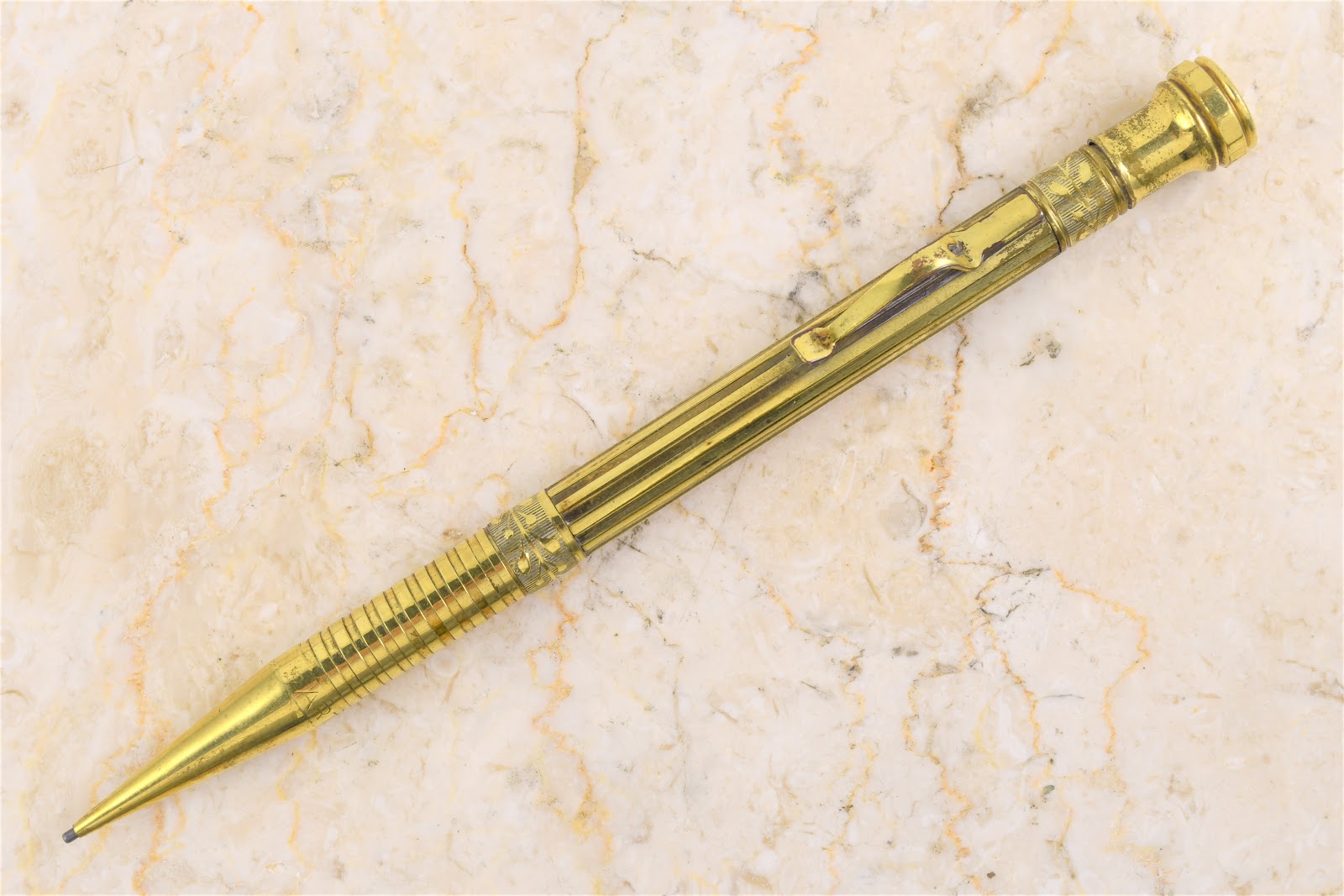
It’s an Artpoint pencil made by the Dollarpoint Pencil Company of Los Angeles.  Back on April 23, I showed off a salesman’s kit with a shorter model of this pencil in that green gold fill, and I thought it would be nice to have each of the three known sizes:


But there was another reason I wanted a full sized model in that gold fill.  At the end of 2016, I posted several long-forgotten newspaper advertisements for the brand (see https://leadheadpencils.blogspot.com/2016/11/what-became-of-dollarpoint-revealed.html), including this one:


This Sun Drug Company advertisement, which ran in the Los Angeles Times on December 10, 1922, is the closest thing we have to a catalog of Artpoint and Dollarpoint models, and it identifies Artpoints in three sizes and four materials.  The cheaper Dollarpoint line was available only in nickel plate, but Artpoints were available in “triple silver,” “statuary bronze,” “gold fill” and “green gold” (I noted in the article that since the gold fill and green gold models are listed at the same price, it must mean green gold filled).

I thought I was finally going to get to show you all four materials in the same pencil:


Crap.  That makes two examples in green gold - I thought my other one was regular gold plate.   So, this will have to do for the time being, as much as it irritates all of my OCD tendencies:


Sigh.  That’ll have to do for now.

Thursday, April 23, 2020

All of the Good Points . . . None of the Bad

This article has been edited and included in The Leadhead's Pencil Blog Volume 6, now on sale at The Legendary Lead Company.  I have just a few hard copies left of the first printing, available here, and an ebook version in pdf format is available for download here.

If you don't want the book but you enjoy this article, please consider supporting the Blog project here.

I know they’re just pencils, workaday items that just don’t matter that much in the grand scheme of human civilization.  But as I tell these stories, I’ve come to appreciate that there are times when something passes into my hands that brings with it more than just the ability to make a dark line on a sheet of paper  - it brings along with it the baggage of rich history.

That’s what happened when this came along:


I’ve put together the story of the Dollarpoint Pencil Company here in many installments - the five-part detailed history was posted in 2014 (it starts in The Leadhead’s Pencil Blog Volume 3, page 47) and I’ve added a few follow up pieces to the story since then (see “What Became of Dollarpoint . . . Revealed” at https://leadheadpencils.blogspot.com/2016/11/what-became-of-dollarpoint-revealed.html and “The Handoff to Western” at https://leadheadpencils.blogspot.com/2016/11/the-handoff-to-western.html).

I inadvertently hoard Dollarpoints, because there are still so many gaps in what I know that I’m always hoping a different imprint or some other feature will fit into that puzzle.  When this one came up in an online auction, I knew it was only a matter of how many dollars it would take to book a one-way ticket for it to travel to Newark, Ohio.  At the end of the day, it was a lot cheaper than I thought it would be.  Sigh . . . sometimes I feel like I’m a cult of one.

Note that on the front of this salesman’s case J.E. Roach & Company is identified as “National Distributors” for the brand – Jesse E. Roach was the assignee of all the company’s design and utility patents, and the company named after him was sometimes identified as the manufacturer, sometimes as the distributor.  Roach was on the board of directors for Dollarpoint, as well.  ‘Twas quite the tangled web.

Inside the case are a nice grouping of Artpoint and Dollarpoint pencils . . . and a note left for posterity:


“C.G. Francis - First Pencil Samples for selling - approx. 1920.”  Not approximately, methinks – damned spot on is more like it.  All of the initial patents, both utility and design, were applied for in 1920, and the incorporation of the Dollarpoint Pencil Company was reported in The Bookseller, Newsdealer and Stationer on July 1, 1920.  In my 2014 series, I reproduced a snippet view from Modern Stationer, which wasn’t available for full viewing at the time.  “The new Dollarpoint and Artpoint pencils will be ready for the market soon,” the Modern Stationer piece indicated.

Since 2014, the full version has been made available, and while that volume of Modern Stationer started in 1920, it overlapped 1921 - this piece actually ran on February 25, 1921, and here’s a clearer copy of the announcement:


I have no idea who C.G. Francis was.  Perhaps he (or she) was a salesperson who received an advance order.  Perhaps Francis had some affiliation with J.E. Roach & Co. or with the stationer Cardinell-Vincent, which had the west coast agency for the brand.  Time will tell, but for our purposes, Francis was a person with the real inside track on what was about to be rolled out at Dollarpoint.

And their offerings, as indicated by the pencils inside this case, were impressive indeed:


The top and bottom examples in this picture are the company’s budget line, marked “Dollarpoint” at the nose.  They are slightly less hefty and lack the more intricate scrollwork found on the upper “Artpoint” line:


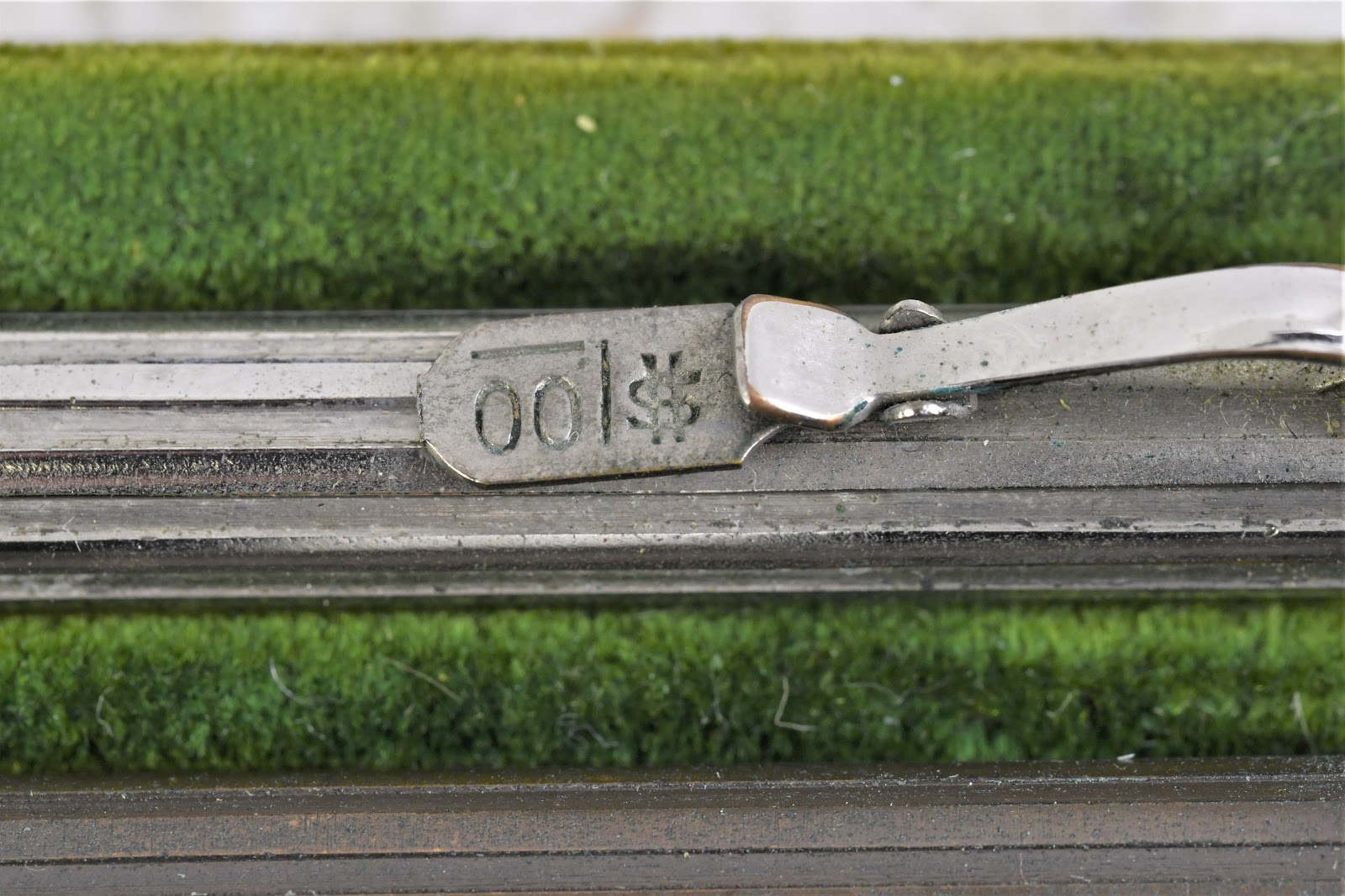
There’s a couple really interesting things about that top one.  First, it’s in a shorter size with a side clip – out of some 25 of these Artpoints and Dollarpoints I’ve found over the years, only one other example has come my way in this size, and it’s an Artpoint rather than a Dollarpoint.  Also, it still has its metal price tag of $1.00, fashioned as a neat little tab that fits under the clip:


The Artpoint ringtop also has a price tag - $1.50 for the heavier, more intricately detailed line’s smallest model:


The long Artpoint with a cap that looks a bit off is a bit worse for wear, but it appears to be corrosion that has occurred sitting in the case over the last century rather than wear from use.  As for the cap, it makes sense to include it in a salesmans’ case since it shows off one of the company’s other talents:


Just like the big boys, Dollarpoint offered custom enamel advertising emblems for the tops of their pencils.   Jevnes’ Fine Foods was a real operation: I found an undated photograph which was supposedly taken at Palos Verdes Estates, California in which one of their delivery trucks unintentionally made a cameo appearance:


The nicest piece in the bunch, at least to me, is that gold filled Artpoint.  It’s also in that rare short side-clip size, and while the plating on these was prone to wear, this one has fared very well in this case for the last century:


Just as the case advertises, “All of the good points . . . none of the bad.”

Thursday, November 24, 2016

The Handoff to Western

This article has been edited and included in The Leadhead's Pencil Blog Volume 4; copies are available print on demand through Amazon here, and I offer an ebook version in pdf format at the Legendary Lead Company here.

If you don't want the book but you enjoy this article, please consider supporting the Blog project here.

“Junk Box Provenance” is a term I use to describe those instances when the circumstances in which an object is found suggests something about the object itself.   The two Artpoint pencils from yesterday’s article came from that bunch:


And each of these shares something interesting.  As I’ve mentioned in earlier articles on the subject, when you are able to wrestle off the cap of an Artpoint, what you will usually find – if there’s anything – is the same imprint:


But when I remove the caps from these two examples, there’s nothing to be found:


I’m also hoping that one of these days, the initials “JEY” will prove significant, since this is the first time I’ve seen one with nice engraving on the top of the cap like that.

The absence of a Dolarpoint imprint suggests that these were not made by Dollarpoint – since I found advertisements from late 1923 suggesting the company might have started using the name “Artpoint Pencil Company” when it attempted to reorganize,  maybe the manufacturers stopped using the Dollarpoint imprint then.   The auction notice from February, 1925 clearly indicated that the assets sold were those of the Dollar Point Pencil Company, though.  I believe it’s more likely that Artpoint pencils lacking an imprint at the top were made by whomever purchased the assets and equipment of the company, using all of the existing tooling on hand.

There are two other pencils that came out of that DC show collection, which I believe supports this conclusion and indicates who that likely buyer was:


Over the course of more than fifteen years of collecting, these two examples nearly doubled my collection of pencils from the “Western Pencil Company.”  Here’s the other three I’ve found, all of which were pictured in The Catalogue on page 172 when I published the book five years ago.  It’s been that long since I’ve found any other examples:


Note that there are two different tips styles on these.  Normally I would think that the ones with the longer tips and straighter barrels are earlier, since the machining is more complicated to make the tapered barrels with a shorter tip:


But that’s just a theory based on observation of similar models.  One thing all three share is the same imprint:


“Western Pencil Co. / Los Angeles - USA” My new black and pearl example is identical to the one I’ve had for awhile, with the same imprint:


The jade example, however . . . is unmarked.

Here’s where the junk box provenance comes in.  That makes four pencils you don’t normally find – two of which I haven’t turned up in more than five years – in one collection.  I think they came from a common source.

There’s plenty of other reasons to suggest that Dollar Point was acquired lock, stock and barrel by a purchaser which resumed operations, turning out Artpoints using the existing tooling (without, of course, the Dollarpoint imprint) and later converting that same mechanism for use with celluloid barrels as brightly colored celluloids supplanted metal pencils towards the end of the 1920s.  Notice how similar the two are:


Unfortunately, I don’t have any direct evidence concerning who this mysterious purchaser might have been – but I do have one solid clue as to who was running the show by the end of 1927:


On December 3, 1927, the Los Angeles Times reported that a fire had destroyed the building “of" (doesn’t say “owned by”) the Western Pencil Company, which was located at 1101 Venice Boulevard, Los Angeles.  Otto Gamball, the factory superintendent, saw a batch of celluloid catch fire when it was overheated in an oven, and in his attempt to remove the burning celluloid from the building he sustained life-threatening burns.  I never found a follow up article indicating whether he survived.

The other clue in the story is a name associated with Western Pencil: “Mrs. H.L. Zimmerman,” who is reported to be “the wife of the owner of the factory.”  Following the conventions of the day, I believe this means the owner of the factory was H.L. Zimmerman, and I believe that means the owner of Western Pencil, not just the building in which it was housed (note that she was injured attempting to rescue the books and records of the company – something a mere building owner would not have risked life and limb to preserve on behalf of a tenant).

Did Western Pencil itself survive the blaze?  Maybe, for a time.  After the report of the fire, the only other mention I found of a “Western Pencil Company” was a notice that all of the firm’s machinery and equipment – even three cars – were being auctioned on February 22, 1938:


The year 1938 seems late for the examples of the Western Pencil Company I’ve found to date.  Maybe that’s why the company folded, as its squared-off flattop pencils became passe and the company failed to keep up with the times.  Maybe the company stopped marking its products, as my new jade example suggests it might have done, and there’s other unmarked, more streamlined pencils out there we just haven’t known to attribute to the company.

But maybe, of course, there’s streamlined pencils out there marked “Western Pencil Company” which would prove that Western not only survived the fire but continued to flourish for another decade.  That’s why, even after I’ve amassed thousands of mechanical pencils, the hunt continues.

Wednesday, November 23, 2016

What Became of Dollarpoint . . . Revealed

This article has been edited and included in The Leadhead's Pencil Blog Volume 4; copies are available print on demand through Amazon here, and I offer an ebook version in pdf format at the Legendary Lead Company here.

If you don't want the book but you enjoy this article, please consider supporting the Blog project here.

At the DC Show, two of the pencils that came out of the hoard I purchased on Friday were these:


These are Artpoint pencils made by the Dollarpoint Pencil Corporation of Los Angeles, and it’s unusual to find them in finishes such as these:


Both look gold . . ish, but on close examination, one is a bright gold plate while the other has more of a bronze finish, with the recesses filled with what looks like black paint.

I wrote about the Dollarpoint Pencil Corporation here in a five-part series after I stumbled across the design patents and a couple names odd enough to unlock the company’s early history (the first in the series posted two years ago at http://leadheadpencils.blogspot.com/2014/10/artfully-to-point.html).  Missing from that series, unfortunately, was the end of the story – although I was able to find out what became of the characters behind the company after it folded, all I knew about Dollarpoint’s demise was that I could find no reference to the company after 1924.  I had found a short notice in Western Advertising that J.E. Roach & Co., the sole selling agent or manufacturer of the company’s pencils (depending on which news report you read) had retained the advertising firm of Smith and Ferris to launch a national advertising campaign, but then the trail went cold after January, 1922.

Since I was really itching to show you a couple new Artpoints – more than just a “here’s a couple more pretty colors” sort of piece – I went back and rechecked my research to see if I could find any new details.

I did.  When I wrote those articles two years ago, it was just before I subscribed to newspapers.com (mostly for the Bloomington Pantagraph, which gave me some valuable insight into the early history of Charles Keeran and his Ever Sharp).  Beginning in September, 1921, Dollarpoint placed enormous advertisements in the Los Angeles Times, starting with this one on September 11, 1921, soliciting sales representatives:


This advertisement is curious in a couple respects: note that only the lower-priced Dollarpoint pencils are advertised – even though the floral detailing shown on the pencils is clearly from the higher priced Artpoint line, the nose cones are clearly marked “Dollarpoint.”   Note also that J.E. Roach & Co. is identified only as “national distributors” in this advertisement – unsurprising, since the focus of the advertisement is to attract sales representatives rather than to advertise the product itself, even though J.E. Roach had been incorporated as a “manufacturer” in May, 1921 and the company by December was identified in various accounts as the manufacturer, rather than just the distributor.

On November 6, 1921, the Dollarpoint Pencil Company’s new advertising agents went to work in the Times with this fantastic half-page advertisement for the new pencils, “right out of our own Los Angeles”:


Note that again, there’s no mention of the Artpoint line, notwithstanding the fact that the Artpoint had been announced in the stationers press a year earlier. Also, Dollarpoint Pencil Corporation and J.E. Roach & Co. are listed side by side, with Dollarpoint being identified as the manufacturer and Roach as the “national distributors.”

The new advertisement must have been a stretch for the fledgling company, as it wasn’t followed up with more advertising for the Christmas, 1921 season.  For the following year, there were a few more modest Christmas advertisements for 1922, including these:


Note that in the latter advertisement, the Sun Drug Company provides the most detailed listing of Dollarpoint’s products.  The lower priced Dollarpoint pencils were offered in nickel plate, while the more detailed Artpoints were offered in triple silver, “statuary bronze” (that must be what my bronzish looking one is), gold plate and “green gold.”  Obviously since the last two were the same price, the green gold is filled or plated, not solid gold:   as heavy as Artpoints are, a solid green gold piece would be something!  

In January, 1923 the company ran this nice ad for “a wonderful product of a wonderful state”:


In June, 1923, the company engaged in another campaign, including these two advertisements:


In a brazen attempt to take on the Eversharp and Autopoint on their home turf, Dollar Point placed a large advertisement in The Chicago Tribune on June 5, 1923, identifying “M. Mundell” in care of the Warner Hotel at the corner of Cottage Grove Avenue and 33rd Street as the point of contact for those interested in becoming dealers


Note the oblique swipe at Autopoint, which had adopted “The Better Pencil” as its slogan: although the Artpoint is touted as “The Non-Plug Pencil,” this advertisement begins with “The better metal pencil has come to town!”

The Dollar Point Pencil Corporation overextended itself in its bid to take over the pencil world.  Cracks were beginning to show at the end of June, when in this June 30 advertisement the top end prices for Artpoint pencils was reduced from $3.50 to $3.00:


On July 24, the Los Angeles Times reported that an earlier report (one which, unfortunately, I have been unable to find) suggesting that Dollar Point was bankrupt was false – one of Dollar Point’s creditors has executed on the firms assets at the factory, but this account reports that the attachment was released:


Although this report indicates that the company planned to “expand its operations with the aid of additional working capital,” it appears that the writing was on the wall for Dollar Point.  In October, 1923, the company published want ads in papers all across the company offering to sell territorial distribution rights.  This one appeared in the Baltimore Sun:


Note that these advertisements contain the only reference I have found to an “Artpoint Pencil Company,” suggesting that there may have been some corporate as well as financial restructuring.  At any rate, the bid to expand failed.  In late 1924, it appears that The Los Angeles Times took a significant portion of the company’s remaining stock as payment for the generously-sized advertisements the paper had been running for the company.  Advertisements such as this one began to run in November, 1921, offering a free Artpoint pencil to anyone who sold a subscription to the paper. Note that the pencils are said to retail for $1.50, half off the already reduced prices advertised in mid-1923:


The Times must have inherited a substantial supply of Artpoints, since advertisements continued to offer free Artpoints as a prize for securing new subscribers as late as this one, from the May 1, 1932 issue:


The January 5, 1925 edition of the Santa Ana Register contains a discount advertisement for Artpoint pencils, marked down to prices ranging from 39 cents to 99 cents – and to add insult to injury, the pencil pictured isn’t even an Artpoint: it’s a Sheaffer Sharp Point (note the “bowler clip”):


It was over for the Dollar Point Pencil Corporation.  On February 8, 1925, it was announced that all the remaining assets of the company would be sold at auction on February 12, 1925.  The firm was still located at the 16th Street address, clarifying that the company’s plans to build an enlarged factory never materialized.  “The entire plant, equipment, etc. will be offered as a whole and in the event that a satisfactory bid is not received will be sold by the piece or in lots to suit those present.”


On February 12, I think there was a satisfactory bid, and I think that bid was from agents of what would become the Western Pencil Company.  More on that tomorrow . . .