Showing posts with label Faber (Eberhard). Show all posts

Sunday, March 22, 2020

A Milepost at Two Important Crossroads

This article has been edited and included in The Leadhead's Pencil Blog Volume 6, now on sale at The Legendary Lead Company.  I have just a few hard copies left of the first printing, available here, and an ebook version in pdf format is available for download here.

If you don't want the book but you enjoy this article, please consider supporting the Blog project here.

When Janet got the order to work from home for the foreseeable future, we scrambled to set up all her equipment in our home office – a room which, for the last ten years, has been where my online purchases have been opened, sort of a pencil halfway house for new arrivals that haven’t made it down to the museum just yet:


Distractions such as these were not conducive to working from home, so it was time this weekend to put these things away.  But as I started doing so, it occurred to me . . . we’ve all been through a lot these last two weeks, and maybe I can do something to give you a taste of normal.  Something you can read that isn’t about some stupid virus or some stupid politician talking about some stupid virus.  I always knew something extraordinary would probably lure me back into writing here, but I thought it would be an extraordinary find – not an extraordinary time. 

So relax, take a deep breath, and forget about all that for a while.  I’ll share some of the neat stuff I’ve been finding to give you something positive things to read.  I’ll start with this one:


When this one popped up, I wasn’t too excited at first.  I still try to limit myself to American pencils, and I always fear once I start branching out into foreign products, such as those from the German house of A.W. Faber, I fear having too many open cans of worms.  This worm, however, proved too enticing to resist, because it has something distinctly American about it:


That’s an American patent date of August 13, 1861, which refers to patent number 33,034 issued to Johann Lothar Faber “of the firm of A.W. Faber”:


This is a really interesting time in Faber’s history.  In 1849, Lothar Faber and his brother Johann Faber dispatched their brother, Eberhard Faber, as their emissary to establish operations in America.  Eberhard set up shop in New York selling a variety of “fancy goods,” but he does not appear in directories as “sole agent” in America for A.W. Faber until 1854.

(Note: I’ve posted a more detailed history concerning the relationship between A.W. Faber and Eberhard Faber here, starting with “So Many Fabers” at https://leadheadpencils.blogspot.com/2016/01/so-many-fabers.html).

Young Eberhard soon began to establish himself as a successful American manufacturer in his own right, a reputation which was enhanced after April 1861, when the American Civil War made importing Faber pencils from abroad more difficult.  His offices and “manufacturer’s depot” were located at 133 William Street, but he later moved his offices to 718 Broadway in 1877.  Eberhard died in 1879.

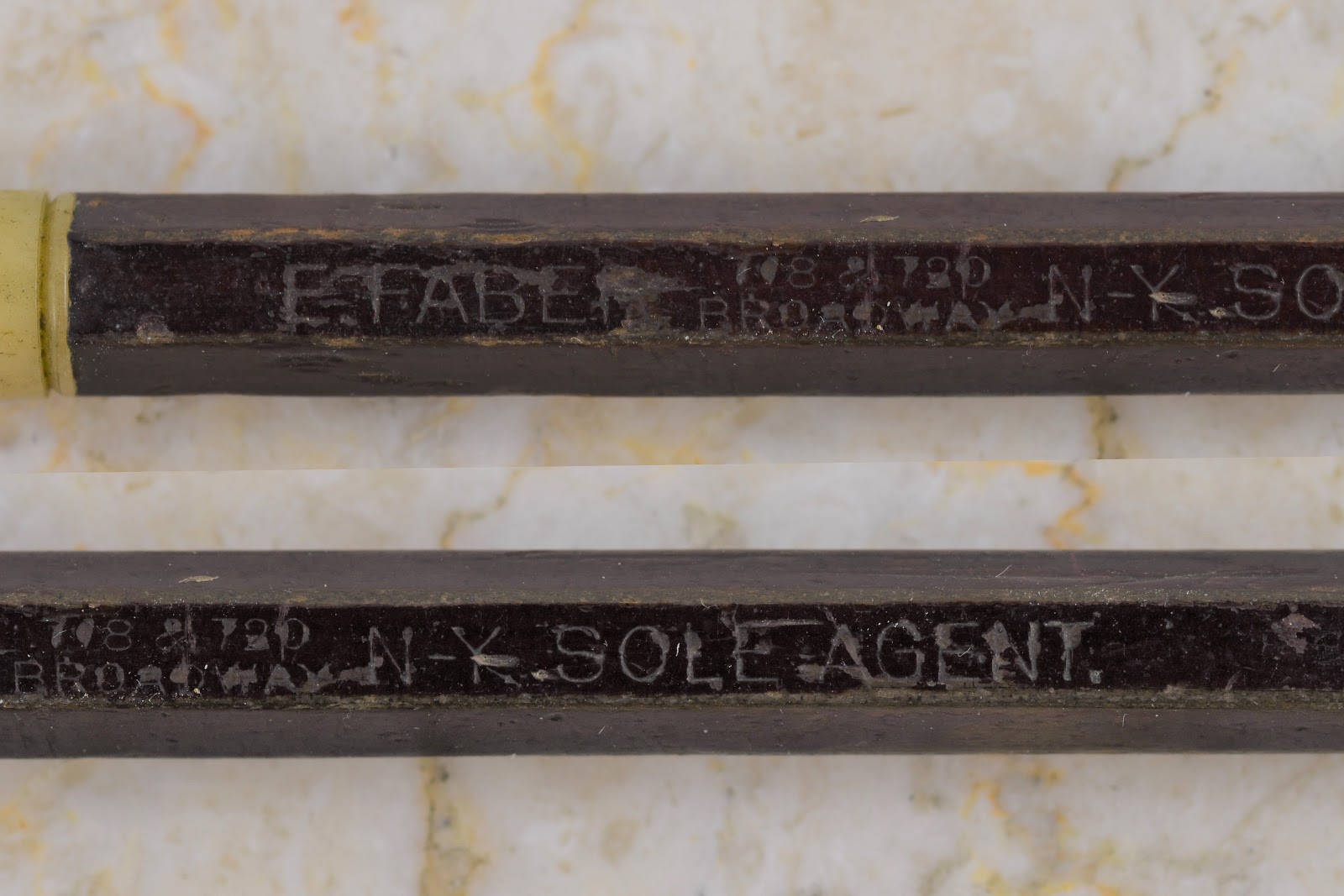
Which brings me to another fascinating detail found on the back side of this pencil – much more faintly imprinted than the gold foil stamp on the other side:


“E. Faber 718 & 720 Broadway NY Sole Agent.”  Our pencil dates to a very narrow window in time, between 1877 when Eberhard moved to that address and his death in 1879.

And it is that window which brings us to our second interesting crossroads, because this Faber shares some intriguing similarities with another pencil I’ve shown here before.  Note that our Faber is “left handed” – while most pencils have lettering running from the tip end towards the top, this one has lettering running the other direction (so the letters are upright when the pencil is held in your left hand).  Also note the hexagonal wood barrel and that bone finial at the top:


That’s our Faber alongside three examples of the “Sun Pocket Pencil,” which are also left-handed, wood hexagonal pencils with bone finials, and a nearly identical nose.  Even the lettering is identical:


Some Sun Pocket Pencils are marked, as the bottom example in this picture, with “Ink & Copying Pat. June 26, 1877.”  That patent reference is to number 192,555 granted to Charles Walpuski and assigned to Joseph Reckendorfer – it’s for the composition of the lead, not for the pencil itself.  “Copying” or indelible lead was impregnated with ink, so that something written with it could be copied by pressing a damp piece of paper against it and then transferring the image to another piece of paper.

And who made the Sun Pocket Pencil?  Reckendorfer’s name on the assignment provides a solid clue if you are up on your pencil history, but a conclusive identification comes from a rather nice book on trademarks titled American Writing Instrument Trademarks 1870-1953:


The Eagle Pencil Company registered the Sun trademark twice.  The earlier one, number 9,208, was filed on February 20, 1882 and was registered on March 21, 1882.  The second one, filed due to changes in trademark registration laws, was registered in 1905.

I’ve always had my Sun Pocket Pencils in the Eagle section at the museum, based on the Walpuski patent date for the lead and the trademarks that were assigned to Eagle.  Conclusive, right?

Maybe.  I’m having second thoughts.

The pencils share a mechanism patented by Johann Faber.  Yes, some Sun Pocket Pencils have the Walpuski patent date, but that’s just for the lead inside.  As for those convincing trademarks registered by Eagle, the earliest was filed in 1882 . . . five years after the Walpuski patent was issued and long after the 1861 patent on my Faber pencil had expired. 

The timing doesn’t make sense: Eagle was extremely aggressive in protecting its intellectual property, filing dozens of patents and trademarks over the years.  If Eagle was marketing a Sun Pocket Pencil in 1877, I’m confident Eagle would not have delayed five years to protect the name.   But if Eagle later purchased the rights to use the name, say in around 1882 . . .

I used to know exactly who made the Sun Pocket Pencil.  I’m still kind of sure, but the only thing I am 100% confident in saying is that whoever made the Sun also made this A.W. Faber pencil during the last two years of Eberhard Faber’s life.

Friday, August 18, 2017

Maybe Not Entirely Correct

This article has been edited and included in The Leadhead's Pencil Blog Volume 5; copies are available print on demand through Amazon here, and I offer an ebook version in pdf format at the Legendary Lead Company here.

If you don't want the book but you enjoy this article, please consider supporting the Blog project here.

Recently,The Pennant asked me to rework my series of articles concerning the history of the Faber houses of A.W. Faber and Eberhard Faber (I added some information concerning the third firm, Johann Faber, while I was at it).

Both here and in The Pennant arttcle, I addressed claims by the German A.W. Faber firm that Eberhard Faber was merely an American agent for its products, and specifically that Eberhard Faber sold nothing other than A.W. Faber products prior to 1894, when the German house terminated the American agency.

The evidence tends to support A.W. Faber’s claim: although Eberhard Faber was a prolific registrant of trademarks, the Eberhard Faber name was not registered for trademark protection until 1920, suggesting that Eberhard was not using his own name in commerce, but that of his German relatives instead.

I do, however, have a bit of evidence to suggest that the name “E. Faber” was in use much earlier than the trademark history suggests:


I’m pretty sure this one came from an online auction, because as plain as it looks, I’m not sure I would have taken the time to read the imprint otherwise:


“E. Faber.NY / Pat. Jan.25,1881."   A patent issued in 1881 would have been good for a period of 17 years, or until 1898 – that doesn’t quite get us back to before 1894, the date before which A.W. Faber claimed Eberhard sold only products marked with the German house’s name . . . but it’s very close.

Patent number 237,005 was issued to Bradley A. Fiske of Napierville, Illinois:


It was his second patent.  His first, number 226,607, was also for a pencil, issued on April 20, 1880:


The year after Fiske’s second patent was issued, in 1882, he relocated to New York, where his next patent, for a penholder (number 255,272), was assigned to Eberhard Faber.  In 1883, another Fiske patent, number 272,948, also for a mechanical pencil, was assigned not to Faber, but to a man named Bernard Hecht, and the patent indicates that Fiske had moved on to Newport, Rhode Island.

Based on Fiske’s history, it appears that his association with Faber was fleeting, and in 1882.  Would Eberhard Faber sit on a newly acquired patent for more than twelve years before putting it into production?  I don’t think that’s likely.

What I do think is likely is that Eberhard Faber was quietly bilding up its own reputation apart from (but derived from) A.W. Faber, and the omission of a trademark filing appears to be an attempt to fly under the radar rather than a historical testament to the accuracy of A.W. Faber’s claim.   By  the name “E.Faber” was finally registered as a trademark, on an application not filed until September 27, 1946, the coast was clear, and Eberhard Faber claimed to have been using the name on lead pencils since 1861:


. . . and on mechanical pencils since 1919.  Now we know that isn’t correct.

Friday, July 14, 2017

The Hard Proof

This article has been edited and included in The Leadhead's Pencil Blog Volume 5; copies are available print on demand through Amazon here, and I offer an ebook version in pdf format at the Legendary Lead Company here.

If you don't want the book but you enjoy this article, please consider supporting the Blog project here.

(Note: this is the second part in a two part series.  If you’re lost and need to start at the beginning, see http://leadheadpencils.blogspot.com/2017/07/the-hutcheon-brothers-sidebar.html).

Here’s a pair of pencils which turned up at the Chicago Show in May.


Before I show you what’s stamped on them, here they are compared to a ringtop pencil I’ve had in my collection for awhile:


All three pencils are stamped on the nose.  The one I’ve had looks like this:


“Mabie Magazine Pencil / Pat. June 7, 10.”  Mabie Magazine pencils are a fairly common sight, and they came in a broad range of materials and patterns.  It wasn’t really fair to show you a ringtop, which are unusual, since they are easy to spot in the side clip version with their patented January 19, 1915 Mabie Todd clips:


The June 7, 1910 patent date refers to patent number 960,588, which Egon L. Schmitz applied for on December 21, 1908 and which was assigned to . . . get ready for your daily dose of randomness . . . to the Eberhard Faber Pencil Company:


Now getting back to these two pencils that came my way in Chicago, you might have noticed that instead of a Mabie Todd patent clip, each sports a very Hutcheon-like clip.  With respect to the gold filled one, it is stamped as you would expect:


“Hutcheon Magazine Pencil / Pat. June 7, 1910.”

It also has the diamond-shaped Hutcheon trademark:


And what of that sterling example?  That one is a little more complicated:


“Sterling / Hallmark / Pat. May 31 & June 7, 1910"

Huh.  The clip looks Hutcheon, the June 7 patent date is a Faber patent shared by Mabie Todd and Hutcheon, but what’s up with that additional patent reference of May 31, 1910?


It refers to patent number 959,531, for a pencil nearly identical to the Schmitz patent, applied for six months later, on June 1, 1909, yet issued a week before the Schmitz patent.  The inventor was John A. Hollenberger of Hagerstown, Maryland.

I don’t have anything concrete yet concerning who might have made or produced the Hallmark magazine pencil.  “Hallmark” might well be a play on Hollenberger’s name, although “Hutcheon Hallmark” has a nice ring to it as well, and with the same clip there’s a strong suggestion that Hutcheon had something to do with it.

And the presence of nearly identical Mabie and Hutcheon Magazine pencils, both made under license from the same Eberhard Faber patent, does prove that Alfred Hutcheon’s relationship with Mabie Todd after 1913 was far more than just that of a former employee.


Update:  the Hallmark mystery is solved -- see http://leadheadpencils.blogspot.com/2017/07/the-hallmark-mystery-solved.html.

Sunday, December 11, 2016

A Flash of Style from the House of Faber

This article has been edited and included in The Leadhead's Pencil Blog Volume 4; copies are available print on demand through Amazon here, and I offer an ebook version in pdf format at the Legendary Lead Company here.

If you don't want the book but you enjoy this article, please consider supporting the Blog project here.

I paid more than I could justify for this one in an online auction:


That great green lizard-skin celluloid is really eye catching, and the chrome accents really set this one apart nicely.


It’s an Eberhard Faber, a brand I’ve always liked but which I have been even more in tune with since that series of articles I posted detailing the company’s history.  The celluloid is a little reminiscent of some of those pencils in the Permapoint series, but a little brighter.  It’s just something fun to look at on a lazy winter’s Sunday.

Wednesday, January 27, 2016

"Coronetesque," Not "Skylinesque"

This article has been edited and included in The Leadhead's Pencil Blog Volume 4; copies are available print on demand through Amazon here, and I offer an ebook version in pdf format at the Legendary Lead Company here.

If you don't want the book but you enjoy this article, please consider supporting the Blog project here.

At the Philadelphia Show this year, I was culling through Rick Krantz’ junk box when I noticed this one:


Since I’d just written a series of articles about the Eberhard Faber Pencil Company, maybe I was a little more in tune to Fabers when I stumbled across this rear-drive pencil marked “E.Faber” on the clip.   I didn’t look at it too closely at the time - I just noticed the name and tossed it into the pile of things I wanted to take home with me.

But now that I’m looking at this more closely, I’ve noticed something.  That plastic, with those purple lines in the green marbled plastic, is pretty distinctive.  In fact, there’s only one other place I’ve ever seen it:


These are Eversharp Bantams from the 1930s.  With a dearth of catalog information during the time period, it’s difficult to say exactly when these were made – we know that some were made in 1933, because of the specially marked “Century of Progress” bands on some made as souvenirs for the Chicago Worlds’ Fair that year.  When they were phased out isn’t clear, but it would certainly have been before the Skyline was introduced in 1940.  The color is an exact match:


This has me circling back around to those “Skylinesque” Faber pencils, which have Eversharp’s repeating mechanisms inside (http://leadheadpencils.blogspot.com/2016/01/maybe-even-closer-than-we-think.html):


And also has me thinking more about the ballpoint story (http://leadheadpencils.blogspot.com/2016/01/then-along-came-ballpoint.html), in which I had noted that with everything I had learned about Eberhard Faber, I couldn’t figure out how the company would have gotten dragged into the ballpoint fiasco in 1945.

This pencil might provide the answer.  Maybe Eversharp and Eberhard Faber didn’t “team up” for the ballpoint project.  Maybe I should have referred to those Faber repeating pencils as “Coronetesque” instead of “Skylinesque,” since the Eversharp Coronet pencils of the mid- to late 1930s also used the same mechanism.  Maybe the association of Eversharp and Eberhard Faber in 1945 isn’t so random after all:


Maybe the two companies had been working together for ten years by the time the ballpoint idea came along.

Friday, January 8, 2016

Then Along Came the Ballpoint

This article has been edited and included in The Leadhead's Pencil Blog Volume 4; copies are available print on demand through Amazon here, and I offer an ebook version in pdf format at the Legendary Lead Company here.

If you don't want the book but you enjoy this article, please consider supporting the Blog project here.

Note:  for the last few days, I've been documenting the history of Eberhard Faber.  That story begins at http://leadheadpencils.blogspot.com/2016/01/so-many-fabers.html.

This adventure started with a few E.Faber repeating pencils, nearly identical to Eversharp Skylines on the inside, from Monday’s article (http://leadheadpencils.blogspot.com/2016/01/maybe-even-closer-than-we-think.html):


When these might have been made intrigued me, because I knew of only one whopper of a connection between Eberhard Faber and Eversharp before I found these: the ballpoint pen.  As I was poking around, all the sources I was finding appeared to plagiarize one another with exactly the same story – usually in the same words.  Eversharp “teamed up with” Eberhard Faber in 1945 to acquire the rights to manufacture Biro’s new ballpoint pens in the United States.

I put “teamed up with” in quotes because that’s the phrase most sources plagiarize from each other . . . and, putting my lawyer’s hat on, there’s no such thing as “teaming up.”  After I've researched this a bit, I’ve got a better understanding of what actually happened, some of which doesn’t square with what all these sources are saying.

And I’ve turned up more questions than answers.

The truth came out, as it so often does, in Court.  When Eversharp and Faber started paying license fees to Eterpen, both companies withheld Federal income taxes on the payments, and when Eterpen wanted the withheld money back, Uncle Sam wasn’t as accommodating as Eterpen would have liked.  The resulting tax case, Eterpen Financiera Sociedad v. United States (1952), 108 F.Supp. 100, explains in detail what the deal was between these companies.

The Court noted that Eversharp and Eberhard Faber entered into an agreement with each other first, on May 5, 1945.  That agreement provided that if the two companies succeeded in negotiating a license deal with Eterpen, Eversharp would produce all of the pens and ink and Faber would be entitled to purchase up to 25 percent of that production for sale by Faber.

Question one answered: Faber did not make those early ballpoints that look so much like Eversharp Fifth Avenue ballpoints: they were made by Eversharp for Faber.

The second agreement – or agreements – were entered into between Eterpen, Eversharp and Eberhard Faber on May 18, 1945.  Part one of this was an exclusive license agreement for Eversharp and Eberhard Faber to “make, use and vend” pens under the Biro patents in the United States, Hawaii and Alaska.  Part two was an option agreement, allowing Eversharp and Eberhard Faber to purchase the Biro patents for $1,500,000.00 on or before March 1, 1946.  By a later amendment, the parties extended the option period until December 1, 1946.

As the December deadline approached, Eberhard Faber did not want to participate in exercising the option, so Eversharp did so on its own, negotiating the price down to $1,100,000.00 – with Faber continuing its license rights under the May 5 agreement.

Correction for the record: unless someone has a source to contradict this court decision – and I’m not counting pen history sites -- Eberhard Faber did not buy the license rights from Biro  for $500,000.00 and Eversharp did not pay Eberhard Faber $1,000,000.00 for those rights.

The court case also tells us, by working the math backwards, roughly what Eversharp and Eberhard Faber’s sales figures were in 1946.   According to the case, both companies withheld 30 percent of the gross payments made in 1946 under the agreement, amounting to $121,038.02 withheld by Eversharp and $25,298.90 by Faber.  That means total royalties payable in 1946 were $487,789.73, which represents under the agreement 5.25 percent of their combined net sales (deducting some unspecified expenses).  That means . . . drumroll . . . net sales of $9,291,233.02 in 1946; in rough numbers (because we don’t know what “net” means or what expenses were deducted).  Even if we divide that by the initial gross sales price of $15.00 per pen, that’s more than 619,000 pens.  And that’s a conservative estimate.

In 1946 alone.  The Court notes production did not begin until 1946.  While it’s possible that just meant royalties weren’t payable until 1946, I’d now like to see primary evidence that Eversharp and Eberhard Faber introduced their ballpoints in 1945.  I don't believe they did.

Enter Milton Reynolds who, unable to acquire his own rights to market the ballpoint, reverse engineered the Biro design in four months and had his new ballpoint on the market in October, 1945.  Our collector’s lore says that Eversharp never saw Reynolds coming and therefore rushed their ballpoint to market and sued Reynolds for patent infringement.

It simply didn’t happen that way.

According to Wikipedia, Milton Reynolds did not discover the Biro ballpoint pen while in Argentina.   The University of Washington has an archive of some 38 boxes of Milton Reynolds documents and papers, and in 1971, Robert Leonard Rosenberg wrote his PhD thesis on the subject, titled The Ventures and Adventures of an Errant Entrepreneur: Milton (Ball-Point) Reynolds (1892–1976).  Given a choice between any other source and the guy who wrote his thesis using the original documents, you know who I believe.

According to Rosenberg, one of the few Biro ballpoints to make it into the U.S. found its way to Goldblatt’s department store in Chicago, where Milton Reynolds saw it – and then he went to Argentina to find the Biros and attempt to secure the rights.  This must have been some time after May of 1945, because when Reynolds arrived, he learned that the deal had already been struck with Eversharp and Eberhard Faber.

At this point I’ll add a chapter to this story which you won’t find anywhere else.  A couple years ago I purchased the remaining assets of the Panda Pencil Company – that’s a whole other story for another time, but the detail I wanted to add here involves a story told by the president of Panda, who was more than 80 years old at the time.  Since Panda supplied lead to Eberhard Faber, he knew several members of the Faber family personally.

According to Panda's former president, when Reynolds returned to the U.S., he went to New York to attempt to purchase or sublicense rights from Eberhard Faber.  We know from the history of Faber that at the time, Lothar had just died, Eberhard was in his eighties, and in August, Lothar’s son died in a drowning accident.  So, Reynolds sought out “Mrs. Faber” (he didn’t say which one) in a New York hospital, where she was recuperating from one of the first double mastectomy procedures in the United States.  He says that when another member of the Faber family discovered Reynolds in Mrs. Faber’s hospital room, trying to get her to sign documents while she was still under heavy sedation and painkillers, he dragged Milton out into the hallway and beat the tar out of him before having security escorted the battered Mr. Reynolds from the hospital.

Is that true?  Who knows - but it does fit perfectly in this story!

Milton Reynolds, unable to secure his own version of the ballpoint, developed his own version of the ballpoint in a remarkably short period of time, and introduced his new pen at Gimbel’s on October 29, 1945.  Many sources report today that Reynolds simply reverse-engineered the Biro, patents be damned, just to make a quick buck.  However, according to the Rosenberg thesis, Reynolds came up with his own design with engineers William Huernergardt and Titus Haffa which did not rely on the patented capillary action, but rather used gravity alone and a thinner, less viscous ink.

Take note: Reynolds didn’t simply copy the Biro design.  He and his engineering team redesigned it to work by gravity alone, in order to avoid a patent dispute.

And here’s a side note from the Rosenberg thesis: he says the ball bearings that formed the points were “repurposed from the metal beads used in war-surplus bomb sights.”  Who made bomb sights during World War II?  The W.A. Sheaffer Pen Company.

Talk amongst yourselves on that one.  I don’t have anything more on whether Sheaffer was involved in Milton Reynolds' adventures as a supplier . . . yet.

Any site reporting that the introduction of the Reynolds Ballpoint in October, 1945 was a surprise to Eversharp and Faber is wrong.  Wrong, wrong, wrong.

There’s a reason why the Reynolds was introduced only at Gimbel’s Department Store: Eversharp had contacted other department stores, including Sears, and threatened that if they carried the Reynolds ballpoint, they would refuse to supply them with any Eversharp products and they would sue them for patent infringement.  On October 6, 1945, the United Press picked up the story that Reynolds had filed suit against Eversharp and Faber, alleging unfair competition and seeking an injunction.  Eversharp and Faber responded with a counterclaim for patent infringement.


Take note:  Reynolds sued Eversharp and Faber first.  Before his pen was introduced.

The case landed on District Judge Leahy’s desk on a motion for an injunction - an order issued by the Court prohibiting Eversharp and Faber from doing things until the case could ultimately be decided.  Judge Leahy’s decision was published on November 17, 1945 (Reynolds International Pen Co. v. Eversharp, Inc., 63 F.Supp. 423 - available online at https://casetext.com/case/reynolds-international-pen-co-v-eversharp).   Reynolds and Eversharp each filed affidavits in support of their cases, and Judge Leahy didn’t believe either of them.  “The only source of what has occurred is to be found in the affidavits,” Leahy said, “and the affidavits contain hearsay and hearsay on hearsay. Every substantial allegation of the complaint is denied by the answers. There is a sharp conflict on every question of fact. These conflicts cannot be resolved by reading hearsay affidavits.”

And then Leahy made a few threats of his own:

“Until this lawsuit is decided defendants — regardless of whether they have or have not done so in the past — should not threaten the trade on account of the Reynolds pen and plaintiff, in turn, should restrict its remarks, as to defendants' violation of law, to the courtroom. The parties are in court and their disagreements should be settled there. If either party becomes careless, until after the trial of the cause is had, about the admonitions just written, an application for an injunction pendente lite will receive quick consideration.”

In short: whoever screws up first loses.

Those affidavits, while they didn’t help either side in court, are valuable for us today in assessing the situation leading up to the Christmas shopping season in 1945.  Reynolds was in Court before the introduction of his pen, claiming that Loud’s expired 1888 patent for the ballpoint meant that Eversharp and Faber could not claim that their Biro rights covered all ballpointed writing instruments – just the ones that were covered by the Biro patents.

As for Eversharp, any illusion that they were in a rush to put their ballpoint on the market is pure poppycock.  Said Judge Leahy:

“Defendants' affidavits recite that their engineers have engaged in intensive laboratory and technical research for the past year in developing the ball-pointed pen covered by the two Biro patents. When they offer their pen to the American public it is their wish that such a pen will not only be efficient but a credit to the names of the two defendants who will sponsor it.”

In fact, it appears that Eversharp’s CA was not available until mid-1946; here’s an article from the June 3, 1946 Harrisburg Telegraph, in which an Eversharp was giving a sneak preview of the pen, on the day it was released:


“The patent rights for the new pen were acquired in the Argentine nearly a year ago, but the product was kept off the market, according to [Eversharp sales representative Bart J.] McClosky, until it was perfected.”

The first advertisement I could find for the Eberhard Faber counterpart was this one, from September, 1946:


Eversharp and Faber didn’t rush the ballpoint pen to market.  They started working on it nearly a year before they started kicking up dust with Milton Reynolds, and after the initially spectacular debut of the Reynolds in October, 1945, it was another six months or so before they launched their version.

Maybe after the fact, as massive numbers of the product were being returned and none of them actually worked, Eversharp and Faber blamed Reynolds for having to hustle to market . . . but it wasn’t true.  The sad fact is that all of Eversharp’s horsemen and all Eversharp’s men couldn’t make the damned thing work.

Clearly, there’s a lot more research to be done on the subject.  I was coming into the story researching things from the Eberhard Faber angle, trying to learn how and why Eberhard Faber got mixed up in the ballpoint fiasco.  Now that I know exactly how the deal with Eterpen developed, I’m at a loss: why was Faber ever interested in the ballpoint concept in the first place, since their existing production of fountain pens were mostly ho-hum, lower quality pens like this one:


Maybe Lothar Faber’s death in 1943 had something to do with it: maybe his son Eberhard started pursuing the idea and had a deal all but worked out, but needed a company like Eversharp to do the production.  Maybe the Biros, who fled Germany for Argentina during the War, felt enough of a connection with the German heritage of the E.Faber firm to insist that any American deal include them?

Maybe.  I’d like to learn more about this.

Thursday, January 7, 2016

End of the Dynasty

This article has been edited and included in The Leadhead's Pencil Blog Volume 4; copies are available print on demand through Amazon here, and I offer an ebook version in pdf format at the Legendary Lead Company here.

If you don't want the book but you enjoy this article, please consider supporting the Blog project here.

Note: this is the third installment in a series of articles documenting the history of the Eberhard Faber Pencil Co.  Part one of this series is posted at http://leadheadpencils.blogspot.com/2016/01/so-many-fabers.html).

When Johann Eberhard Faber passed away in 1879, control of the firm he established in America passed to his sons, 21-year-old Eberhard and 18-year-old Lothar.  Under their leadership, the firm grew, weathered the schism from the German firm of A.W. Faber in 1898 and the legal dispute that culminated in the 1905 United States Supreme Court decision upholding the company’s right to use the name “E.Faber” on its products.

After that, it would appear, the company lived happily ever after, and the Eberhard Faber Pencil Company quietly hummed along under remarkably stable leadership, with the help of numerous long-term employees who celebrated 25-year veteran get-togethers periodically, as reported in the local press.

In April, 1943, after co-running the company with his brother for 64 years, Lothar took ill and was no longer able to work.  He died three weeks later:


While Eberhard remained active in the management of the company, Lothar’s son – who was also named Eberhard – was the vice president of the company and the heir apparent to lead E. Faber into the post-war era.  Unfortunately, tragedy struck on August 25, 1945, when the 51-year-old Eberhard was swimming in the ocean with his 8-year-old son, Eberhard Faber IV, near Point Pleasant, New Jersey.  Eberhard IV was swept out to sea by the undertow, and Eberhard III along with two of his brothers-in-law swam out to save him.  Eberhard IV was saved, but Eberhard III and one of his brothers-in-law were drowned.


One might have expected his uncle and namesake, Eberhard, to take over the job of President. The elder Eberhard remained Chairman of the Board, but for whatever reason, whether it be advanced age, grief or a combination of the two, he didn't.  For the first time since the American Fabers landed on these shores, family wasn’t tapped for the job.   J. Coburn Musser was elected President in September, 1945:


Less than a year later, on May 16, 1946, after 67 years of leading the company, Eberhard Faber also passed away.  His obituary records that he was married twice: his first wife, Abby, passed away in 1898, the year tensions with his German relatives boiled over into the establishment of a fully independent, American Faber pencil firm.  He was survived by his second wife, Roberta, whom he married in 1904, the year his German relatives sued him.

His death notice does not indicate he had any children.


Other family members would carry on the famous name, and many would be involved in the company’s affairs.  The direct lineage of control of the American firm from father to son, which started in Germany with Kaspar Faber in 1761, was over.

In 1956, Eberhard Faber left Greenpoint for greener pastures, closing the Brooklyn facilities and relocating to Wilkes-Barre, Pennsylvania.  In 1973 Eberhard Faber IV, the young man who was saved from drowning in 1946, became the firm's chief executive officer and chairman of the board.  He held those positions until 1987, when Eberhard Faber, Inc. was sold -- to Faber-Castell.

Wednesday, January 6, 2016

A Gap Wider Than The Atlantic

This article has been edited and included in The Leadhead's Pencil Blog Volume 4; copies are available print on demand through Amazon here, and I offer an ebook version in pdf format at the Legendary Lead Company here.

If you don't want the book but you enjoy this article, please consider supporting the Blog project here.

Note: this is the second installment in a series of articles documenting the history of the Eberhard Faber Pencil Co.  Part one of this series is posted at http://leadheadpencils.blogspot.com/2016/01/so-many-fabers.html).

After the death of Eberhard Faber, founder of the American Faber pencil operations, his two sons – Eberhard, named for his father, and Lothar, named for his uncle, head of the German firm of A.W. Faber – really grabbed the bull by the horns.   According to the Eberhard Faber Pencil Company Historic District Designation Report prepared by the New York City Historic Landmarks Commission, only two of the surviving buildings which now form the Faber industrial complex were constructed prior to the firm’s relocation to Brooklyn in the summer of 1872: 100 West Street, into which the company first moved, and 98 West Street, built according to the Commission around 1870.   Beginning in 1881, the brothers embarked on building projects which eventually filled an entire city block with the company’s facilities:


As the Eberhard Faber Pencil Company’s star rose – literally, as the star within a diamond logo was placed all over the firm’s buildings – tensions were building between the American and German operations.  Although I haven’t found a record of exactly what those tensions were, developments in the Germany contingent certainly suggest what happened..

In 1881, Lothar Faber was ennobled by the Kingdom of Bavaria and thereafter was known as Baron Lothar Von Faber – at least in Germany.  In 1893, the Baron lost his only son, Baron William von Fabe:  for the first time since 1761, there would be no male heir to whom the great A.W. Faber pencilmaking concern could be passed:


Just three years later, on July 26, 1896, Baron Lothar von Faber died, and already, details of the German company’s history are becoming confused (note that A.W. Faber, not Kaspar, is credited with establishing the firm, and the year is wrong):


Next in the royal Faber line, set to inherit the fortune of the house von Faber and assume command of the company, was Lothar’s granddaughter, the 19-year-old Baroness Ottilie von Faber, born in 1877.  According to Wikipedia, in order to keep the pencil works in the hands of the Faber family, a marriage was arranged with Count Alexander Friedrich Lothar von Castell-Rüdenhausen.  Count Alexander, given a choice between nobility and control of the Faber family fortune, renounced his title like a hot rock and was awarded a new title of the Count von Faber-Castell.  Even though he and Ottilie divorced in 1918, it was Count Alexander von Faber-Castell, who kept the company and even the Castle Stein.

I have a hard time writing the preceding sentences without sarcasm.  Assuming that Eberhard and his progeny had any American qualities rub off on them, it’s not hard to see the widening rift fueled by the German side of the family increasingly acting royal, culminating in 1898 with an outsider assuming control of the company for the first time in more than a century and, with all of the pomposity of a nineteenth-century European patrician, making some very royal sounding, easily ignored pronouncements.

One of the first of these was that, while the German firm changed its name to Faber-Castell to reflect the family’s new title, the American firm could not use the name “Faber” alone in connection with the sale of pencils.  The royal pronouncement was embodied in a legal contract, drawn up by A.W. Faber and signed by A.W. Faber and John Eberhard Faber, as a copartner in the Eberhard Faber partnership, on March 16, 1898.  The Eberhard Faber Pencil Company was formally incorporated in 1898.

To illustrate how much of a gap had developed between the two houses, though, a legal dispute arose over the meaning of the contract, the source of which was in the translation of the agreement from the original German into English.  The American Fabers thought that it was permissible under the contract to stamp “E. Faber” on the company’s products.

The German house, however, insisted that preceding the word “Faber” with just the initial “E.” violated the contract, and sued Eberhard Faber for the alleged infraction in 1904:


Note that after a mere six years of marriage into the family, “Alexander von Faber-Castell” is already described as “the sole surviving member of the copartnership of A.W. Faber.”  In 1904, he was initially awarded a permanent injunction prohibiting John Eberhard Faber  from stamping pencils “Faber” or even “E.Faber,” and also awarded all profits from pencils stamped “E. Faber.”

On appeal, the Courts reversed this decision in an opinion published May 28, 1905.  “We think, however, that irrespective of the alleged inaccuracy in translation the defendant fully complied with the contract when he stamped his manufactures E. Faber,” the Court held.


Undaunted, Alexander von Faber-Castell appealed to the United States Supreme Court, which issued a terse, one-word decision on December 4, 1905: “Denied.”   Von Faber-Castell v. Faber, 199 U.S. 609 (1905).  That was, literally, the final word.  Whatever fuzzy family relationship existed prior to 1898 between the German house of A.W. Faber and the American Eberhard Faber Pencil Company was gone.

The next installment in this series is posted at http://leadheadpencils.blogspot.com/2016/01/end-of-dynasty.html).

Tuesday, January 5, 2016

So Many Fabers

This article has been edited and included in The Leadhead's Pencil Blog Volume 4; copies are available print on demand through Amazon here, and I offer an ebook version in pdf format at the Legendary Lead Company here.

If you don't want the book but you enjoy this article, please consider supporting the Blog project here.

Note:  this is the first in a series of articles documenting the history of the Eberhard Faber Pencil Co.

I’ll admit to neglecting Eberhard Faber in my collecting.  Sure, they had offices and a factory in New York, but I keep telling myself I limit my collection to American pencils . . . and after all, Faber is a German company, right?

During my research regarding the “Faber Skylines” from yesterday’s article (http://leadheadpencils.blogspot.com/2016/01/maybe-even-closer-than-we-think.html), I’ve finally figured out how Eberhard Faber, A.W. Faber and Faber-Castell are all related to each other.  The story is confused by the fact that all factions of the Faber clan were involved in the family business, all had a propensity to name their kids after themselves (at least four “Eberhards” and two “Lothar/Lothairs”), and all were at times trying to be confused with each other and trying not to be confused with each other – whenever it was convenient to do so.

According to Faber-Castell’s website, the Faber family got into the business of making pencils in 1761 when cabinetmaker Kaspar (sometimes spelled Caspar) Faber began making pencils in Stein, Germany.   Upon Kaspar’s death, his son, Anton Wilhelm Faber, took over the business, which is where the “A.W. Faber” name comes from.

Georg Leonhard Faber, Anton’s son, took over control of the company, but he continued to do business under the A.W. Faber name.  He ran the company until his death in 1839; at that time, one of his three sons, Lothar, took over the company.  A second son, Johann, worked alongside Lothar in Stein.

And then there was the youngest . . . Johann Eberhard Faber, born on December 6, 1822, who came to New York.  The official story, from the other side of the Atlantic, is that Eberhard was sent here in 1849 to set up American offices for A.W. Faber, but I doubt that official version.  If it were true, you’d expect to see trade announcements and listings in the New York directories beginning in 1849 or at least, in 1850.  There aren’t.  In fact, the first mention I can find of Eberhard in the new world is an announcement of a limited partnership he formed in 1852 with a man named John R. Boiken, for the manufacture of “Pocket-books”:


He does appear in Trow’s 1852 directory selling lead pencils at 133 William Street, but there’s no indication he’s selling on behalf of A.W.:


The 1853-1854 Trow’s directory lists him at 113 William, which I think might be a misprint, but there, for the first time, he’s listed as the sole agent for A.W. Faber’s pencils . . .


. . . as well as selling other stuff.  If Eberhard Faber was in the U.S. solely at his older brother’s beck and call to sell A.W. Faber’s pencils, it doesn’t look like Eberhard got the memo – or if he did, he was far enough away to ignore it.  In 1855, whether he was reined in by the family or otherwise, advertisements start appearing for the A.W. Faber “manufacturer’s depot” at 133 William Street:


When the American Civil War began in April, 1861, shipping from Europe became more complicated.  All the sources I read agree that in 1861, Eberhard Faber “built” a factory in the United States, on the site of what is now the United Nations; one source indicated new import tariffs might have been a contributing factor in that decision, and George Petrosky’s “The Pencil: A History of Design and Circumstance” suggests that the factory was built with the financial support of the German Fabers and manufactured only those grades of pencils which were more heavily taxed, with the more expensive grades being imported.

Although sources after the fact hailed this as the first pencil manufacturing facility in the United States, there doesn’t appear to have been much fanfare at the time about its establishment or operation.  In fact, I found nothing about Faber’s first facility until the New York Herald reported that the factory burned down on the morning of May 29, 1872:


The article indicates that Faber lost $150,000.00 in equipment and stock, and that Faber had 261 employees working in the 100-foot-square, four-story building – that he was renting from a “John Ahsbahs.”

Faber, though was anything but down.  The following day, he published a notice about his future plans:


“An impression is conveyed,” Faber says, “that my 300 employees will be out employment.  This I desire to correct.”  Faber indicates – just two days after the fire – that his new factory was “already secured and which will be in running order in a few weeks.”  The man was true to his word: he acquired the building known as 100 West Street  from Francis N. Gove on June 24, 1872, according to the Eberhard Faber Pencil Company Historic District Designation Report prepared by the New York City Landmarks Preservation Commission.  By September 8, 1872, the facility appears to have been operational, and the H.H. Seavey arrived at the Port of New York from Faber’s lumber production facility in Cedar Keys, Florida, laden with cedar logs destined to become pencils:


Eberhard Faber died in 1879.  His obituary was picked up in the national press – here’s a copy from the Janesville, Wisconsin Daily Gazette:


This is where Faber’s history becomes really confusing.  True to tradition, the American Faber business was handed down to Eberhard Faber’s sons.  The older, named Eberhard Faber after the head of the American Fabers, took over the sales and marketing; the younger, named Lothar Faber after his uncle, the head of the German Fabers, became president of the company, according to this biographical sketch in the 1910 Cyclopedia of American Biography:  


Note that while Faber’s obituary says Eberhard Faber first operated “as an agency to the main house in Germany,” the 1910 sketch says that he “established himself in business under his own name.”  I believe both are true.  However, as his children developed and grew his business in the decades to come, the distance between the two families would widen.

Part two of this series is posted at http://leadheadpencils.blogspot.com/2016/01/a-gap-wider-than-atlantic.html.