Showing posts with label Eversharp checking pencil. Show all posts

Wednesday, October 8, 2025

From Crawl to Stroll to Jog

Eversharp: Cornerstone of an Industry has been out for just about a year now, and it wouldn’t be the success that it is without a dedicated peanut gallery of collectors who helped me round things up to include in its pages. You might be tempted to think that 434 pages would cover the subject in its entirety . . . and you would be wrong. That’s why mechanical pencils have held my fascination for more than 25 years - I’ll never be “finished” as long as new things crawl out of the woodwork. 

And crawl they have – in fact, increased interest in the brand after the book came out has picked up the pace of new finds from crawl, to leisurely stroll, to a jog . . . yielding quite a few updates to report in a relatively short period of time.

The monster chapter in Eversharp was Chapter Four, which presents the most comprehensive guide ever published to metal Eversharp pencils made by the Wahl Company between 1917 and 1930. The law of inertia applies, and a peanut gallery in motion has remained in motion to tell me, show me, and sell me things that I would have included in the book had I known about them. Things like these:


David Yager and I like to get together at the Baltimore and DC Shows, and we made arrangements to meet during a somewhat quiet time at DC this year for him to show me these. I couldn’t pry them away from him, but I settled for “half mine” – that is, when he’s done enjoying them, I’ll get the chance to be their next caretaker.

Turn to page 111 in the Eversharp book, and in Figure 4-155 you’ll see that top pattern included in a group of unfinished, experimental barrels residing in Jack Leone’s collection. David’s clipless example is the only one of these that I have seen finished into a working pencil. It is a post-1924 Improved Eversharp (see pages 70 and 71 in the book for the changes Wahl introduced in 1924), consistent with dating those experimental barrels to 1927 or 1928. It combines Wahl's Colonial pattern with alternating bands of rings:


David’s other example is pre-1924 and it is . . . unprecedented in my experience.  It is engine-turned across its entire barrel surface, like “Ripple” (Eversharp, page 92) or “Charlie Brown” (Eversharp, page 116), but the bumps in the engine turning have been changed to create hexagons – since I’m breaking the news and David didn’t tell me how he describes it, I’ll take a shot at dubbing an appropriate nickname: “Honeycomb” seems appropriate.


Now that I’ve photographed them, back they go to David until the day he’s ready to part with them. The top example in this next image was also borrowed:


The silver plated example is owned by Roger Veley – or “Dad,” as I call him. A few years ago, while we were working on the Autopoint book, I helped Dad photograph other things in his collection, including his Eversharps. I forgot that I had taken a picture of it when I wrote the book, because at the time, I didn’t understand what it was . . . in fact, none of us knew what it was, until Larry Liebman loaned me an original copy of Wahl’s 1929 catalog as I was writing the book.

With Larry’s help, I was able to identify this pattern on page 112 of the Eversharp book as  “Engine Turned” – that appears to have been Wahl’s formal name for the pattern. This “Engine Turned” pattern is a simplified version of “Lakeside” (Eversharp, page 104), which had blue enamel on the unengraved areas of the barrel. Wahl called it a “Champlevé” pattern, even though that isn’t technically correct: the Champlevé technique traditionally has colored enamel in the recessed areas, rather than on the exposed high points.

Jack Leone’s set of experimental barrels includes other Champlevé-style patterns (Eversharp, pages 109-110), including a Lakeside-ish patterned pen with orange enamel instead of blue. I hesitated to call that orange one “Lakeside,” since the only documentation of the name – a 1928 advertisement  in the Saturday Evening Post – doesn’t say whether “Lakeside” means blue enamel with this engraving, or whether the name included the same engraving accented with other colors. 

The other pencil in that last image has the same engraving as the Lakeside, but without the blue enamel – I included my short military-clip example on page 112 in the book. Gabriel Galecia Goldsmith included this full-length example in that bunch he sold me a few months ago (see “All Boxed In” on August 27, 2025). Here is a detail of my Lakeside as shown on page 104 in the Eversharp book, alongside Gabriel’s example and the one I borrowed from Dad:    


At least I can offer a more complete image . . . although the ringtop in “Engine Turned” shown on page 112 was on loan from Matt McColm, so until I find my own or borrow Matt's again, this will have to do:


As I was photographing these, I noticed something. While my military-clip example has absolutely no traces of the blue enamel seen on the Lakeside, the example I got from Gabriel has intact blue enamel underneath the clip:


That observation, unfortunately, leads to my first official correction of something I wrote in the Eversharp book. In describing this pattern, I wrote, “although the engraving is the same [as the Lakeside], the barrel also has fine ribbing.” My example of the Lakeside is in very good but not perfect condition, and when I looked at it more closely . . . 


The Lakeside also had that fine ribbing – likely to better promote adhesion of the enamel. That correction, however, raises yet another question.

If you examine those last two images closely, you’ll notice that while Gabriel’s pencil (and my military-clip example) have clearly visible gold fill in all unengraved areas, my Lakeside does not. I still cannot rule out the possibility that those with gold fill in the unengraved areas were never intended to have enamel applied to them – Wahl did something similar with its tinted barrel designs (Eversharp, pages 103 and 117), which sometimes had the tinting and sometimes did not. With luck, documentation might surface to prove that Wahl offered pencils with Lakeside engraving, sometimes with blue enamel and sometimes as a gold-on-silver unpainted version – maybe called “Lakeside,” maybe called something else.

Or, says Occam standing by with his razor, maybe the enamel on Gabriel’s pencil became so badly damaged that someone over the course of the last century stripped off whatever they could reach to make it look better. Either way, I’m still proud to own it.

Gabriel included another metal Eversharp in that last bunch he sold to me:


This one has a medallion secured to the clip that looks like a choo-choo at first blush.


Choo-choos, however, do not have hand cranks on the boiler. No, this is an accurate representation of a Todd Protectograph Check Writer, which was used to emboss the amount on checks to prevent alteration. The Todd Protectograph Company of Rochester, New York unveiled its 1918 Model in advertisements published beginning in 1917:


These last two finds arrived via online auctions – a different sort of peanut gallery, but a fruitful (or nut-full) one nonetheless. Whenever a fleur-de-lis Eversharp comes along, I have to bite on them: they are so hard to find that I’m always hoping to learn something new when I get one in hand:


I covered these on page 79 in the Eversharp book: they were uncataloged – at least, not in the catalogs that are available as of today (the earliest Wahl catalog in the PCA’s library dates to 1919). The fleur-de-lis pattern was patented by John C. Wahl, who applied for design patent number 56,681 on November 19, 1918:


Unfortunately, this pattern is usually very faint, particularly on the gold-filled examples, and this new find is no exception:


However, there is something loud and clear on this one that adds to my understanding about these: the imprint. On page 79 in Eversharp, I had dated the fleur-de-lis pattern to early 1917, since all of the examples I had found had imprints reading “Wahl Ever Sharp,” with “Ever Sharp” in two words. As I explained on page 68 in Eversharp, Wahl changed the imprints on its pencils several times: the “Wahl Ever Sharp” imprint (Type 2, I called it) was in use between mid-1916, when Wahl acquired a controlling interest in the Eversharp Pencil Company, and mid-1917, when Wahl contracted “Eversharp” to one word.

The engraving may be faint, but the imprint on this new find is loud and clear:


“Eversharp” in one word, with “Patented” spelled out. This is what I called a Type 3 imprint, because Wahl added “Made in U.S.A.” to its Type 4 imprints after establishing an English subsidiary in 1920. Since this is the only example I have found with this imprint, my very small sampling suggests, as the book indicates, that the vast majority of these were made before mid-1917; this example, however, proves that some were made later, but still before that 1919 catalog was published.

Our last update – for today – was something I scooped up because the opening bid was cheap and nobody else caught what was special about it. I was confident that I had one and thought I might make a buck or two selling it at the next show:


My confidence was misplaced. I saw that the lead was thicker than usual, but between the fuzzy online pictures and my failure to really look closely at it, I assumed it was a Series 7 Eversharp – a standard girth barrel, but fitted for fatter leads measuring .075", nearly twice the normal diameter. On page 105 in Eversharp, I showed two examples: a Model 761 in Check pattern and a Model 714 in Grecian Border (model numbers were the same as for regular Eversharps but with a leading number 7 to denote the larger lead size). I also indicated that there was a Dart pattern model 724 and a silver plate Model 720, both cataloged in 1925.

No Wahl catalog indicates that a plain, gold filled Model 760 was offered, so I should have been chasing this one as an avid collector rather than as a casual investor. However, this isn’t a Model 760, either . . . it is something else entirely. The lead size measures .120" – that’s checking pencil size. Shown here from top are a regular size .046" Eversharp, my Model 761 with .075" lead, this new find, and a Model 67 “Executive” Checking Pencil manufactured between 1922 and 1928.


Executive Checking pencils are covered in Chapter Five in the Eversharp book, along with the usual enameled checking pencils Eversharp made between 1921 and 1929. All of the Executive models shown on page 136 in the book were made between 1922 and 1928 – they were a little longer than this new example, and they all have that distinctive tip with a pronounced bevel:


The Executive also retained the Eversharp’s flat pre-1924 clip in all of its cataloged appearances, long after the improved clip found on this new example entered production on non-checking pencil models.


The shorter size, ribbed clip and different tip all conclusively identify this new addition as something I had not seen before in person: a 1929 Eversharp Executive . . . ish.

On page 138 in Eversharp, I included this image to illustrate the three generations of Wahl’s checking pencils, from the 1921 Eversharp 100 at top, the checking pencils made between 1922 and 1928, and at bottom the redesigned Wahl checking pencil of 1929:


On page 137 in Eversharp, I include this page from Larry’s copy of Wahl’s 1929 catalog, showing these redesigned checking pencils. The page includes a plain, gold filled checking pencil as Model 30260C. It is no longer called the “Executive” (hence the “ish”), but the text states that all of them, enameled or gold filled, were “much in demand by executives, accountants, shipping clerks and stock keepers.”


I didn’t specifically mention in the book that the Eversharp Executive was offered after 1928, mostly because I had never seen one. Now I have:


And my next challenge is to find an example of the 1921 Eversharp 100 in Executive configuration. Yes, I went back and rechecked Wahl’s 1921 catalog, and yes, they are only listed with painted enamel barrels.

Saturday, June 5, 2021

All In Proportion

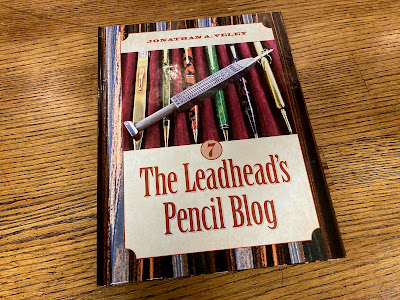
This article has been included in The Leadhead's Pencil Blog Volume 7, now available here.


If you don't want the book but you enjoy the article, please consider supporting the Blog project here.

Since these are unmarked, they frequently go unnoticed:


It is an Eversharp “Match Thin” pencil, a curious little diversion for the company into the novelty market, since these are not very comfortable to write with.  Here it is shown alongside a regular-sized Eversharp:


I was feeling pretty smug about snagging this one in an online auction for a song.  However, as Mark Knopfler once sang, “some days you’re the Louisville Slugger and some days you’re the ball.”  Not long after this one came home with me, this lot showed up online:


It was in my watch list, and I went back and forth about whether to bid . . . could these be silver plated “match thin” pencils?  The angle wasn’t very helpful, there were a lot of cheap imitations and . . . someone else had placed a bid on it.  For whatever reason, I didn’t feel like rolling the dice that day.

Fortunately, it was David Nishimura who was in a gambling mood, and a couple weeks later they were showing up on his website.  Yes, I paid more for one than he paid for the whole party, and it was worth every penny to have one:


These were the first “match thin” pencils I’ve seen in silver plate, but after I reviewed Eversharp’s catalogs I should have known they were out there.  Both the silver plate and gold filled versions appear in the 1924 catalog, a weird year for Eversharp which saw the transition to the new improved version of the regular line pencils as well as those strange miniature side clip versions, which were illustrated on the same page alongside match thin pencils:


Had I remembered this, I would have been much more rabid about chasing that lot of silver plate ones.  The gold filled pencils you usually see were denominated simply as Model No. 2, while the silver plated ones . . . well, they were Model No. 1.  The OCD Eversharp collector in me simply couldn’t bear to have an extensive collection starting with Model No. 2!


I believe the reason the silver plated “match thin” pencils are so much more scarce is that they were apparently discontinued after just one year, while the gold filled Model 2 remained in production, appearing in the 1925 and 1928 catalogs.  Here’s the page from  1925:


The gold filled match thin makes its final appearance in the 1929 catalog, but it was redesignated as Model 1060W and the name was shortened to “Match pencil”:


Meanwhile in England, consumer tastes continued to favor all-metal pencils later than in the United States, where they fell from fashion as brightly colored celluloid pencils began to dominate the market.  Early on at the blog (Volume 1, page 130) I discussed a boxed version of the “Match thin” Eversharp, marketed in England as “The Tiny Eversharp”:


I believe these were made later than their American cousins, since the nose is significantly longer:


What sets miniature Eversharps apart from the cheap imitations is the mechanism.  The familiar pushrod assembly is replaced with a simple screw which drives the lead forward, an efficiency which makes the small diameter possible.  That mechanism, however, is not unique to the match thin pencils.  It is also found on Eversharp’s metal checking pencils:


The match thin is a proportionally exact, miniaturized version of the Eversharp checking pencil . . . which brings me to the second part of this story.  Most of these checking pencils, with their .120" diameter leads, had painted barrels which matched the color of lead with which they were originally fitted (see Volume 2, page 193).  However, Eversharp also offered checking pencils in gold fill and silver plate, referred to in catalogs as “Executive” pencils - the Wahl version of a broker’s pencil.  They were illustrated in the 1925 catalog, denominated as Model 32 (plain silver plate), 34 (check pattern, silver plate) and 67 (check pattern, gold filled):


At the Raleigh show a few years ago, Brian McQueen parted with a Model 34 that was worse for wear.  Recently, I turned up one that was a significant upgrade:


Brian’s example had an interesting feature not seen on my new one: the Eversharp imprint appears both on the barrel and the cap.  Given the wear on both I don’t question whether it has been this way for perhaps its entire life, but I don’t believe that is significant.  Enameled checking pencils were marked only on the cap like this, so whether the cap was replaced early in the pencil’s life or slipped out of the factory like that is largely academic . . . as I’ve said many times, if you can “make” a rare variation by mixing and matching pieces, the sum is never worth more than the parts.


After I upgraded my Model 34, I was ready to run this article with an updated family photo of Eversharp Executive pencils, including the 34, a 67 and an uncataloged variant with a short, smooth barrel and military clip (see Volume 4, page 199)


But then . . . stop press.  A Model 32 surfaced in England:


As mentioned earlier, consumer tastes in England favored all metal pencils longer than in the United States, which might explain one tiny, telling detail:


While that medial rib was added on Eversharp’s regular line in 1924 for greater stability, flat, pre-1924 clips are illustrated on checking and Executive pencils in Wahl’s catalogs through the end of the run in 1929, and I’ve never seen an Eversharp outfitted for checking leads that have the later clip.  Perhaps it was a factory error, perhaps it is a replacement.  

The barrel is stamped “Made in USA,” but since it has only recently arrived back on our shores from England in the last few weeks, a third possibility is that it was made much later, after Wahl’s supply of flat clips was exhausted, for export to the English market.

I’ll admit that it drives me a little crazy that my Model 32 has a different clip from the others, but it’s a good crazy . . . the same feeling I get from that uncataloged variant:


Friday, October 19, 2018

The Minutian Empire

This article has been edited and included in The Leadhead's Pencil Blog Volume 5; copies are available print on demand through Amazon here, and I offer an ebook version in pdf format at the Legendary Lead Company here.

If you don't want the book but you enjoy this article, please consider supporting the Blog project here.

The art of noticing, I call it – the ability to look at an object and pinpoint those tiny little details that distinguish it in a sea of what appear at first blush to be the same darned thing.  We collectors dwell in minutia because it is those little details that can make the difference between just another two-dollar junker and an unusual variation costing hundreds of dollars.

The first 50 copies (now 51 – long story) of each of these volumes has been reserved for those hardcore, dedicated collectors who have supported this blog for years – good eggs I call “The Order of the Leadheads.”  These first copies are numbered and include a label inside the front cover, and volume 3, released just a couple weeks ago, commemorates what I call the “third glorious campaign into the Minutian Empire.”


Eversharps, more than any other brand in my opinion, offer an infinite pool of these rabbit holes, and over the last few month I’ve picked up quite a few examples, each of which has a tiny little twist that irk and delight me at the same time. 

First is this silver-plated Eversharp, shown next to what I consider to be its more “normal” counterpart:


Octagonal barrels on metal Eversharps were, I believed, earlier models that were discontinued before Eversharp redesigned its metal pencil line in 1924; yet this one has the longer tip, ribbed clip and redesigned guts indicating post-1924 production:


. . . along with the latest incarnation of Eversharp imprints, with the small, superscript “Wahl” preceding the Eversharp name:


Eversharp Checking Pencils have been an ongoing project here at the blog.  In Volume 4 at page 199, I showed an ultra-rare short model with military clip, along with the catalog reference to "Executive" gold filled and silver plated examples in the regular lengths.  Unfortunately, at the time I didn’t have the more normal versions to show you.  In Chicago I finally turned up the gold filled model (I don’t remember who had it), and in Raleigh Brian McQueen was able to supply a very tired looking but nevertheless heartily welcomed silver plate one:


One of these dollar pencils recently came my way, and it had what appeared to be an identical twin:


In fact, both bear advertisements for Eversharp’s Red Top Leads; but with one little difference: the slogans are different.


Eversharp Dollar Pencils have been another ongoing theme here at the blog.  By this point, color variations aren’t anything new to write home about, but this one really knocked my socks off:


On these Equipoised models, what appear to be the latest flattop incarnations abandoned the black nose cone in favor of a one-piece barrel with a longer tip:


Into the 1930s, this next shot shows another pair of coral “tempoint-styled” pencils - however, these are fitted with Equipoised mechanisms rather than the modified version of Charles Keeran’s 1913 design.  Note that the full sized version has a commemorative 1934 imprint, bordering on anachronistic rather than simply later production!


The shorter cap versions with military clips, however, seem to be even scarcer.  They appear at the top of page 61 in The Catalogue, and I reported them as “the most difficult size” to find; although at the time, I completely missed the fact that they had Equipoised mechanisms inside, and they should have been shown alongside the pencils in frame 7e. 


Coronets – more properly (and boringly) known as “All-Metal pencils” by Eversharp – have a few twists and turns of their own.  Bob Novak had to point this one out to me in Chicago, because I missed what was special:


“It doesn’t have the triangles,” Bob said.  I couldn’t remember whether I’d seen that variation, so I decided to splurge.  Bob was right:


I was thinking of the version with a simple row of rectangles at either end, not a simple row of smaller triangles.  Note that the engraving on the barrel is the same as on the “normal” one with large inserts – the inserts have simply been omitted:


The goofy repeater in the center of this next picture came my way at the DC show in August, with no trim bands at all and marked only with an Eversharp imprint on the back side.  It’s shown between an Eversharp Air-Lite, in the same repeating configuration but with a silver plated clip marked “Eversharp,” and an Eversharp Varsity, a twist-action pencil with that same unmarked, gold filled clip:


Into the 1940s, here’s a Skyline that turned up in Chicago:


I refer to these as a Skyline “Standard II,” with the striped upper barrel and thick center band.  I bought it only because it is so pristine and I thought it would be an upgrade, with two stickers, one indicating price and model and the other hawking the company’s leads:


When I brought it home, though, I found out I didn’t have one in this configuration, color and size – and speaking of size, it reminded me to tell you something.  Conventional wisdom teaches us there are three sizes of Skylines: Demi, Standard and Executive.  Conventional wisdom is wrong:


There were four.

Yeah, I know the Executive in that last shot isn’t a match, but as far as I know they weren’t offered in the Standard II configuration.  But speaking of Executives:


I’ve stumbled across something interesting about them.  While I was trying to fix one for a customer, I had reason to take them apart to see how the mechanisms were different from the standard sized pencils.  Imagine my surprise to find this:


One of my examples has a standard-size mechanism, with the quarter-inch difference in size made up with what appears to be a specially made, extra long eraser button!

Finally, into the 1950s Eversharp’s last quality effort was the Symphony line.  Towards the very end of the Symphony line, Eversharp did some weird configurations that must have cost the company far more than it could afford to specially fabricate.  This is one of them, courtesy of Robert (“Speerbob”) Speerbrecher:


The stacked coin band is a nice touch, and the silver trim and narrow Skyline-like top band are a bit different from the standard Symphony fare.  But then again, towards the end, none of these were exactly mainstream: