Showing posts with label Sheaffer Balance. Show all posts

Monday, August 2, 2021

That Third Swing

This article has been included in The Leadhead's Pencil Blog Volume 7, now available here.
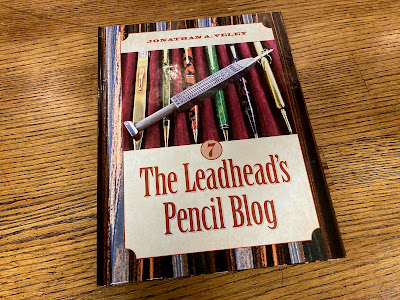

If you don't want the book but you enjoy the article, please consider supporting the Blog project here.

After the Baltimore 2020 Show, it had been more than a year without a U.S. pen show before Raleigh. During that time, online shopping was responsible for nearly all of the new acquisitions arriving on my doorstep; along with them came the freeloaders - other bits of collateral junk (er, little treasures) that were not the target of my bidding.

They accumulated in two small plastic totes – one contained nicer things, but duplicates of what was already in the collection, and one containing . . . little treasures.  

Both of these little totes were along for the ride as I went to Raleigh.  Once things were spread out on a display table, I knew I’d finally have the time (and space) to incorporate the items in the better tote into my show display.  As for the lesser of two totes?  To quote Rob Bader as I tend to do, I was looking for the opportunity to tell someone “I’m not taking them home with me, so the only question is how much you are going to pay me for them.”

Funny that it was Rob Bader who gave me the opportunity to say something close to that.  He had one really cool pencil that he had shown me during Thursday’s preshow trading.  We both knew I’d end up with it, and the only question was how it was going to happen.  

My goal when I go to shows is to come home with different crap, not less crap - but this time, I saw an opportunity to do both.  Since Rob and I rarely use cash as things pass back and forth between us, I put on my best Memphis drawl to make a proposal, puffing out my chest as I announced: “I . . . will trade you . . . this entire tote full of inventory . . . for just that one pencil.”  Rob liked my impression of him:


What’s so special about this one?  Give it a second . . . 


This Sheaffer Balance is outfitted for .075" checking lead, and it is only the second example I’ve seen.  The first was also at the Raleigh Pen Show, shortly after I started the Legendary Lead Company – Rob Morrison brought one exactly like this one over to my table looking for some leads that would fit it.  

I probably “shot myself in the ass” when I said that I had some, because any chance I might have persuaded him to part with the pencil evaporated once he made a few scrawls with my “Mighty 75" leads in china marker.  In fact, he scampered off so quickly to go play with his prized Sheaffer that I didn’t get the chance to take a few pictures!

Sheaffer also used the .075" mechanism – just as rarely – on earlier “Titan” flattop pencils.  A couple years ago I had a better shot at one of these, when Nathaniel Cerf had an example over at penmarket.com in jade.  Nathaniel let me share his picture of it here:


But there was a problem.  Yes, I’d seen Nathaniel’s post about the pencil on social media . . . yes, I was thinking about pulling the trigger on it . . . and yes, Nathaniel and I were talking about it.  However, while I was a’ thinkin’ about it, Matt McColm sent me an email, excitedly asking me “what the heck is THIS?”

After all Matt has done for me over the years, I wasn’t going to get in the way - Matt didn’t know Nathaniel, so I convinced myself it was better to introduce two good friends and let Matt have this one.  Besides, I'd be just as happy with Nathaniel’s picture as I would be owning an example.

OK, I’ll admit I’m lying about that last part.

Matt managed to wrestle a mechanism out of a regular-lead Titan for a better look at what's inside.  


Sheaffer pencils are among the most robust out there, but these checking pencils are really built like tanks – blindfolded, with a standard lead Sheaffer in one hand and a checking pencil in the other, you’d have no trouble telling which is which just by the weight.  

The Titan was cataloged in black with “oversize” lead as model SLCO – the “O” was for oversize – in 1930.  


Jade was also cataloged as model SJCO, although the illustration doesn’t show it that way, and “coral,” Sheaffer’s orange color, was SOCO:


A few years ago I took pictures of another, more common variety of Sheaffer’s checking pencils, in a form more like what you would expect – an all-metal utility model with an exposed eraser:


These were also cataloged in 1930 - as model SAA with standard leads, and AAA for oversized leads:


Models SAA and AAA are also found in Sheaffer’s 1935 catalog, but the AAA appears to be an ordinary bell top Sheaffer with ordinary lead.  By 1935, the “rigid radius” clips - introduced as the “First Lady Line,” were in production, but the catalogs report no pencils using thicker lead.  By 1936, neither model is listed, and whether Sheaffer’s checking pencils were geared towards utilitarian or the luxury market, all were displaced by the “Working Togs” pencils (see “Rise of Tog” at https://leadheadpencils.blogspot.com/2021/04/rise-of-tog.html).

Since these pictures of the model AAA were taken before I started the Legendary Lead Company, I didn’t have any lead to add to it at the time.  I’ve since added a piece of “Mighty 75" to it, and I’ve also managed to scrounge up a wooden tube of Sheaffer-branded checking leads.


Rob Bader’s Sheaffer was the second nicest thing I picked up in Raleigh this year.  He set up his wares on Friday morning, with boxes of pencils to paw through on his table . . . but nothing else caught my eye.  In fact, after I’d dug around a bit in one of them, I was recognizing some of them from that tote I had traded to him the day before.  I placed Rob on explicit orders to shoot me if I tried to buy something I had traded to him the day before.

Rob professes to prefer "less crap, not different crap" by show's end, but after he took my tote full o' gems he was behind in the count.  As is his habit, Rob headed home after the show closed on Saturday.  When the show reopened on Sunday morning, his table was arranged with a few dozen heavy, cast iron bits of ephemera . . . ink stand bases and such, and a sign:  first item is free, leave $5 in the cup for your second one.

He didn’t leave a cup.


Saturday, May 2, 2020

Beats the Band

This article has been edited and included in The Leadhead's Pencil Blog Volume 6, now on sale at The Legendary Lead Company.  I have just a few hard copies left of the first printing, available here, and an ebook version in pdf format is available for download here.

If you don't want the book but you enjoy this article, please consider supporting the Blog project here.

My Sheaffer collection is mostly the result of fishing with hand grenades.  Sometimes I have deliberately targeted a Sheaffer specifically to add to my collection, but most of what I have came from box lots, purchased collections and such.  Sheaffers are diverted from the stream of incoming stuff, and compared to what I’ve got – any differences, no matter how small, and here they stay.  Duplicates are strictly catch and release.

Today’s subject is just such an example.  A lot of two dozen or so relatively interesting things showed up in an auction, and I’d noticed a Sheaffer in there that I knew I’d be comparing to the Sheaffer Balances I had on hand:


When it arrived just a couple days ago, diverted it was to the Sheaffer corner, where I noticed something:


The other bandless Sheaffer Balance pencils I have sport flat ball clips like this (earlier models still have the round ball clips).  This new example has a “rigid radius” clip, introduced in 1935, and every single example of that line in my collection has a band:


(Well, they aren’t always thin bands like these, or single bands like these . . . but I digress.  There’s usually bands.)

I haven’t been turning my nose up at bandless rigid radius clip Balance pencils; I just haven’t run across any . . . and with as many hand grenades have sent hoards of pencils floating my way over the years, that probably says something.  I checked the catalogs in the PCA’s library, and all the rigid radius clip models had bands.  Bandless models from 1935 and later were a lower-priced line, paired with the earlier flat ball clips on the Junior line, through and including Sheaffer’s 1941 catalog.

So was this a factory error?  No, this was no mistake.  There was a very specific reason why the band was omitted from this one: it would have been in the way.


“The GORHAM Company,” is prominently imprinted where that band would otherwise have been, and there are traces of gold flake still visible in the letters.   This was a very special edition made for Gorham, the prominent silvermaker (and producer of some nice Victorian figural pencils, too – see The Leadhead’s Pencil Blog Vol. 2, page 245).

Initials on that clip are a turn-off for most collectors, but on a pencil like this, made for a special customer’s special occasion, I’m all in.  “S.H.” is likely the initials of a prominent person within the Gorham organization in the 1930s, sometime between 1935 and 1941.  I haven’t (yet) figured out who that was.

The time during which this pencil might have been made is also intriguing.  Gorham had been absorbed by Black, Starr & Frost around 1929, according to my research for an earlier article here (see The Leadhead’s Pencil Blog Volume 3, page 227-228), but as I scoured newspapers looking for someone connected with Gorham with the initials S.H., I noticed that advertisements simply identified it as “The Gorham Company” through 1938.  If the transfer happened in 1929, at least the buyers had the good sense to continue using the name they had paid for.

And the Gorham/Sheaffer connection has an interesting twist: both were later acquired by Textron.  That, I truly believe, is a coincidence (and that is rare for me). 

Saturday, April 28, 2018

The Sacrificial Bids

This article has been edited and included in The Leadhead's Pencil Blog Volume 5; copies are available print on demand through Amazon here, and I offer an ebook version in pdf format at the Legendary Lead Company here.

If you don't want the book but you enjoy this article, please consider supporting the Blog project here.

There was an amazing series of online auctions of weird Sheaffer pencils recently . . . the last of them to close was for a real gem, and I knew who my likely competition would be.  A bit of strategy was in order.

Since several of the lots leading up to the grand finale were along the same lines, I decided to put in some moderately low bids on the earlier lots – low enough to lose at a reasonable price, hoping to lure my competition into a false sense of security as I lost one after another that I wasn’t really serious about parting with the cash it would take to win the big one at the end. 

It was purely a head game. Did it work?  Well, I won the finale . . . and wondering how much more I would have had to pay if I didn’t is another case of If Dog Rabbit (if that phrase confuses you, try https://leadheadpencils.blogspot.com/2014/11/if-dog-rabbit.html).

And, unintentionally, I won three of these items with sacrificially low bids:


In all fairness, I probably would have bid on these even if they weren’t pawns in a larger game, and without my eye on the prize I probably would have bid more than I did.  All three are Sheaffer Balance pencils with wide jewelers’ bands – none too common.  The top one was in a size and color I didn’t have; the same went for the lower one, although what the seller thought was a deep scratch circling the lower barrel turned out to be a crack (this material for some reason is the most prone to deterioration).  As shown, it wears a fresh barrel from my parts bins in much better condition.

The middle example, though, has a curious detail in which I was keenly interested to have a closer look, even though it is identical to one already in my collection:


The seller had noted that the clip is a little bit odd – faceted and drawn to a point, like an Eversharp Coronet clip.  You can see it in this picture.  Was this some weird Sheaffer experiment?  On closer examination, I doubt it:


It looks more like someone has taken the time to file the sides of the clip down - you can see where the gold fill has been cut through, and you can even see tiny holes on the sides where the metal forming the ball of the clip has been folded over and formed.

The vintage of this Sheaffer is consistent with the Eversharp Coronet – maybe some random jeweler or owner thought it would be cool to see how it would look with more of a Coronetty look.

But note the initials on the band . . . L.P.S., with a more stylized “S” that looks a lot like the same letter as it is presented in the Sheaffer logo.  Was there someone in the Sheaffer family with those initials?

It’s fantasy and a longshot.  But kind of fun to think about.

Tuesday, August 9, 2016

What Lurks Within

This article has been edited and included in The Leadhead's Pencil Blog Volume 4; copies are available print on demand through Amazon here, and I offer an ebook version in pdf format at the Legendary Lead Company here.

If you don't want the book but you enjoy this article, please consider supporting the Blog project here.

When I arrive at a show these days, John Hall and I are wheeling in a cart loaded up like the Grinch’s sleigh, usually with two layers of totes topped by shelving, photography equipment and such.  And also these days, I never get to my table to unload it all before someone comes up to me and says they have a pencil to show me. 

At the Chicago show in May, it was Rob Bader who flagged me down and had me abandoning my cart mid-aisle on the way to my table.  He showed me four pretty spectacular things (three of which I’ll tell you about later), but this one had several of us really scratching our heads:


When Rob handed it to me, it was with the clip facing away for dramatic effect, since he knew from the shape and color of the pencil the first words that would come out of my mouth would be “Why are you showing me an Arnold?”  And those were my first words exactly, after which he turned it around . . .


What what what?  There’s so much about this pencil that doesn’t make sense, and Occam’s razor had me trimming this one back to a Sheaffer clip installed on something else -- anything but a Sheaffer.  For a Sheaffer Balance, the shape is wrong, the color is wrong, the three thin bands are wrong . . . and what’s inside looked unfamiliar, too:


As several of us were looking at this one, none of us – myself included – recalled seeing a Sheaffer mechanism that looks like this.  Both of us knew I’d have to bring it home with me, but we both had some difficulty figuring out what was fair.  The price we eventually came to was expensive if it proved to be a Sheaffer clip mounted on something else, and cheap if it proved to be the real thing.

Now that I’ve done my homework, I know I got off cheap this time.

When I got home, I was so befuddled by this goofy looking thing that the first thing I did was compare this pencil to others in my collection to see if it matched anything else – more on that tomorrow.  Then I pulled out my patent book to see if Sheaffer patented a screw drive pencil mechanism with that big bushing.  Sure enough, there it was:


Craig R. Sheaffer and William R. Cuthbert filed a patent application for this mechanism on April 1, 1929, and the patent was issued on March 7, 1933 as patent number 1,900,669.   The inside of this pencil and the clip are both all Sheaffer after all.

My next step was to dig out a "typical" Sheaffer Balance pencil from the flat ball clip era, so I could show you how different this new one is from the norm:


Note how the new addition is chubbier, with a more steeply tapered top and more pointy end.  The tip is shorter:


The clip appears to be a cheap gold wash rather than they typical heavy gold fill, and as I mentioned earlier, three thin bands is a trim configuration unknown in the Balance series:


But what I really wanted to show you was what a “normal” Balance mechanism looks like.  Removing Balance mechanisms is a real crapshoot, and I’d compare it to arguing with an ex-wife: whenever I’m finally successful, it feels almost like the pencil wanted me to win.  Sometimes the tip unscrews easily, but when it doesn’t want to budge, if it’s absolutely necessary to take the thing apart I normally end up destroying the tip and replacing it.  Then there’s the matter of extracting the mechanism - if it’s going to come out, once it budges a little bit it usually comes free.  If that first budge doesn’t free it, I usually chalk that one up to a stubborn one that isn’t going to come free.

The problem I was having was that every single one of my flat ball clip Sheaffers appeared to be in the stubborn category, so I finally picked this one – since the tip came off easilly – to wrestle with.  After considerable persuasion, this is what I found:


How embarrassing.  It would appear that whenever a mechanism proved difficult to remove, it wasn’t because of random crankiness – the older, bushing-style Sheaffers are just a lot harder to remove than the later, straight bore kind.  That was why I’d never seen one before.  Once I had the hang of getting these things loose, I found that all of the earlier Balances had them.  For example, here’s a ringtop in jade, one of the initial colors used for the Balance line:


There is a bright side in this.  If I had already known the mechanism inside this odd Sheaffer was genuine Sheaffer, I probably wouldn’t have started comparing it to other things in my collection to figure out what it was derived from.  And if I hadn’t done that, I wouldn’t have found something really interesting . . .

The story continues here.

Monday, June 29, 2015

Easy as 1-2-3? I don't think so.

This article has been edited and included in The Leadhead's Pencil Blog Volume 3; copies are available print on demand through Amazon here, and I offer an ebook version in pdf format at the Legendary Lead Company here.

If you don't want the book but you enjoy this article, please consider supporting the Blog project here.

Jon Rosenbaum passed away recently.  Many will remember his friendly, smiling face and unassuming demeanor, as he sat at his table behind a sign that said in bold letters simply, “I Buy Old Pens.”  Funny how a sign like that sticks in your mind amongst a sea of enthusiasts at a pen show, 100 percent of whom . . . buy old pens.    Most important, what I will remember about Jon is that he was a heluva nice guy.  Second, I’ll now remember him for something I didn’t know about him while he was alive.

Jon was a pencil collector.

I had admired pencils on Jon’s table before at shows and bought a few of them, but I did not know they were a passion for him until I was contacted by one of his friends, who Jon’s family asked to help liquidate his collection (name withheld until I get an OK to include it here).   Would I be interested?  Of course I would.  And along came four pictures of cases of pencils, each of which had monstrously nice things.  The problem was that I had many of them.

But there was one pencil in there . . . one that I honed in on immediately, fuzzy picture notwithstanding.  When I called him back, I told him if I only bought one of Jon’s pencils, it would be that one.  We agreed to get together at this year’s Chicago Show, and of course, I bought more than just that one – more on the other ones later.  Today I’ll tell you about the one:


Single-banded Sheaffer Balance pencils are the norm.  Double-banded examples, like the ones I’ve shown here, are an occasion for whoopin and hollerin.  These ultra-rare triple banded examples?  I’ve only seen one other pencil, in ebonized pearl.  That makes these about the most rare of the Sheaffer pencils – even more rare than the ebonized pearl golf pencil (I know where four of those are).

And yet, when I showed it proudly to a friend right after I acquired it, he wondered why Sheaffer made a one-piece band with black painted rings, just like so many of the lower-quality pencils that flooded the market during the 1940s and later.  Once piece?  No, it’s three, I said, and we went back and forth over the issue, looking as closely as we could in a dark ballroom with a loupe.   Now, under more controlled lighting and with a good lens, it’s clear that we were both right.  Yes, it’s clearly three bands – you can see the bits of red and grey in between them:


And yes, the spaces between them were once painted black.

Monday, December 1, 2014

My Quandry Is Resolved

I wish I could say things at the museum are as organized as they look in the pictures I share here. Sure, most of what’s there is in drawers or on shelves, and I can generally find everything when I try. But there are also little piles of stuff laying about – pencils in the queue to be photographed, pencils pulled from the shelves and grouped together for comparison, and sometimes just groups of pencils I pulled from different places because I thought they would look cool together.

Here’s one of those little piles:


These are all Sheaffers in "ebonized pearl" – in my opinion, one of the most distinctive and beautiful plastics produced by any company during the golden age. Most of the pencils shown in this picture are too special to just be laying around like this, with double band, jewelers’ bands and "fishscale" bands in the mix. Yet they’ve been sitting there for several months: I pulled them out of several different drawers of Sheaffers (I group my Sheaffer’s by year and trim configuration, not by color) because I wanted to see them all alongside two very special additions I’ve been meaning to write about . . .

To learn more, this full article is included in The Leadhead's Pencil Blog Volume 3, available at Amazon, Barnes & Noble and everywhere else you buy books, or you can order a copy signed by yours truly through the Legendary Lead Company HERE.


Saturday, November 8, 2014

Girls Just Want To Have Fun

I got a hot tip from a buddy, it must have been two years ago now, that there was a pencil in an online auction that was really rare, wasn’t properly described and might well go for a song. I remember that I paid more than a couple songs – more like half an album – but it was still a lot less than I expected:


To learn more, this full article is included in The Leadhead's Pencil Blog Volume 3, available at Amazon, Barnes & Noble and everywhere else you buy books, or you can order a copy signed by yours truly through the Legendary Lead Company HERE.


Monday, April 1, 2013

In Celebration of the Day

Here’s a Sheaffer that turned up in an online auction. I remember that I didn’t pay to much for it, because I wasn’t too sure about it:


To learn more, this full article is included in The Leadhead's Pencil Blog Volume 2, available at Amazon, Barnes & Noble and everywhere else you buy books, or you can order a copy signed by yours truly through the Legendary Lead Company HERE.