Showing posts with label Tiffany. Show all posts

Tuesday, November 25, 2025

This Marvelous Human Endeavor

Nearly everything I acquire these days is brought to me by friends at pen shows or comes from someone who has stumbled across this blog and emailed me. When I am out on the prowl at antique shows and malls, I rarely find anything that interests me; it sometimes seems like we are reaching a singularity in which all the pens and pencils are already in the hands of collectors. 

Imagine my elation when Janet and I walked into an antique mall we had not visited for some time in September, and the first showcase inside the door looked like this:


I asked the person working the desk to let me have a look – might as well bring the whole box up to the counter, I told her, because this might take a while. Most of it wasn’t worth buying, but there were a few things that were reasonably priced. I still probably overpaid, but it’s hard to maintain interest in the thrill of the chase if you never catch anything.


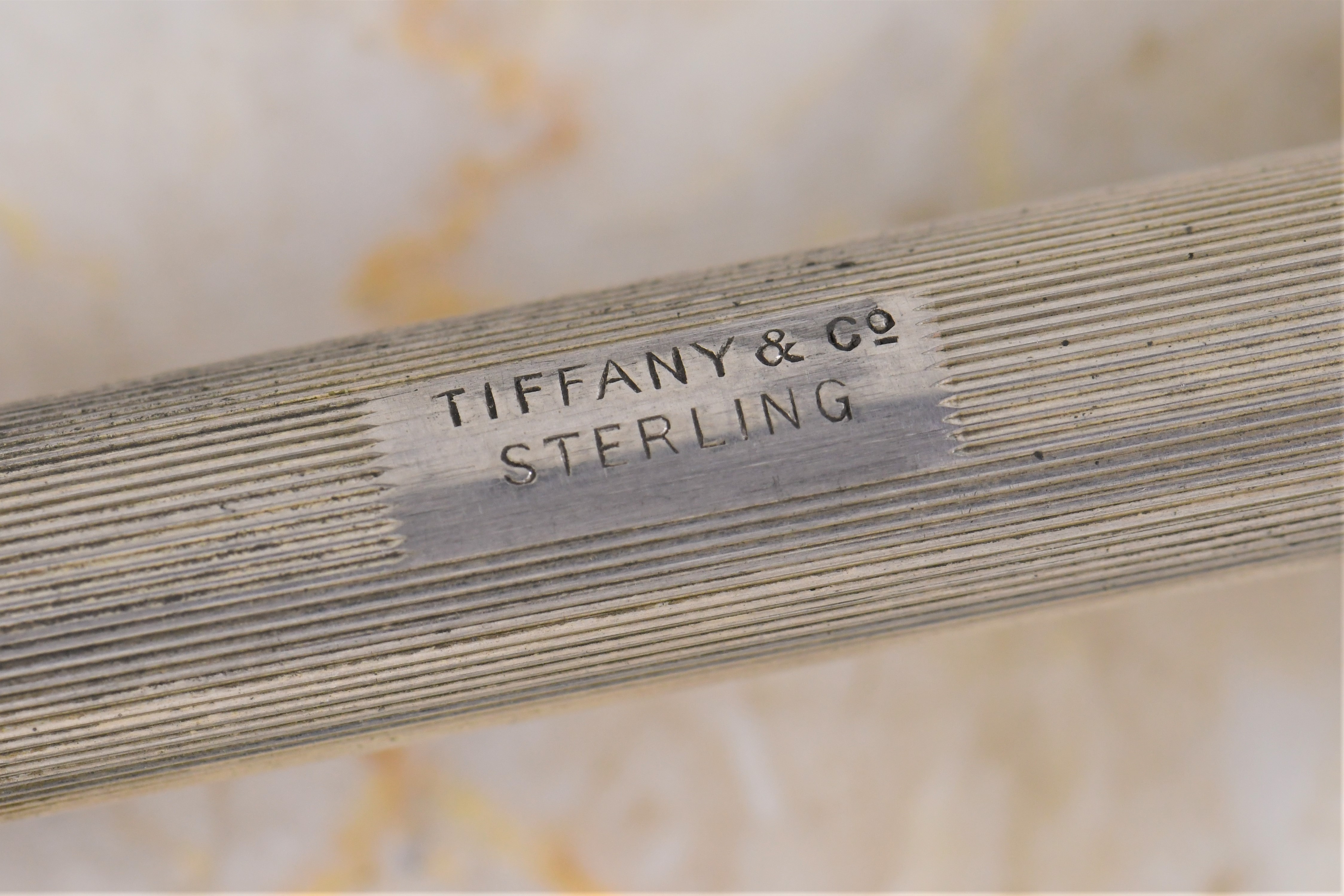
The top one is another of those Hicks snail-patterned pencils; nothing to write home about, but it’s clean and people like these at pen shows. The next two items in this little haul are a pair of Tiffany ballpoints. They aren’t the prettiest – that’s Exhibit A for the premise that Tiffany-marked stuff is like Ohio State memorabilia (put that name on a dried out dog turd and they would sell like hotcakes). Still . . . the two patterns were nice to buy together, and they aren’t bad additions to the Tiffany section at the museum, which now also includes a Tiffany magic pencil that came from Rob Bader’s Victorian haul.


The next one, in floral-engraved sterling, has a hallmark near the nose - an F in a shield. That denotes Fairchild & Co., the last incarnation of the firm founded by Leroy Fairchild, as carried on by his son Harry from 1905 until 1927 (see “Three of a Kind . . . Maybe Four” on March 23, 2018: Volume 5, page 199). You don’t see those often, especially in the wild, and I didn’t have one like it. 

Next is something I don’t normally chase; it’s unmarked, but I just liked it. The three colored buttons on top indicate the lead colors in the three pencils nested inside.


That had me going back through the Victorian haul from Rob Bader looking for something I thought wound up in my pile, and it did. Rob’s is also unmarked, which is why it wound up in inventory rather than the museum . . . 


Two’s a coincidence and three’s a collection, as Janet always says. Dammit, there’s no point putting these back in inventory, because I know myself . . . when the next one comes along, I know I’ll bite and I’ll drive myself crazy trying to find these two again. They now reside in the “unmarked but worthy” wing at the museum, with a space next to them for the day I know will eventually come.

That blue plastic fountain pen with what looks like a modern plastic clip is much older and better than it looks: it’s a “Graphomatic,” made by the Sager Barrel O’ Ink guys. I have wanted an example of my own since Richard Binder allowed me to use an image of one in his collection in a piece I wrote about a Graphomatic double-ended pencil – see “A Name Closer to Right” (April 15, 2020: Volume 6, page 48).  


Then there’s that Eversharp lookalike at bottom - it’s actually a Shur-Rite, and even though it’s really clean, I’ve got a couple others just like it at home.


I had to have it anyway, even though it was a bit overpriced, because of what was on the top: “Awarded by L.C. Smith & Bros. Typw. Co.,” it reads.

With my little pile of goodies waiting in my bin at the checkout counter, Janet and I explored the rest of the mall and I found . . . absolutely nothing. The thrill of the chase was losing all of its thrill as we trudged along, and I began to have an existential moment wondering what the heck I’m doing. I’ve chased these things for more than twenty five years now, and I’ve got more of them than I’ll ever have time to write about, much less use – even if I wrote one word with each one for my next book.

Maybe that’s an exaggeration. I write a lot.

Whenever I have these thoughts, it makes me remember something I first heard in 1995 that has dogged me ever since. That was when I first watched what I consider to be the finest hour of television that ever aired: it was an episode of The X-Files titled “Clyde Bruckman’s Final Repose” - season three, episode four for those of you who track that sort of thing.

Peter Boyle (best remembered as Ray Romano’s dad in Everybody Loves Raymond) guest starred as Clyde Bruckman, an insurance salesman with a unique but very limited gift: he knew how and when any particular person would die.

As Mulder and Scully investigated the murders of several fortune tellers, Mulder tried to tap Bruckman’s gifts by taking him to the scene of the latest crime. There, standing in the midst of the victim’s extensive collection of dolls, Mulder asks Bruckman if he had any insights into what motivated the killer. Bruckman’s response has haunted me.

“Why does anyone do the things they do?” Bruckman replies. “Why do I sell insurance? I wish I knew. Why did this woman collect dolls? What was it about her life? Was it one specific moment where she suddenly said, ‘I know... dolls.’ Or was it a whole series of things? Starting when her parents first met that somehow combined in such a way that in the end, she had no choice but to be a doll colle...” 

With that, Bruckman has a vision, and he trails off mid-sentence.

I reached the end of that aisle in the antique mall as I thought once again about Clyde Bruckman’s words, musing as I have done countless times why I was doing what I was doing. This time, the tumblers of the universe aligned at that precise moment; I rounded the corner, and I found something.

It wasn’t a pencil. It was my explanation.

There, laying in the center of an antique table, was a coffee table book titled The Baseball Companion. It was opened to display what was written inside the front cover: 


“Scott - 

“Since I can’t always be your ‘companion,’ maybe this book can substitute and remind you of the good times we had playing catch in the backyard . . . . . and how that helped you go on to be a champion with the A’s (and with everything else that you have accomplished)!

Love,

Dad 

8/3/95

“P.S. Remember, God will be your “companion” always, and will keep you a champion -”

With that, just like Clyde Bruckman also did in 1995, “Dad” trails off . . . leaving me standing there thirty years later, in the middle of an antique mall trying to hold back the tears.

That’s it. That’s always been it.

Whether or not I have always known it, my fascination with writing tools and with writing about those tools has been a celebration of the miracle that is the act of writing itself. “Scott’s” father dragged a stick with a bit of ink in it across a piece of paper thirty years ago, and the shapes he made with that stick planted forceful and visceral emotions into my head that remain every bit as powerful today.

Writing is powerful. Whether it’s a pen, or a pencil, or an old typewriter, or a laptop – the tool doesn’t matter, but the raw and awe-inspiring capabilities these things have in the hands of the humans who wield them does. Sometimes that power is used for good, and sometimes it is used for evil. Nearly always, what is good or evil is mostly a matter of perspective.

We are born, we tamp down the earth beneath our feet as we walk around this little round rock for a while, and then we are gone. To paraphrase comedian Randy Feltface in “Randy Writes a Novel” (another hour well worth spending), life is just that insignificant hyphen in between birth and death. We leave no trace of what we thought, who we loved, or who we didn’t. For better or for worse, all of that ends when we do.

Unless we write.

I write books about pencils, tools that by themselves are of no real consequence. When I write an article, there’s something more to it than the pencil itself, and thanks to Scott’s father I can finally articulate why. Telling you these stories connects me with you – and your children, and your children’s children – in a way that nothing else in life can do. Every anecdote that is preserved passes on human thoughts and emotions from which future generations may benefit and learn in some small way. 

It doesn’t matter whether you agree with me or whether the words I write please you, anger you, enlighten you, or bewilder you. It is a marvelous human endeavor that I can press buttons on a machine and no matter the distance, no matter the decade – you feel something.

I didn’t buy that copy of The Baseball Companion, as much as I wanted to bring it home. To extrapolate on Clyde Bruckman, imagine all of the things that had to occur for that instant to happen, at exactly the right time. Whether by design or by an incredible series of coincidences, I was given this amazing gift and I do not believe that gift was only for me. I left that book right where it was in the hopes that others would see it and would be as moved as I was – surprised by the unexpected emotions welling up inside them as they experience an inexplicable and intimate connection with a person they have never met. Maybe that in turn would provide them with a greater appreciation for the connections they have with those in their own lives. 

Maybe they will go home, pick up the phone, and call their own fathers - or their children, or whoever else is important to them.

Maybe now that I’ve told you this story, you will, too. 

Wednesday, September 24, 2025

As My Last Bastion Falls

Back in 2022, Larry Liebman was in Columbus for the Ohio Show, and he spent a night or two at our place so he could fully take in the museum. He did not come empty handed: Larry brought with him some of the pieces he has collected made by Louis Tamis & Son, the New York jeweler’s firm that made high quality writing instruments both on its own account as well as for luxury retailers such as Tiffany, Cartier and the like.

Larry collects these because he has a distant family connection to LT & Son - he’s tried to explain it to me, and I keep getting confused about who is twice or thrice removed. Most recently, I talked about that in  “Narrowing the Gap” (May 31, 2021: Volume 7, page 156). Larry snapped a few photos with his iPad in preparation of his visit to see what he should bring for better shots; this one was the one I couldn’t wait to lay my hands upon, even if only for a brief photo session:


Yes, it is solid gold - and a two-tone yellow and rose gold to boot.


I recreated this pattern for my Legendary Pencil Company Model 124, which I dubbed the “Trinity.” I wasn’t deifying Tamis’ work - the Trinity reference is rooted in the fact that this same sort of design was used by three distinct makers.


Here, Larry’s LT & Sons pencil is flanked by two examples in my collection. The top one is a magic pencil bearing a W.S. Hicks hallmark. It isn’t stamped very well, but you can make it out near where the pencil emerges:


The one at bottom is a later gold filled pencil made by Mabie Todd & Co. in the late 1930s. These frequently slip under the radar because the imprint is in the center of the pencil:


Now I have to correct something a little bit. On the Legendary Pencil Company’s website listing for the Model 124, I identified the trinity of father, son, and pencil ghost as Louis Tamis & Son, William S. Hicks, and Edward Todd & Co. – not Mabie Todd & Co.


At the time I came up with the Trinity name, I had forgotten about these later Mabie Todds . . . forgivable, I hope, since this was the only models Mabie Todd did in this pattern, while the other three used it with abandon on lots of different things. If it isn’t forgivable, I’d hedge and say we’ll call it three and a half, given the abnormally close relationship between Edward Todd and Hicks.

Mea culpa. Trinity sounds much better than “Foursome” or “Trinity-ish,” so we’ll just chalk up my mistake to brilliant marketing and move on to the other thing Larry wanted to be sure we photographed. 


This solid gold fountain pen has the typical turned-up ball clip used by Edward Todd, Hicks and Louis Tamis – but not by Mabie Todd (see, I knew there was a reason I left Mabie out of the equation). While I can probably rule out Edward Todd, which used a slightly smaller clip, it is a tossup as between the other two, since it isn’t marked for either. This one is marked only for Tiffany & Co.


While we were having fun playing with these things and I had all of my similar stuff out for manhandling, I took a better picture of my LT & Son watch pencil. I had noticed that in the last time I talked about it, I had used only the auction house picture – I think I was so excited to write about it that the article published before the pencil was in my hands. See “Tying In Tamis” (June 18, 2021: Volume 7, page 206):


Over the years, I’ve expressed my disdain for buying solid gold, since I value history more than metal and for the price I can buy more history if the gold is not pure. I’ve also had a bit of a chip on my shoulder about high-faluting names - yeah, I apologize for my recent comparison of Tiffany products to Buckeyes memorabilia and dog turds. For God’s sake, don’t get me started on “precious resins,” either – precious, my butt. At least all I got wrong in my marketing was a model name.

I do cry Uncle on Larry’s solid gold stuff. They are absolutely beautiful and in my opinion, worth more than the metal in them solely based on their artistic merit. I have surrendered myself to the fact that the reason the Tiffany name commands a premium is because the company has earned it.

I have, however, maintained my last bastion of resistance to those bamboo pencils, which are nearly always marked only for the luxury retailer that offered them. LT & Son was the last of the “trinity” to survive, and I believe LT & Son made most if not all of these. They come in pencils as well as ballpoints, and I last visited them in “Dr. Seested, I Presume . . .” (January 18, 2016: Volume 4, page 97). 

Vic Seested and I finally met in person at the DC Show that year, after months of email correspondence. He had brought a spread of Hicks, LT and the like for me to photograph, including his solid gold bamboo pencil, marked both LT & Son and Tiffany:


“Dang, again,” I wrote, “as in dang, that’s ugly, but I do appreciate the attraction to something so distinctive . . . every time I see one, I think to myself to hold one is to look like you have waaaaay too much money. Maybe that is what they were going for.”

I don’t think I was wrong.

Dan Schenkein has recently taken a liking to these metal bamboo figurals, too. Here are his two ballpoints and an LT-marked pencil.


I am gradually developing greater appreciation and fewer objections on principle to these. When my friend Chiaming Chen in Taiwan posted a picture of this Cartier-marked example – in real bamboo, not metal – I quickly jumped on the opportunity to obtain permission to use the images:


It has British 18k hallmarks on the nose, above the Cartier name:


My growing appreciation and waning objections to bamboo pencils finally hit critical mass when I quietly managed to find one of these up for myself. At last I had spotted my prey laying in the weeds, improperly described, and buried in with a bunch of unrelated junk, so I was able to scoop it up at a price I could swallow: 


It actually wasn’t laying too deep in the weeds: since it measures over six inches long, it was more like a giraffe hiding behind a telephone pole in the middle of an open field. Still, nobody else seemed to pick up on what it was. On one nose, it is stamped “Made in Italy” and “laminato oro,” meaning gold filled or plated:


The other end reveals which high-end retailer thought a six-inch, double ended piece of wood sticking out of one’s shirt pocket might be considered a status symbol in certain circles:


Gucci. 

Sunday, September 21, 2025

Two Kings

As I started writing this, that 90's Spin Doctors song “Two Princes” kept scrolling through my head. You’re welcome for today’s earworm.

I was very proud of myself at this year’s Philadelphia Pen Show, because I had accomplished every single objective when in all prior years I had accomplished all but one. Seeing friends for the first show of the year? Check. Buy some cool stuff? Check. Laugh, drink, and survive another cannonball run down the Pennsylvania Turnpike? Check. Check. Check.

Where I have always failed has been on the financial end of things. Try as I might, I never seem to bring in more dollars than the cost of the hotel and parking – hell, I’d do better to bring the truck up to my room than pay as much as it costs to board a large dog to park it in a garage.

Add to that the unpredictable weather . . . who doesn’t remember the 2016 Snow Bowl, during which a few feet of snow closed the streets, the businesses, even the train lines. I GROSSED $3 that entire weekend by selling a single tube of leads. 

Yet here I am, year after year. I must really like you people.

This year’s show, however, was a banner year. I had the new Eversharp books on hand, some neat new vintage stuff, and I’d decided it was time to have a clearance sale for my Legendary Pencil models that just haven’t sold very well for whatever reason (mostly, it turns out, because I forgot to put them up on the website). 

I bought a lot of things I wanted, but I didn’t spend nearly as much as I took in. When the dealin’ was done and there was time enough to count ‘em, for the first time ever I had brought in more money than what I spent on food, lodging, and parking.

But then I got a message.

Charles Potters reached out to tell me that he had a very special pencil he was willing to sell - one that he said I had called the “King” or something at some point. I instantly knew he was talking about those figural magic pencils shaped like New York’s Metropolitan Life Insurance Building, which were made by or for Tiffany & Co. near the turn of the last century. In the closing article of Volume 7, I discussed the factors that make a pencil desirable and valuable, and I wrote that taking all of those elements into account, these pencils are in my opinion “The King.” See “The King” (August 9, 2021: Volume 7, page 325). 

I was excited but skeptical. Yes, Charles was paying attention to my blog, he knew what he had, and he shared with me his credentials. He told me the pencil was in perfect working condition, and it even came with the box:


I asked if by any chance he was near Philadelphia, since we had not yet left the city for our loooooong drive home. He was only ninety minutes away, he said . . . but it was in the wrong direction. Janet and I decided that adding another three hours to an already excruciating drive was just too much, so Charles and I talked price, got on the same page, and we agreed to do things by mail.

A week or so later, there were two Kings holding court at the museum. The new addition is at top, with the example I showed in Volume 7 below it:


I feel almost guilty saying that the one I have owned has been bugging me a little. I am mindful that beggars can’t be choosers and I was lucky to have acquired one at all in any condition, but it has bothered me nonetheless that my Met Life pencil – as American as American can be – is wrapped in an English Tiffany box. This second example is in a box marked with Tiffany’s New York office location . . . that is perfection in my book.


And what’s this? “To find leads unscrew base”? I was never going to go twisting and yanking willy nilly on my most valued pencil before, but with directions in hand I dared to tread where I had not yet tread before:


Whaddaya know. The base unscrews, and there’s spare leads inside the chamber. 

As for the pencils themselves, they are identical in every respect – that was no big surprise to me, but it would have been worth reporting if there was any evidence that different molds had been used.


The darkened patina on Charles’ pencil is something I’ll leave undisturbed. Yes, I could give it a nice shine, but (1) untarnishing is easy but retarnishing is not, and (2) I always want to remember which is which, for reasons I myself don’t fully understand now that I’m writing these words down.

As you may have noticed from that earlier picture, the new example has both an outer Tiffany box as well as an inner blue cardboard box. I’m suspecting that the blue box is a replacement, and it was once housed in something akin to my London example, sized to fit the outer box more snugly. I’ve seen a few in online auctions, and if I see one with the exact outer dimensions to fit this box, I might have to spring for that extra bit of new old stock goodness. Since I leave no stone unturned when I examine these things, there’s something I need to show you written on the end of the outer box:


It looks like “Carborund,” and there’s a bit of a second line. Is it a continuation of the word, or a second word that reads “run?” Come on, Internet . . . bless me with some intelligence that isn’t artificial . . . 

Carborundum, not “carborundrum,” is another name for silicon carbide. It is the second hardest substance after diamonds, according to some sources, and is used primarily as a synthetic abrasive or in the manufacture of ceramics and electronics. 

I tunneled a little deeper to understand why such a word would be written on the side of a Tiffany & Co. jewelry box, and I learned that since it is nearly as hard as diamonds, carborundum is sometimes used as a diamond substitute - sort of like cubic zirconia, but harder to come by naturally and usually lab “grown.” When fashioned into a gemstone, it is also referred to as moissanite.

Well heck . . . maybe the outer box isn’t original to the pencil, strictly speaking, but whatever bit of Carborundum goodness it may have contained, it must also have been a pencil, since the top of the box talks about spare leads. At least it’s a freaking New York Tiffany box containing a New York Tiffany pencil! Besides, I’ve also run across a couple other Tiffany pencils in the last year or so, and without question they are contained within boxes that are fully correct according to Hoyle. 

The first one showed up in an online auction, and I didn’t have many hopes I would be able to win it. Tiffany collectibles and Ohio State Buckeyes memorabilia have something in common: you can paint those words on the side of dog turds and sell them like hotcakes for twenty bucks all day long. All the Breakfast at Tiffany’s fans must have been asleep at the switch on the day the auction closed, and I was pleased to bring it home:


This one is a “dropper” – hold the nose end pointed down and press the button, and the pencil part drops down and locks into writing position. She was cranky at first, but a good dose of lighter fluid freed things up nicely:


The pencil is marked on the button at the top end, and while the etched scribbling above the Tiffany name is not legible, I am confident that this was made by W.S. Hicks, which routinely hand-etched stock numbers on items Hicks made for high-end retailers - usually on the solid gold ones, but also on sterling products.


I’ve had this next one a little bit longer, since I snapped pictures of it back in 2022. 


This one is a conventional “magic” pencil, which advances the pencil in one direction when the top is pulled in the other.


The top end is a little unusual for these, with a little longer, more graceful point. I also suspect that W.S. Hicks manufactured this one, although it doesn’t have stock mark etching:


Yeah, I’m just as guilty as the next guy, buying these Tiffany things just because of the name that’s on them. They sure aren’t dog turds, but even if they were I’d have a museum full of them.

Monday, August 9, 2021

The King

This article has been included in The Leadhead's Pencil Blog Volume 7, now available here.


If you don't want the book but you enjoy the article, please consider supporting the Blog project here.

"The King of Pencils . . ." Charles Keeran used that slogan to advertise his new Ever Sharp back in 1914.  It was just one example of Keeran's P.T. Barnum-style hyperbole -- however, his new pencils did trigger an industry-wide seismic jolt and singlehandedly standardized the size of ordinary writing lead to 1.1 millimeters in diameter.

Maybe Keeran was right.

His turn of phrase got me to thinking:  out of more than 15,000 mechanical pencils in my collection, what would cause me to call just one pencil "the king" over all others?  


I finally acquired something that I've chased for years, and as soon as I did, I had the title of this article in mind -- but for these last few weeks I've been turning the thought over in my head like pebbles in a rock tumbler . . . what elements of desirability, when they all swirl together into one perfect storm, would sift those 15,000 pencils down to the point at which I can truthfully say, "that one."

Rare . . . but not too rare

No pre-War pencils really fit the definition of "common," since even an ordinary Sheaffer pencil from the 1940s isn't something you'll trip over while walking out your front door every other Tuesday.  However, in my hyperfocused world I'll admit I grow weary of seeing the same things scroll by in the online auctions, over and over again . . . and I grow wearier still of the sellers who persist in describing them as "rare."  Perhaps what they mean is "undercooked."

However, after immersing myself in this microcosm I've created for more than two decades, the exercise of seeing so many examples of what I recognize as ordinary is what brings the extraordinary into sharp focus.  This blog celebrates the things you don't see often . . . but it takes time and experience to recognize them.   That "wow" factor causes me to buy box lots or even entire collections, just for that one pencil I haven't seen before. 

Over the last decade, starting with The Catalogue of American Mechanical Pencils, more and more people are starting to see what I've seen all along.  These days, I am competing for pencils rather than taking them off the hands of grateful pen collectors who didn't see much use in anything you can't fill with ink.

Here are some examples of rarities from the blog:


From top:

1. a Chilton "clown" pencil, 

2. the Triad from Saturday's article, 

3. an early Autopoint,

4. an Aikin Lambert "tree trunk" leadholder, and 

5. the Heath snake pencil.

"They didn't just make one" has been my mantra whenever I have a chance to acquire things like these but the price is too high for my comfort.  "They are like buses -- you can always wait for the next one" is something else I've also said more than once (most recently, just a couple days ago).  

Sometimes, however, they did only make one, and when I know that's the case, I'll pay as much as I can get away with, bearing in mind the scrutiny that might result in the event the domestic finance committee might have dissenting votes should my investment be discovered.  Prototypes or "shop pieces" are good examples, such as this collection of Ruxton Multi-Vider shop pieces, prototypes, paper ephemera, and production models, which surfaced in the hands of one of the heirs of Leonard G. Yoder, the Ruxton's shadowy man-behind-the-Ruxton in America (see Volume 4, page 351):


There's a problem when it comes to one-offs such as these:  they can't sustain collector interest, because there is zero chance another collector would be able to acquire another example.  The market for the only surviving example of anything is whatever that one owner is willing to accept in exchange for it . . . therefore, there is no market.

The "king" therefore would actually be an oligarchy of identical, yet impossibly rare examples.  There must be enough to generate and sustain prices, so that when by chance one becomes available, the community at large takes notice of the price for which it changes hands and the price (if disclosed) sets the benchmark whenever the next one comes along.

Ingenuity

A pencil crowned "King" must have something unique about it which sets it apart from other pencils because of its design or function.   Here are some good examples:


From top,

1. a General Manufacturing "Kaligraf" lever-operated pencil; 

2. the weird Riedell, 

3. a prototype Tri-Point from Edgar Nichols' estate, 

4. an 1840s Addison with a perpetual calendar, and

5. a "Cranesharp" with its specially fabricated triangular lead.

The engineering that went into building these mouse traps elevates them above their contemporaries. 

A Royal Name

All the pencils pictured so far have one thing in common:  they don't bear the name of a manufacturer which is generally recognized outside of our circle of enthusiasts.  Pencils from the "Big Four" manufacturers  (Parker, Sheaffer, Eversharp, and Waterman) always have a leg up on lesser-known brands, because even people who know little or nothing about pencils will pay more for these than comparable (or even better) pencils just because of their name.  Consider these:


From top, 

1. the Parker Vacumatic in "cobra" or "eggshell", 

2. the Sheaffer ebonized pearl golf pencil, 

3. an early Heath-clip Ever Sharp (two words in the early days), and 

4. the Waterman "Christmas" pencil bearing season's greetings from Frank D. Waterman.  

A well-known manufacturer, like the other factors listed, will only go so far in ascending a rare variant to the level of King above all others.  Each of these is rare, but who could say which Parker out of hundreds of models is the most rare and highly treasured Parker?  Furthermore, even if the entire collecting community were to unanimously ordain any one Parker as the best out of all of them, who outside the walls of a pen show ballroom would readily take notice?   

Crossover appeal

Many highly desirable writing instruments enjoy enhanced appeal because they are sought after by enthusiasts of different disciplines.  Examples include these: 


From top: 

1. a Parker golf pencil sporting a Masonic imprint (Masons and Parker collectors want these), 

2. an Eversharp "tree trunk" pencil (sought by Eversharp and Waterman collectors alike), 

3. an Inkograph Mickey Mouse pencil (valued far more by fans of the mouse than fans of the pencils), and 

4. a "sin" pencil (for fans of pencils, pens, gamblers, pin-up girls, and tobacciana . . . and aficionados of goofiness such as myself).

Intrinsic Value

The vast majority of writing instruments are made of plated ("filled," if heavily plated) metal; however, many manufacturers also turned out pencils made from solid gold, like these:


From top, 

1. an Eversharp, 

2. an Edward Todd calendar pencil, 

3. a Rauch 1851 patent combination, 

4. a Rauch based on Mabie's October 3, 1854 patent,

5. a Tamis watch pencil.

However, intrinsic value also has its limits in elevating a pencil's status in its claim to the throne.  With the price of gold as high as it is, the intrinsic value of pencils such as these is often eclipsed by the value of the metal from which they have been fashioned.

Historical significance

A writing instrument's association with a person or its context within the history of American industry will often greatly enhance its value.  One excellent example is this solid gold Sheaffer, engraved with Craig Sheaffer's signature and mounted on an autographed presentation card addressed to Edd Dawson, one of the early pioneers in pencil collecting:


The earliest American pencils, made in the 1830s and 1840s, provide insights into the development of the American pencilmaking industry during its infancy, their history is significant . . . but perhaps only within our community of enthusiasts.


From top:

1. an Addison, 

2. a Hague, 

3. a Rauch, 

4. a Lownds, and 

5. a Bard & Brothers (predecessor to Mabie, Todd & Co.).

On a larger scale, the nearly complete factory archive from the Dur-O-Lite Pencil Company, which I acquired in 2018, preserves the company's history:


Could any one pencil out of all of these single-handedly be declared King above all the others?  One could spend hours debating the question of which of these is the best . . . which means no, none of them could.

Putting it all together

To be crowned King in a collection of more than 15,000 pencils, one piece must score highly on all fronts:  it must be rare, with just enough surviving examples to establish a market; it must have some ingenious construction to grab a collector's attention; it must hail from a "royal" family, famed outside the world of pencils; it should have crossover appeal to collectors in other disciplines; it should have historic significance; and it should be made of some material other than plated base metal.

I can think of only one that checks off all these boxes:


This is the Metropolitan Life pencil, made by Tiffany to commemorate the completion of the Metropolitan Life Insurance Building in 1909 -- the tallest building in New York until the construction of the Empire State Building.  This was the example in the KB Collection, and I took this picture in January of 2019 while I was previewing the KB Auction in Salisbury, England; I decided to shoot it resting in my hand, to give a sense of scale and the commanding presence it conveys in person.  

Fortunately, I didn't travel to England solely to acquire this example -- I was there to chase the Heath snake pencil pictured earlier in this article.  However, after luck went my way and the Heath was acquired for a pittance, I conserved all of my remaining budget to chase the Met Life.  

Unfortunately, I learned just how desirable these are only after I had passed on several other reasonably priced items:  the closing price on this pencil was some 3,500 pounds . . . plus auction premium, plus the 15 percent value added tax.  

Other pencils in the auction sold for even more -- the Cartier in the immediately preceding lot went for some 7,000 pounds.  However, (1) the Cartier was nondescript and ugly and (2) the closing price for the Met Life drew more surprised gasps from the audience . . . people knew it was important, but underestimated just how important.  

I came home with the Heath snake and a picture of the Met Life in my hands, content but hoping someday I might get another chance at one for less than the price of a used car.  Luck came my way at the Raleigh Show in June:  Joe Nemecek had a spare.   After he was convinced the example in his collection was lost forever, he tracked down a second example to replace it.  When his original example finally resurfaced, he made me the offer of a lifetime:  I could have his duplicate for what he paid for it.

No, I'm not going to tell you how much that was:


The pencil is housed in a box from the English house of Tiffany & Co., which is odd given that it commemorates a building in the ungrateful former colonies.  The extender, however, it is marked with an American imprint, not English hallmarks:


The metalwork in sterling exquisitely and accurately replicates the architecture of New York's famous landmark:


There are just a handful of these pencils known to exist; rare but not too rare.  The figural shape in combination with the surprise pencil inside gives it some ingenuity. The Royal name of "Tiffany" is known both in pencil collecting circles and is better known outside our circles than any of the Big Four.  It has crossover appeal with those who collect and appreciate New York history and architecture as well as pencils.  Its subject -- the Metropolitan Life Building -- has historic significance in celebrating the tallest building in New York until the Empire State Building was built.

The only pencil that might unseat the Tiffany Met Life pencil from the throne would be this same pencil, but in solid gold rather than sterling.  To my knowledge, no such pencil exists.  

Until it does . . . Long Live The King!